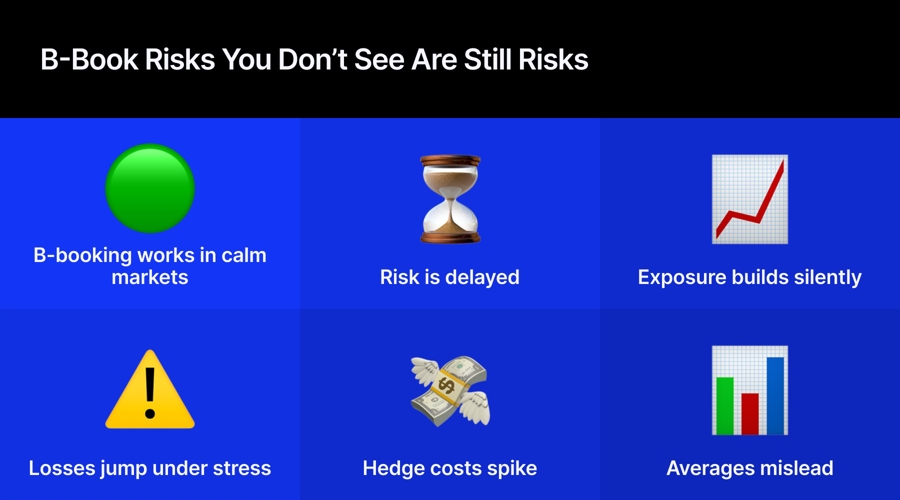
These controls, which are common in B-book dominant models, quietly introduce non-linear loss because the timing and structure of their controls are fragile under stress.
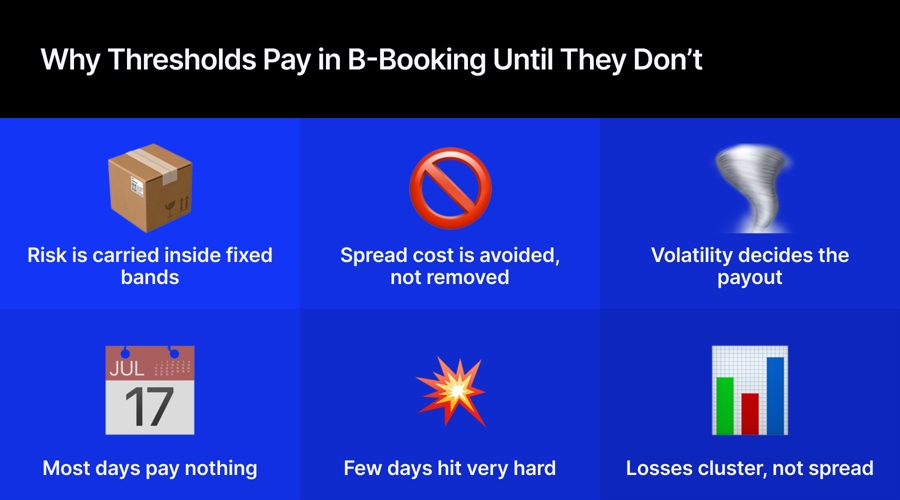
Delayed hedging shifts cost from the mean into the tail. Thresholds compress that tail into a small number of extreme events. Volatility turns those events into convex losses.
A significant proportion of retail brokers and prime of primes deliberately internalise
the majority of client flow. This is not a weakness or a temporary compromise. It is a
rational commercial choice.
For many firms, B-booking works. Client behaviour is statistically favourable, flow
nets naturally, and internalisation delivers cleaner economics than externalising
every trade. In stable market conditions, the model is efficient, scalable, and
predictable.
Delayed hedging and threshold-based controls, which are
common in B-book dominant models, quietly introduce non-linear loss. Not because
the strategy is flawed, but because the timing and structure of its controls are fragile
under stress.
Internalisation Changes the Shape of Risk
B-booking is often described as reducing risk. In practice, it redistributes it.
Instead of paying spread continuously through immediate hedging, the broker
accumulates inventory and relies on netting, client asymmetry, and time
diversification. As long as exposure builds gradually and markets remain liquid, this
works well.
However, internalisation postpones market interaction. Once the decision is made to
hedge, the broker is no longer acting opportunistically. They are acting under
constraint.
The difference between those two states is subtle in calm markets and decisive in
fast ones.
Where Delayed Hedging Really Comes From
In most retail and hybrid models, delayed hedging is not caused by technology. It is
caused by design.
Typical controls include exposure bands within which no hedging occurs, minimum
size thresholds, netting windows, volatility or spread filters that suppress hedging,
and manual approval gates during fast markets.
Each control makes sense in isolation. Together, they allow risk to accumulate
quietly and release it abruptly.
Market stress compresses time and correlation. Exposure builds faster, multiple
thresholds are crossed in quick succession, and execution quality deteriorates at the
same moment hedging urgency increases.
The hedge arrives later than expected, into a worse market than assumed.
Internalisation models are usually calibrated on expected value. Risk limits,
thresholds, and hedge cadence are tuned to average flow, average volatility, and
average execution cost.
The problem is that losses are not generated at the average. They are generated in
the tail.
When exposure is allowed to accumulate inside a band, the broker is implicitly
assuming that:
Exposure grows approximately linearly in time
Hedge cost is roughly proportional to hedge size
Execution quality is independent of urgency
None of those assumptions holds in stressed regimes.
Empirically, three relationships break down simultaneously.
Exposure growth accelerates: Client flow becomes clustered and directional. Net exposure often grows super-linearly with volatility. What takes hours to accumulate in calm markets can occur in
minutes when volatility doubles.
Hedge cost becomes convex: Execution cost is no longer a linear function of size. Spread paid, slippage, and
reject probability all increase as a function of urgency and market stress. The cost
curve steepens precisely when the hedge is most needed.
Delay increases conditional loss: The expected cost of hedging becomes path-dependent. Two identical exposures
can have very different realised costs depending on whether the hedge is initiated
before or after a volatility regime shift.
A threshold-based hedging rule can be expressed simply as carrying risk until the price moves far enough to justify paying the spread.
This framing reveals the embedded optionality.
Inside the threshold, the broker collects economic benefit by avoiding hedge costs.
Once the threshold is breached, the broker pays the full cost of hedging under
prevailing conditions.
In effect, the broker is short a volatility-dependent option whose payoff is realised
when the threshold is crossed.
Most days, this option expires worthless. On a small number of days, the payoff is
large and negative.
Quantitatively, this shows up as:
Low variance in daily P&L.
Fat-tailed loss distributions,
Benign average slippage metrics.
Extreme slippage and reject clustering in the top few percentiles of events.
This is why average execution statistics are poor indicators of true risk.
When Holding Risk Feels Optimal, but Isn’t
Many internalisation models are explicitly designed to hold risk. The rationale is
straightforward: client flow mean-reverts, time nets exposure, and releasing risk too
early incurs unnecessary spread and slippage.
In stable regimes, this logic is often correct.
The issue is not that holding risk is irrational. It is that the decision is usually justified
using expected value, while the cost of holding risk is realised through variance and
tail events.
When a broker chooses to hold inventory rather than release it, they are implicitly
assuming that:
Future client flow will offset current exposure
Market conditions will remain sufficiently liquid
Execution cost tomorrow will be no worse than execution cost today
Those assumptions hold most of the time. They fail together.
From a risk perspective, holding inventory is not free. It is a position with a time-dependent cost of exit. The longer the position is held, the more its exit cost
becomes conditional on the regime.
What appears to be patience can, in stressed markets, become an unpriced option
written to volatility.
Why Delay Multiplies Loss, Not Just Cost
The economic impact of delayed hedging is often described as “a bit more slippage”.
In practice, delay multiplies loss through interaction effects.
Three measurable variables matter:
Δt: time between exposure creation and hedge completion
σ: realised volatility during that window
C: execution cost per unit hedged
A simple way to formalise the effect is to split the cost of delay into two components:
Total Cost ≈ (Exposure × Price Move while waiting) + (Hedge Size × Execution
Cost)
The first term captures the price movement incurred while risk is carried. It increases
with the length of the delay and with realised volatility during that window. The
second term captures the execution penalty paid when the hedge is finally placed.
That cost is not constant. It rises with urgency as spreads widen, available size
fragments, and reject rates increase.
In calm conditions, execution cost is relatively flat with respect to both time and
volatility.
In stressed conditions, execution cost becomes a convex function of both.
That means:
Increasing the delay by a factor of two can increase the total cost by more than a
factor of two
Identical hedge sizes can produce materially different outcomes depending on
timing
Delaying hedging into a higher-volatility regime increases both price risk and
execution risk simultaneously
Loss is no longer exposure multiplied by market move. It becomes exposure
multiplied by market move, multiplied again by an execution penalty.
This is the non-linearity most control systems fail to capture.
XAU/USD as a Stress Amplifier, Not a Special Case
These dynamics exist in major FX pairs, but they are easier to observe in XAU/USD
because the slopes are steeper.
In gold, the relationship between volatility and
execution cost is stronger. Spreads widen
more abruptly, available size collapses faster,
and reject rates increase earlier in the volatility
cycle.
This means the gradient of execution cost with
respect to delay is higher.
In practical terms, a one-minute delay in a fast
gold market can be economically equivalent to
a much longer delay in a major FX pair. The same control logic, therefore, produces visibly worse outcomes sooner.
XAU/USD does not introduce a new risk. It exposes the same risk with a higher signal-to-noise.
To ground this analysis operationally, the metrics are simple and powerful.
Measure distributions, not averages, for:
Time-to-hedge conditional on volatility regime.
Execution cost as a function of hedge urgency.
Reject probability versus hedge size and spread state.
Exposure growth rate before threshold breach.
Tail P&L contribution from the top 1 to 5 per cent of events.
When plotted correctly, most firms see the same pattern: stable averages, unstable
tails.
That is not a market failure. It is a control design issue.
Designing Controls that Survive Stress
The objective is not to abandon B-booking. It is to remove brittle behaviour.
Practically, that means:
Progressive or proportional hedging rather than binary triggers.
Volatility-aware exposure bands that tighten as regimes change.
Separating risk release from execution-quality gating.
Pre-authorised stress playbooks that remove decision latency.
Stress-testing the control system itself, not just the book.
These approaches preserve internalisation economics while materially reducing
convex loss.
Reframed Quantitatively
Internalisation optimises expected value. Risk management must control variance
and tail loss.
Delayed hedging shifts cost from the mean into the tail. Thresholds compress that
tail into a small number of extreme events. Volatility turns those events into convex
losses.
The firms that manage this well do not predict markets better. They design controls
whose cost curves remain shallow as volatility rises.
Because once the hedge becomes urgent, the mathematics are no longer on your
side.
A significant proportion of retail brokers and prime of primes deliberately internalise
the majority of client flow. This is not a weakness or a temporary compromise. It is a
rational commercial choice.
For many firms, B-booking works. Client behaviour is statistically favourable, flow
nets naturally, and internalisation delivers cleaner economics than externalising
every trade. In stable market conditions, the model is efficient, scalable, and
predictable.
Delayed hedging and threshold-based controls, which are
common in B-book dominant models, quietly introduce non-linear loss. Not because
the strategy is flawed, but because the timing and structure of its controls are fragile
under stress.
Internalisation Changes the Shape of Risk
B-booking is often described as reducing risk. In practice, it redistributes it.
Instead of paying spread continuously through immediate hedging, the broker
accumulates inventory and relies on netting, client asymmetry, and time
diversification. As long as exposure builds gradually and markets remain liquid, this
works well.
However, internalisation postpones market interaction. Once the decision is made to
hedge, the broker is no longer acting opportunistically. They are acting under
constraint.
The difference between those two states is subtle in calm markets and decisive in
fast ones.
Where Delayed Hedging Really Comes From
In most retail and hybrid models, delayed hedging is not caused by technology. It is
caused by design.
Typical controls include exposure bands within which no hedging occurs, minimum
size thresholds, netting windows, volatility or spread filters that suppress hedging,
and manual approval gates during fast markets.
Each control makes sense in isolation. Together, they allow risk to accumulate
quietly and release it abruptly.
Market stress compresses time and correlation. Exposure builds faster, multiple
thresholds are crossed in quick succession, and execution quality deteriorates at the
same moment hedging urgency increases.
The hedge arrives later than expected, into a worse market than assumed.
Internalisation models are usually calibrated on expected value. Risk limits,
thresholds, and hedge cadence are tuned to average flow, average volatility, and
average execution cost.
The problem is that losses are not generated at the average. They are generated in
the tail.
When exposure is allowed to accumulate inside a band, the broker is implicitly
assuming that:
Exposure grows approximately linearly in time
Hedge cost is roughly proportional to hedge size
Execution quality is independent of urgency
None of those assumptions holds in stressed regimes.
Empirically, three relationships break down simultaneously.
Exposure growth accelerates: Client flow becomes clustered and directional. Net exposure often grows super-linearly with volatility. What takes hours to accumulate in calm markets can occur in
minutes when volatility doubles.
Hedge cost becomes convex: Execution cost is no longer a linear function of size. Spread paid, slippage, and
reject probability all increase as a function of urgency and market stress. The cost
curve steepens precisely when the hedge is most needed.
Delay increases conditional loss: The expected cost of hedging becomes path-dependent. Two identical exposures
can have very different realised costs depending on whether the hedge is initiated
before or after a volatility regime shift.
A threshold-based hedging rule can be expressed simply as carrying risk until the price moves far enough to justify paying the spread.
This framing reveals the embedded optionality.
Inside the threshold, the broker collects economic benefit by avoiding hedge costs.
Once the threshold is breached, the broker pays the full cost of hedging under
prevailing conditions.
In effect, the broker is short a volatility-dependent option whose payoff is realised
when the threshold is crossed.
Most days, this option expires worthless. On a small number of days, the payoff is
large and negative.
Quantitatively, this shows up as:
Low variance in daily P&L.
Fat-tailed loss distributions,
Benign average slippage metrics.
Extreme slippage and reject clustering in the top few percentiles of events.
This is why average execution statistics are poor indicators of true risk.
When Holding Risk Feels Optimal, but Isn’t
Many internalisation models are explicitly designed to hold risk. The rationale is
straightforward: client flow mean-reverts, time nets exposure, and releasing risk too
early incurs unnecessary spread and slippage.
In stable regimes, this logic is often correct.
The issue is not that holding risk is irrational. It is that the decision is usually justified
using expected value, while the cost of holding risk is realised through variance and
tail events.
When a broker chooses to hold inventory rather than release it, they are implicitly
assuming that:
Future client flow will offset current exposure
Market conditions will remain sufficiently liquid
Execution cost tomorrow will be no worse than execution cost today
Those assumptions hold most of the time. They fail together.
From a risk perspective, holding inventory is not free. It is a position with a time-dependent cost of exit. The longer the position is held, the more its exit cost
becomes conditional on the regime.
What appears to be patience can, in stressed markets, become an unpriced option
written to volatility.
Why Delay Multiplies Loss, Not Just Cost
The economic impact of delayed hedging is often described as “a bit more slippage”.
In practice, delay multiplies loss through interaction effects.
Three measurable variables matter:
Δt: time between exposure creation and hedge completion
σ: realised volatility during that window
C: execution cost per unit hedged
A simple way to formalise the effect is to split the cost of delay into two components:
Total Cost ≈ (Exposure × Price Move while waiting) + (Hedge Size × Execution
Cost)
The first term captures the price movement incurred while risk is carried. It increases
with the length of the delay and with realised volatility during that window. The
second term captures the execution penalty paid when the hedge is finally placed.
That cost is not constant. It rises with urgency as spreads widen, available size
fragments, and reject rates increase.
In calm conditions, execution cost is relatively flat with respect to both time and
volatility.
In stressed conditions, execution cost becomes a convex function of both.
That means:
Increasing the delay by a factor of two can increase the total cost by more than a
factor of two
Identical hedge sizes can produce materially different outcomes depending on
timing
Delaying hedging into a higher-volatility regime increases both price risk and
execution risk simultaneously
Loss is no longer exposure multiplied by market move. It becomes exposure
multiplied by market move, multiplied again by an execution penalty.
This is the non-linearity most control systems fail to capture.
XAU/USD as a Stress Amplifier, Not a Special Case
These dynamics exist in major FX pairs, but they are easier to observe in XAU/USD
because the slopes are steeper.
In gold, the relationship between volatility and
execution cost is stronger. Spreads widen
more abruptly, available size collapses faster,
and reject rates increase earlier in the volatility
cycle.
This means the gradient of execution cost with
respect to delay is higher.
In practical terms, a one-minute delay in a fast
gold market can be economically equivalent to
a much longer delay in a major FX pair. The same control logic, therefore, produces visibly worse outcomes sooner.
XAU/USD does not introduce a new risk. It exposes the same risk with a higher signal-to-noise.
To ground this analysis operationally, the metrics are simple and powerful.
Measure distributions, not averages, for:
Time-to-hedge conditional on volatility regime.
Execution cost as a function of hedge urgency.
Reject probability versus hedge size and spread state.
Exposure growth rate before threshold breach.
Tail P&L contribution from the top 1 to 5 per cent of events.
When plotted correctly, most firms see the same pattern: stable averages, unstable
tails.
That is not a market failure. It is a control design issue.
Designing Controls that Survive Stress
The objective is not to abandon B-booking. It is to remove brittle behaviour.
Practically, that means:
Progressive or proportional hedging rather than binary triggers.
Volatility-aware exposure bands that tighten as regimes change.
Separating risk release from execution-quality gating.
Pre-authorised stress playbooks that remove decision latency.
Stress-testing the control system itself, not just the book.
These approaches preserve internalisation economics while materially reducing
convex loss.
Reframed Quantitatively
Internalisation optimises expected value. Risk management must control variance
and tail loss.
Delayed hedging shifts cost from the mean into the tail. Thresholds compress that
tail into a small number of extreme events. Volatility turns those events into convex
losses.
The firms that manage this well do not predict markets better. They design controls
whose cost curves remain shallow as volatility rises.
Because once the hedge becomes urgent, the mathematics are no longer on your
side.
Jamie Rose is Founder at Isomiq, an independent advisory focused on electronic market structure, execution, and risk in FX and multi-asset trading. He has over 30 years of experience across bank eFX desks, trading platforms, and brokerage environments. His writing examines how execution design, internalisation, and risk decisions shape real trading outcomes.
42% of Swiss Financial Firms Have No Digital Fraud Policy, FINMA Finds
Featured Videos
FP Markets Winner Spotlight 🏆 | Global Broker of the Year 2025 #Trading #Broker #Innovation #Shorts
FP Markets Winner Spotlight 🏆 | Global Broker of the Year 2025 #Trading #Broker #Innovation #Shorts
FP Markets Winner Spotlight 🏆 | Global Broker of the Year 2025 #Trading #Broker #Innovation #Shorts
FP Markets Winner Spotlight 🏆 | Global Broker of the Year 2025 #Trading #Broker #Innovation #Shorts
FP Markets takes the spotlight as Global Broker of the Year 2025 at the Finance Magnates Awards.
Martin Stoilov, Head of Client Experience, shares that trust, innovation, and people played a key role in the company’s success, supported by a strong foundation of integrity and client-centricity.
Following this milestone, FP Markets continues to focus on growth, technology investment, and its core values of transparency and excellence.
👉 Be part of FM Awards 2026: https://awards.financemagnates.com/#nominate
FP Markets takes the spotlight as Global Broker of the Year 2025 at the Finance Magnates Awards.
Martin Stoilov, Head of Client Experience, shares that trust, innovation, and people played a key role in the company’s success, supported by a strong foundation of integrity and client-centricity.
Following this milestone, FP Markets continues to focus on growth, technology investment, and its core values of transparency and excellence.
👉 Be part of FM Awards 2026: https://awards.financemagnates.com/#nominate
FP Markets takes the spotlight as Global Broker of the Year 2025 at the Finance Magnates Awards.
Martin Stoilov, Head of Client Experience, shares that trust, innovation, and people played a key role in the company’s success, supported by a strong foundation of integrity and client-centricity.
Following this milestone, FP Markets continues to focus on growth, technology investment, and its core values of transparency and excellence.
👉 Be part of FM Awards 2026: https://awards.financemagnates.com/#nominate
FP Markets takes the spotlight as Global Broker of the Year 2025 at the Finance Magnates Awards.
Martin Stoilov, Head of Client Experience, shares that trust, innovation, and people played a key role in the company’s success, supported by a strong foundation of integrity and client-centricity.
Following this milestone, FP Markets continues to focus on growth, technology investment, and its core values of transparency and excellence.
👉 Be part of FM Awards 2026: https://awards.financemagnates.com/#nominate
In this video, we review @HolaPrimeMarketsOfficial, a multi-asset forex and CFDs broker offering different account types, trading platforms, and flexible trading conditions.
We cover the broker’s overall offering, including account options, trading environment, platforms like MT4 and MT5, and additional services such as managed accounts and fast withdrawals.
Watch the full video to see if Hola Prime Markets fits your trading needs.
📣 Stay up to date with the latest in finance and trading. Follow Finance Magnates for industry news, insights, and global event coverage.
Connect with us:
🔗 LinkedIn: /financemagnates
👍 Facebook: /financemagnates
📸 Instagram: https://www.instagram.com/financemagnates
🐦 X: https://x.com/financemagnates
🎥 TikTok: https://www.tiktok.com/tag/financemagnates
▶️ YouTube: /@financemagnates_official
#HolaPrime #ForexBroker #CFDTrading #FinanceMagnates #Trading #Forex #BrokerReview
In this video, we review @HolaPrimeMarketsOfficial, a multi-asset forex and CFDs broker offering different account types, trading platforms, and flexible trading conditions.
We cover the broker’s overall offering, including account options, trading environment, platforms like MT4 and MT5, and additional services such as managed accounts and fast withdrawals.
Watch the full video to see if Hola Prime Markets fits your trading needs.
📣 Stay up to date with the latest in finance and trading. Follow Finance Magnates for industry news, insights, and global event coverage.
Connect with us:
🔗 LinkedIn: /financemagnates
👍 Facebook: /financemagnates
📸 Instagram: https://www.instagram.com/financemagnates
🐦 X: https://x.com/financemagnates
🎥 TikTok: https://www.tiktok.com/tag/financemagnates
▶️ YouTube: /@financemagnates_official
#HolaPrime #ForexBroker #CFDTrading #FinanceMagnates #Trading #Forex #BrokerReview
In this video, we review @HolaPrimeMarketsOfficial, a multi-asset forex and CFDs broker offering different account types, trading platforms, and flexible trading conditions.
We cover the broker’s overall offering, including account options, trading environment, platforms like MT4 and MT5, and additional services such as managed accounts and fast withdrawals.
Watch the full video to see if Hola Prime Markets fits your trading needs.
📣 Stay up to date with the latest in finance and trading. Follow Finance Magnates for industry news, insights, and global event coverage.
Connect with us:
🔗 LinkedIn: /financemagnates
👍 Facebook: /financemagnates
📸 Instagram: https://www.instagram.com/financemagnates
🐦 X: https://x.com/financemagnates
🎥 TikTok: https://www.tiktok.com/tag/financemagnates
▶️ YouTube: /@financemagnates_official
#HolaPrime #ForexBroker #CFDTrading #FinanceMagnates #Trading #Forex #BrokerReview
In this video, we review @HolaPrimeMarketsOfficial, a multi-asset forex and CFDs broker offering different account types, trading platforms, and flexible trading conditions.
We cover the broker’s overall offering, including account options, trading environment, platforms like MT4 and MT5, and additional services such as managed accounts and fast withdrawals.
Watch the full video to see if Hola Prime Markets fits your trading needs.
📣 Stay up to date with the latest in finance and trading. Follow Finance Magnates for industry news, insights, and global event coverage.
Connect with us:
🔗 LinkedIn: /financemagnates
👍 Facebook: /financemagnates
📸 Instagram: https://www.instagram.com/financemagnates
🐦 X: https://x.com/financemagnates
🎥 TikTok: https://www.tiktok.com/tag/financemagnates
▶️ YouTube: /@financemagnates_official
#HolaPrime #ForexBroker #CFDTrading #FinanceMagnates #Trading #Forex #BrokerReview
In this video, we review @HolaPrimeMarketsOfficial, a multi-asset forex and CFDs broker offering different account types, trading platforms, and flexible trading conditions.
We cover the broker’s overall offering, including account options, trading environment, platforms like MT4 and MT5, and additional services such as managed accounts and fast withdrawals.
Watch the full video to see if Hola Prime Markets fits your trading needs.
📣 Stay up to date with the latest in finance and trading. Follow Finance Magnates for industry news, insights, and global event coverage.
Connect with us:
🔗 LinkedIn: /financemagnates
👍 Facebook: /financemagnates
📸 Instagram: https://www.instagram.com/financemagnates
🐦 X: https://x.com/financemagnates
🎥 TikTok: https://www.tiktok.com/tag/financemagnates
▶️ YouTube: /@financemagnates_official
#HolaPrime #ForexBroker #CFDTrading #FinanceMagnates #Trading #Forex #BrokerReview
In this video, we review @HolaPrimeMarketsOfficial, a multi-asset forex and CFDs broker offering different account types, trading platforms, and flexible trading conditions.
We cover the broker’s overall offering, including account options, trading environment, platforms like MT4 and MT5, and additional services such as managed accounts and fast withdrawals.
Watch the full video to see if Hola Prime Markets fits your trading needs.
📣 Stay up to date with the latest in finance and trading. Follow Finance Magnates for industry news, insights, and global event coverage.
Connect with us:
🔗 LinkedIn: /financemagnates
👍 Facebook: /financemagnates
📸 Instagram: https://www.instagram.com/financemagnates
🐦 X: https://x.com/financemagnates
🎥 TikTok: https://www.tiktok.com/tag/financemagnates
▶️ YouTube: /@financemagnates_official
#HolaPrime #ForexBroker #CFDTrading #FinanceMagnates #Trading #Forex #BrokerReview
Hola Prime Review: What You Need to Know | Full Breakdown by Finance Magnates
Hola Prime Review: What You Need to Know | Full Breakdown by Finance Magnates
Hola Prime Review: What You Need to Know | Full Breakdown by Finance Magnates
Hola Prime Review: What You Need to Know | Full Breakdown by Finance Magnates
Hola Prime Review: What You Need to Know | Full Breakdown by Finance Magnates
Hola Prime Review: What You Need to Know | Full Breakdown by Finance Magnates
In this video, we review @HolaPrime_Global, a proprietary trading firm offering evaluation programs and performance-based payouts in simulated market environments.
We cover how the challenge model works, including account types, profit splits (up to 95%), trading rules, and what it takes to reach a funded account. You’ll also learn about available platforms like MT4, MT5, cTrader, and more, along with insights into payouts, support, and trading conditions.
Watch the full video to see if Hola Prime fits your trading style.
📣 Stay up to date with the latest in finance and trading. Follow Finance Magnates for industry news, insights, and global event coverage.
Connect with us:
🔗 LinkedIn: /financemagnates
👍 Facebook: /financemagnates
📸 Instagram: https://www.instagram.com/financemagnates
🐦 X: https://x.com/financemagnates
🎥 TikTok: https://www.tiktok.com/tag/financemagnates
▶️ YouTube: /@financemagnates_official
#HolaPrime #PropFirm #Trading #FinanceMagnates #Forex #FuturesTrading #TradingReview #PropFirmReview
In this video, we review @HolaPrime_Global, a proprietary trading firm offering evaluation programs and performance-based payouts in simulated market environments.
We cover how the challenge model works, including account types, profit splits (up to 95%), trading rules, and what it takes to reach a funded account. You’ll also learn about available platforms like MT4, MT5, cTrader, and more, along with insights into payouts, support, and trading conditions.
Watch the full video to see if Hola Prime fits your trading style.
📣 Stay up to date with the latest in finance and trading. Follow Finance Magnates for industry news, insights, and global event coverage.
Connect with us:
🔗 LinkedIn: /financemagnates
👍 Facebook: /financemagnates
📸 Instagram: https://www.instagram.com/financemagnates
🐦 X: https://x.com/financemagnates
🎥 TikTok: https://www.tiktok.com/tag/financemagnates
▶️ YouTube: /@financemagnates_official
#HolaPrime #PropFirm #Trading #FinanceMagnates #Forex #FuturesTrading #TradingReview #PropFirmReview
In this video, we review @HolaPrime_Global, a proprietary trading firm offering evaluation programs and performance-based payouts in simulated market environments.
We cover how the challenge model works, including account types, profit splits (up to 95%), trading rules, and what it takes to reach a funded account. You’ll also learn about available platforms like MT4, MT5, cTrader, and more, along with insights into payouts, support, and trading conditions.
Watch the full video to see if Hola Prime fits your trading style.
📣 Stay up to date with the latest in finance and trading. Follow Finance Magnates for industry news, insights, and global event coverage.
Connect with us:
🔗 LinkedIn: /financemagnates
👍 Facebook: /financemagnates
📸 Instagram: https://www.instagram.com/financemagnates
🐦 X: https://x.com/financemagnates
🎥 TikTok: https://www.tiktok.com/tag/financemagnates
▶️ YouTube: /@financemagnates_official
#HolaPrime #PropFirm #Trading #FinanceMagnates #Forex #FuturesTrading #TradingReview #PropFirmReview
In this video, we review @HolaPrime_Global, a proprietary trading firm offering evaluation programs and performance-based payouts in simulated market environments.
We cover how the challenge model works, including account types, profit splits (up to 95%), trading rules, and what it takes to reach a funded account. You’ll also learn about available platforms like MT4, MT5, cTrader, and more, along with insights into payouts, support, and trading conditions.
Watch the full video to see if Hola Prime fits your trading style.
📣 Stay up to date with the latest in finance and trading. Follow Finance Magnates for industry news, insights, and global event coverage.
Connect with us:
🔗 LinkedIn: /financemagnates
👍 Facebook: /financemagnates
📸 Instagram: https://www.instagram.com/financemagnates
🐦 X: https://x.com/financemagnates
🎥 TikTok: https://www.tiktok.com/tag/financemagnates
▶️ YouTube: /@financemagnates_official
#HolaPrime #PropFirm #Trading #FinanceMagnates #Forex #FuturesTrading #TradingReview #PropFirmReview
In this video, we review @HolaPrime_Global, a proprietary trading firm offering evaluation programs and performance-based payouts in simulated market environments.
We cover how the challenge model works, including account types, profit splits (up to 95%), trading rules, and what it takes to reach a funded account. You’ll also learn about available platforms like MT4, MT5, cTrader, and more, along with insights into payouts, support, and trading conditions.
Watch the full video to see if Hola Prime fits your trading style.
📣 Stay up to date with the latest in finance and trading. Follow Finance Magnates for industry news, insights, and global event coverage.
Connect with us:
🔗 LinkedIn: /financemagnates
👍 Facebook: /financemagnates
📸 Instagram: https://www.instagram.com/financemagnates
🐦 X: https://x.com/financemagnates
🎥 TikTok: https://www.tiktok.com/tag/financemagnates
▶️ YouTube: /@financemagnates_official
#HolaPrime #PropFirm #Trading #FinanceMagnates #Forex #FuturesTrading #TradingReview #PropFirmReview
In this video, we review @HolaPrime_Global, a proprietary trading firm offering evaluation programs and performance-based payouts in simulated market environments.
We cover how the challenge model works, including account types, profit splits (up to 95%), trading rules, and what it takes to reach a funded account. You’ll also learn about available platforms like MT4, MT5, cTrader, and more, along with insights into payouts, support, and trading conditions.
Watch the full video to see if Hola Prime fits your trading style.
📣 Stay up to date with the latest in finance and trading. Follow Finance Magnates for industry news, insights, and global event coverage.
Connect with us:
🔗 LinkedIn: /financemagnates
👍 Facebook: /financemagnates
📸 Instagram: https://www.instagram.com/financemagnates
🐦 X: https://x.com/financemagnates
🎥 TikTok: https://www.tiktok.com/tag/financemagnates
▶️ YouTube: /@financemagnates_official
#HolaPrime #PropFirm #Trading #FinanceMagnates #Forex #FuturesTrading #TradingReview #PropFirmReview
Axi Winner Spotlight 🏆 | Global Most Innovative Broker 2025 #Innovation #Trading #Fintech #Broker
Axi Winner Spotlight 🏆 | Global Most Innovative Broker 2025 #Innovation #Trading #Fintech #Broker
Axi Winner Spotlight 🏆 | Global Most Innovative Broker 2025 #Innovation #Trading #Fintech #Broker
Axi Winner Spotlight 🏆 | Global Most Innovative Broker 2025 #Innovation #Trading #Fintech #Broker
Axi Winner Spotlight 🏆 | Global Most Innovative Broker 2025 #Innovation #Trading #Fintech #Broker
Axi Winner Spotlight 🏆 | Global Most Innovative Broker 2025 #Innovation #Trading #Fintech #Broker
Axi takes the spotlight at the Finance Magnates Awards, winning Global Most Innovative Broker 2025.
Olivia Xenofontos and Ivanna Openko share how the team will feel: proud, motivated, and ready to keep delivering.
They also describe the night as well-organized, focused, and enjoyable for all.
👉 Be part of FM Awards 2026.
Axi takes the spotlight at the Finance Magnates Awards, winning Global Most Innovative Broker 2025.
Olivia Xenofontos and Ivanna Openko share how the team will feel: proud, motivated, and ready to keep delivering.
They also describe the night as well-organized, focused, and enjoyable for all.
👉 Be part of FM Awards 2026.
Axi takes the spotlight at the Finance Magnates Awards, winning Global Most Innovative Broker 2025.
Olivia Xenofontos and Ivanna Openko share how the team will feel: proud, motivated, and ready to keep delivering.
They also describe the night as well-organized, focused, and enjoyable for all.
👉 Be part of FM Awards 2026.
Axi takes the spotlight at the Finance Magnates Awards, winning Global Most Innovative Broker 2025.
Olivia Xenofontos and Ivanna Openko share how the team will feel: proud, motivated, and ready to keep delivering.
They also describe the night as well-organized, focused, and enjoyable for all.
👉 Be part of FM Awards 2026.
Axi takes the spotlight at the Finance Magnates Awards, winning Global Most Innovative Broker 2025.
Olivia Xenofontos and Ivanna Openko share how the team will feel: proud, motivated, and ready to keep delivering.
They also describe the night as well-organized, focused, and enjoyable for all.
👉 Be part of FM Awards 2026.
Axi takes the spotlight at the Finance Magnates Awards, winning Global Most Innovative Broker 2025.
Olivia Xenofontos and Ivanna Openko share how the team will feel: proud, motivated, and ready to keep delivering.
They also describe the night as well-organized, focused, and enjoyable for all.
👉 Be part of FM Awards 2026.
Recognition that matters.
Built on transparency.
Driven by the industry.
The Finance Magnates Awards 2026.
Nominations are now open.
🔗 https://awards.financemagnates.com/?utm_source=SM&utm_medium=social&utm_campaign=recognition-matters
Recognition that matters.
Built on transparency.
Driven by the industry.
The Finance Magnates Awards 2026.
Nominations are now open.
🔗 https://awards.financemagnates.com/?utm_source=SM&utm_medium=social&utm_campaign=recognition-matters
Recognition that matters.
Built on transparency.
Driven by the industry.
The Finance Magnates Awards 2026.
Nominations are now open.
🔗 https://awards.financemagnates.com/?utm_source=SM&utm_medium=social&utm_campaign=recognition-matters
Recognition that matters.
Built on transparency.
Driven by the industry.
The Finance Magnates Awards 2026.
Nominations are now open.
🔗 https://awards.financemagnates.com/?utm_source=SM&utm_medium=social&utm_campaign=recognition-matters
Recognition that matters.
Built on transparency.
Driven by the industry.
The Finance Magnates Awards 2026.
Nominations are now open.
🔗 https://awards.financemagnates.com/?utm_source=SM&utm_medium=social&utm_campaign=recognition-matters
Recognition that matters.
Built on transparency.
Driven by the industry.
The Finance Magnates Awards 2026.
Nominations are now open.
🔗 https://awards.financemagnates.com/?utm_source=SM&utm_medium=social&utm_campaign=recognition-matters