Tech providers address integration and due diligence as demands soar.
They express mixed views about the move's impact on bad actors.
Analysis
On Saturday, September 24th, the FX and CFD industry was greeted with a crude shock: Apple had suddenly pulled down MetaQuotes’ MetaTrader 4 (MT4) and MetaTrader 5 (MT5) trading apps from its App Store. MetaQuotes later confirmed to Finance Magnates that it had received a letter from Apple the day before, stating that the apps did not comply with the App Store Review Guidelines.
To make up for this, MetaQuotes on Monday launched a new MT5 web terminal that was "redeveloped from scratch" and makes it possible for traders to "fully manage their trading accounts using a mobile device."
MetaQuotes' shift to a stricter white-label policy towards offshore brokers in July may have foretold of the troubles ahead, but the move by Apple caught the industry by surprise. Finance Magnates reported that the development,
which many attributed to the rising number of scams being
perpetrated by bad actors, created 'lots of
headaches' among market participants.
It’s been several weeks since the news broke, and as the dust settles, Finance Magnates explores how Apple's delisting has affected the industry so far.
A Threat to MetaTrader's Dominance?
With MT4 first introduced 17 years ago and
the upgraded MT5 following it five years later, MetaQuotes has established itself as an industry giant with a strong market presence.
According to the Finance Magnates Quarterly Intelligence Report, MT4 and MT5 as a pair accounted for 83.8% of the total
market share at the end of the second quarter of this year.
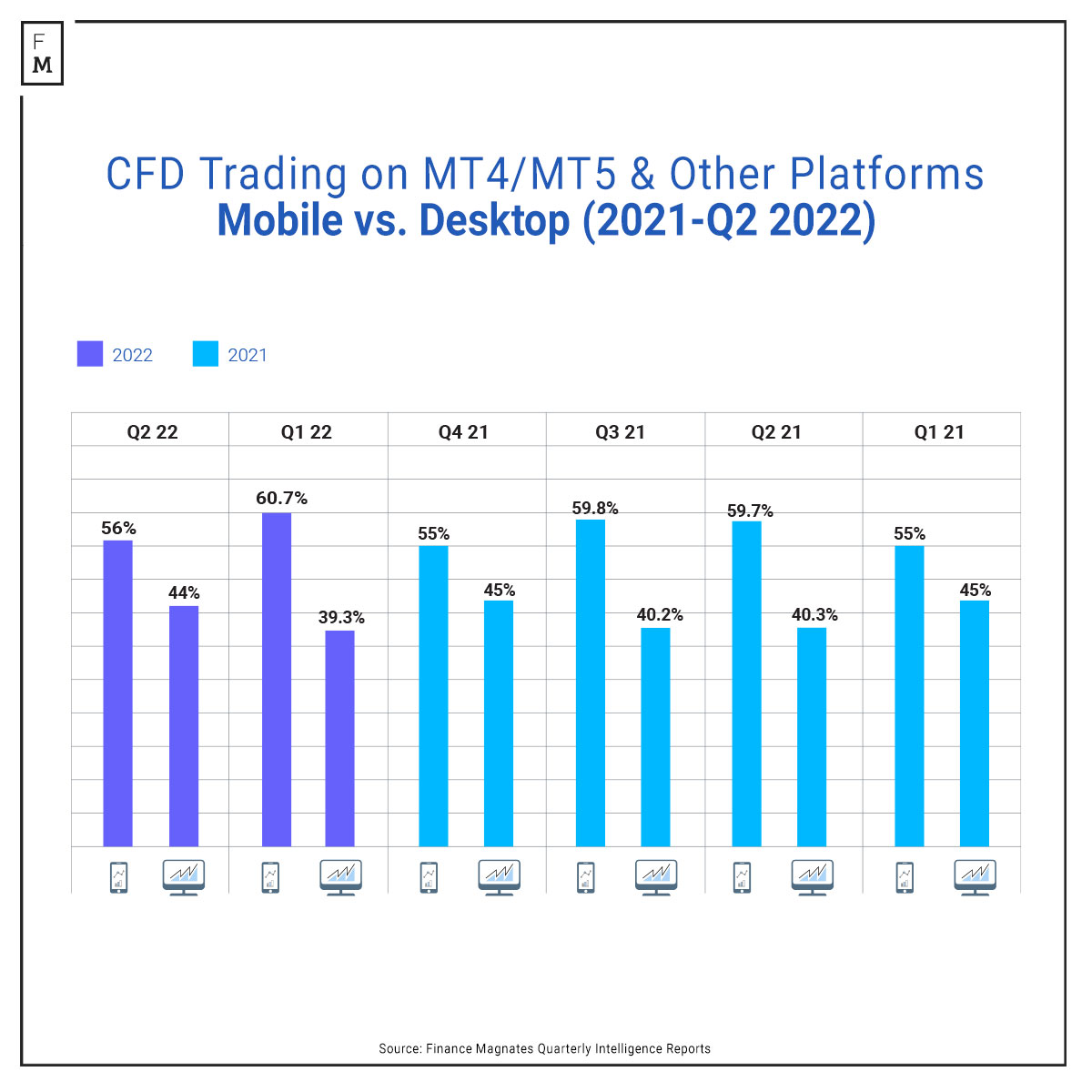
But, if the trading platform has consistently led the pack, the devices traders use it on have been gradually changing. As of the first quarter of this year, trading on
mobile devices accounted for 60.7% of CFD trades, while 39.3% was attributed to the desktop. Tracking back to
Q1 2021, mobile usage stood at 55%, with desktops claiming 45% of total trades.
Trading on mobile devices remains the dominant forex and CFD trading method.
The dominating market position of mobile trading
underscores why Apple’s removal of the MT4 and MT5 trading apps could be a significant market-altering move, especially for MetaQuotes which boasts the largest slice.
The suspension of the apps does not affect existing iOS users, but foregoing the acquisition of iPhone users is not something brokers can easily swallow. And, as alternative tech providers gleefully report, brokers have been flooding their gates.
Brokers in Search of Alternatives
In the days after MetaQuotes' announcement, it was hard to avoid the 'business is booming' messages by technology providers on LinkedIn. Now, we have reached out to several executives in the field to get a more nuanced image of who their new prospects are.
“Normally, they are small-to-medium-sized brokers that suddenly found
themselves unable to survive,” explained Maoz Tenenbaum, the Vice President
(VP) of Sales at Leverate. “Their primary concern is localization
(supporting the languages of their traders), and the smooth and safe
migration of data,” Tenenbaum explained.
Maoz Tenenbaum, Leverate's VP of Sales
Others have reported interest from a 'real mix' of clients, from
small white labels and large global brokers.
“Some are concerned with
provider stability, app support, and integrations. Others are looking to
the future to ensure they don’t get locked into the same platform as
everyone else,” said John Light, the VP of Trading Solutions at Devexperts.
And, while mobiles are obviously a must, desktops still serve
important functions. “More than 50% of trading comes from mobile users,
so mobile access is vital, but traders still use desktop apps for
running algos, though performance and latency are critical,” Tom
Higgins, the Founder and CEO of Gold-i, pointed out.
Smooth or Rough Integration?
New business means new concerns, too. Tenenbaum noted that data migration is a significant concern the company is seeking to address.
Aris Christoforou, Head of Marketing at Spotware Systems
“The main challenge is the migration of data
to ensure all traders, assets, and positions are moving smoothly without
causing traders and brokers any inconvenience,” he noted.
To address this, Leverate created a
dedicated team specializing in migration from MT4/MT5 to the company's Sirix trading platform.
Spotware Systems has taken a different approach. “Our goal is to be
proactive in accommodating new brokers that are being onboarded,” said
Aris Christoforou, the firm’s Head of Marketing. In mid-October, the company announced new investments in major infrastructural upgrades and
disclosed that it was investing in improved connectivity to Equinix
NY2 and LD5 data centres in New Jersey and London, respectively, and in
new proxy points in Vietnam and Indonesia.
Jon Light, VP of Trading Solutions at Devexperts
But, despite the efforts being made to facilitate integrations, all providers have reported smooth operations. Light said the trading provider’s onboarding process is very streamlined.
“When
we onboard a broker, we integrate to any LP or LP hub of their choice
and have a lot of these connections already. So, it is very easy for an
existing broker to get up and running quickly as we can connect to their
existing bridge providers,” Light explained.
Higgins
also noted that integration for the company is a very straightforward
approach as the trading platform provider guides its partners and
clients through. "We provide the FIX specifications and a test
system to develop against and then help the partner or client through
conformance testing.”
Is Due Diligence Changing?
Since the removal of MetaQuotes’ MT4 and MT5 was allegedly related to
unscrupulous behavior, one may wonder how tech providers inspect the
'flood' of inquiries before onboarding clients. As they are not obliged
to require a regulatory stamp of approval, the due diligence process
they perform is varied.
Light noted that the
firm runs a KYC procedure, sanctions checks, and client due diligence on
all its brokers even when it has no such regulatory obligation.
Tom Higgins, CEO, Gold-i
He also suggested a new standard for the industry in the form of the Global FX Code of Conduct: “We have publicly signed the Code and adhere to the ethics and
governance principles; I would encourage all tech providers in our space
to do the same.”
But what do you do when you are focusing on the
nascent, hardly regulated crypto market? Higgins told Finance Magnates
that while unregulated firms may work with Gold-I, the London-headquartered firm conducts its in-house due diligence to check that a
company is legitimate. "Brokers would need to show us their
company registration details," he said, and regarding FX, he added, "we
always discuss with them what they can and cannot do in relation to LPs
and MetaQuotes, etc."
Weighing in on the subject, Christoforou told Finance Magnates that the
cTrader’s provider works exclusively with “white hat operations”, and
had not changed its due diligence procedure since its inception 12
years ago. “Spotware is known in the industry for fighting
malicious brokers, refusing service to multiple bucket shop brokers and
brokers accepting US clients.”
Unregulated Brokers: Harder Days Ahead?
And while the sands are shifting for tech providers, scammers keep perpetuating fraud across the board, from the US to Israel.
Apple’s removal of
MetaQuotes’ MetaTrader apps is most likely being felt among unregulated
brokers, especially those in offshore jurisdictions. But, will it curtail them? Higgins believes that Apple’s
move “will just change how traders use the apps.”
“Tech companies like
MetaQuotes should register one app per broker in the App Store, not a generic
one, and then the problem goes away,” Gold-i's CEO said, adding that: “the web-based app is
also a perfectly viable alternative now."
However, Tenenbaum predicts a market consolidation. “There is no doubt that it will encourage brokers to operate as
legitimately as possible, or they will disappear altogether."
But
whatever the eventual fallout of Apple’s move may be, it probably won’t
lead by itself to the cleanup some wish to see. "It’s up to all
participants to make it impossible for these brokers to operate," Light
concluded.
On Saturday, September 24th, the FX and CFD industry was greeted with a crude shock: Apple had suddenly pulled down MetaQuotes’ MetaTrader 4 (MT4) and MetaTrader 5 (MT5) trading apps from its App Store. MetaQuotes later confirmed to Finance Magnates that it had received a letter from Apple the day before, stating that the apps did not comply with the App Store Review Guidelines.
To make up for this, MetaQuotes on Monday launched a new MT5 web terminal that was "redeveloped from scratch" and makes it possible for traders to "fully manage their trading accounts using a mobile device."
MetaQuotes' shift to a stricter white-label policy towards offshore brokers in July may have foretold of the troubles ahead, but the move by Apple caught the industry by surprise. Finance Magnates reported that the development,
which many attributed to the rising number of scams being
perpetrated by bad actors, created 'lots of
headaches' among market participants.
It’s been several weeks since the news broke, and as the dust settles, Finance Magnates explores how Apple's delisting has affected the industry so far.
A Threat to MetaTrader's Dominance?
With MT4 first introduced 17 years ago and
the upgraded MT5 following it five years later, MetaQuotes has established itself as an industry giant with a strong market presence.
According to the Finance Magnates Quarterly Intelligence Report, MT4 and MT5 as a pair accounted for 83.8% of the total
market share at the end of the second quarter of this year.
But, if the trading platform has consistently led the pack, the devices traders use it on have been gradually changing. As of the first quarter of this year, trading on
mobile devices accounted for 60.7% of CFD trades, while 39.3% was attributed to the desktop. Tracking back to
Q1 2021, mobile usage stood at 55%, with desktops claiming 45% of total trades.
Trading on mobile devices remains the dominant forex and CFD trading method.
The dominating market position of mobile trading
underscores why Apple’s removal of the MT4 and MT5 trading apps could be a significant market-altering move, especially for MetaQuotes which boasts the largest slice.
The suspension of the apps does not affect existing iOS users, but foregoing the acquisition of iPhone users is not something brokers can easily swallow. And, as alternative tech providers gleefully report, brokers have been flooding their gates.
Brokers in Search of Alternatives
In the days after MetaQuotes' announcement, it was hard to avoid the 'business is booming' messages by technology providers on LinkedIn. Now, we have reached out to several executives in the field to get a more nuanced image of who their new prospects are.
“Normally, they are small-to-medium-sized brokers that suddenly found
themselves unable to survive,” explained Maoz Tenenbaum, the Vice President
(VP) of Sales at Leverate. “Their primary concern is localization
(supporting the languages of their traders), and the smooth and safe
migration of data,” Tenenbaum explained.
Maoz Tenenbaum, Leverate's VP of Sales
Others have reported interest from a 'real mix' of clients, from
small white labels and large global brokers.
“Some are concerned with
provider stability, app support, and integrations. Others are looking to
the future to ensure they don’t get locked into the same platform as
everyone else,” said John Light, the VP of Trading Solutions at Devexperts.
And, while mobiles are obviously a must, desktops still serve
important functions. “More than 50% of trading comes from mobile users,
so mobile access is vital, but traders still use desktop apps for
running algos, though performance and latency are critical,” Tom
Higgins, the Founder and CEO of Gold-i, pointed out.
Smooth or Rough Integration?
New business means new concerns, too. Tenenbaum noted that data migration is a significant concern the company is seeking to address.
Aris Christoforou, Head of Marketing at Spotware Systems
“The main challenge is the migration of data
to ensure all traders, assets, and positions are moving smoothly without
causing traders and brokers any inconvenience,” he noted.
To address this, Leverate created a
dedicated team specializing in migration from MT4/MT5 to the company's Sirix trading platform.
Spotware Systems has taken a different approach. “Our goal is to be
proactive in accommodating new brokers that are being onboarded,” said
Aris Christoforou, the firm’s Head of Marketing. In mid-October, the company announced new investments in major infrastructural upgrades and
disclosed that it was investing in improved connectivity to Equinix
NY2 and LD5 data centres in New Jersey and London, respectively, and in
new proxy points in Vietnam and Indonesia.
Jon Light, VP of Trading Solutions at Devexperts
But, despite the efforts being made to facilitate integrations, all providers have reported smooth operations. Light said the trading provider’s onboarding process is very streamlined.
“When
we onboard a broker, we integrate to any LP or LP hub of their choice
and have a lot of these connections already. So, it is very easy for an
existing broker to get up and running quickly as we can connect to their
existing bridge providers,” Light explained.
Higgins
also noted that integration for the company is a very straightforward
approach as the trading platform provider guides its partners and
clients through. "We provide the FIX specifications and a test
system to develop against and then help the partner or client through
conformance testing.”
Is Due Diligence Changing?
Since the removal of MetaQuotes’ MT4 and MT5 was allegedly related to
unscrupulous behavior, one may wonder how tech providers inspect the
'flood' of inquiries before onboarding clients. As they are not obliged
to require a regulatory stamp of approval, the due diligence process
they perform is varied.
Light noted that the
firm runs a KYC procedure, sanctions checks, and client due diligence on
all its brokers even when it has no such regulatory obligation.
Tom Higgins, CEO, Gold-i
He also suggested a new standard for the industry in the form of the Global FX Code of Conduct: “We have publicly signed the Code and adhere to the ethics and
governance principles; I would encourage all tech providers in our space
to do the same.”
But what do you do when you are focusing on the
nascent, hardly regulated crypto market? Higgins told Finance Magnates
that while unregulated firms may work with Gold-I, the London-headquartered firm conducts its in-house due diligence to check that a
company is legitimate. "Brokers would need to show us their
company registration details," he said, and regarding FX, he added, "we
always discuss with them what they can and cannot do in relation to LPs
and MetaQuotes, etc."
Weighing in on the subject, Christoforou told Finance Magnates that the
cTrader’s provider works exclusively with “white hat operations”, and
had not changed its due diligence procedure since its inception 12
years ago. “Spotware is known in the industry for fighting
malicious brokers, refusing service to multiple bucket shop brokers and
brokers accepting US clients.”
Unregulated Brokers: Harder Days Ahead?
And while the sands are shifting for tech providers, scammers keep perpetuating fraud across the board, from the US to Israel.
Apple’s removal of
MetaQuotes’ MetaTrader apps is most likely being felt among unregulated
brokers, especially those in offshore jurisdictions. But, will it curtail them? Higgins believes that Apple’s
move “will just change how traders use the apps.”
“Tech companies like
MetaQuotes should register one app per broker in the App Store, not a generic
one, and then the problem goes away,” Gold-i's CEO said, adding that: “the web-based app is
also a perfectly viable alternative now."
However, Tenenbaum predicts a market consolidation. “There is no doubt that it will encourage brokers to operate as
legitimately as possible, or they will disappear altogether."
But
whatever the eventual fallout of Apple’s move may be, it probably won’t
lead by itself to the cleanup some wish to see. "It’s up to all
participants to make it impossible for these brokers to operate," Light
concluded.
Solomon Oladipupo is a journalist and editor from Nigeria that covers the tech, FX, fintech and cryptocurrency industries. He is a former assistant editor at AgroNigeria Magazine where he covered the agribusiness industry. Solomon holds a first-class degree in Journalism & Mass Communication from the University of Lagos where he graduated top of his class.
Webull Spent Big to Hit Record Revenue, and the Bill Is in the Fine Print
FP Markets Winner Spotlight 🏆 | Global Broker of the Year 2025 #Trading #Broker #Innovation #Shorts
FP Markets Winner Spotlight 🏆 | Global Broker of the Year 2025 #Trading #Broker #Innovation #Shorts
FP Markets takes the spotlight as Global Broker of the Year 2025 at the Finance Magnates Awards.
Martin Stoilov, Head of Client Experience, shares that trust, innovation, and people played a key role in the company’s success, supported by a strong foundation of integrity and client-centricity.
Following this milestone, FP Markets continues to focus on growth, technology investment, and its core values of transparency and excellence.
👉 Be part of FM Awards 2026: https://awards.financemagnates.com/#nominate
FP Markets takes the spotlight as Global Broker of the Year 2025 at the Finance Magnates Awards.
Martin Stoilov, Head of Client Experience, shares that trust, innovation, and people played a key role in the company’s success, supported by a strong foundation of integrity and client-centricity.
Following this milestone, FP Markets continues to focus on growth, technology investment, and its core values of transparency and excellence.
👉 Be part of FM Awards 2026: https://awards.financemagnates.com/#nominate
In this video, we review @HolaPrimeMarketsOfficial, a multi-asset forex and CFDs broker offering different account types, trading platforms, and flexible trading conditions.
We cover the broker’s overall offering, including account options, trading environment, platforms like MT4 and MT5, and additional services such as managed accounts and fast withdrawals.
Watch the full video to see if Hola Prime Markets fits your trading needs.
📣 Stay up to date with the latest in finance and trading. Follow Finance Magnates for industry news, insights, and global event coverage.
Connect with us:
🔗 LinkedIn: /financemagnates
👍 Facebook: /financemagnates
📸 Instagram: https://www.instagram.com/financemagnates
🐦 X: https://x.com/financemagnates
🎥 TikTok: https://www.tiktok.com/tag/financemagnates
▶️ YouTube: /@financemagnates_official
#HolaPrime #ForexBroker #CFDTrading #FinanceMagnates #Trading #Forex #BrokerReview
In this video, we review @HolaPrimeMarketsOfficial, a multi-asset forex and CFDs broker offering different account types, trading platforms, and flexible trading conditions.
We cover the broker’s overall offering, including account options, trading environment, platforms like MT4 and MT5, and additional services such as managed accounts and fast withdrawals.
Watch the full video to see if Hola Prime Markets fits your trading needs.
📣 Stay up to date with the latest in finance and trading. Follow Finance Magnates for industry news, insights, and global event coverage.
Connect with us:
🔗 LinkedIn: /financemagnates
👍 Facebook: /financemagnates
📸 Instagram: https://www.instagram.com/financemagnates
🐦 X: https://x.com/financemagnates
🎥 TikTok: https://www.tiktok.com/tag/financemagnates
▶️ YouTube: /@financemagnates_official
#HolaPrime #ForexBroker #CFDTrading #FinanceMagnates #Trading #Forex #BrokerReview
Hola Prime Review: What You Need to Know | Full Breakdown by Finance Magnates
Hola Prime Review: What You Need to Know | Full Breakdown by Finance Magnates
In this video, we review @HolaPrime_Global, a proprietary trading firm offering evaluation programs and performance-based payouts in simulated market environments.
We cover how the challenge model works, including account types, profit splits (up to 95%), trading rules, and what it takes to reach a funded account. You’ll also learn about available platforms like MT4, MT5, cTrader, and more, along with insights into payouts, support, and trading conditions.
Watch the full video to see if Hola Prime fits your trading style.
📣 Stay up to date with the latest in finance and trading. Follow Finance Magnates for industry news, insights, and global event coverage.
Connect with us:
🔗 LinkedIn: /financemagnates
👍 Facebook: /financemagnates
📸 Instagram: https://www.instagram.com/financemagnates
🐦 X: https://x.com/financemagnates
🎥 TikTok: https://www.tiktok.com/tag/financemagnates
▶️ YouTube: /@financemagnates_official
#HolaPrime #PropFirm #Trading #FinanceMagnates #Forex #FuturesTrading #TradingReview #PropFirmReview
In this video, we review @HolaPrime_Global, a proprietary trading firm offering evaluation programs and performance-based payouts in simulated market environments.
We cover how the challenge model works, including account types, profit splits (up to 95%), trading rules, and what it takes to reach a funded account. You’ll also learn about available platforms like MT4, MT5, cTrader, and more, along with insights into payouts, support, and trading conditions.
Watch the full video to see if Hola Prime fits your trading style.
📣 Stay up to date with the latest in finance and trading. Follow Finance Magnates for industry news, insights, and global event coverage.
Connect with us:
🔗 LinkedIn: /financemagnates
👍 Facebook: /financemagnates
📸 Instagram: https://www.instagram.com/financemagnates
🐦 X: https://x.com/financemagnates
🎥 TikTok: https://www.tiktok.com/tag/financemagnates
▶️ YouTube: /@financemagnates_official
#HolaPrime #PropFirm #Trading #FinanceMagnates #Forex #FuturesTrading #TradingReview #PropFirmReview
Axi Winner Spotlight 🏆 | Global Most Innovative Broker 2025 #Innovation #Trading #Fintech #Broker
Axi Winner Spotlight 🏆 | Global Most Innovative Broker 2025 #Innovation #Trading #Fintech #Broker
Axi takes the spotlight at the Finance Magnates Awards, winning Global Most Innovative Broker 2025.
Olivia Xenofontos and Ivanna Openko share how the team will feel: proud, motivated, and ready to keep delivering.
They also describe the night as well-organized, focused, and enjoyable for all.
👉 Be part of FM Awards 2026.
Axi takes the spotlight at the Finance Magnates Awards, winning Global Most Innovative Broker 2025.
Olivia Xenofontos and Ivanna Openko share how the team will feel: proud, motivated, and ready to keep delivering.
They also describe the night as well-organized, focused, and enjoyable for all.
👉 Be part of FM Awards 2026.
Recognition that matters.
Built on transparency.
Driven by the industry.
The Finance Magnates Awards 2026.
Nominations are now open.
🔗 https://awards.financemagnates.com/?utm_source=SM&utm_medium=social&utm_campaign=recognition-matters
Recognition that matters.
Built on transparency.
Driven by the industry.
The Finance Magnates Awards 2026.
Nominations are now open.
🔗 https://awards.financemagnates.com/?utm_source=SM&utm_medium=social&utm_campaign=recognition-matters