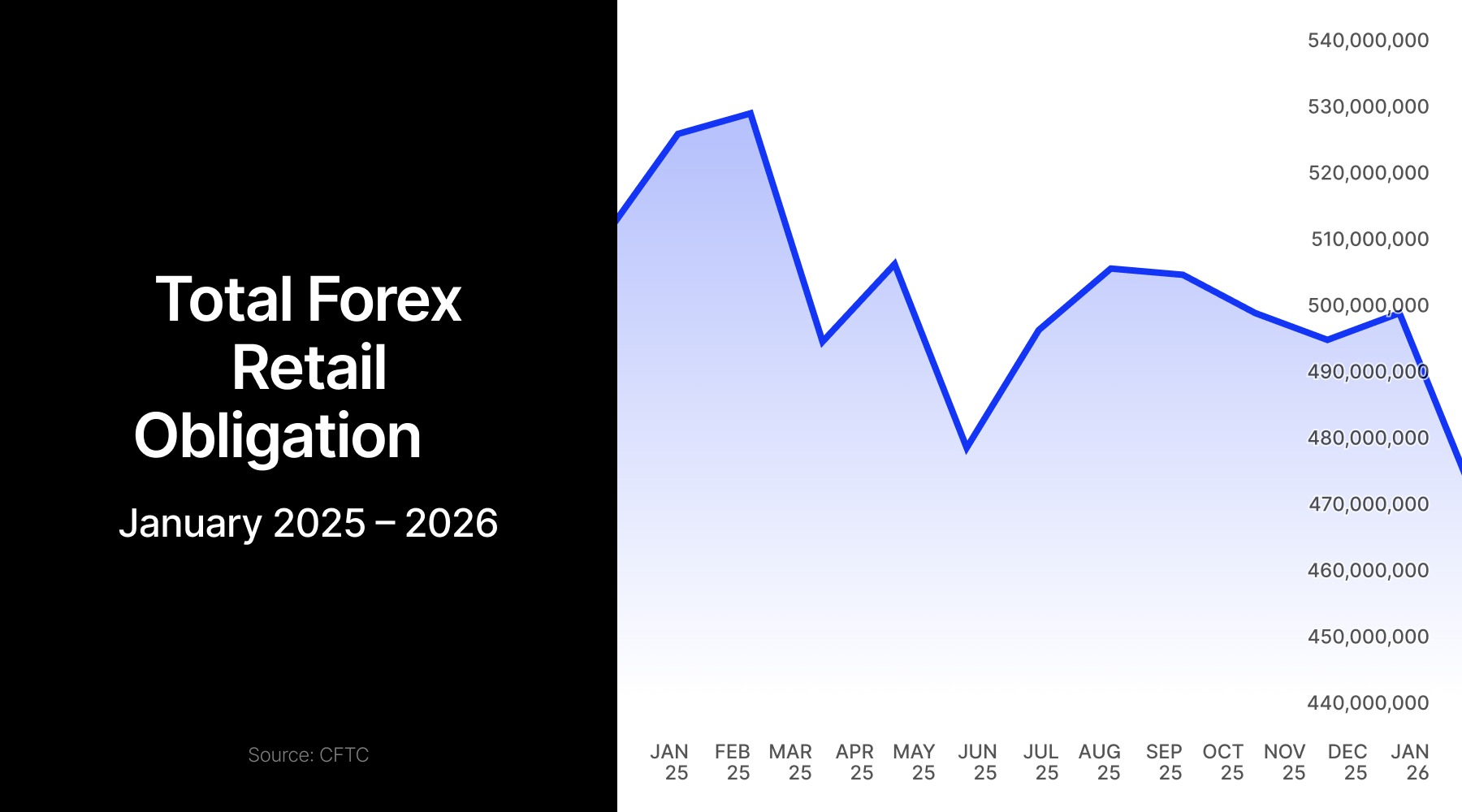
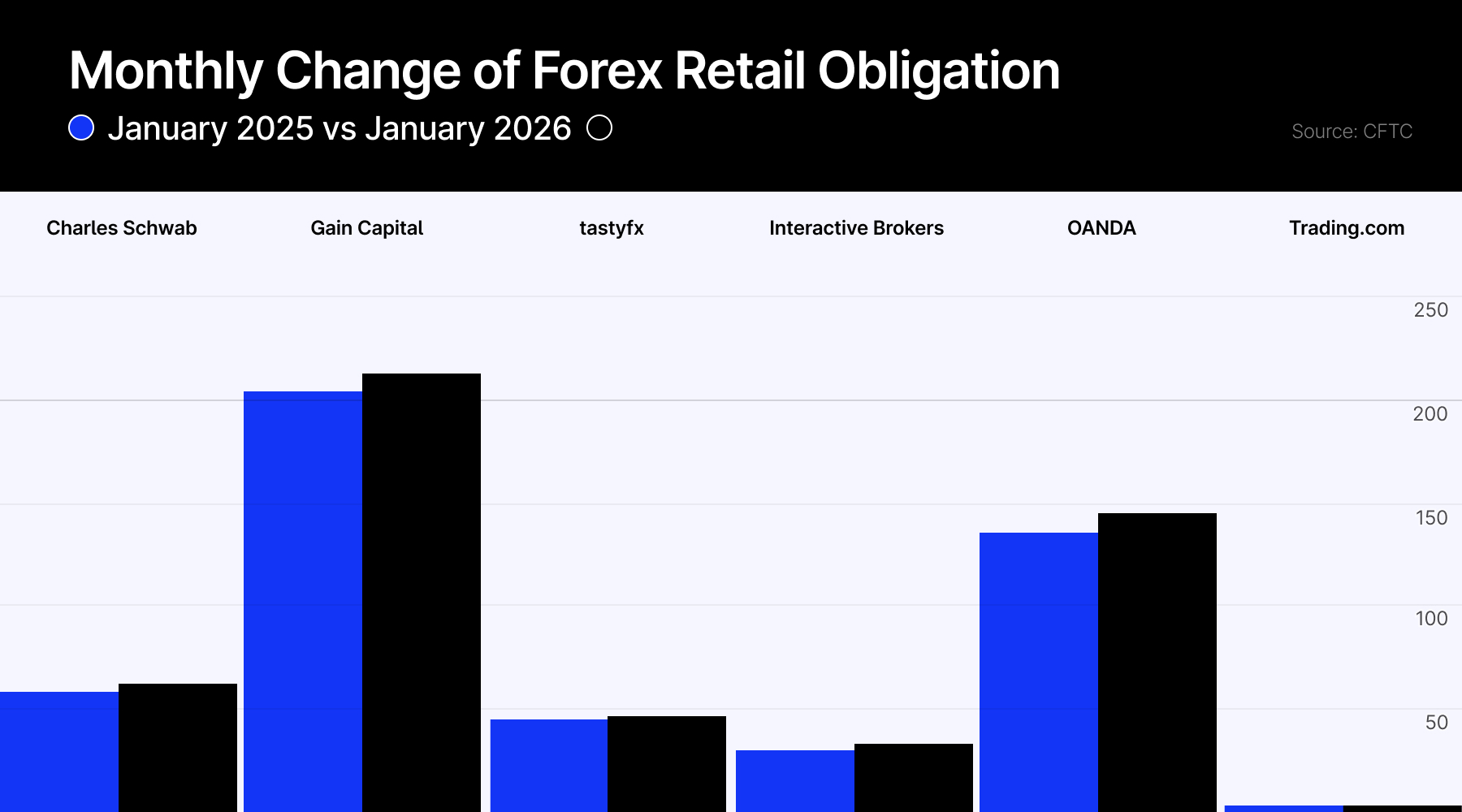
Customer deposits held by US retail forex brokers fell sharply in January, with the industry's combined total dropping to $472.96 million, the lowest figure recorded in more than two years and well below a high-water mark of $557.5 million set back in June 2024.
Singapore Summit: Meet the largest APAC brokers you know (and those you still don't!)
Every broker tracked in the monthly CFTC financial disclosure data posted a decline from December's levels, and four of the six platforms are sitting below where they were twelve months ago. The data, drawn from the Commodity Futures Trading Commission's (CFTC) mandatory Futures Commission Merchant (FCM) filings, capture total retail forex obligations, effectively, the pool of customer assets each regulated dealer holds on behalf of its US clients.
OANDA's Decline Deepens Under New Ownership
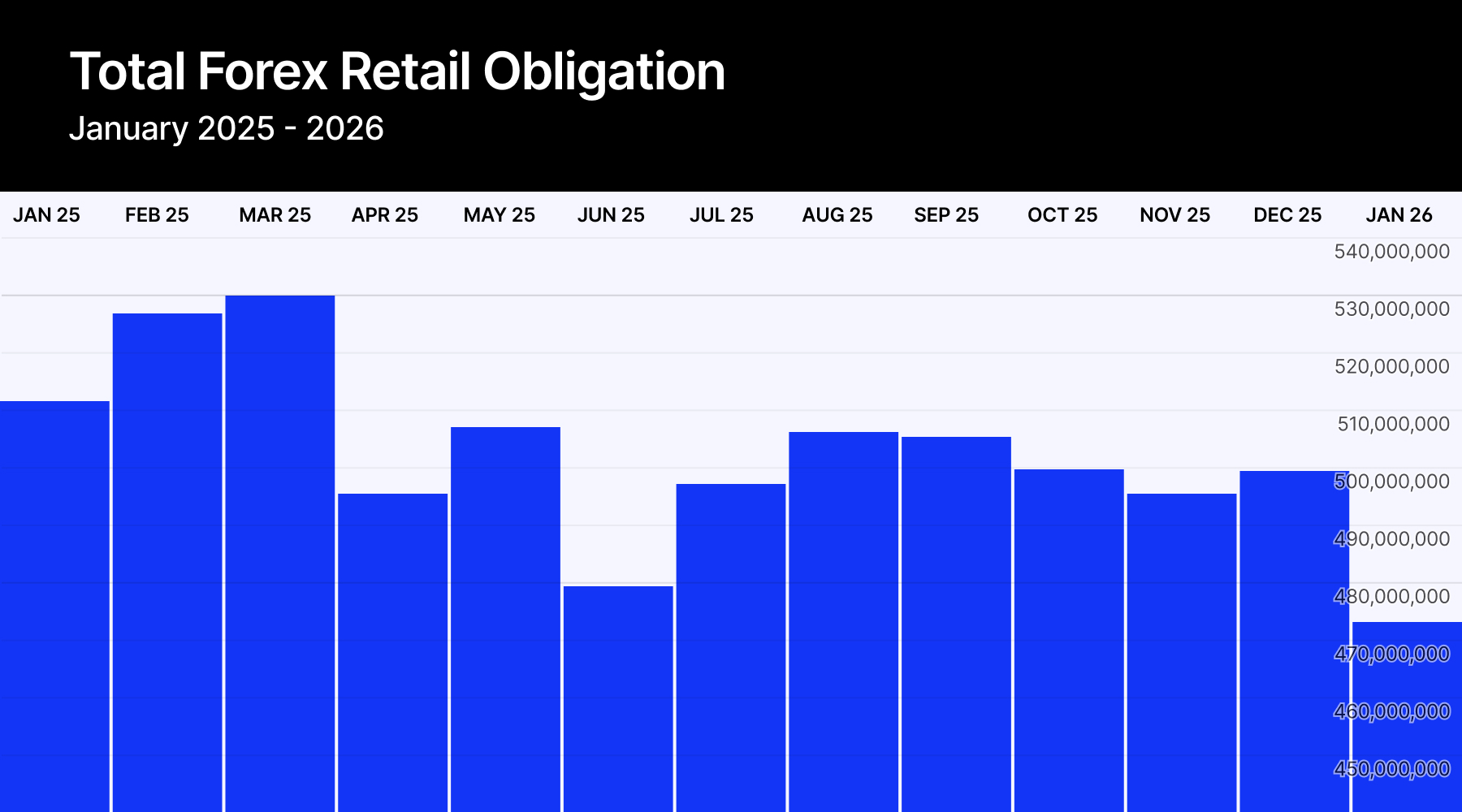
No broker has lost more ground than OANDA. January's figure of $133.7 million represents an 8% drop from December and a 19% collapse year-on-year, when OANDA was still managing $165.6 million in US retail forex deposits.
The slide is hard to disentangle from the ownership change that reshaped the broker's profile last year. Prop trading giant FTMO acquired OANDA in early 2025, and by March 2026 OANDA had formally transitioned its prop trading clients to the FTMO brand, narrowing the scope of its US retail operation in the process.
- Interactive Brokers Surges 21% to Lead the US Forex Deposit Recovery
- US Forex Deposits Edge Lower in November as Interactive Brokers Plunges 20%
- Major Forex Brokers Feel the Pain as Dollar Hit Rock Bottom
OANDA's share of total US retail forex deposits now stands at roughly 28%, down from a position that once put it firmly in second place with greater distance behind Gain Capital.
Gain Capital Holds Firm, Though Its Lead Narrows
Gain Capital, which operates the Forex.com platform in the United States, remains the dominant player with $203.1 million in January, still commanding 42.9% of the total market. But the number itself has pulled back from the $211.8 million it held at year-end, and it is running 4% below the $211.5 million reported in January 2025, when the broker was benefiting from strong monthly inflows.
The broker has not posted a meaningful breakout since touching $226.6 million in March 2025. That plateau, combined with a post-summer cooling across the market, suggests demand in US retail forex is under genuine pressure.
Gain Capital's market share above 44% in the second half of 2024 has gradually eroded, and the December 2025 data now looks more like a temporary stabilization.
Charles Schwab and tastyfx Lose Ground
Charles Schwab's forex unit shed just over 5% in January, falling to $58.6 million from $61.8 million in December. That marks a roughly $2.6 million shortfall against the same month last year, though Schwab's year-on-year decline of 4.3% is relatively contained compared to broader industry weakness.
tastyfx, the US retail forex brand of London-listed IG Group, which rebranded from IG US in 2024, dropped 3.7% on the month to $44.6 million. Of the four brokers showing annual declines, tastyfx is the most modest, down just 1.7% year-on-year.
The broker launched Prime accounts in September 2025 targeting professional traders with a 6% promotional annual yield on cash deposits, a product designed to attract larger clients and retain high-value balances.
Interactive Brokers and Trading.com Swim Against the Tide
Against an otherwise uniform picture of decline, Interactive Brokers and Trading.com stand out as the only two brokers showing positive deposits compared to January 2025. Interactive Brokers held $30.1 million in retail forex assets at end-January, down 7.3% from December but up 16.4% year-on-year - a contrast that reflects how badly the broker had underperformed a year ago when deposits had already fallen to a low base.
In November 2025, Interactive Brokers' deposits plunged 20% in a single month, making the subsequent recovery, including a 21% surge in December, look more like oscillation than a trend.
Trading.com, the smallest platform by absolute deposit size at $2.86 million, posted the shallowest monthly decline of any broker, shedding just 1.4% from December. More notable is the year-on-year comparison: Trading.com's deposits are up 25.4% from a year ago, continuing a growth trajectory that, while small in absolute dollar terms, is consistent and directionally distinct from the rest of the market.
US retail forex brokers operating as Futures Commission Merchants or Retail Foreign Exchange Dealers are required to report monthly financial disclosures to the CFTC, including adjusted net capital figures and total retail forex obligations. All six brokers covered here remain in compliance with NFA membership and CFTC registration requirements as of the January reporting date.