UBS Adds $2Bn to Its Litigation Warchest as Regulators Sharpen Their Sabres
Tuesday,28/10/2014|14:34GMTby
George Tchetvertakov
The Top 10 banks are building sizeable capital reserves to mitigate a looming regulatory backlash specifically aimed at FX-rate manipulation. Regardless of the penalties, "litigation and regulatory matters will remain elevated for the foreseeable future".
The largest investment bank in Switzerland, and one of the largest in the world, UBS, published its quarterly financial results earlier today.
According to its Q3 2014 report UBS has set aside 1.8 billion Swiss francs ($1.9 billion) in “legal provisions for litigation, regulatory and similar matters." A substantial part of the allocated funds are expected to address the looming fines to be imposed by a queue of regulators, including FINMA, FCA, BaFIN and others. Legal reserves at UBS, which had already raised its provisions for future litigation to 2 billion francs earlier this year, now stand at 3.5 billion francs ($3.7 billion).
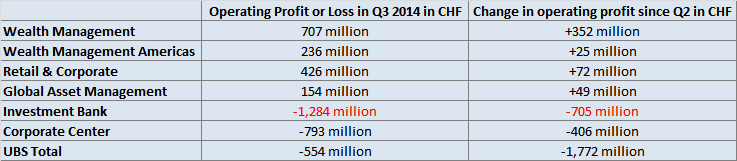
Overall, UBS beat forecasts with a 32% rise in net profit from a year earlier, largely due to a gain of 1.3 billion francs from slightly adjusting how it accounts for deferred tax assets. However, on a reporting basis the bank suffered a 554 million francs ($585 million) loss in Q3 2014.
In September 2013, UBS provided the U.S. Department of Justice with information about practices related to foreign Exchange fixings. Since then, the FCA (in tandem with other agencies) has begun talks with UBS and five other banks – Barclays, HSBC, Royal Bank of Scotland, JP Morgan and Citigroup – about a possible settlement that could result in heavy fines being imposed on each bank confirmed to have been involved in manipulative behaviour. The resulting fines are rumoured to be in the £300 million - £500 million range for each bank. The banks are expected to be fined different amounts depending on the gravity of the alleged misconduct.
Justice Renegotiated
With over $3bn now allocated for litigation and regulatory fines, UBS foresees stormy waters ahead. In the Q3 report, UBS states, “No agreement has been reached on the form of a resolution with the Antitrust or Criminal Divisions of the DOJ. It is possible that other investigating authorities may seek to commence discussions of potential resolutions in the near future." The door is open for more regulators to step forward and lay claims against the bank.
In a clear admission of a sour state of Compliance within the banking industry as a whole, UBS says, “We expect charges associated with litigation, regulatory and similar matters to remain at elevated levels through 2014. At this point in time, we believe that the industry continues to operate in an environment where charges associated with litigation, regulatory and similar matters will remain elevated for the foreseeable future."
The bank said Q3 net profit was 762 million francs although the bank suffered a 554 million francs net loss – the disparity emanating from a convoluted method used by UBS in its financial reporting whereby each figure is given three shades of true in the form of ‘underlying’, ‘adjusted’ and ‘actual’.
Most of the bank’s financial underperformance came from its Investment Bank and Corporate Center units amid widespread downsizing and “restructuring costs."
The UBS report estimates “restructuring costs of approximately 700 million for 2014 and 1.4 billion for 2015. For 2016, restructuring costs of 900 million and 400 million in 2017."
Meanwhile, French prosecutors are close to finalising a €5 billion fine to be imposed on UBS for allegedly helping wealthy French individuals avoid/evade taxes, according to Reuters.
Avoiding Media Scrutiny, Evading a Quagmire
Last week, Deutsche Bank was reported to be setting aside litigation costs of €894 million for a number of items for when the banks reports its quarterly results tomorrow. According to Reuters, Deutsche (among other top FX banks) is expecting to be cut down with billions in fines by UK and US authorities, if and when banks and regulators “settle” on a figure.
In addition, Reuters reported that Deutsche was bracing to pay almost €1 billion for LIBOR-related fines as it nears a deal with U.S. and UK authorities to settle allegations that it had attempted to manipulate the benchmark interest rate.
Given UBS’s and Deutsche’s contingency plans related to FX penalties, it seems the world’s top ten banks are bracing for the regulatory crunch as if it was a chore rather than a crusade.
The largest investment bank in Switzerland, and one of the largest in the world, UBS, published its quarterly financial results earlier today.
According to its Q3 2014 report UBS has set aside 1.8 billion Swiss francs ($1.9 billion) in “legal provisions for litigation, regulatory and similar matters." A substantial part of the allocated funds are expected to address the looming fines to be imposed by a queue of regulators, including FINMA, FCA, BaFIN and others. Legal reserves at UBS, which had already raised its provisions for future litigation to 2 billion francs earlier this year, now stand at 3.5 billion francs ($3.7 billion).
Overall, UBS beat forecasts with a 32% rise in net profit from a year earlier, largely due to a gain of 1.3 billion francs from slightly adjusting how it accounts for deferred tax assets. However, on a reporting basis the bank suffered a 554 million francs ($585 million) loss in Q3 2014.
In September 2013, UBS provided the U.S. Department of Justice with information about practices related to foreign Exchange fixings. Since then, the FCA (in tandem with other agencies) has begun talks with UBS and five other banks – Barclays, HSBC, Royal Bank of Scotland, JP Morgan and Citigroup – about a possible settlement that could result in heavy fines being imposed on each bank confirmed to have been involved in manipulative behaviour. The resulting fines are rumoured to be in the £300 million - £500 million range for each bank. The banks are expected to be fined different amounts depending on the gravity of the alleged misconduct.
Justice Renegotiated
With over $3bn now allocated for litigation and regulatory fines, UBS foresees stormy waters ahead. In the Q3 report, UBS states, “No agreement has been reached on the form of a resolution with the Antitrust or Criminal Divisions of the DOJ. It is possible that other investigating authorities may seek to commence discussions of potential resolutions in the near future." The door is open for more regulators to step forward and lay claims against the bank.
In a clear admission of a sour state of Compliance within the banking industry as a whole, UBS says, “We expect charges associated with litigation, regulatory and similar matters to remain at elevated levels through 2014. At this point in time, we believe that the industry continues to operate in an environment where charges associated with litigation, regulatory and similar matters will remain elevated for the foreseeable future."
The bank said Q3 net profit was 762 million francs although the bank suffered a 554 million francs net loss – the disparity emanating from a convoluted method used by UBS in its financial reporting whereby each figure is given three shades of true in the form of ‘underlying’, ‘adjusted’ and ‘actual’.
Most of the bank’s financial underperformance came from its Investment Bank and Corporate Center units amid widespread downsizing and “restructuring costs."
The UBS report estimates “restructuring costs of approximately 700 million for 2014 and 1.4 billion for 2015. For 2016, restructuring costs of 900 million and 400 million in 2017."
Meanwhile, French prosecutors are close to finalising a €5 billion fine to be imposed on UBS for allegedly helping wealthy French individuals avoid/evade taxes, according to Reuters.
Avoiding Media Scrutiny, Evading a Quagmire
Last week, Deutsche Bank was reported to be setting aside litigation costs of €894 million for a number of items for when the banks reports its quarterly results tomorrow. According to Reuters, Deutsche (among other top FX banks) is expecting to be cut down with billions in fines by UK and US authorities, if and when banks and regulators “settle” on a figure.
In addition, Reuters reported that Deutsche was bracing to pay almost €1 billion for LIBOR-related fines as it nears a deal with U.S. and UK authorities to settle allegations that it had attempted to manipulate the benchmark interest rate.
Given UBS’s and Deutsche’s contingency plans related to FX penalties, it seems the world’s top ten banks are bracing for the regulatory crunch as if it was a chore rather than a crusade.
OANDA Japan Pushes Clients to MT5 as It Sets MT4 Shutdown
CMC Markets’ Artur Delijergijevs on Metals Demand, Volatility, & Stable Execution
CMC Markets’ Artur Delijergijevs on Metals Demand, Volatility, & Stable Execution
In this exclusive Executive Interview, Finance Magnates speaks with Artur Delijergijevs, Head of Systematic Market Making at CMC Markets, about the current state of metals demand and market volatility.
Delijergijevs offers a desk-level view on:
- Metals Demand: Why metals are seeing the strongest demand from both retail and institutional clients right now.
- The Safe-Haven Debate: Questioning whether gold still fits the classic safe-haven definition given large daily price movements.
- Volatile Market Prep: How a market-making desk prepares its systems and pricing for stressed market conditions and high-impact economic events.
- Hybrid Execution: Why the best execution model combines electronic speed with human relationship support, especially during volatility.
- AI in Workflow: Where CMC Markets is integrating machine learning for risk management and pricing, and the limitations of AI during stressed markets.
- Dubai's Role: The strategic importance of Dubai’s location for covering global trading sessions across Asia, Europe, and the US.
Watch to understand how CMC Markets maintains stable pricing and reliable execution quality in high-volatility environments.
#CMCmarkets #forex #metals #gold #trading #volatility #MarketMaking #iFXDubai #FinanceMagnates #Finance #Fintech #Execution #AlgorithmicTrading #RiskManagement
In this exclusive Executive Interview, Finance Magnates speaks with Artur Delijergijevs, Head of Systematic Market Making at CMC Markets, about the current state of metals demand and market volatility.
Delijergijevs offers a desk-level view on:
- Metals Demand: Why metals are seeing the strongest demand from both retail and institutional clients right now.
- The Safe-Haven Debate: Questioning whether gold still fits the classic safe-haven definition given large daily price movements.
- Volatile Market Prep: How a market-making desk prepares its systems and pricing for stressed market conditions and high-impact economic events.
- Hybrid Execution: Why the best execution model combines electronic speed with human relationship support, especially during volatility.
- AI in Workflow: Where CMC Markets is integrating machine learning for risk management and pricing, and the limitations of AI during stressed markets.
- Dubai's Role: The strategic importance of Dubai’s location for covering global trading sessions across Asia, Europe, and the US.
Watch to understand how CMC Markets maintains stable pricing and reliable execution quality in high-volatility environments.
#CMCmarkets #forex #metals #gold #trading #volatility #MarketMaking #iFXDubai #FinanceMagnates #Finance #Fintech #Execution #AlgorithmicTrading #RiskManagement
Finance Magnates Awards 2026 – Nominations Now Open
Finance Magnates Awards 2026 – Nominations Now Open
The Finance Magnates Awards 2026 nominations are now open. 🏆
From fintech innovators to leading brokers, this is where the finance industry celebrates its biggest achievements.
Winners will be announced at the Cyprus Gala Dinner on November 6, 2026.
Nominate your brand now.
https://awards.financemagnates.com/?utm_source=linkedin&utm_medium=video&utm_campaign=nominations-open
#FMAwards #FinanceMagnates #FintechAwards #Fintech #FinanceIndustry
The Finance Magnates Awards 2026 nominations are now open. 🏆
From fintech innovators to leading brokers, this is where the finance industry celebrates its biggest achievements.
Winners will be announced at the Cyprus Gala Dinner on November 6, 2026.
Nominate your brand now.
https://awards.financemagnates.com/?utm_source=linkedin&utm_medium=video&utm_campaign=nominations-open
#FMAwards #FinanceMagnates #FintechAwards #Fintech #FinanceIndustry
Finance Magnates Awards 2026 | Nominations Now Open 🏆#Fintech #FMAwards #TradingIndustry
Finance Magnates Awards 2026 | Nominations Now Open 🏆#Fintech #FMAwards #TradingIndustry
Lights on. Cameras ready. 🎬
Finance Magnates Awards 2026 nominations are now open. 🏆
#FMAwards #FinanceMagnates #FintechAwards #Fintech
Lights on. Cameras ready. 🎬
Finance Magnates Awards 2026 nominations are now open. 🏆
#FMAwards #FinanceMagnates #FintechAwards #Fintech
Exness sees trust as the key theme for growth in MENA Trading Growth for 2026
Exness sees trust as the key theme for growth in MENA Trading Growth for 2026
Mohammad Amer, Regional Commercial Director at Exness, sits down to discuss the booming MENA financial trading market. Find out why Dubai is key to the company's growth strategy, how a mobile-first generation is changing expectations, and why trust will be the defining theme for traders in 2026.
In this interview, you'll learn:
* Why Dubai and the MENA region are critical growth markets for fintech and online trading.
* How Exness is addressing the demands of mobile-first, younger traders through engineering, platform stability, and transparent conditions.
* The essential role local talent plays in providing a culturally relevant and compliant user experience.
* Mohammad Amer's outlook on the future of the online trading industry and why stronger controls and systems are necessary.
* Why "trust" isn't just a brand value, but has commercial value—and why he predicts 2026 will be the "Year of Trust."
Key Takeaways:
➡️ The MENA region is rapidly shaping global financial markets.
➡️ New traders expect stability, precise execution, and transparency.
➡️ Local expertise is key to regulatory compliance and user experience.
➡️ Future success belongs to firms capable of meeting rising standards across regulation and platform consistency.
Read the full article at: https://www.financemagnates.com/thought-leadership/exness-sees-trust-as-the-key-theme-for-growth-in-mena-trading-growth-for-2026/
#Exness #MENA #Trading #FinTech #Dubai #OnlineTrading #FinanceMagnates #MohammadAmer #Trust #MobileTrading
Mohammad Amer, Regional Commercial Director at Exness, sits down to discuss the booming MENA financial trading market. Find out why Dubai is key to the company's growth strategy, how a mobile-first generation is changing expectations, and why trust will be the defining theme for traders in 2026.
In this interview, you'll learn:
* Why Dubai and the MENA region are critical growth markets for fintech and online trading.
* How Exness is addressing the demands of mobile-first, younger traders through engineering, platform stability, and transparent conditions.
* The essential role local talent plays in providing a culturally relevant and compliant user experience.
* Mohammad Amer's outlook on the future of the online trading industry and why stronger controls and systems are necessary.
* Why "trust" isn't just a brand value, but has commercial value—and why he predicts 2026 will be the "Year of Trust."
Key Takeaways:
➡️ The MENA region is rapidly shaping global financial markets.
➡️ New traders expect stability, precise execution, and transparency.
➡️ Local expertise is key to regulatory compliance and user experience.
➡️ Future success belongs to firms capable of meeting rising standards across regulation and platform consistency.
Read the full article at: https://www.financemagnates.com/thought-leadership/exness-sees-trust-as-the-key-theme-for-growth-in-mena-trading-growth-for-2026/
#Exness #MENA #Trading #FinTech #Dubai #OnlineTrading #FinanceMagnates #MohammadAmer #Trust #MobileTrading
Paytiko CEO Razi Salih on Why Payment Orchestration is a MUST-HAVE for Brokers in 2026
Paytiko CEO Razi Salih on Why Payment Orchestration is a MUST-HAVE for Brokers in 2026
At iFX Expo Dubai, Finance Magnates spoke with Razi Salih, CEO at Paytiko, about the evolution of the payments ecosystem and why payment orchestration has shifted from an option to a necessity for brokers, prop firms, and exchanges.
Mr. Salih explains how global expansion, the need for deep localisation, and the sheer number of new payment methods, from instant banking to stablecoins, are driving this critical infrastructure shift.
#PaymentOrchestration #Fintech #Brokerage #TradingPayments #RaziSalih #Paytiko #iFXExpoDubai #Stablecoins #AIinFintech
At iFX Expo Dubai, Finance Magnates spoke with Razi Salih, CEO at Paytiko, about the evolution of the payments ecosystem and why payment orchestration has shifted from an option to a necessity for brokers, prop firms, and exchanges.
Mr. Salih explains how global expansion, the need for deep localisation, and the sheer number of new payment methods, from instant banking to stablecoins, are driving this critical infrastructure shift.
#PaymentOrchestration #Fintech #Brokerage #TradingPayments #RaziSalih #Paytiko #iFXExpoDubai #Stablecoins #AIinFintech