Russia Scrambles to Defend Ruble Amid Capital Security Concerns
Wednesday,01/10/2014|11:35GMTby
George Tchetvertakov
The CBR is rumoured to be on the verge of implementing capital controls for the first time since 1998, as the country maintains its overwhelming dependence on lofty oil prices and artificial market controls in ruble flows.
The Central Bank of Russia (CBR) is being buffeted on several fronts this week as the bank struggles to contain rampant ruble speculation with rumours surfacing yesterday and today that the bank will implement capital controls to dampen the impact of significant capital flight from Russia in the near future. According to TASS news agency, the CBR is considering artificial currency management and capital controls.
Market speculation that the CBR is considering capital controls sent RUB currency pairs spiralling lower. Against the US dollar, the ruble reached a multi-year low of 39.77 before paring back some losses late in the Asian trading session on Wednesday. Against the euro, the ruble is trading above 50.00 for only the second time since late 2008.
Using the CBR's own valuation of the ruble compared to the basket of euros and US dollars, the ruble fell beyond the 44.40 level which the CBR references as the 'line in the sand' beyond which intervention will occur.
The CBR widened the ruble’s trading band in August of this year in preparation for a free-floating ruble next year - a policy shift that would make interest rates rather than reserve utilisation as the primary mechanism for controlling currency movements and managing inflation.
The ruble was also weaker after the CBR conducted its first overnight ruble-dollar swap operation to boost banking Liquidity . The CBR announced that the size of the ruble-dollar swap operation equalled $581 million. This was the first time the bank used this mechanism since its introduction on September 16th, 2014.
There's No Russia without Oil & Gas
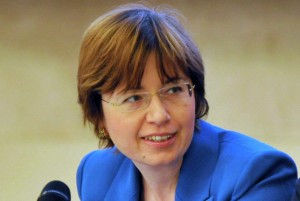
CBR’s First Deputy Governor Ksenia Yudayeva.
In related news that affects both Russia, the US dollar and crude oil prices, the CBR has announced that it will assume an “oil price of $60 per barrel in its new stress scenario for monetary policy,” according to CBR’s First Deputy Governor, Ksenia Yudayeva.
"The purpose of this scenario is to prepare a shock scenario to work out an action plan which we would implement to limit negative effects," said Ms. Yudayeva.
Russian authorities are once again in a quandary as how to best to reign in speculative attacks on the ruble, support an ailing ruble bond market, as well as how to protect Russia's biggest source of revenue - raw material and commodity sales. As the ruble has been falling in value against the US dollar for almost the 11th week in a row, holders of ruble-denominated bonds are suffering twice over in terms of a depreciating currency and exposure to falling bond prices.
Russia is no stranger to capital restrictions caused by international financial effects. Russia first imposed restrictions on capital outflows in 1998 when the ruble's decline led to a default on sovereign ruble-denominated debt. Those capital controls were only removed in 2006. Implementing similar controls today risks damaging Russia's ambition to compete in the international financial markets without government assistance and with a free-floating currency.
The Central Bank of Russia (CBR) is being buffeted on several fronts this week as the bank struggles to contain rampant ruble speculation with rumours surfacing yesterday and today that the bank will implement capital controls to dampen the impact of significant capital flight from Russia in the near future. According to TASS news agency, the CBR is considering artificial currency management and capital controls.
Market speculation that the CBR is considering capital controls sent RUB currency pairs spiralling lower. Against the US dollar, the ruble reached a multi-year low of 39.77 before paring back some losses late in the Asian trading session on Wednesday. Against the euro, the ruble is trading above 50.00 for only the second time since late 2008.
Using the CBR's own valuation of the ruble compared to the basket of euros and US dollars, the ruble fell beyond the 44.40 level which the CBR references as the 'line in the sand' beyond which intervention will occur.
The CBR widened the ruble’s trading band in August of this year in preparation for a free-floating ruble next year - a policy shift that would make interest rates rather than reserve utilisation as the primary mechanism for controlling currency movements and managing inflation.
The ruble was also weaker after the CBR conducted its first overnight ruble-dollar swap operation to boost banking Liquidity . The CBR announced that the size of the ruble-dollar swap operation equalled $581 million. This was the first time the bank used this mechanism since its introduction on September 16th, 2014.
There's No Russia without Oil & Gas
CBR’s First Deputy Governor Ksenia Yudayeva.
In related news that affects both Russia, the US dollar and crude oil prices, the CBR has announced that it will assume an “oil price of $60 per barrel in its new stress scenario for monetary policy,” according to CBR’s First Deputy Governor, Ksenia Yudayeva.
"The purpose of this scenario is to prepare a shock scenario to work out an action plan which we would implement to limit negative effects," said Ms. Yudayeva.
Russian authorities are once again in a quandary as how to best to reign in speculative attacks on the ruble, support an ailing ruble bond market, as well as how to protect Russia's biggest source of revenue - raw material and commodity sales. As the ruble has been falling in value against the US dollar for almost the 11th week in a row, holders of ruble-denominated bonds are suffering twice over in terms of a depreciating currency and exposure to falling bond prices.
Russia is no stranger to capital restrictions caused by international financial effects. Russia first imposed restrictions on capital outflows in 1998 when the ruble's decline led to a default on sovereign ruble-denominated debt. Those capital controls were only removed in 2006. Implementing similar controls today risks damaging Russia's ambition to compete in the international financial markets without government assistance and with a free-floating currency.
Italy’s Consob Tightens Net on AI-Fueled Scams With Fresh Website Bans
FP Markets Winner Spotlight 🏆 | Global Broker of the Year 2025 #Trading #Broker #Innovation #Shorts
FP Markets Winner Spotlight 🏆 | Global Broker of the Year 2025 #Trading #Broker #Innovation #Shorts
FP Markets takes the spotlight as Global Broker of the Year 2025 at the Finance Magnates Awards.
Martin Stoilov, Head of Client Experience, shares that trust, innovation, and people played a key role in the company’s success, supported by a strong foundation of integrity and client-centricity.
Following this milestone, FP Markets continues to focus on growth, technology investment, and its core values of transparency and excellence.
👉 Be part of FM Awards 2026: https://awards.financemagnates.com/#nominate
FP Markets takes the spotlight as Global Broker of the Year 2025 at the Finance Magnates Awards.
Martin Stoilov, Head of Client Experience, shares that trust, innovation, and people played a key role in the company’s success, supported by a strong foundation of integrity and client-centricity.
Following this milestone, FP Markets continues to focus on growth, technology investment, and its core values of transparency and excellence.
👉 Be part of FM Awards 2026: https://awards.financemagnates.com/#nominate
In this video, we review @HolaPrimeMarketsOfficial, a multi-asset forex and CFDs broker offering different account types, trading platforms, and flexible trading conditions.
We cover the broker’s overall offering, including account options, trading environment, platforms like MT4 and MT5, and additional services such as managed accounts and fast withdrawals.
Watch the full video to see if Hola Prime Markets fits your trading needs.
📣 Stay up to date with the latest in finance and trading. Follow Finance Magnates for industry news, insights, and global event coverage.
Connect with us:
🔗 LinkedIn: /financemagnates
👍 Facebook: /financemagnates
📸 Instagram: https://www.instagram.com/financemagnates
🐦 X: https://x.com/financemagnates
🎥 TikTok: https://www.tiktok.com/tag/financemagnates
▶️ YouTube: /@financemagnates_official
#HolaPrime #ForexBroker #CFDTrading #FinanceMagnates #Trading #Forex #BrokerReview
In this video, we review @HolaPrimeMarketsOfficial, a multi-asset forex and CFDs broker offering different account types, trading platforms, and flexible trading conditions.
We cover the broker’s overall offering, including account options, trading environment, platforms like MT4 and MT5, and additional services such as managed accounts and fast withdrawals.
Watch the full video to see if Hola Prime Markets fits your trading needs.
📣 Stay up to date with the latest in finance and trading. Follow Finance Magnates for industry news, insights, and global event coverage.
Connect with us:
🔗 LinkedIn: /financemagnates
👍 Facebook: /financemagnates
📸 Instagram: https://www.instagram.com/financemagnates
🐦 X: https://x.com/financemagnates
🎥 TikTok: https://www.tiktok.com/tag/financemagnates
▶️ YouTube: /@financemagnates_official
#HolaPrime #ForexBroker #CFDTrading #FinanceMagnates #Trading #Forex #BrokerReview
Hola Prime Review: What You Need to Know | Full Breakdown by Finance Magnates
Hola Prime Review: What You Need to Know | Full Breakdown by Finance Magnates
In this video, we review @HolaPrime_Global, a proprietary trading firm offering evaluation programs and performance-based payouts in simulated market environments.
We cover how the challenge model works, including account types, profit splits (up to 95%), trading rules, and what it takes to reach a funded account. You’ll also learn about available platforms like MT4, MT5, cTrader, and more, along with insights into payouts, support, and trading conditions.
Watch the full video to see if Hola Prime fits your trading style.
📣 Stay up to date with the latest in finance and trading. Follow Finance Magnates for industry news, insights, and global event coverage.
Connect with us:
🔗 LinkedIn: /financemagnates
👍 Facebook: /financemagnates
📸 Instagram: https://www.instagram.com/financemagnates
🐦 X: https://x.com/financemagnates
🎥 TikTok: https://www.tiktok.com/tag/financemagnates
▶️ YouTube: /@financemagnates_official
#HolaPrime #PropFirm #Trading #FinanceMagnates #Forex #FuturesTrading #TradingReview #PropFirmReview
In this video, we review @HolaPrime_Global, a proprietary trading firm offering evaluation programs and performance-based payouts in simulated market environments.
We cover how the challenge model works, including account types, profit splits (up to 95%), trading rules, and what it takes to reach a funded account. You’ll also learn about available platforms like MT4, MT5, cTrader, and more, along with insights into payouts, support, and trading conditions.
Watch the full video to see if Hola Prime fits your trading style.
📣 Stay up to date with the latest in finance and trading. Follow Finance Magnates for industry news, insights, and global event coverage.
Connect with us:
🔗 LinkedIn: /financemagnates
👍 Facebook: /financemagnates
📸 Instagram: https://www.instagram.com/financemagnates
🐦 X: https://x.com/financemagnates
🎥 TikTok: https://www.tiktok.com/tag/financemagnates
▶️ YouTube: /@financemagnates_official
#HolaPrime #PropFirm #Trading #FinanceMagnates #Forex #FuturesTrading #TradingReview #PropFirmReview
Axi Winner Spotlight 🏆 | Global Most Innovative Broker 2025 #Innovation #Trading #Fintech #Broker
Axi Winner Spotlight 🏆 | Global Most Innovative Broker 2025 #Innovation #Trading #Fintech #Broker
Axi takes the spotlight at the Finance Magnates Awards, winning Global Most Innovative Broker 2025.
Olivia Xenofontos and Ivanna Openko share how the team will feel: proud, motivated, and ready to keep delivering.
They also describe the night as well-organized, focused, and enjoyable for all.
👉 Be part of FM Awards 2026.
Axi takes the spotlight at the Finance Magnates Awards, winning Global Most Innovative Broker 2025.
Olivia Xenofontos and Ivanna Openko share how the team will feel: proud, motivated, and ready to keep delivering.
They also describe the night as well-organized, focused, and enjoyable for all.
👉 Be part of FM Awards 2026.
Recognition that matters.
Built on transparency.
Driven by the industry.
The Finance Magnates Awards 2026.
Nominations are now open.
🔗 https://awards.financemagnates.com/?utm_source=SM&utm_medium=social&utm_campaign=recognition-matters
Recognition that matters.
Built on transparency.
Driven by the industry.
The Finance Magnates Awards 2026.
Nominations are now open.
🔗 https://awards.financemagnates.com/?utm_source=SM&utm_medium=social&utm_campaign=recognition-matters