>
Rupee Weakness Boosts Trading Activity of The Indian Currency
Rupee Weakness Boosts Trading Activity of The Indian Currency
Thursday,22/08/2013|00:27GMTby
Adil Siddiqui
Trading volumes in the Indian rupee have been bolstered as activity picks up on the back of weakness against the greenback. The weak rupee meant brokers saw increased trading and money transfers.
Dark clouds have been casting their shadows over major financial instruments in India, bond yields are skyrocketing, the rupee hits record lows and the country's main stock index plummets. what more can, Manmohan Singh, the country's prime minister ask for in the run up to elections in 2014.
The currency hit a record low (against the USD) this week when it crossed the 64 rupee to a dollar mark, thus signalling major talking points for Indian regulators.
Year to date it's not looking good, the rupee has plunged 17%, furthermore over a period of three trading sessions - from August 16 to August 20 - the rupee has traded in the range of 61.81 to 64 to the dollar.
Nawaz Ali
Indian has been a model growth story for emerging market countries, since the economy started its journey to economic glory, in the early 90’s, however with messy management and an imbalance of its current account the BRIC nation is expected to swing into misery.
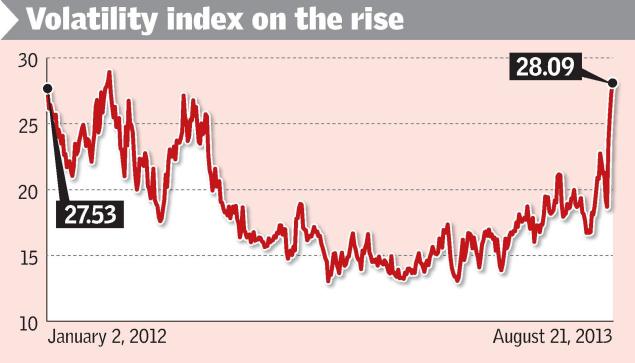
The weakness in the rupee is spreading shock waves across the whole market, India's version of the VIX index, a gauge to measure investors sentiment and panic in the market, has been floating above the 28 mark, yesterday the index hit an intra-day high of 29.96 on Wednesday; a 20-month high.
Indian VIX
Volumes
Trading activity in major currencies in 2013 has benefited from the heightened volatility due to the QE3 tapering and Yen uncertainty. The same ethos is witnessed in trade volumes in the rupee. Currencies Direct, a payment services firm has seen a sharp rise in rupee activity, the firm told Forex Magnates that; “We have seen an increase in demand to the extent of 16.5%.”
The same message was shared by leading Swiss FX bank, SwissQuote, the firm recently launched emerging market currency pairs and in the current volatile climate the bank has benefited from increased activity, Ryan Nettles, Head of FX at the bank said to Forex Magnates: “Regarding our volumes, we’ve excellent client trading volumes in Indian Rupee. Last week, USD INR trading volumes increased over 100% versus the week before with traders mostly buying INR on USD weakness.”
The overall weakness of the rupee does not have to be all doom and gloom, indian exports will be cheaper and tourists and NRI’s will get more for their pounds and dollars when repatriating money back home.
The Gold effect
With the festive season approaching, a combination of Diwali, Eid and the busy wedding months, Indians engage in buying of Gold, a weak rupee and a confused Gold could be a cause for concern.
Ryan Nettles
John Hardy, Head of FX Strategy at Saxo Bank, spoke about some of the after effects of the rupee downfall, he stated: “The implications are extremely important for the Indian market and there could be some spillover into precious metals as India has traditionally been the world’s largest gold consumer, though recent strict gold import measures are meant to limit gold purchases to help relieve India’s current account predicament.”
Amir Khan, corporate dealer at Currencies Direct agrees with Mr Hardy, he says: "The cycle gets even more viscous as imports of gold and oil are further aggravated by the weak rupee. Most of the RBI measures are deemed temporary, as the real problem that needs to be tackled in India is large scale structural reform and until then, the rupee is likely to remain weak."
Groundhog day 1991
The Indian rupee last suffered a major downfall in 1991, during the Indian Crisis of 91, where it suffered a 32% decline, analysts are cautious of the repeat in performance which saw india reached out for the IMF lifeline, India's reserves were at a petty state where the country’s reserves were only ripe for three weeks.
The prime minister of india disputed the current comparison, he said in a statement to the Press Trust of India: "There is no comparison. And no question of going back to [the] 1991 crisis."
Nawaz Ali, UK Market Analyst at Western Union Business Solutions commented: “Looking at the domestic picture, the fundamentals also look poor. What’s more, the RBI’s attempts to protect the currency leaves its policy unbalanced and confusing for investors already fleeing emerging markets.
Try this..
Promoth Manghat
The central bank has done its best to try stabilize the floodplains with new bond buying programs, interest rate changes and restrictions on capital flows.
The BRICS story of economic glory has been a victim of its own success, with weakness seen in the Rand and the Real, India has already seen over $11 billion in investor outflows from June according to data compiled by exchanges, and the recent measures by the central bank seem to have had little or no impact. The question on everyone's mind is how far can it go down?
“Add concerns stemming from China and India’s own economic problems to the list, and you have a very strong case to dump the Indian rupee,” concludes Mr Ali.
Dark clouds have been casting their shadows over major financial instruments in India, bond yields are skyrocketing, the rupee hits record lows and the country's main stock index plummets. what more can, Manmohan Singh, the country's prime minister ask for in the run up to elections in 2014.
The currency hit a record low (against the USD) this week when it crossed the 64 rupee to a dollar mark, thus signalling major talking points for Indian regulators.
Year to date it's not looking good, the rupee has plunged 17%, furthermore over a period of three trading sessions - from August 16 to August 20 - the rupee has traded in the range of 61.81 to 64 to the dollar.
Nawaz Ali
Indian has been a model growth story for emerging market countries, since the economy started its journey to economic glory, in the early 90’s, however with messy management and an imbalance of its current account the BRIC nation is expected to swing into misery.
The weakness in the rupee is spreading shock waves across the whole market, India's version of the VIX index, a gauge to measure investors sentiment and panic in the market, has been floating above the 28 mark, yesterday the index hit an intra-day high of 29.96 on Wednesday; a 20-month high.
Indian VIX
Volumes
Trading activity in major currencies in 2013 has benefited from the heightened volatility due to the QE3 tapering and Yen uncertainty. The same ethos is witnessed in trade volumes in the rupee. Currencies Direct, a payment services firm has seen a sharp rise in rupee activity, the firm told Forex Magnates that; “We have seen an increase in demand to the extent of 16.5%.”
The same message was shared by leading Swiss FX bank, SwissQuote, the firm recently launched emerging market currency pairs and in the current volatile climate the bank has benefited from increased activity, Ryan Nettles, Head of FX at the bank said to Forex Magnates: “Regarding our volumes, we’ve excellent client trading volumes in Indian Rupee. Last week, USD INR trading volumes increased over 100% versus the week before with traders mostly buying INR on USD weakness.”
The overall weakness of the rupee does not have to be all doom and gloom, indian exports will be cheaper and tourists and NRI’s will get more for their pounds and dollars when repatriating money back home.
The Gold effect
With the festive season approaching, a combination of Diwali, Eid and the busy wedding months, Indians engage in buying of Gold, a weak rupee and a confused Gold could be a cause for concern.
Ryan Nettles
John Hardy, Head of FX Strategy at Saxo Bank, spoke about some of the after effects of the rupee downfall, he stated: “The implications are extremely important for the Indian market and there could be some spillover into precious metals as India has traditionally been the world’s largest gold consumer, though recent strict gold import measures are meant to limit gold purchases to help relieve India’s current account predicament.”
Amir Khan, corporate dealer at Currencies Direct agrees with Mr Hardy, he says: "The cycle gets even more viscous as imports of gold and oil are further aggravated by the weak rupee. Most of the RBI measures are deemed temporary, as the real problem that needs to be tackled in India is large scale structural reform and until then, the rupee is likely to remain weak."
Groundhog day 1991
The Indian rupee last suffered a major downfall in 1991, during the Indian Crisis of 91, where it suffered a 32% decline, analysts are cautious of the repeat in performance which saw india reached out for the IMF lifeline, India's reserves were at a petty state where the country’s reserves were only ripe for three weeks.
The prime minister of india disputed the current comparison, he said in a statement to the Press Trust of India: "There is no comparison. And no question of going back to [the] 1991 crisis."
Nawaz Ali, UK Market Analyst at Western Union Business Solutions commented: “Looking at the domestic picture, the fundamentals also look poor. What’s more, the RBI’s attempts to protect the currency leaves its policy unbalanced and confusing for investors already fleeing emerging markets.
Try this..
Promoth Manghat
The central bank has done its best to try stabilize the floodplains with new bond buying programs, interest rate changes and restrictions on capital flows.
The BRICS story of economic glory has been a victim of its own success, with weakness seen in the Rand and the Real, India has already seen over $11 billion in investor outflows from June according to data compiled by exchanges, and the recent measures by the central bank seem to have had little or no impact. The question on everyone's mind is how far can it go down?
“Add concerns stemming from China and India’s own economic problems to the list, and you have a very strong case to dump the Indian rupee,” concludes Mr Ali.
Swiss Banks, Brokers and Fintechs Must Prove Online Clients Are Real People
Featured Videos
AvaTrade to Acquire Most of FXCM; NAGA Raises $8M
AvaTrade to Acquire Most of FXCM; NAGA Raises $8M
AvaTrade to Acquire Most of FXCM; NAGA Raises $8M
AvaTrade to Acquire Most of FXCM; NAGA Raises $8M
Today’s financial news recap covers AvaTrade agrees to acquire most of FXCM, NAGA secures eight million dollars in new financing, and Wise seeks a tax settlement in the UK.
Finance Magnates Daily Recap brings you the latest news from forex and CFD brokers, fintech, payments, cryptocurrency, digital assets, trading platforms, financial regulation and global markets.
Get the key company news, executive moves, deals, regulatory updates and market developments of the day, in just a few minutes. New episodes published every weekday.
Read more: https://www.financemagnates.com
#FinanceMagnates #ForexNews #FintechNews
Today’s financial news recap covers AvaTrade agrees to acquire most of FXCM, NAGA secures eight million dollars in new financing, and Wise seeks a tax settlement in the UK.
Finance Magnates Daily Recap brings you the latest news from forex and CFD brokers, fintech, payments, cryptocurrency, digital assets, trading platforms, financial regulation and global markets.
Get the key company news, executive moves, deals, regulatory updates and market developments of the day, in just a few minutes. New episodes published every weekday.
Read more: https://www.financemagnates.com
#FinanceMagnates #ForexNews #FintechNews
Today’s financial news recap covers AvaTrade agrees to acquire most of FXCM, NAGA secures eight million dollars in new financing, and Wise seeks a tax settlement in the UK.
Finance Magnates Daily Recap brings you the latest news from forex and CFD brokers, fintech, payments, cryptocurrency, digital assets, trading platforms, financial regulation and global markets.
Get the key company news, executive moves, deals, regulatory updates and market developments of the day, in just a few minutes. New episodes published every weekday.
Read more: https://www.financemagnates.com
#FinanceMagnates #ForexNews #FintechNews
Today’s financial news recap covers AvaTrade agrees to acquire most of FXCM, NAGA secures eight million dollars in new financing, and Wise seeks a tax settlement in the UK.
Finance Magnates Daily Recap brings you the latest news from forex and CFD brokers, fintech, payments, cryptocurrency, digital assets, trading platforms, financial regulation and global markets.
Get the key company news, executive moves, deals, regulatory updates and market developments of the day, in just a few minutes. New episodes published every weekday.
Read more: https://www.financemagnates.com
#FinanceMagnates #ForexNews #FintechNews
XTB Adds Overnight US Stock Trading; Nasdaq Ventures Invests in One Trading
XTB Adds Overnight US Stock Trading; Nasdaq Ventures Invests in One Trading
XTB Adds Overnight US Stock Trading; Nasdaq Ventures Invests in One Trading
XTB Adds Overnight US Stock Trading; Nasdaq Ventures Invests in One Trading
XTB Adds Overnight US Stock Trading; Nasdaq Ventures Invests in One Trading
XTB Adds Overnight US Stock Trading; Nasdaq Ventures Invests in One Trading
Today’s financial news recap covers XTB expands overnight US stock trading, Fortrade reports higher revenue, Nasdaq backs One Trading, and Vest Labs raises 13 million dollars.
Finance Magnates Daily Recap brings you the latest news from forex and CFD brokers, fintech, payments, cryptocurrency, digital assets, trading platforms, financial regulation and global markets.
Get the key company news, executive moves, deals, regulatory updates and market developments of the day, in just a few minutes. New episodes published every weekday.
Read more: https://www.financemagnates.com
#FinanceMagnates #ForexNews #FintechNews
Today’s financial news recap covers XTB expands overnight US stock trading, Fortrade reports higher revenue, Nasdaq backs One Trading, and Vest Labs raises 13 million dollars.
Finance Magnates Daily Recap brings you the latest news from forex and CFD brokers, fintech, payments, cryptocurrency, digital assets, trading platforms, financial regulation and global markets.
Get the key company news, executive moves, deals, regulatory updates and market developments of the day, in just a few minutes. New episodes published every weekday.
Read more: https://www.financemagnates.com
#FinanceMagnates #ForexNews #FintechNews
Today’s financial news recap covers XTB expands overnight US stock trading, Fortrade reports higher revenue, Nasdaq backs One Trading, and Vest Labs raises 13 million dollars.
Finance Magnates Daily Recap brings you the latest news from forex and CFD brokers, fintech, payments, cryptocurrency, digital assets, trading platforms, financial regulation and global markets.
Get the key company news, executive moves, deals, regulatory updates and market developments of the day, in just a few minutes. New episodes published every weekday.
Read more: https://www.financemagnates.com
#FinanceMagnates #ForexNews #FintechNews
Today’s financial news recap covers XTB expands overnight US stock trading, Fortrade reports higher revenue, Nasdaq backs One Trading, and Vest Labs raises 13 million dollars.
Finance Magnates Daily Recap brings you the latest news from forex and CFD brokers, fintech, payments, cryptocurrency, digital assets, trading platforms, financial regulation and global markets.
Get the key company news, executive moves, deals, regulatory updates and market developments of the day, in just a few minutes. New episodes published every weekday.
Read more: https://www.financemagnates.com
#FinanceMagnates #ForexNews #FintechNews
Today’s financial news recap covers XTB expands overnight US stock trading, Fortrade reports higher revenue, Nasdaq backs One Trading, and Vest Labs raises 13 million dollars.
Finance Magnates Daily Recap brings you the latest news from forex and CFD brokers, fintech, payments, cryptocurrency, digital assets, trading platforms, financial regulation and global markets.
Get the key company news, executive moves, deals, regulatory updates and market developments of the day, in just a few minutes. New episodes published every weekday.
Read more: https://www.financemagnates.com
#FinanceMagnates #ForexNews #FintechNews
Today’s financial news recap covers XTB expands overnight US stock trading, Fortrade reports higher revenue, Nasdaq backs One Trading, and Vest Labs raises 13 million dollars.
Finance Magnates Daily Recap brings you the latest news from forex and CFD brokers, fintech, payments, cryptocurrency, digital assets, trading platforms, financial regulation and global markets.
Get the key company news, executive moves, deals, regulatory updates and market developments of the day, in just a few minutes. New episodes published every weekday.
Read more: https://www.financemagnates.com
#FinanceMagnates #ForexNews #FintechNews
CMC Founder Downplays Volatility Hit; Devexperts Names CEO
CMC Founder Downplays Volatility Hit; Devexperts Names CEO
CMC Founder Downplays Volatility Hit; Devexperts Names CEO
CMC Founder Downplays Volatility Hit; Devexperts Names CEO
CMC Founder Downplays Volatility Hit; Devexperts Names CEO
CMC Founder Downplays Volatility Hit; Devexperts Names CEO
Today’s financial news recap covers low volatility pressures brokers, Devexperts names a new CEO, Saxo cuts onboarding time, and OKX reaches a 25 billion dollar valuation.
Finance Magnates Daily Recap brings you the latest news from forex and CFD brokers, fintech, payments, cryptocurrency, digital assets, trading platforms, financial regulation and global markets.
Get the key company news, executive moves, deals, regulatory updates and market developments of the day, in just a few minutes. New episodes published every weekday.
Read more: https://www.financemagnates.com
#FinanceMagnates #ForexNews #FintechNews
Today’s financial news recap covers low volatility pressures brokers, Devexperts names a new CEO, Saxo cuts onboarding time, and OKX reaches a 25 billion dollar valuation.
Finance Magnates Daily Recap brings you the latest news from forex and CFD brokers, fintech, payments, cryptocurrency, digital assets, trading platforms, financial regulation and global markets.
Get the key company news, executive moves, deals, regulatory updates and market developments of the day, in just a few minutes. New episodes published every weekday.
Read more: https://www.financemagnates.com
#FinanceMagnates #ForexNews #FintechNews
Today’s financial news recap covers low volatility pressures brokers, Devexperts names a new CEO, Saxo cuts onboarding time, and OKX reaches a 25 billion dollar valuation.
Finance Magnates Daily Recap brings you the latest news from forex and CFD brokers, fintech, payments, cryptocurrency, digital assets, trading platforms, financial regulation and global markets.
Get the key company news, executive moves, deals, regulatory updates and market developments of the day, in just a few minutes. New episodes published every weekday.
Read more: https://www.financemagnates.com
#FinanceMagnates #ForexNews #FintechNews
Today’s financial news recap covers low volatility pressures brokers, Devexperts names a new CEO, Saxo cuts onboarding time, and OKX reaches a 25 billion dollar valuation.
Finance Magnates Daily Recap brings you the latest news from forex and CFD brokers, fintech, payments, cryptocurrency, digital assets, trading platforms, financial regulation and global markets.
Get the key company news, executive moves, deals, regulatory updates and market developments of the day, in just a few minutes. New episodes published every weekday.
Read more: https://www.financemagnates.com
#FinanceMagnates #ForexNews #FintechNews
Today’s financial news recap covers low volatility pressures brokers, Devexperts names a new CEO, Saxo cuts onboarding time, and OKX reaches a 25 billion dollar valuation.
Finance Magnates Daily Recap brings you the latest news from forex and CFD brokers, fintech, payments, cryptocurrency, digital assets, trading platforms, financial regulation and global markets.
Get the key company news, executive moves, deals, regulatory updates and market developments of the day, in just a few minutes. New episodes published every weekday.
Read more: https://www.financemagnates.com
#FinanceMagnates #ForexNews #FintechNews
Today’s financial news recap covers low volatility pressures brokers, Devexperts names a new CEO, Saxo cuts onboarding time, and OKX reaches a 25 billion dollar valuation.
Finance Magnates Daily Recap brings you the latest news from forex and CFD brokers, fintech, payments, cryptocurrency, digital assets, trading platforms, financial regulation and global markets.
Get the key company news, executive moves, deals, regulatory updates and market developments of the day, in just a few minutes. New episodes published every weekday.
Read more: https://www.financemagnates.com
#FinanceMagnates #ForexNews #FintechNews
Today’s financial news recap covers Trade Nation buys FXCM's UK client book, Trading 212 reports higher revenue, the CFTC's move to allow perpetual index futures.
Finance Magnates Daily Recap brings you the latest news from forex and CFD brokers, fintech, payments, cryptocurrency, digital assets, trading platforms, financial regulation and global markets.
Get the key company news, executive moves, deals, regulatory updates and market developments of the day, in just a few minutes. New episodes published every weekday.
Read more: https://www.financemagnates.com
#FinanceMagnates #ForexNews #FintechNews
Today’s financial news recap covers Trade Nation buys FXCM's UK client book, Trading 212 reports higher revenue, the CFTC's move to allow perpetual index futures.
Finance Magnates Daily Recap brings you the latest news from forex and CFD brokers, fintech, payments, cryptocurrency, digital assets, trading platforms, financial regulation and global markets.
Get the key company news, executive moves, deals, regulatory updates and market developments of the day, in just a few minutes. New episodes published every weekday.
Read more: https://www.financemagnates.com
#FinanceMagnates #ForexNews #FintechNews
Today’s financial news recap covers Trade Nation buys FXCM's UK client book, Trading 212 reports higher revenue, the CFTC's move to allow perpetual index futures.
Finance Magnates Daily Recap brings you the latest news from forex and CFD brokers, fintech, payments, cryptocurrency, digital assets, trading platforms, financial regulation and global markets.
Get the key company news, executive moves, deals, regulatory updates and market developments of the day, in just a few minutes. New episodes published every weekday.
Read more: https://www.financemagnates.com
#FinanceMagnates #ForexNews #FintechNews
Today’s financial news recap covers Trade Nation buys FXCM's UK client book, Trading 212 reports higher revenue, the CFTC's move to allow perpetual index futures.
Finance Magnates Daily Recap brings you the latest news from forex and CFD brokers, fintech, payments, cryptocurrency, digital assets, trading platforms, financial regulation and global markets.
Get the key company news, executive moves, deals, regulatory updates and market developments of the day, in just a few minutes. New episodes published every weekday.
Read more: https://www.financemagnates.com
#FinanceMagnates #ForexNews #FintechNews
Today’s financial news recap covers Trade Nation buys FXCM's UK client book, Trading 212 reports higher revenue, the CFTC's move to allow perpetual index futures.
Finance Magnates Daily Recap brings you the latest news from forex and CFD brokers, fintech, payments, cryptocurrency, digital assets, trading platforms, financial regulation and global markets.
Get the key company news, executive moves, deals, regulatory updates and market developments of the day, in just a few minutes. New episodes published every weekday.
Read more: https://www.financemagnates.com
#FinanceMagnates #ForexNews #FintechNews
Today’s financial news recap covers Trade Nation buys FXCM's UK client book, Trading 212 reports higher revenue, the CFTC's move to allow perpetual index futures.
Finance Magnates Daily Recap brings you the latest news from forex and CFD brokers, fintech, payments, cryptocurrency, digital assets, trading platforms, financial regulation and global markets.
Get the key company news, executive moves, deals, regulatory updates and market developments of the day, in just a few minutes. New episodes published every weekday.
Read more: https://www.financemagnates.com
#FinanceMagnates #ForexNews #FintechNews
Your career isn’t a linear path.
Your career isn’t a linear path.
Your career isn’t a linear path.
Your career isn’t a linear path.
Your career isn’t a linear path.
Your career isn’t a linear path.
Roles change. Career goals change. Sometimes you want a completely new challenge.
But the skills and knowledge you build along the way can stay with you and give you something to build on.
For Jeff Patterson, that continued growth is key to long-term career development.
You bring the skills. FM Academy helps you build the knowledge.
#FMAcademy #FinanceMagnates #FinanceCareers #ProfessionalDevelopment #Fintech
Roles change. Career goals change. Sometimes you want a completely new challenge.
But the skills and knowledge you build along the way can stay with you and give you something to build on.
For Jeff Patterson, that continued growth is key to long-term career development.
You bring the skills. FM Academy helps you build the knowledge.
#FMAcademy #FinanceMagnates #FinanceCareers #ProfessionalDevelopment #Fintech
Roles change. Career goals change. Sometimes you want a completely new challenge.
But the skills and knowledge you build along the way can stay with you and give you something to build on.
For Jeff Patterson, that continued growth is key to long-term career development.
You bring the skills. FM Academy helps you build the knowledge.
#FMAcademy #FinanceMagnates #FinanceCareers #ProfessionalDevelopment #Fintech
Roles change. Career goals change. Sometimes you want a completely new challenge.
But the skills and knowledge you build along the way can stay with you and give you something to build on.
For Jeff Patterson, that continued growth is key to long-term career development.
You bring the skills. FM Academy helps you build the knowledge.
#FMAcademy #FinanceMagnates #FinanceCareers #ProfessionalDevelopment #Fintech
Roles change. Career goals change. Sometimes you want a completely new challenge.
But the skills and knowledge you build along the way can stay with you and give you something to build on.
For Jeff Patterson, that continued growth is key to long-term career development.
You bring the skills. FM Academy helps you build the knowledge.
#FMAcademy #FinanceMagnates #FinanceCareers #ProfessionalDevelopment #Fintech
Roles change. Career goals change. Sometimes you want a completely new challenge.
But the skills and knowledge you build along the way can stay with you and give you something to build on.
For Jeff Patterson, that continued growth is key to long-term career development.
You bring the skills. FM Academy helps you build the knowledge.
#FMAcademy #FinanceMagnates #FinanceCareers #ProfessionalDevelopment #Fintech