RBA Expects Subdued Economic Conditions and Wariness of Monetary Policy Effects in the APAC Region
Friday,07/11/2014|06:18GMTby
George Tchetvertakov
The Reserve Bank of Australia says the nation's economy is set to remain subdued and warns Japan's monetary policy could spur flows that support the Aussie dollar.
In a highly anticipated policy statement, The Reserve Bank of Australia (RBA) said that the current monetary policy is very accommodative because lower interest rates are supported by a recent decline in the Australian dollar.
According to the central bank, the Australian dollar is “above fundamental value given commodity price falls” – which could explain why the AUD/USD has fallen to lows below 0.86 for the first time since mid-2010.
Still, based on current indications, the RBA has repeated its guidance that the "most prudent course is likely to be a period of stability in interest rates."
"The very accommodative monetary-policy settings will continue to provide support to demand and help growth to strengthen in time," the RBA said in its quarterly ‘Statement of Monetary Policy’ published earlier today.
The Australian dollar may decline further owing to "the prospect of a rise in U.S. interest rates next year," said the RBA. Adding, “Such a depreciation will add somewhat to growth but will also lead to upward pressure on inflation though there is a possibility the net effect will be smaller if the fall in the Exchange rate is also accompanied by a larger-than-expected decline in commodity prices.”
In the latest statistical release in October, Australia added 24,100 jobs (vs. 20,300 expected) and the unemployment rate remains at 6.2% - a low level compared to other G20 countries.
According to the RBA, "Gross domestic product growth is still expected to be below trend until mid-2015." The bank has left its growth forecasts largely unchanged. The inflation forecast was revised, reflecting recent further depreciation in the Australian dollar. The overall outlook on inflation is unchanged and "consistent with the inflation target over the forecast period."
Inflation statistics for Q3 were significant. Headline inflation fell from the top of the RBA's target band down to 2.3% YoY – confirming inflation is not an issue in Australia. Furthermore, underlying inflation eased down to 2.5% YoY – below the RBA’s forecast issued in August.
About Japan
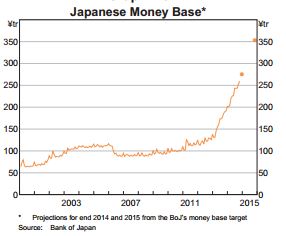
The RBA voiced concerns about recent monetary policy changes in Japan.
The RBA said, "There is a possibility the Australian dollar stays at a higher level than real economic fundamentals would imply because the recent announcements in Japan on monetary policy and pension-fund asset allocation increases the probability of capital flows seeking attractive yields in Australia."
Australia's currency remained strong even as commodity prices declined in response to better supply conditions and a slowing in Chinese energy demand growth.
About China
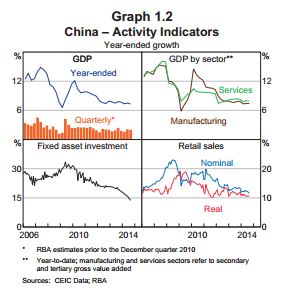
China’s rate of expansion has slowed from the 10%+ rates in years gone by to a more lukewarm 7.5% as estimated by the RBA - the slowest pace since 1990.
"If there was a very large and protracted decline in the Chinese property market, this would be likely to reduce demand for Australia's exports of bulk commodities and the prices received for them," the statement said.
Chinese GDP growth "is expected to trend gradually lower, one reason being that policy-makers may be willing to accept some
easing in growth in order to place financing on a sounder footing," said the RBA.
In a highly anticipated policy statement, The Reserve Bank of Australia (RBA) said that the current monetary policy is very accommodative because lower interest rates are supported by a recent decline in the Australian dollar.
According to the central bank, the Australian dollar is “above fundamental value given commodity price falls” – which could explain why the AUD/USD has fallen to lows below 0.86 for the first time since mid-2010.
Still, based on current indications, the RBA has repeated its guidance that the "most prudent course is likely to be a period of stability in interest rates."
"The very accommodative monetary-policy settings will continue to provide support to demand and help growth to strengthen in time," the RBA said in its quarterly ‘Statement of Monetary Policy’ published earlier today.
The Australian dollar may decline further owing to "the prospect of a rise in U.S. interest rates next year," said the RBA. Adding, “Such a depreciation will add somewhat to growth but will also lead to upward pressure on inflation though there is a possibility the net effect will be smaller if the fall in the Exchange rate is also accompanied by a larger-than-expected decline in commodity prices.”
In the latest statistical release in October, Australia added 24,100 jobs (vs. 20,300 expected) and the unemployment rate remains at 6.2% - a low level compared to other G20 countries.
According to the RBA, "Gross domestic product growth is still expected to be below trend until mid-2015." The bank has left its growth forecasts largely unchanged. The inflation forecast was revised, reflecting recent further depreciation in the Australian dollar. The overall outlook on inflation is unchanged and "consistent with the inflation target over the forecast period."
Inflation statistics for Q3 were significant. Headline inflation fell from the top of the RBA's target band down to 2.3% YoY – confirming inflation is not an issue in Australia. Furthermore, underlying inflation eased down to 2.5% YoY – below the RBA’s forecast issued in August.
About Japan
The RBA voiced concerns about recent monetary policy changes in Japan.
The RBA said, "There is a possibility the Australian dollar stays at a higher level than real economic fundamentals would imply because the recent announcements in Japan on monetary policy and pension-fund asset allocation increases the probability of capital flows seeking attractive yields in Australia."
Australia's currency remained strong even as commodity prices declined in response to better supply conditions and a slowing in Chinese energy demand growth.
About China
China’s rate of expansion has slowed from the 10%+ rates in years gone by to a more lukewarm 7.5% as estimated by the RBA - the slowest pace since 1990.
"If there was a very large and protracted decline in the Chinese property market, this would be likely to reduce demand for Australia's exports of bulk commodities and the prices received for them," the statement said.
Chinese GDP growth "is expected to trend gradually lower, one reason being that policy-makers may be willing to accept some
easing in growth in order to place financing on a sounder footing," said the RBA.
Italy’s Consob Tightens Net on AI-Fueled Scams With Fresh Website Bans
FP Markets Winner Spotlight 🏆 | Global Broker of the Year 2025 #Trading #Broker #Innovation #Shorts
FP Markets Winner Spotlight 🏆 | Global Broker of the Year 2025 #Trading #Broker #Innovation #Shorts
FP Markets takes the spotlight as Global Broker of the Year 2025 at the Finance Magnates Awards.
Martin Stoilov, Head of Client Experience, shares that trust, innovation, and people played a key role in the company’s success, supported by a strong foundation of integrity and client-centricity.
Following this milestone, FP Markets continues to focus on growth, technology investment, and its core values of transparency and excellence.
👉 Be part of FM Awards 2026: https://awards.financemagnates.com/#nominate
FP Markets takes the spotlight as Global Broker of the Year 2025 at the Finance Magnates Awards.
Martin Stoilov, Head of Client Experience, shares that trust, innovation, and people played a key role in the company’s success, supported by a strong foundation of integrity and client-centricity.
Following this milestone, FP Markets continues to focus on growth, technology investment, and its core values of transparency and excellence.
👉 Be part of FM Awards 2026: https://awards.financemagnates.com/#nominate
In this video, we review @HolaPrimeMarketsOfficial, a multi-asset forex and CFDs broker offering different account types, trading platforms, and flexible trading conditions.
We cover the broker’s overall offering, including account options, trading environment, platforms like MT4 and MT5, and additional services such as managed accounts and fast withdrawals.
Watch the full video to see if Hola Prime Markets fits your trading needs.
📣 Stay up to date with the latest in finance and trading. Follow Finance Magnates for industry news, insights, and global event coverage.
Connect with us:
🔗 LinkedIn: /financemagnates
👍 Facebook: /financemagnates
📸 Instagram: https://www.instagram.com/financemagnates
🐦 X: https://x.com/financemagnates
🎥 TikTok: https://www.tiktok.com/tag/financemagnates
▶️ YouTube: /@financemagnates_official
#HolaPrime #ForexBroker #CFDTrading #FinanceMagnates #Trading #Forex #BrokerReview
In this video, we review @HolaPrimeMarketsOfficial, a multi-asset forex and CFDs broker offering different account types, trading platforms, and flexible trading conditions.
We cover the broker’s overall offering, including account options, trading environment, platforms like MT4 and MT5, and additional services such as managed accounts and fast withdrawals.
Watch the full video to see if Hola Prime Markets fits your trading needs.
📣 Stay up to date with the latest in finance and trading. Follow Finance Magnates for industry news, insights, and global event coverage.
Connect with us:
🔗 LinkedIn: /financemagnates
👍 Facebook: /financemagnates
📸 Instagram: https://www.instagram.com/financemagnates
🐦 X: https://x.com/financemagnates
🎥 TikTok: https://www.tiktok.com/tag/financemagnates
▶️ YouTube: /@financemagnates_official
#HolaPrime #ForexBroker #CFDTrading #FinanceMagnates #Trading #Forex #BrokerReview
Hola Prime Review: What You Need to Know | Full Breakdown by Finance Magnates
Hola Prime Review: What You Need to Know | Full Breakdown by Finance Magnates
In this video, we review @HolaPrime_Global, a proprietary trading firm offering evaluation programs and performance-based payouts in simulated market environments.
We cover how the challenge model works, including account types, profit splits (up to 95%), trading rules, and what it takes to reach a funded account. You’ll also learn about available platforms like MT4, MT5, cTrader, and more, along with insights into payouts, support, and trading conditions.
Watch the full video to see if Hola Prime fits your trading style.
📣 Stay up to date with the latest in finance and trading. Follow Finance Magnates for industry news, insights, and global event coverage.
Connect with us:
🔗 LinkedIn: /financemagnates
👍 Facebook: /financemagnates
📸 Instagram: https://www.instagram.com/financemagnates
🐦 X: https://x.com/financemagnates
🎥 TikTok: https://www.tiktok.com/tag/financemagnates
▶️ YouTube: /@financemagnates_official
#HolaPrime #PropFirm #Trading #FinanceMagnates #Forex #FuturesTrading #TradingReview #PropFirmReview
In this video, we review @HolaPrime_Global, a proprietary trading firm offering evaluation programs and performance-based payouts in simulated market environments.
We cover how the challenge model works, including account types, profit splits (up to 95%), trading rules, and what it takes to reach a funded account. You’ll also learn about available platforms like MT4, MT5, cTrader, and more, along with insights into payouts, support, and trading conditions.
Watch the full video to see if Hola Prime fits your trading style.
📣 Stay up to date with the latest in finance and trading. Follow Finance Magnates for industry news, insights, and global event coverage.
Connect with us:
🔗 LinkedIn: /financemagnates
👍 Facebook: /financemagnates
📸 Instagram: https://www.instagram.com/financemagnates
🐦 X: https://x.com/financemagnates
🎥 TikTok: https://www.tiktok.com/tag/financemagnates
▶️ YouTube: /@financemagnates_official
#HolaPrime #PropFirm #Trading #FinanceMagnates #Forex #FuturesTrading #TradingReview #PropFirmReview
Axi Winner Spotlight 🏆 | Global Most Innovative Broker 2025 #Innovation #Trading #Fintech #Broker
Axi Winner Spotlight 🏆 | Global Most Innovative Broker 2025 #Innovation #Trading #Fintech #Broker
Axi takes the spotlight at the Finance Magnates Awards, winning Global Most Innovative Broker 2025.
Olivia Xenofontos and Ivanna Openko share how the team will feel: proud, motivated, and ready to keep delivering.
They also describe the night as well-organized, focused, and enjoyable for all.
👉 Be part of FM Awards 2026.
Axi takes the spotlight at the Finance Magnates Awards, winning Global Most Innovative Broker 2025.
Olivia Xenofontos and Ivanna Openko share how the team will feel: proud, motivated, and ready to keep delivering.
They also describe the night as well-organized, focused, and enjoyable for all.
👉 Be part of FM Awards 2026.
Recognition that matters.
Built on transparency.
Driven by the industry.
The Finance Magnates Awards 2026.
Nominations are now open.
🔗 https://awards.financemagnates.com/?utm_source=SM&utm_medium=social&utm_campaign=recognition-matters
Recognition that matters.
Built on transparency.
Driven by the industry.
The Finance Magnates Awards 2026.
Nominations are now open.
🔗 https://awards.financemagnates.com/?utm_source=SM&utm_medium=social&utm_campaign=recognition-matters