>
KVB Kunlun Shares Double up Via Inside Information Leak and Takeover Discussions
KVB Kunlun Shares Double up Via Inside Information Leak and Takeover Discussions
Wednesday,12/11/2014|06:04GMTby
George Tchetvertakov
In what seems like a case of leaked takeover information finding its way into the hands of speculators, KVB Kunlun shares have doubled despite being halted yesterday. With the dust still settling an enquiry is most likely afoot.
After suffering a trading halt on its shares yesterday, Hong Kong-based broker, KVB Kunlun, today revealed that there is a potential buyer in the marketplace looking to buy up all their shares. The company added that the takeover bid is undergoing negotiations and discussions with no guarantees over the striking of any deal.
Yesterday, KVB Kunlun shares listed in Hong Kong caught a stratospheric bid, rising 35% from HK$0.46 to HK$0.62 on unusually large volumes before HKEx called a trading halt pending further announcements.
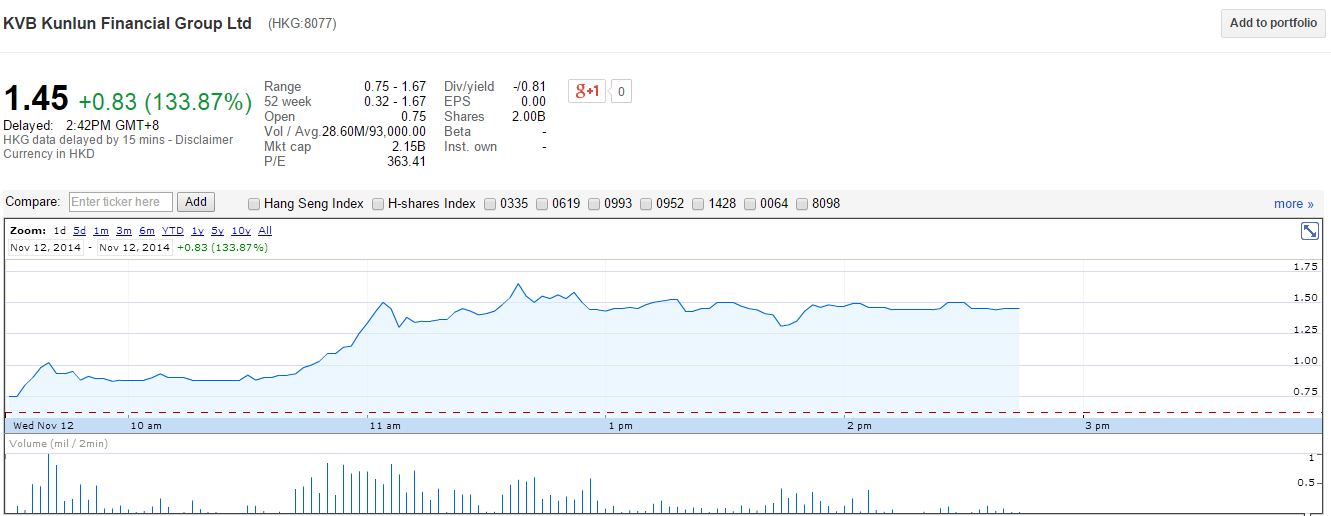
Last week, KVB shares were trading in tight range around $0.46. Yesterday's rampant buying interest helped shares rise to HK$0.62 before being halted. Trading in KVB shares resumed today (November 12) in the Asian trading session, opening at HK$0.75 and have been rising ever since. At the time of writing, shares were trading at HK$1.43 (having reached a high of $HK1.65 earlier) – more than 200% higher compared to last week.
Source: Google Finance
What Goes up Could Go Higher
On average, 10,000 – 50,000 KVB shares are traded on any given day. During the entire month of October, 1,710,000 shares were traded, however, over the course of yesterday, KVB Kunlun trading volume on HKEx reached 3,685,000 shares.
The KVB Kunlun Board has "noted the recent unusual movements in the Company’s share price and in the volume of share turnover. The Board is not aware of any specific reason that caused such movements."
In an official statement KVB it said: "For information, the Board has been acknowledged by the controlling shareholder of the Company, KVB Kunlun Holdings Limited, that it has been approached by an independent potential investor in relation to a possible acquisition of all or part of the 1,500 million Shares owned by the Controlling Shareholder. Discussions are at a preliminary stage without any definitive agreement in any form whatsoever and may or may not result in any transaction."
According to KVB, there are currently 2 billion issued shares and outstanding options to subscribe for 38,280,000 shares.
In a bid to douse speculator activity and allow for Plan B, KVB said, "There is no assurance that the discussions will result in any agreement between the Controlling Shareholder and the Potential Purchaser. However, if and when an agreement is reached, the Potential Purchaser may be required to make a mandatory offer for all issued Shares (other than those already owned or agreed to be acquired by the Potential Purchaser and parties acting in concert with it) in accordance with Rule 26.1 of the Takeovers Code."
It seems reasonable to assume that KVB's takeover is unconnected to the large share purchases, with the rise in share price coming as a rather unexpected surprise, which now means the potential suitor will likely pay more per share as a result. With a potential buyer now known to be interested and the current swirling speculation, right now is probably the worst time for a takeover.
At the start of the week KVB’s total market value was approximately HK$940 million (~$121 million), and at the time of writing, the company is worth HK$2.9 billion (~$374 million).
The statement goes on to say that broker-dealers (and their clients) are exempt from disclosure restrictions “as long as the value of dealings undertaken for a client during any 7 day period is less than $1 million."
In a veiled threat KVB Kunlun goes on the offensive by saying, “This dispensation does not alter the obligation of principals, associates and other persons themselves to initiate disclosure of their own dealings, whatever total value is involved."
Yesterday’s total trading activity amounted to approximately HK$1.8 million, which is possibly why KVB chose to reference the HK$1 million disclosure exemption.
Adding, “Intermediaries are expected to co-operate with the Executive in its dealings enquiries. Therefore, those who deal in relevant securities should appreciate that stockbrokers and other intermediaries will supply the Executive with relevant information as to those dealings, including identities of clients, as part of that co-operation.”
In other words, KVB is saying that small transactions that would have otherwise not been scrutinized, in this case, very large transactions will be. If information was leaked and used to purchase a large amount of shares, it will likely be found by whom and by extension, how that information could have possibly been shared.
Most likely an enquiry is already afoot.
After suffering a trading halt on its shares yesterday, Hong Kong-based broker, KVB Kunlun, today revealed that there is a potential buyer in the marketplace looking to buy up all their shares. The company added that the takeover bid is undergoing negotiations and discussions with no guarantees over the striking of any deal.
Yesterday, KVB Kunlun shares listed in Hong Kong caught a stratospheric bid, rising 35% from HK$0.46 to HK$0.62 on unusually large volumes before HKEx called a trading halt pending further announcements.
Last week, KVB shares were trading in tight range around $0.46. Yesterday's rampant buying interest helped shares rise to HK$0.62 before being halted. Trading in KVB shares resumed today (November 12) in the Asian trading session, opening at HK$0.75 and have been rising ever since. At the time of writing, shares were trading at HK$1.43 (having reached a high of $HK1.65 earlier) – more than 200% higher compared to last week.
Source: Google Finance
What Goes up Could Go Higher
On average, 10,000 – 50,000 KVB shares are traded on any given day. During the entire month of October, 1,710,000 shares were traded, however, over the course of yesterday, KVB Kunlun trading volume on HKEx reached 3,685,000 shares.
The KVB Kunlun Board has "noted the recent unusual movements in the Company’s share price and in the volume of share turnover. The Board is not aware of any specific reason that caused such movements."
In an official statement KVB it said: "For information, the Board has been acknowledged by the controlling shareholder of the Company, KVB Kunlun Holdings Limited, that it has been approached by an independent potential investor in relation to a possible acquisition of all or part of the 1,500 million Shares owned by the Controlling Shareholder. Discussions are at a preliminary stage without any definitive agreement in any form whatsoever and may or may not result in any transaction."
According to KVB, there are currently 2 billion issued shares and outstanding options to subscribe for 38,280,000 shares.
In a bid to douse speculator activity and allow for Plan B, KVB said, "There is no assurance that the discussions will result in any agreement between the Controlling Shareholder and the Potential Purchaser. However, if and when an agreement is reached, the Potential Purchaser may be required to make a mandatory offer for all issued Shares (other than those already owned or agreed to be acquired by the Potential Purchaser and parties acting in concert with it) in accordance with Rule 26.1 of the Takeovers Code."
It seems reasonable to assume that KVB's takeover is unconnected to the large share purchases, with the rise in share price coming as a rather unexpected surprise, which now means the potential suitor will likely pay more per share as a result. With a potential buyer now known to be interested and the current swirling speculation, right now is probably the worst time for a takeover.
At the start of the week KVB’s total market value was approximately HK$940 million (~$121 million), and at the time of writing, the company is worth HK$2.9 billion (~$374 million).
The statement goes on to say that broker-dealers (and their clients) are exempt from disclosure restrictions “as long as the value of dealings undertaken for a client during any 7 day period is less than $1 million."
In a veiled threat KVB Kunlun goes on the offensive by saying, “This dispensation does not alter the obligation of principals, associates and other persons themselves to initiate disclosure of their own dealings, whatever total value is involved."
Yesterday’s total trading activity amounted to approximately HK$1.8 million, which is possibly why KVB chose to reference the HK$1 million disclosure exemption.
Adding, “Intermediaries are expected to co-operate with the Executive in its dealings enquiries. Therefore, those who deal in relevant securities should appreciate that stockbrokers and other intermediaries will supply the Executive with relevant information as to those dealings, including identities of clients, as part of that co-operation.”
In other words, KVB is saying that small transactions that would have otherwise not been scrutinized, in this case, very large transactions will be. If information was leaked and used to purchase a large amount of shares, it will likely be found by whom and by extension, how that information could have possibly been shared.
London Stock Exchange Owner Says NVIDIA Chips Crunch Years of Trading Data in Seconds
Featured Videos
FxPro Sells EU Clients to Capital.com; NAGA H1 Profit Revised
FxPro Sells EU Clients to Capital.com; NAGA H1 Profit Revised
FxPro Sells EU Clients to Capital.com; NAGA H1 Profit Revised
FxPro Sells EU Clients to Capital.com; NAGA H1 Profit Revised
Today’s financial news recap covers FxPro agrees to sell its European client book to Capital.com, NAGA raises its first-half profit estimate, Trade Republic prepares a fee-free pension account, and Interactive Brokers introduces Ether staking.
Finance Magnates Daily Recap brings you the latest news from forex and CFD brokers, fintech, payments, cryptocurrency, digital assets, trading platforms, financial regulation and global markets.
Get the key company news, executive moves, deals, regulatory updates and market developments of the day, in just a few minutes. New episodes published every weekday.
Read more: https://www.financemagnates.com
#FinanceMagnates #ForexNews #FintechNews
Today’s financial news recap covers FxPro agrees to sell its European client book to Capital.com, NAGA raises its first-half profit estimate, Trade Republic prepares a fee-free pension account, and Interactive Brokers introduces Ether staking.
Finance Magnates Daily Recap brings you the latest news from forex and CFD brokers, fintech, payments, cryptocurrency, digital assets, trading platforms, financial regulation and global markets.
Get the key company news, executive moves, deals, regulatory updates and market developments of the day, in just a few minutes. New episodes published every weekday.
Read more: https://www.financemagnates.com
#FinanceMagnates #ForexNews #FintechNews
Today’s financial news recap covers FxPro agrees to sell its European client book to Capital.com, NAGA raises its first-half profit estimate, Trade Republic prepares a fee-free pension account, and Interactive Brokers introduces Ether staking.
Finance Magnates Daily Recap brings you the latest news from forex and CFD brokers, fintech, payments, cryptocurrency, digital assets, trading platforms, financial regulation and global markets.
Get the key company news, executive moves, deals, regulatory updates and market developments of the day, in just a few minutes. New episodes published every weekday.
Read more: https://www.financemagnates.com
#FinanceMagnates #ForexNews #FintechNews
Today’s financial news recap covers FxPro agrees to sell its European client book to Capital.com, NAGA raises its first-half profit estimate, Trade Republic prepares a fee-free pension account, and Interactive Brokers introduces Ether staking.
Finance Magnates Daily Recap brings you the latest news from forex and CFD brokers, fintech, payments, cryptocurrency, digital assets, trading platforms, financial regulation and global markets.
Get the key company news, executive moves, deals, regulatory updates and market developments of the day, in just a few minutes. New episodes published every weekday.
Read more: https://www.financemagnates.com
#FinanceMagnates #ForexNews #FintechNews
Plus500 Plans US Super-App; Investec to Offer IG Platform
Plus500 Plans US Super-App; Investec to Offer IG Platform
Plus500 Plans US Super-App; Investec to Offer IG Platform
Plus500 Plans US Super-App; Investec to Offer IG Platform
Plus500 Plans US Super-App; Investec to Offer IG Platform
Plus500 Plans US Super-App; Investec to Offer IG Platform
Today’s financial news recap covers Plus500 plans a US trading super-app, Investec partners with IG, Trade Republic reports a sevenfold profit jump, and BingX adds thousands of US stocks.
Finance Magnates Daily Recap brings you the latest news from forex and CFD brokers, fintech, payments, cryptocurrency, digital assets, trading platforms, financial regulation and global markets.
Get the key company news, executive moves, deals, regulatory updates and market developments of the day, in just a few minutes. New episodes published every weekday.
Read more: https://www.financemagnates.com
#FinanceMagnates #ForexNews #FintechNews
Today’s financial news recap covers Plus500 plans a US trading super-app, Investec partners with IG, Trade Republic reports a sevenfold profit jump, and BingX adds thousands of US stocks.
Finance Magnates Daily Recap brings you the latest news from forex and CFD brokers, fintech, payments, cryptocurrency, digital assets, trading platforms, financial regulation and global markets.
Get the key company news, executive moves, deals, regulatory updates and market developments of the day, in just a few minutes. New episodes published every weekday.
Read more: https://www.financemagnates.com
#FinanceMagnates #ForexNews #FintechNews
Today’s financial news recap covers Plus500 plans a US trading super-app, Investec partners with IG, Trade Republic reports a sevenfold profit jump, and BingX adds thousands of US stocks.
Finance Magnates Daily Recap brings you the latest news from forex and CFD brokers, fintech, payments, cryptocurrency, digital assets, trading platforms, financial regulation and global markets.
Get the key company news, executive moves, deals, regulatory updates and market developments of the day, in just a few minutes. New episodes published every weekday.
Read more: https://www.financemagnates.com
#FinanceMagnates #ForexNews #FintechNews
Today’s financial news recap covers Plus500 plans a US trading super-app, Investec partners with IG, Trade Republic reports a sevenfold profit jump, and BingX adds thousands of US stocks.
Finance Magnates Daily Recap brings you the latest news from forex and CFD brokers, fintech, payments, cryptocurrency, digital assets, trading platforms, financial regulation and global markets.
Get the key company news, executive moves, deals, regulatory updates and market developments of the day, in just a few minutes. New episodes published every weekday.
Read more: https://www.financemagnates.com
#FinanceMagnates #ForexNews #FintechNews
Today’s financial news recap covers Plus500 plans a US trading super-app, Investec partners with IG, Trade Republic reports a sevenfold profit jump, and BingX adds thousands of US stocks.
Finance Magnates Daily Recap brings you the latest news from forex and CFD brokers, fintech, payments, cryptocurrency, digital assets, trading platforms, financial regulation and global markets.
Get the key company news, executive moves, deals, regulatory updates and market developments of the day, in just a few minutes. New episodes published every weekday.
Read more: https://www.financemagnates.com
#FinanceMagnates #ForexNews #FintechNews
Today’s financial news recap covers Plus500 plans a US trading super-app, Investec partners with IG, Trade Republic reports a sevenfold profit jump, and BingX adds thousands of US stocks.
Finance Magnates Daily Recap brings you the latest news from forex and CFD brokers, fintech, payments, cryptocurrency, digital assets, trading platforms, financial regulation and global markets.
Get the key company news, executive moves, deals, regulatory updates and market developments of the day, in just a few minutes. New episodes published every weekday.
Read more: https://www.financemagnates.com
#FinanceMagnates #ForexNews #FintechNews
FXCM UK Holds $110m in Client Money; IG CEO Questions Prediction Market Volumes
FXCM UK Holds $110m in Client Money; IG CEO Questions Prediction Market Volumes
FXCM UK Holds $110m in Client Money; IG CEO Questions Prediction Market Volumes
FXCM UK Holds $110m in Client Money; IG CEO Questions Prediction Market Volumes
FXCM UK Holds $110m in Client Money; IG CEO Questions Prediction Market Volumes
FXCM UK Holds $110m in Client Money; IG CEO Questions Prediction Market Volumes
Today’s financial news recap covers FXCM's UK arm holds $110 million in client money ahead of its sale to Trade Nation, Citadel Securities' UK profit falls 38 per cent, and Kraken secures its final Dubai crypto licence.
Finance Magnates Daily Recap brings you the latest news from forex and CFD brokers, fintech, payments, cryptocurrency, digital assets, trading platforms, financial regulation and global markets.
Get the key company news, executive moves, deals, regulatory updates and market developments of the day, in just a few minutes. New episodes published every weekday.
Read more: https://www.financemagnates.com
#FinanceMagnates #ForexNews #FintechNews
Today’s financial news recap covers FXCM's UK arm holds $110 million in client money ahead of its sale to Trade Nation, Citadel Securities' UK profit falls 38 per cent, and Kraken secures its final Dubai crypto licence.
Finance Magnates Daily Recap brings you the latest news from forex and CFD brokers, fintech, payments, cryptocurrency, digital assets, trading platforms, financial regulation and global markets.
Get the key company news, executive moves, deals, regulatory updates and market developments of the day, in just a few minutes. New episodes published every weekday.
Read more: https://www.financemagnates.com
#FinanceMagnates #ForexNews #FintechNews
Today’s financial news recap covers FXCM's UK arm holds $110 million in client money ahead of its sale to Trade Nation, Citadel Securities' UK profit falls 38 per cent, and Kraken secures its final Dubai crypto licence.
Finance Magnates Daily Recap brings you the latest news from forex and CFD brokers, fintech, payments, cryptocurrency, digital assets, trading platforms, financial regulation and global markets.
Get the key company news, executive moves, deals, regulatory updates and market developments of the day, in just a few minutes. New episodes published every weekday.
Read more: https://www.financemagnates.com
#FinanceMagnates #ForexNews #FintechNews
Today’s financial news recap covers FXCM's UK arm holds $110 million in client money ahead of its sale to Trade Nation, Citadel Securities' UK profit falls 38 per cent, and Kraken secures its final Dubai crypto licence.
Finance Magnates Daily Recap brings you the latest news from forex and CFD brokers, fintech, payments, cryptocurrency, digital assets, trading platforms, financial regulation and global markets.
Get the key company news, executive moves, deals, regulatory updates and market developments of the day, in just a few minutes. New episodes published every weekday.
Read more: https://www.financemagnates.com
#FinanceMagnates #ForexNews #FintechNews
Today’s financial news recap covers FXCM's UK arm holds $110 million in client money ahead of its sale to Trade Nation, Citadel Securities' UK profit falls 38 per cent, and Kraken secures its final Dubai crypto licence.
Finance Magnates Daily Recap brings you the latest news from forex and CFD brokers, fintech, payments, cryptocurrency, digital assets, trading platforms, financial regulation and global markets.
Get the key company news, executive moves, deals, regulatory updates and market developments of the day, in just a few minutes. New episodes published every weekday.
Read more: https://www.financemagnates.com
#FinanceMagnates #ForexNews #FintechNews
Today’s financial news recap covers FXCM's UK arm holds $110 million in client money ahead of its sale to Trade Nation, Citadel Securities' UK profit falls 38 per cent, and Kraken secures its final Dubai crypto licence.
Finance Magnates Daily Recap brings you the latest news from forex and CFD brokers, fintech, payments, cryptocurrency, digital assets, trading platforms, financial regulation and global markets.
Get the key company news, executive moves, deals, regulatory updates and market developments of the day, in just a few minutes. New episodes published every weekday.
Read more: https://www.financemagnates.com
#FinanceMagnates #ForexNews #FintechNews
AvaTrade to Acquire Most of FXCM; NAGA Raises $8M
AvaTrade to Acquire Most of FXCM; NAGA Raises $8M
AvaTrade to Acquire Most of FXCM; NAGA Raises $8M
AvaTrade to Acquire Most of FXCM; NAGA Raises $8M
AvaTrade to Acquire Most of FXCM; NAGA Raises $8M
AvaTrade to Acquire Most of FXCM; NAGA Raises $8M
Today’s financial news recap covers AvaTrade agrees to acquire most of FXCM, NAGA secures eight million dollars in new financing, and Wise seeks a tax settlement in the UK.
Finance Magnates Daily Recap brings you the latest news from forex and CFD brokers, fintech, payments, cryptocurrency, digital assets, trading platforms, financial regulation and global markets.
Get the key company news, executive moves, deals, regulatory updates and market developments of the day, in just a few minutes. New episodes published every weekday.
Read more: https://www.financemagnates.com
#FinanceMagnates #ForexNews #FintechNews
Today’s financial news recap covers AvaTrade agrees to acquire most of FXCM, NAGA secures eight million dollars in new financing, and Wise seeks a tax settlement in the UK.
Finance Magnates Daily Recap brings you the latest news from forex and CFD brokers, fintech, payments, cryptocurrency, digital assets, trading platforms, financial regulation and global markets.
Get the key company news, executive moves, deals, regulatory updates and market developments of the day, in just a few minutes. New episodes published every weekday.
Read more: https://www.financemagnates.com
#FinanceMagnates #ForexNews #FintechNews
Today’s financial news recap covers AvaTrade agrees to acquire most of FXCM, NAGA secures eight million dollars in new financing, and Wise seeks a tax settlement in the UK.
Finance Magnates Daily Recap brings you the latest news from forex and CFD brokers, fintech, payments, cryptocurrency, digital assets, trading platforms, financial regulation and global markets.
Get the key company news, executive moves, deals, regulatory updates and market developments of the day, in just a few minutes. New episodes published every weekday.
Read more: https://www.financemagnates.com
#FinanceMagnates #ForexNews #FintechNews
Today’s financial news recap covers AvaTrade agrees to acquire most of FXCM, NAGA secures eight million dollars in new financing, and Wise seeks a tax settlement in the UK.
Finance Magnates Daily Recap brings you the latest news from forex and CFD brokers, fintech, payments, cryptocurrency, digital assets, trading platforms, financial regulation and global markets.
Get the key company news, executive moves, deals, regulatory updates and market developments of the day, in just a few minutes. New episodes published every weekday.
Read more: https://www.financemagnates.com
#FinanceMagnates #ForexNews #FintechNews
Today’s financial news recap covers AvaTrade agrees to acquire most of FXCM, NAGA secures eight million dollars in new financing, and Wise seeks a tax settlement in the UK.
Finance Magnates Daily Recap brings you the latest news from forex and CFD brokers, fintech, payments, cryptocurrency, digital assets, trading platforms, financial regulation and global markets.
Get the key company news, executive moves, deals, regulatory updates and market developments of the day, in just a few minutes. New episodes published every weekday.
Read more: https://www.financemagnates.com
#FinanceMagnates #ForexNews #FintechNews
Today’s financial news recap covers AvaTrade agrees to acquire most of FXCM, NAGA secures eight million dollars in new financing, and Wise seeks a tax settlement in the UK.
Finance Magnates Daily Recap brings you the latest news from forex and CFD brokers, fintech, payments, cryptocurrency, digital assets, trading platforms, financial regulation and global markets.
Get the key company news, executive moves, deals, regulatory updates and market developments of the day, in just a few minutes. New episodes published every weekday.
Read more: https://www.financemagnates.com
#FinanceMagnates #ForexNews #FintechNews
XTB Adds Overnight US Stock Trading; Nasdaq Ventures Invests in One Trading
XTB Adds Overnight US Stock Trading; Nasdaq Ventures Invests in One Trading
XTB Adds Overnight US Stock Trading; Nasdaq Ventures Invests in One Trading
XTB Adds Overnight US Stock Trading; Nasdaq Ventures Invests in One Trading
XTB Adds Overnight US Stock Trading; Nasdaq Ventures Invests in One Trading
XTB Adds Overnight US Stock Trading; Nasdaq Ventures Invests in One Trading
Today’s financial news recap covers XTB expands overnight US stock trading, Fortrade reports higher revenue, Nasdaq backs One Trading, and Vest Labs raises 13 million dollars.
Finance Magnates Daily Recap brings you the latest news from forex and CFD brokers, fintech, payments, cryptocurrency, digital assets, trading platforms, financial regulation and global markets.
Get the key company news, executive moves, deals, regulatory updates and market developments of the day, in just a few minutes. New episodes published every weekday.
Read more: https://www.financemagnates.com
#FinanceMagnates #ForexNews #FintechNews
Today’s financial news recap covers XTB expands overnight US stock trading, Fortrade reports higher revenue, Nasdaq backs One Trading, and Vest Labs raises 13 million dollars.
Finance Magnates Daily Recap brings you the latest news from forex and CFD brokers, fintech, payments, cryptocurrency, digital assets, trading platforms, financial regulation and global markets.
Get the key company news, executive moves, deals, regulatory updates and market developments of the day, in just a few minutes. New episodes published every weekday.
Read more: https://www.financemagnates.com
#FinanceMagnates #ForexNews #FintechNews
Today’s financial news recap covers XTB expands overnight US stock trading, Fortrade reports higher revenue, Nasdaq backs One Trading, and Vest Labs raises 13 million dollars.
Finance Magnates Daily Recap brings you the latest news from forex and CFD brokers, fintech, payments, cryptocurrency, digital assets, trading platforms, financial regulation and global markets.
Get the key company news, executive moves, deals, regulatory updates and market developments of the day, in just a few minutes. New episodes published every weekday.
Read more: https://www.financemagnates.com
#FinanceMagnates #ForexNews #FintechNews
Today’s financial news recap covers XTB expands overnight US stock trading, Fortrade reports higher revenue, Nasdaq backs One Trading, and Vest Labs raises 13 million dollars.
Finance Magnates Daily Recap brings you the latest news from forex and CFD brokers, fintech, payments, cryptocurrency, digital assets, trading platforms, financial regulation and global markets.
Get the key company news, executive moves, deals, regulatory updates and market developments of the day, in just a few minutes. New episodes published every weekday.
Read more: https://www.financemagnates.com
#FinanceMagnates #ForexNews #FintechNews
Today’s financial news recap covers XTB expands overnight US stock trading, Fortrade reports higher revenue, Nasdaq backs One Trading, and Vest Labs raises 13 million dollars.
Finance Magnates Daily Recap brings you the latest news from forex and CFD brokers, fintech, payments, cryptocurrency, digital assets, trading platforms, financial regulation and global markets.
Get the key company news, executive moves, deals, regulatory updates and market developments of the day, in just a few minutes. New episodes published every weekday.
Read more: https://www.financemagnates.com
#FinanceMagnates #ForexNews #FintechNews
Today’s financial news recap covers XTB expands overnight US stock trading, Fortrade reports higher revenue, Nasdaq backs One Trading, and Vest Labs raises 13 million dollars.
Finance Magnates Daily Recap brings you the latest news from forex and CFD brokers, fintech, payments, cryptocurrency, digital assets, trading platforms, financial regulation and global markets.
Get the key company news, executive moves, deals, regulatory updates and market developments of the day, in just a few minutes. New episodes published every weekday.
Read more: https://www.financemagnates.com
#FinanceMagnates #ForexNews #FintechNews