Hungary Weeds out Foreign Currency Mortgages as Forint Slide Raises Debt Servicing Costs
Monday,10/11/2014|13:12GMTby
George Tchetvertakov
Foreign currency loans that were so popular across Eastern Europe during the hay-making pre-GFC years, are now biting back as exchange rates have shifted disadvantageously for Hungarian property investors.
Foreign currency loans in Hungary are close to being phased out over the coming months, and existing loans will be converted to Hungarian forints at current exchange rates.
In an interview on national television, Minister of National Economy, Mihaly Varga said,“Foreign currency loans will be phased out by the end of 2015 if parliament approves two laws on fair banking and the conversion of these loans into forints this year." The day before, the ministry signed an agreement with the Hungarian Bank Association including terms for foreign exchange loan conversions.
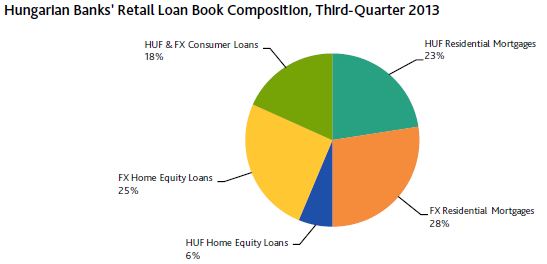
Prior to the recent developments, Hungarian property buyers often took out mortgages denominated in foreign currencies which frequently provided lower interest rates, but in parallel generated foreign exchange risk which was not a problem until the exchange rates began to fluctuate.
Most of the forex mortgages were denominated in Swiss francs, euros and yen and proved popular due to their comparatively cheaper repayment schedules. Mortgage Payments since have increased sharply due to the rise of the Swiss franc (euro and yen) against the forint, and many households have had difficulties meeting payments.
The Swiss franc appreciated 50% against the Hungarian forint between 2008 and 2012, while property prices slumped over 20% in the same period.
Source: Hungarian Central Bank
The new loan conversion agreement is estimated to affect 1.3 million households in a country with an estimated population of 10 million. The Hungarian government is also hopeful that the savings generated from its citizens will be used to boost domestic consumption.
Mihaly Varga, Hungarian Economy Minister
According to Hungary's Ministry for National Economy, under the agreement banks will convert the foreign currency mortgages at either the central bank’s prevailing exchange rate on November 7th, 2014, or according to the average of the central bank’s official daily exchange rates since June 16th, 2014. The official rates quoted by the Hungarian central bank to be used for mortgage conversion purposes are: CHF/HUF: 256.60, EUR/HUF: 308.87 and JPY/HUF: 2.1630.
In a video posted on the ministry’s website, Mr. Varga said: “Households could see a 25% to 30% drop in their monthly installments."
To finance the billions in loan conversions to be carried out by the Hungarian banks on behalf of investors/homeowners, the central bank will provide as much as €9 billion ($12 billion) in direct Liquidity from its foreign exchange reserves to “avoid an unwanted weakening of the Hungarian forint as a result of the conversion."
Despite the central bank tapping almost a third of Hungary’s ~ €30 billion forex reserves to facilitate the changes, its foreign exchange levels “remain adequate," according to the central bank. The bank also added that the conversion will reduce Hungary’s short-term external debt, and that the decline in the country’s foreign currency reserves will be gradual a gradual process that will take place over the next three years.
Foreign currency loans in Hungary are close to being phased out over the coming months, and existing loans will be converted to Hungarian forints at current exchange rates.
In an interview on national television, Minister of National Economy, Mihaly Varga said,“Foreign currency loans will be phased out by the end of 2015 if parliament approves two laws on fair banking and the conversion of these loans into forints this year." The day before, the ministry signed an agreement with the Hungarian Bank Association including terms for foreign exchange loan conversions.
Prior to the recent developments, Hungarian property buyers often took out mortgages denominated in foreign currencies which frequently provided lower interest rates, but in parallel generated foreign exchange risk which was not a problem until the exchange rates began to fluctuate.
Most of the forex mortgages were denominated in Swiss francs, euros and yen and proved popular due to their comparatively cheaper repayment schedules. Mortgage Payments since have increased sharply due to the rise of the Swiss franc (euro and yen) against the forint, and many households have had difficulties meeting payments.
The Swiss franc appreciated 50% against the Hungarian forint between 2008 and 2012, while property prices slumped over 20% in the same period.
Source: Hungarian Central Bank
The new loan conversion agreement is estimated to affect 1.3 million households in a country with an estimated population of 10 million. The Hungarian government is also hopeful that the savings generated from its citizens will be used to boost domestic consumption.
Mihaly Varga, Hungarian Economy Minister
According to Hungary's Ministry for National Economy, under the agreement banks will convert the foreign currency mortgages at either the central bank’s prevailing exchange rate on November 7th, 2014, or according to the average of the central bank’s official daily exchange rates since June 16th, 2014. The official rates quoted by the Hungarian central bank to be used for mortgage conversion purposes are: CHF/HUF: 256.60, EUR/HUF: 308.87 and JPY/HUF: 2.1630.
In a video posted on the ministry’s website, Mr. Varga said: “Households could see a 25% to 30% drop in their monthly installments."
To finance the billions in loan conversions to be carried out by the Hungarian banks on behalf of investors/homeowners, the central bank will provide as much as €9 billion ($12 billion) in direct Liquidity from its foreign exchange reserves to “avoid an unwanted weakening of the Hungarian forint as a result of the conversion."
Despite the central bank tapping almost a third of Hungary’s ~ €30 billion forex reserves to facilitate the changes, its foreign exchange levels “remain adequate," according to the central bank. The bank also added that the conversion will reduce Hungary’s short-term external debt, and that the decline in the country’s foreign currency reserves will be gradual a gradual process that will take place over the next three years.
Tradition Posts Record CHF 1.2 Billion Revenue as UAE Business Rises 55%
CMC Markets’ Artur Delijergijevs on Metals Demand, Volatility, & Stable Execution
CMC Markets’ Artur Delijergijevs on Metals Demand, Volatility, & Stable Execution
In this exclusive Executive Interview, Finance Magnates speaks with Artur Delijergijevs, Head of Systematic Market Making at CMC Markets, about the current state of metals demand and market volatility.
Delijergijevs offers a desk-level view on:
- Metals Demand: Why metals are seeing the strongest demand from both retail and institutional clients right now.
- The Safe-Haven Debate: Questioning whether gold still fits the classic safe-haven definition given large daily price movements.
- Volatile Market Prep: How a market-making desk prepares its systems and pricing for stressed market conditions and high-impact economic events.
- Hybrid Execution: Why the best execution model combines electronic speed with human relationship support, especially during volatility.
- AI in Workflow: Where CMC Markets is integrating machine learning for risk management and pricing, and the limitations of AI during stressed markets.
- Dubai's Role: The strategic importance of Dubai’s location for covering global trading sessions across Asia, Europe, and the US.
Watch to understand how CMC Markets maintains stable pricing and reliable execution quality in high-volatility environments.
#CMCmarkets #forex #metals #gold #trading #volatility #MarketMaking #iFXDubai #FinanceMagnates #Finance #Fintech #Execution #AlgorithmicTrading #RiskManagement
In this exclusive Executive Interview, Finance Magnates speaks with Artur Delijergijevs, Head of Systematic Market Making at CMC Markets, about the current state of metals demand and market volatility.
Delijergijevs offers a desk-level view on:
- Metals Demand: Why metals are seeing the strongest demand from both retail and institutional clients right now.
- The Safe-Haven Debate: Questioning whether gold still fits the classic safe-haven definition given large daily price movements.
- Volatile Market Prep: How a market-making desk prepares its systems and pricing for stressed market conditions and high-impact economic events.
- Hybrid Execution: Why the best execution model combines electronic speed with human relationship support, especially during volatility.
- AI in Workflow: Where CMC Markets is integrating machine learning for risk management and pricing, and the limitations of AI during stressed markets.
- Dubai's Role: The strategic importance of Dubai’s location for covering global trading sessions across Asia, Europe, and the US.
Watch to understand how CMC Markets maintains stable pricing and reliable execution quality in high-volatility environments.
#CMCmarkets #forex #metals #gold #trading #volatility #MarketMaking #iFXDubai #FinanceMagnates #Finance #Fintech #Execution #AlgorithmicTrading #RiskManagement
Finance Magnates Awards 2026 – Nominations Now Open
Finance Magnates Awards 2026 – Nominations Now Open
The Finance Magnates Awards 2026 nominations are now open. 🏆
From fintech innovators to leading brokers, this is where the finance industry celebrates its biggest achievements.
Winners will be announced at the Cyprus Gala Dinner on November 6, 2026.
Nominate your brand now.
https://awards.financemagnates.com/?utm_source=linkedin&utm_medium=video&utm_campaign=nominations-open
#FMAwards #FinanceMagnates #FintechAwards #Fintech #FinanceIndustry
The Finance Magnates Awards 2026 nominations are now open. 🏆
From fintech innovators to leading brokers, this is where the finance industry celebrates its biggest achievements.
Winners will be announced at the Cyprus Gala Dinner on November 6, 2026.
Nominate your brand now.
https://awards.financemagnates.com/?utm_source=linkedin&utm_medium=video&utm_campaign=nominations-open
#FMAwards #FinanceMagnates #FintechAwards #Fintech #FinanceIndustry
Finance Magnates Awards 2026 | Nominations Now Open 🏆#Fintech #FMAwards #TradingIndustry
Finance Magnates Awards 2026 | Nominations Now Open 🏆#Fintech #FMAwards #TradingIndustry
Lights on. Cameras ready. 🎬
Finance Magnates Awards 2026 nominations are now open. 🏆
#FMAwards #FinanceMagnates #FintechAwards #Fintech
Lights on. Cameras ready. 🎬
Finance Magnates Awards 2026 nominations are now open. 🏆
#FMAwards #FinanceMagnates #FintechAwards #Fintech
Exness sees trust as the key theme for growth in MENA Trading Growth for 2026
Exness sees trust as the key theme for growth in MENA Trading Growth for 2026
Mohammad Amer, Regional Commercial Director at Exness, sits down to discuss the booming MENA financial trading market. Find out why Dubai is key to the company's growth strategy, how a mobile-first generation is changing expectations, and why trust will be the defining theme for traders in 2026.
In this interview, you'll learn:
* Why Dubai and the MENA region are critical growth markets for fintech and online trading.
* How Exness is addressing the demands of mobile-first, younger traders through engineering, platform stability, and transparent conditions.
* The essential role local talent plays in providing a culturally relevant and compliant user experience.
* Mohammad Amer's outlook on the future of the online trading industry and why stronger controls and systems are necessary.
* Why "trust" isn't just a brand value, but has commercial value—and why he predicts 2026 will be the "Year of Trust."
Key Takeaways:
➡️ The MENA region is rapidly shaping global financial markets.
➡️ New traders expect stability, precise execution, and transparency.
➡️ Local expertise is key to regulatory compliance and user experience.
➡️ Future success belongs to firms capable of meeting rising standards across regulation and platform consistency.
Read the full article at: https://www.financemagnates.com/thought-leadership/exness-sees-trust-as-the-key-theme-for-growth-in-mena-trading-growth-for-2026/
#Exness #MENA #Trading #FinTech #Dubai #OnlineTrading #FinanceMagnates #MohammadAmer #Trust #MobileTrading
Mohammad Amer, Regional Commercial Director at Exness, sits down to discuss the booming MENA financial trading market. Find out why Dubai is key to the company's growth strategy, how a mobile-first generation is changing expectations, and why trust will be the defining theme for traders in 2026.
In this interview, you'll learn:
* Why Dubai and the MENA region are critical growth markets for fintech and online trading.
* How Exness is addressing the demands of mobile-first, younger traders through engineering, platform stability, and transparent conditions.
* The essential role local talent plays in providing a culturally relevant and compliant user experience.
* Mohammad Amer's outlook on the future of the online trading industry and why stronger controls and systems are necessary.
* Why "trust" isn't just a brand value, but has commercial value—and why he predicts 2026 will be the "Year of Trust."
Key Takeaways:
➡️ The MENA region is rapidly shaping global financial markets.
➡️ New traders expect stability, precise execution, and transparency.
➡️ Local expertise is key to regulatory compliance and user experience.
➡️ Future success belongs to firms capable of meeting rising standards across regulation and platform consistency.
Read the full article at: https://www.financemagnates.com/thought-leadership/exness-sees-trust-as-the-key-theme-for-growth-in-mena-trading-growth-for-2026/
#Exness #MENA #Trading #FinTech #Dubai #OnlineTrading #FinanceMagnates #MohammadAmer #Trust #MobileTrading
Paytiko CEO Razi Salih on Why Payment Orchestration is a MUST-HAVE for Brokers in 2026
Paytiko CEO Razi Salih on Why Payment Orchestration is a MUST-HAVE for Brokers in 2026
At iFX Expo Dubai, Finance Magnates spoke with Razi Salih, CEO at Paytiko, about the evolution of the payments ecosystem and why payment orchestration has shifted from an option to a necessity for brokers, prop firms, and exchanges.
Mr. Salih explains how global expansion, the need for deep localisation, and the sheer number of new payment methods, from instant banking to stablecoins, are driving this critical infrastructure shift.
#PaymentOrchestration #Fintech #Brokerage #TradingPayments #RaziSalih #Paytiko #iFXExpoDubai #Stablecoins #AIinFintech
At iFX Expo Dubai, Finance Magnates spoke with Razi Salih, CEO at Paytiko, about the evolution of the payments ecosystem and why payment orchestration has shifted from an option to a necessity for brokers, prop firms, and exchanges.
Mr. Salih explains how global expansion, the need for deep localisation, and the sheer number of new payment methods, from instant banking to stablecoins, are driving this critical infrastructure shift.
#PaymentOrchestration #Fintech #Brokerage #TradingPayments #RaziSalih #Paytiko #iFXExpoDubai #Stablecoins #AIinFintech