Global Renminbi Payments Are Growing Steadily as China Mulls Unrestrained Currency Liberalization
Friday,26/09/2014|11:56GMTby
George Tchetvertakov
SWIFT is reporting that 35% of businesses now use the Renminbi for international payments. Continuous growth in Renminbi use could eventually force China's hand in how it disentangles itself from currency management.
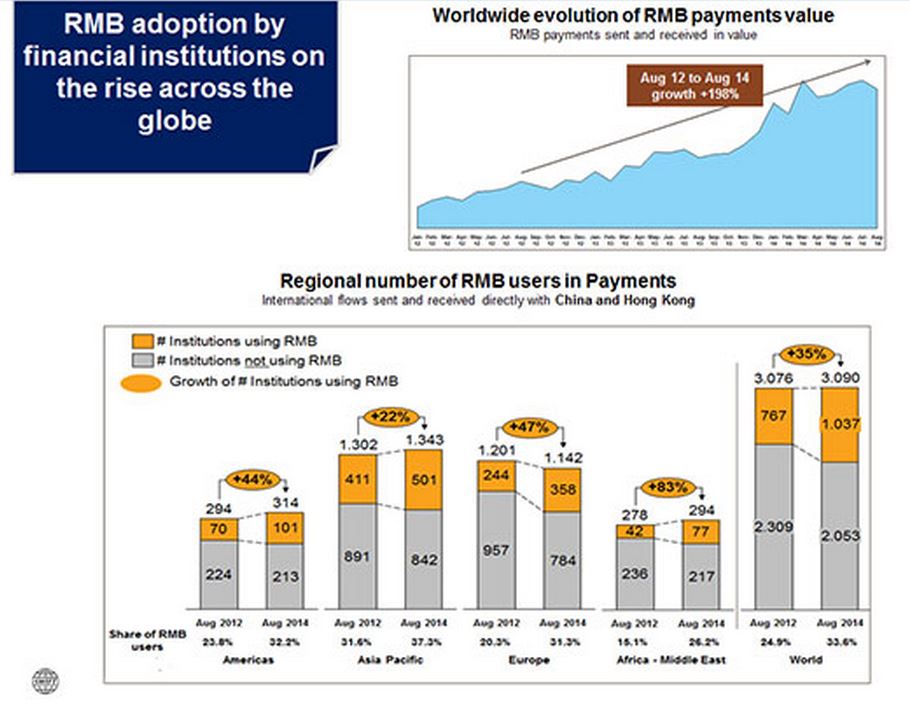
The Society for Worldwide Interbank Financial Telecommunication (SWIFT) is a co-operative facilitating global Payments between banking organizations, securities institutions and corporates in 212 countries. Earlier today, SWIFT announced that their own proprietary Renminbi (RMB) monitoring tool called ‘RMB Tracker,’ indicates a 198% increase in RMB payments worldwide since 2012.
The SWIFT RMB Tracker was launched in September 2011, with the aim of reporting monthly statistics of RMB flows in order to streamline the RMB's progress towards becoming a fully liberalized international currency, that if free-floating, without an artificial central bank support/weakness.
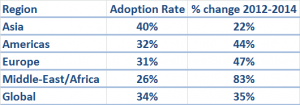
Broken down into geographical regions, SWIFT reports the following figures:
RMB adoption rates and 2012-2014 change split by region
SWIFT reports a 35% increase in the amount of institutions using the Chinese national currency for payments with China and Hong Kong. According to SWIFT, “More than one third of financial institutions around the world are now using the RMB."
Stephen Gilderdale, Head of New Business Development at SWIFT
In a statement, Stephen Gilderdale, Head of New Business Development at SWIFT said, “It is encouraging to see that RMB usage by financial institutions and corporates is steadily growing. More financial institutions using the RMB will improve the utility of the currency in Hong Kong, China and other offshore centres. As the currency continues to grow, opportunities will arise leading to the development of new products and services denominated in RMB."
The RMB now stands as the 7th ranked global payments currency, accounting for 1.64% of global payments, up from 1.57% in July. Slowly but surely does it.
RMB payments fell 6% in August 2014, which is “attributable to low seasonal payments activity,” according to SWIFT.
The Dragon Is Waking
China is the world’s 2nd largest economy as measured by gross domestic product (GDP), according to the most recent annual figures. China is also the world’s largest net exporter and 2nd largest net importer. Overall, China accounts for approximately 15% of total world trade. Other economic indicators such as foreign direct investment (FDI) are also mushrooming. China attracts over $100 billion in annual FDI flows from around the world and is currently the largest holder of FX reserves, with a total of USD$3.8 trillion, according to official annual figures for 2013.
The macro-statistics underline that foreign demand for RMB is growing and is likely to maintain that level of growth, as long as the Chinese economic juggernaut can maintain its multi-faceted progress. Property market bubbles and excessive price inflation on food in particular, are just two risks Chinese authorities are trying to mitigate in their bid to sustain blistering GDP growth when compared to the rest of the developed (and developing) world.
Over the not too distant future, it is expected that China will finally allow a full internationalization of the yuan and support its integration into the international monetary system alongside new Clearing and settlement infrastructures being integrated. The big question is, how long will the People's Bank of China (PBoC) and Chinese authorities wait?
The answer at this stage is unclear and is open to speculation. Economic developments and Chinese economic performance will almost certainly have interim effects and influence any schedule currently pencilled in by the PBoC.
More broadly speaking however, considering China's insatiable appetite for growth and development in all economic spheres - by the time the RMB free-floats, it may not be a case of getting the renimibi ready for the global money markets, but rather getting the global money markets ready for the renminbi.
The Society for Worldwide Interbank Financial Telecommunication (SWIFT) is a co-operative facilitating global Payments between banking organizations, securities institutions and corporates in 212 countries. Earlier today, SWIFT announced that their own proprietary Renminbi (RMB) monitoring tool called ‘RMB Tracker,’ indicates a 198% increase in RMB payments worldwide since 2012.
The SWIFT RMB Tracker was launched in September 2011, with the aim of reporting monthly statistics of RMB flows in order to streamline the RMB's progress towards becoming a fully liberalized international currency, that if free-floating, without an artificial central bank support/weakness.
Broken down into geographical regions, SWIFT reports the following figures:
RMB adoption rates and 2012-2014 change split by region
SWIFT reports a 35% increase in the amount of institutions using the Chinese national currency for payments with China and Hong Kong. According to SWIFT, “More than one third of financial institutions around the world are now using the RMB."
Stephen Gilderdale, Head of New Business Development at SWIFT
In a statement, Stephen Gilderdale, Head of New Business Development at SWIFT said, “It is encouraging to see that RMB usage by financial institutions and corporates is steadily growing. More financial institutions using the RMB will improve the utility of the currency in Hong Kong, China and other offshore centres. As the currency continues to grow, opportunities will arise leading to the development of new products and services denominated in RMB."
The RMB now stands as the 7th ranked global payments currency, accounting for 1.64% of global payments, up from 1.57% in July. Slowly but surely does it.
RMB payments fell 6% in August 2014, which is “attributable to low seasonal payments activity,” according to SWIFT.
The Dragon Is Waking
China is the world’s 2nd largest economy as measured by gross domestic product (GDP), according to the most recent annual figures. China is also the world’s largest net exporter and 2nd largest net importer. Overall, China accounts for approximately 15% of total world trade. Other economic indicators such as foreign direct investment (FDI) are also mushrooming. China attracts over $100 billion in annual FDI flows from around the world and is currently the largest holder of FX reserves, with a total of USD$3.8 trillion, according to official annual figures for 2013.
The macro-statistics underline that foreign demand for RMB is growing and is likely to maintain that level of growth, as long as the Chinese economic juggernaut can maintain its multi-faceted progress. Property market bubbles and excessive price inflation on food in particular, are just two risks Chinese authorities are trying to mitigate in their bid to sustain blistering GDP growth when compared to the rest of the developed (and developing) world.
Over the not too distant future, it is expected that China will finally allow a full internationalization of the yuan and support its integration into the international monetary system alongside new Clearing and settlement infrastructures being integrated. The big question is, how long will the People's Bank of China (PBoC) and Chinese authorities wait?
The answer at this stage is unclear and is open to speculation. Economic developments and Chinese economic performance will almost certainly have interim effects and influence any schedule currently pencilled in by the PBoC.
More broadly speaking however, considering China's insatiable appetite for growth and development in all economic spheres - by the time the RMB free-floats, it may not be a case of getting the renimibi ready for the global money markets, but rather getting the global money markets ready for the renminbi.
Italy’s Consob Tightens Net on AI-Fueled Scams With Fresh Website Bans
FP Markets Winner Spotlight 🏆 | Global Broker of the Year 2025 #Trading #Broker #Innovation #Shorts
FP Markets Winner Spotlight 🏆 | Global Broker of the Year 2025 #Trading #Broker #Innovation #Shorts
FP Markets takes the spotlight as Global Broker of the Year 2025 at the Finance Magnates Awards.
Martin Stoilov, Head of Client Experience, shares that trust, innovation, and people played a key role in the company’s success, supported by a strong foundation of integrity and client-centricity.
Following this milestone, FP Markets continues to focus on growth, technology investment, and its core values of transparency and excellence.
👉 Be part of FM Awards 2026: https://awards.financemagnates.com/#nominate
FP Markets takes the spotlight as Global Broker of the Year 2025 at the Finance Magnates Awards.
Martin Stoilov, Head of Client Experience, shares that trust, innovation, and people played a key role in the company’s success, supported by a strong foundation of integrity and client-centricity.
Following this milestone, FP Markets continues to focus on growth, technology investment, and its core values of transparency and excellence.
👉 Be part of FM Awards 2026: https://awards.financemagnates.com/#nominate
In this video, we review @HolaPrimeMarketsOfficial, a multi-asset forex and CFDs broker offering different account types, trading platforms, and flexible trading conditions.
We cover the broker’s overall offering, including account options, trading environment, platforms like MT4 and MT5, and additional services such as managed accounts and fast withdrawals.
Watch the full video to see if Hola Prime Markets fits your trading needs.
📣 Stay up to date with the latest in finance and trading. Follow Finance Magnates for industry news, insights, and global event coverage.
Connect with us:
🔗 LinkedIn: /financemagnates
👍 Facebook: /financemagnates
📸 Instagram: https://www.instagram.com/financemagnates
🐦 X: https://x.com/financemagnates
🎥 TikTok: https://www.tiktok.com/tag/financemagnates
▶️ YouTube: /@financemagnates_official
#HolaPrime #ForexBroker #CFDTrading #FinanceMagnates #Trading #Forex #BrokerReview
In this video, we review @HolaPrimeMarketsOfficial, a multi-asset forex and CFDs broker offering different account types, trading platforms, and flexible trading conditions.
We cover the broker’s overall offering, including account options, trading environment, platforms like MT4 and MT5, and additional services such as managed accounts and fast withdrawals.
Watch the full video to see if Hola Prime Markets fits your trading needs.
📣 Stay up to date with the latest in finance and trading. Follow Finance Magnates for industry news, insights, and global event coverage.
Connect with us:
🔗 LinkedIn: /financemagnates
👍 Facebook: /financemagnates
📸 Instagram: https://www.instagram.com/financemagnates
🐦 X: https://x.com/financemagnates
🎥 TikTok: https://www.tiktok.com/tag/financemagnates
▶️ YouTube: /@financemagnates_official
#HolaPrime #ForexBroker #CFDTrading #FinanceMagnates #Trading #Forex #BrokerReview
Hola Prime Review: What You Need to Know | Full Breakdown by Finance Magnates
Hola Prime Review: What You Need to Know | Full Breakdown by Finance Magnates
In this video, we review @HolaPrime_Global, a proprietary trading firm offering evaluation programs and performance-based payouts in simulated market environments.
We cover how the challenge model works, including account types, profit splits (up to 95%), trading rules, and what it takes to reach a funded account. You’ll also learn about available platforms like MT4, MT5, cTrader, and more, along with insights into payouts, support, and trading conditions.
Watch the full video to see if Hola Prime fits your trading style.
📣 Stay up to date with the latest in finance and trading. Follow Finance Magnates for industry news, insights, and global event coverage.
Connect with us:
🔗 LinkedIn: /financemagnates
👍 Facebook: /financemagnates
📸 Instagram: https://www.instagram.com/financemagnates
🐦 X: https://x.com/financemagnates
🎥 TikTok: https://www.tiktok.com/tag/financemagnates
▶️ YouTube: /@financemagnates_official
#HolaPrime #PropFirm #Trading #FinanceMagnates #Forex #FuturesTrading #TradingReview #PropFirmReview
In this video, we review @HolaPrime_Global, a proprietary trading firm offering evaluation programs and performance-based payouts in simulated market environments.
We cover how the challenge model works, including account types, profit splits (up to 95%), trading rules, and what it takes to reach a funded account. You’ll also learn about available platforms like MT4, MT5, cTrader, and more, along with insights into payouts, support, and trading conditions.
Watch the full video to see if Hola Prime fits your trading style.
📣 Stay up to date with the latest in finance and trading. Follow Finance Magnates for industry news, insights, and global event coverage.
Connect with us:
🔗 LinkedIn: /financemagnates
👍 Facebook: /financemagnates
📸 Instagram: https://www.instagram.com/financemagnates
🐦 X: https://x.com/financemagnates
🎥 TikTok: https://www.tiktok.com/tag/financemagnates
▶️ YouTube: /@financemagnates_official
#HolaPrime #PropFirm #Trading #FinanceMagnates #Forex #FuturesTrading #TradingReview #PropFirmReview
Axi Winner Spotlight 🏆 | Global Most Innovative Broker 2025 #Innovation #Trading #Fintech #Broker
Axi Winner Spotlight 🏆 | Global Most Innovative Broker 2025 #Innovation #Trading #Fintech #Broker
Axi takes the spotlight at the Finance Magnates Awards, winning Global Most Innovative Broker 2025.
Olivia Xenofontos and Ivanna Openko share how the team will feel: proud, motivated, and ready to keep delivering.
They also describe the night as well-organized, focused, and enjoyable for all.
👉 Be part of FM Awards 2026.
Axi takes the spotlight at the Finance Magnates Awards, winning Global Most Innovative Broker 2025.
Olivia Xenofontos and Ivanna Openko share how the team will feel: proud, motivated, and ready to keep delivering.
They also describe the night as well-organized, focused, and enjoyable for all.
👉 Be part of FM Awards 2026.
Recognition that matters.
Built on transparency.
Driven by the industry.
The Finance Magnates Awards 2026.
Nominations are now open.
🔗 https://awards.financemagnates.com/?utm_source=SM&utm_medium=social&utm_campaign=recognition-matters
Recognition that matters.
Built on transparency.
Driven by the industry.
The Finance Magnates Awards 2026.
Nominations are now open.
🔗 https://awards.financemagnates.com/?utm_source=SM&utm_medium=social&utm_campaign=recognition-matters