Wednesday,15/10/2014|06:19GMTby
George Tchetvertakov
Cumulatively, Japanese retail brokers report a 93% improvement in forex trading volumes in September with a 42% improvement YoY. Binary Options volumes suffered a 16% fall although existing and active accounts continued to rise.
The Financial Futures Association of Japan (FFAJ) has published its monthly update on FX and Binary Options volumes seen at retail Japanese brokerages listed with the association. The OTC FX monthly bulletin is accompanied by the personal OTC binary options bulletin showing that whereas Forex volumes have broadly increased amongst Japanese brokers in the month of September, binary options interest slowed.
The FFAJ lists 61 OTC retail FX margin trading operators with firms such as GMO Click, IG Securities, JFX and Waijei FX among the names although only 50 brokers report trading figures for collation.
The significant change in total FX trading volume from ¥195.7 trillion ($1.82 trillion) in August to ¥378 trillion ($3.53 trillion) in September represents a 93% month on month increase. Compared to September 2013, FX volumes rose 42% year-on-year. Open-interest in FX margin contracts decreased from 67,749 in August to 66,842 in September, a 1.3% fall.
Pick the Pair
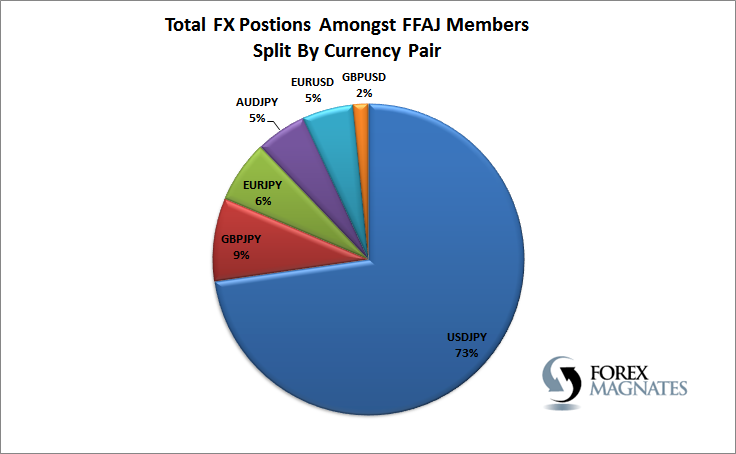
In terms of currency pair preference, the majority of traders at Japanese broking firms prefer to trade USD/JPY (73%) and GBP/JPY (9%) as prime favourites. Whereas European-based traders tend to focus on EUR/USD on average, in Japan only 5% of all trading volume was conducted between the Euro and the US dollar.
The cumulative figures published by the FFAJ predictably indicate that the raft of positive volumes reports from Japanese brokers since the end of September adds up to a superbly lucrative month for the Japanese Retail Trading industry.
Binary Options
The FFAJ also publishes statistics relating to OTC binary options products being offered by Japanese brokers. OTC Retail Binary Options figures do not include binary option transactions traded by corporates or institutional investors.
The 8 reporting members saw a 16% decline in binary options volume in September with ¥57.5 billion (~$536 million) being traded in September, down from ¥69 billion (~$633 million) in August.
The amount of existing binary accounts has grown by a modest 1% from 287,132 to 289,979 while a total of 614 new active accounts were opened in September - amongst the 7 trading members and 1 intermediate member of the JJAF (GMO Click Securities, Traders Securities, IG Securities, JFX, Planex Trade, YJ FX, Hirose FX and FX Trade Financial).
The Financial Futures Association of Japan (FFAJ) has published its monthly update on FX and Binary Options volumes seen at retail Japanese brokerages listed with the association. The OTC FX monthly bulletin is accompanied by the personal OTC binary options bulletin showing that whereas Forex volumes have broadly increased amongst Japanese brokers in the month of September, binary options interest slowed.
The FFAJ lists 61 OTC retail FX margin trading operators with firms such as GMO Click, IG Securities, JFX and Waijei FX among the names although only 50 brokers report trading figures for collation.
The significant change in total FX trading volume from ¥195.7 trillion ($1.82 trillion) in August to ¥378 trillion ($3.53 trillion) in September represents a 93% month on month increase. Compared to September 2013, FX volumes rose 42% year-on-year. Open-interest in FX margin contracts decreased from 67,749 in August to 66,842 in September, a 1.3% fall.
Pick the Pair
In terms of currency pair preference, the majority of traders at Japanese broking firms prefer to trade USD/JPY (73%) and GBP/JPY (9%) as prime favourites. Whereas European-based traders tend to focus on EUR/USD on average, in Japan only 5% of all trading volume was conducted between the Euro and the US dollar.
The cumulative figures published by the FFAJ predictably indicate that the raft of positive volumes reports from Japanese brokers since the end of September adds up to a superbly lucrative month for the Japanese Retail Trading industry.
Binary Options
The FFAJ also publishes statistics relating to OTC binary options products being offered by Japanese brokers. OTC Retail Binary Options figures do not include binary option transactions traded by corporates or institutional investors.
The 8 reporting members saw a 16% decline in binary options volume in September with ¥57.5 billion (~$536 million) being traded in September, down from ¥69 billion (~$633 million) in August.
The amount of existing binary accounts has grown by a modest 1% from 287,132 to 289,979 while a total of 614 new active accounts were opened in September - amongst the 7 trading members and 1 intermediate member of the JJAF (GMO Click Securities, Traders Securities, IG Securities, JFX, Planex Trade, YJ FX, Hirose FX and FX Trade Financial).
DXtrade Adds Automated Scalper Detection and A/B-Booking Tool via Gold-i Deal
CMC Markets’ Artur Delijergijevs on Metals Demand, Volatility, & Stable Execution
CMC Markets’ Artur Delijergijevs on Metals Demand, Volatility, & Stable Execution
In this exclusive Executive Interview, Finance Magnates speaks with Artur Delijergijevs, Head of Systematic Market Making at CMC Markets, about the current state of metals demand and market volatility.
Delijergijevs offers a desk-level view on:
- Metals Demand: Why metals are seeing the strongest demand from both retail and institutional clients right now.
- The Safe-Haven Debate: Questioning whether gold still fits the classic safe-haven definition given large daily price movements.
- Volatile Market Prep: How a market-making desk prepares its systems and pricing for stressed market conditions and high-impact economic events.
- Hybrid Execution: Why the best execution model combines electronic speed with human relationship support, especially during volatility.
- AI in Workflow: Where CMC Markets is integrating machine learning for risk management and pricing, and the limitations of AI during stressed markets.
- Dubai's Role: The strategic importance of Dubai’s location for covering global trading sessions across Asia, Europe, and the US.
Watch to understand how CMC Markets maintains stable pricing and reliable execution quality in high-volatility environments.
#CMCmarkets #forex #metals #gold #trading #volatility #MarketMaking #iFXDubai #FinanceMagnates #Finance #Fintech #Execution #AlgorithmicTrading #RiskManagement
In this exclusive Executive Interview, Finance Magnates speaks with Artur Delijergijevs, Head of Systematic Market Making at CMC Markets, about the current state of metals demand and market volatility.
Delijergijevs offers a desk-level view on:
- Metals Demand: Why metals are seeing the strongest demand from both retail and institutional clients right now.
- The Safe-Haven Debate: Questioning whether gold still fits the classic safe-haven definition given large daily price movements.
- Volatile Market Prep: How a market-making desk prepares its systems and pricing for stressed market conditions and high-impact economic events.
- Hybrid Execution: Why the best execution model combines electronic speed with human relationship support, especially during volatility.
- AI in Workflow: Where CMC Markets is integrating machine learning for risk management and pricing, and the limitations of AI during stressed markets.
- Dubai's Role: The strategic importance of Dubai’s location for covering global trading sessions across Asia, Europe, and the US.
Watch to understand how CMC Markets maintains stable pricing and reliable execution quality in high-volatility environments.
#CMCmarkets #forex #metals #gold #trading #volatility #MarketMaking #iFXDubai #FinanceMagnates #Finance #Fintech #Execution #AlgorithmicTrading #RiskManagement
Finance Magnates Awards 2026 – Nominations Now Open
Finance Magnates Awards 2026 – Nominations Now Open
The Finance Magnates Awards 2026 nominations are now open. 🏆
From fintech innovators to leading brokers, this is where the finance industry celebrates its biggest achievements.
Winners will be announced at the Cyprus Gala Dinner on November 6, 2026.
Nominate your brand now.
https://awards.financemagnates.com/?utm_source=linkedin&utm_medium=video&utm_campaign=nominations-open
#FMAwards #FinanceMagnates #FintechAwards #Fintech #FinanceIndustry
The Finance Magnates Awards 2026 nominations are now open. 🏆
From fintech innovators to leading brokers, this is where the finance industry celebrates its biggest achievements.
Winners will be announced at the Cyprus Gala Dinner on November 6, 2026.
Nominate your brand now.
https://awards.financemagnates.com/?utm_source=linkedin&utm_medium=video&utm_campaign=nominations-open
#FMAwards #FinanceMagnates #FintechAwards #Fintech #FinanceIndustry
Finance Magnates Awards 2026 | Nominations Now Open 🏆#Fintech #FMAwards #TradingIndustry
Finance Magnates Awards 2026 | Nominations Now Open 🏆#Fintech #FMAwards #TradingIndustry
Lights on. Cameras ready. 🎬
Finance Magnates Awards 2026 nominations are now open. 🏆
#FMAwards #FinanceMagnates #FintechAwards #Fintech
Lights on. Cameras ready. 🎬
Finance Magnates Awards 2026 nominations are now open. 🏆
#FMAwards #FinanceMagnates #FintechAwards #Fintech
Exness sees trust as the key theme for growth in MENA Trading Growth for 2026
Exness sees trust as the key theme for growth in MENA Trading Growth for 2026
Mohammad Amer, Regional Commercial Director at Exness, sits down to discuss the booming MENA financial trading market. Find out why Dubai is key to the company's growth strategy, how a mobile-first generation is changing expectations, and why trust will be the defining theme for traders in 2026.
In this interview, you'll learn:
* Why Dubai and the MENA region are critical growth markets for fintech and online trading.
* How Exness is addressing the demands of mobile-first, younger traders through engineering, platform stability, and transparent conditions.
* The essential role local talent plays in providing a culturally relevant and compliant user experience.
* Mohammad Amer's outlook on the future of the online trading industry and why stronger controls and systems are necessary.
* Why "trust" isn't just a brand value, but has commercial value—and why he predicts 2026 will be the "Year of Trust."
Key Takeaways:
➡️ The MENA region is rapidly shaping global financial markets.
➡️ New traders expect stability, precise execution, and transparency.
➡️ Local expertise is key to regulatory compliance and user experience.
➡️ Future success belongs to firms capable of meeting rising standards across regulation and platform consistency.
Read the full article at: https://www.financemagnates.com/thought-leadership/exness-sees-trust-as-the-key-theme-for-growth-in-mena-trading-growth-for-2026/
#Exness #MENA #Trading #FinTech #Dubai #OnlineTrading #FinanceMagnates #MohammadAmer #Trust #MobileTrading
Mohammad Amer, Regional Commercial Director at Exness, sits down to discuss the booming MENA financial trading market. Find out why Dubai is key to the company's growth strategy, how a mobile-first generation is changing expectations, and why trust will be the defining theme for traders in 2026.
In this interview, you'll learn:
* Why Dubai and the MENA region are critical growth markets for fintech and online trading.
* How Exness is addressing the demands of mobile-first, younger traders through engineering, platform stability, and transparent conditions.
* The essential role local talent plays in providing a culturally relevant and compliant user experience.
* Mohammad Amer's outlook on the future of the online trading industry and why stronger controls and systems are necessary.
* Why "trust" isn't just a brand value, but has commercial value—and why he predicts 2026 will be the "Year of Trust."
Key Takeaways:
➡️ The MENA region is rapidly shaping global financial markets.
➡️ New traders expect stability, precise execution, and transparency.
➡️ Local expertise is key to regulatory compliance and user experience.
➡️ Future success belongs to firms capable of meeting rising standards across regulation and platform consistency.
Read the full article at: https://www.financemagnates.com/thought-leadership/exness-sees-trust-as-the-key-theme-for-growth-in-mena-trading-growth-for-2026/
#Exness #MENA #Trading #FinTech #Dubai #OnlineTrading #FinanceMagnates #MohammadAmer #Trust #MobileTrading
Paytiko CEO Razi Salih on Why Payment Orchestration is a MUST-HAVE for Brokers in 2026
Paytiko CEO Razi Salih on Why Payment Orchestration is a MUST-HAVE for Brokers in 2026
At iFX Expo Dubai, Finance Magnates spoke with Razi Salih, CEO at Paytiko, about the evolution of the payments ecosystem and why payment orchestration has shifted from an option to a necessity for brokers, prop firms, and exchanges.
Mr. Salih explains how global expansion, the need for deep localisation, and the sheer number of new payment methods, from instant banking to stablecoins, are driving this critical infrastructure shift.
#PaymentOrchestration #Fintech #Brokerage #TradingPayments #RaziSalih #Paytiko #iFXExpoDubai #Stablecoins #AIinFintech
At iFX Expo Dubai, Finance Magnates spoke with Razi Salih, CEO at Paytiko, about the evolution of the payments ecosystem and why payment orchestration has shifted from an option to a necessity for brokers, prop firms, and exchanges.
Mr. Salih explains how global expansion, the need for deep localisation, and the sheer number of new payment methods, from instant banking to stablecoins, are driving this critical infrastructure shift.
#PaymentOrchestration #Fintech #Brokerage #TradingPayments #RaziSalih #Paytiko #iFXExpoDubai #Stablecoins #AIinFintech