Deutsche Bank Reports Mixed Bag of Quarterly Results: Spends Almost €900 Million on Litigation
Wednesday,29/10/2014|08:55GMTby
George Tchetvertakov
Deutsche Bank's Q3 results fall short of investor expectations partly due to mounting litigation expenses. Top banks want to ring-fence their exposure but regulatory penalizations continue to sprout in most asset classes.
Deutsche Bank, one of the world’s largest investment banks and an interbank leader in FX volumes, has just announced its quarterly financial figures covering the third quarter of 2014. Several European banks are reporting quarterly figures around this time – UBS did so just yesterday.
Deutsche’s financial results in the first three quarters of 2014 remain mixed despite a €92 million net loss in Q3. Group net revenues were €24.1 billion in the first nine months of 2014 (5 % lower year-on-year). Income before income taxes was €2.9 billion (11% lower year-on-year). Net income decreased to €1.2 billion in Q1-Q3, compared to €2.0 billion in the same period last year.
Interestingly, the bank cited "low interest rates, further litigation charges, decreasing market activity and rising regulatory costs" as the prime challenges facing the bank. Deutsche’s provisions for credit losses have fallen from €1,340 million to €765 million and litigation related charges were €894 million in Q3 2014, €270 million lower compared to Q3 2013.
Since 2012, the bank has spent in excess of €7 billion on fines and settlements related to a variety of flagrancies and improprieties. These include LIBOR manipulation, alleged FX manipulation, mis-selling of Mortgage Backed Securities (MBS) and breaching sanctions imposed by international agencies. Comments made by several top tier bank executives over the past 12 months seem to indicate a prolonged period of elevated litigation expenditure at several large financial institutions, such as Deutsche and UBS.
Admit but Mitigate
In the report, Deutsche Bank states: "Litigation expenses and regulatory settlements continued to be a considerable burden for global banks, with several individual banks’ settlements setting new records for corporate fines in the US." Adding, "Particularly for individual institutions in both regions [Europe & US], litigation costs remain an important tail risk." Deutsche's comments relating to expected future litigation echo comments made by UBS yesterday.
Jürgen Fitschen and Anshu Jain, Co-Chairmen of the Management Board (Co-CEOs), said: “In the third quarter we met several challenges. We took substantial litigation charges and saw reduced profits in investment banking, leading to a lower quarterly result."
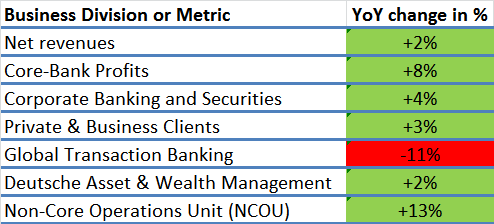
Results in the third quarter of 2014 reflect a solid performance despite the ongoing market challenges. Higher net revenues were reported across Corporate Banking & Securities (CB&S), Private & Business Clients (PBC) and Global Transaction Banking (GTB), partially offset by reduced net revenues from the Non-Core Operations Unit (NCOU). Revenues in Deutsche Asset & Wealth Management (Deutsche AWM) remained stable.
Higher revenues from increased client investment activity reflecting higher Volatility and a slight improvement in market conditions across all businesses in the third quarter were partially offset by lower portfolio revenues from NCOU reflecting further de-risking.
Deutsche's Debt Sales & Trading net revenues were €1.4 billion in Q3 2014, an increase of 15% (€186 million) year-on-year. Foreign Exchange revenues were "significantly higher driven by an improved market environment and higher client activity reflecting increased volatility."
At market close in New York on Tuesday, Deutsche Bank's shares closed at $32.48 per share but in early European trade this morning Deutsche's Frankfurt listed shares opened 2% lower due to the unexpected net quarterly loss, driven by "legacy" penalties.
In related news, late on Tuesday Deutsche announced a reshuffle among top management personnel by naming Marcus Schenck, former Finance Chief at energy group E.ON and Goldman Sachs banker, as Chief Financial Officer (CFO) and putting current CFO Stefan Krause in charge of operations and strategy.
Mr. Krause will take on responsibility for strategy alongside his CFO post on November 1st and Mr. Schenck will assume the CFO title on May 21st, 2015.
Deutsche Bank, one of the world’s largest investment banks and an interbank leader in FX volumes, has just announced its quarterly financial figures covering the third quarter of 2014. Several European banks are reporting quarterly figures around this time – UBS did so just yesterday.
Deutsche’s financial results in the first three quarters of 2014 remain mixed despite a €92 million net loss in Q3. Group net revenues were €24.1 billion in the first nine months of 2014 (5 % lower year-on-year). Income before income taxes was €2.9 billion (11% lower year-on-year). Net income decreased to €1.2 billion in Q1-Q3, compared to €2.0 billion in the same period last year.
Interestingly, the bank cited "low interest rates, further litigation charges, decreasing market activity and rising regulatory costs" as the prime challenges facing the bank. Deutsche’s provisions for credit losses have fallen from €1,340 million to €765 million and litigation related charges were €894 million in Q3 2014, €270 million lower compared to Q3 2013.
Since 2012, the bank has spent in excess of €7 billion on fines and settlements related to a variety of flagrancies and improprieties. These include LIBOR manipulation, alleged FX manipulation, mis-selling of Mortgage Backed Securities (MBS) and breaching sanctions imposed by international agencies. Comments made by several top tier bank executives over the past 12 months seem to indicate a prolonged period of elevated litigation expenditure at several large financial institutions, such as Deutsche and UBS.
Admit but Mitigate
In the report, Deutsche Bank states: "Litigation expenses and regulatory settlements continued to be a considerable burden for global banks, with several individual banks’ settlements setting new records for corporate fines in the US." Adding, "Particularly for individual institutions in both regions [Europe & US], litigation costs remain an important tail risk." Deutsche's comments relating to expected future litigation echo comments made by UBS yesterday.
Jürgen Fitschen and Anshu Jain, Co-Chairmen of the Management Board (Co-CEOs), said: “In the third quarter we met several challenges. We took substantial litigation charges and saw reduced profits in investment banking, leading to a lower quarterly result."
Results in the third quarter of 2014 reflect a solid performance despite the ongoing market challenges. Higher net revenues were reported across Corporate Banking & Securities (CB&S), Private & Business Clients (PBC) and Global Transaction Banking (GTB), partially offset by reduced net revenues from the Non-Core Operations Unit (NCOU). Revenues in Deutsche Asset & Wealth Management (Deutsche AWM) remained stable.
Higher revenues from increased client investment activity reflecting higher Volatility and a slight improvement in market conditions across all businesses in the third quarter were partially offset by lower portfolio revenues from NCOU reflecting further de-risking.
Deutsche's Debt Sales & Trading net revenues were €1.4 billion in Q3 2014, an increase of 15% (€186 million) year-on-year. Foreign Exchange revenues were "significantly higher driven by an improved market environment and higher client activity reflecting increased volatility."
At market close in New York on Tuesday, Deutsche Bank's shares closed at $32.48 per share but in early European trade this morning Deutsche's Frankfurt listed shares opened 2% lower due to the unexpected net quarterly loss, driven by "legacy" penalties.
In related news, late on Tuesday Deutsche announced a reshuffle among top management personnel by naming Marcus Schenck, former Finance Chief at energy group E.ON and Goldman Sachs banker, as Chief Financial Officer (CFO) and putting current CFO Stefan Krause in charge of operations and strategy.
Mr. Krause will take on responsibility for strategy alongside his CFO post on November 1st and Mr. Schenck will assume the CFO title on May 21st, 2015.
42% of Swiss Financial Firms Have No Digital Fraud Policy, FINMA Finds
FP Markets Winner Spotlight 🏆 | Global Broker of the Year 2025 #Trading #Broker #Innovation #Shorts
FP Markets Winner Spotlight 🏆 | Global Broker of the Year 2025 #Trading #Broker #Innovation #Shorts
FP Markets takes the spotlight as Global Broker of the Year 2025 at the Finance Magnates Awards.
Martin Stoilov, Head of Client Experience, shares that trust, innovation, and people played a key role in the company’s success, supported by a strong foundation of integrity and client-centricity.
Following this milestone, FP Markets continues to focus on growth, technology investment, and its core values of transparency and excellence.
👉 Be part of FM Awards 2026: https://awards.financemagnates.com/#nominate
FP Markets takes the spotlight as Global Broker of the Year 2025 at the Finance Magnates Awards.
Martin Stoilov, Head of Client Experience, shares that trust, innovation, and people played a key role in the company’s success, supported by a strong foundation of integrity and client-centricity.
Following this milestone, FP Markets continues to focus on growth, technology investment, and its core values of transparency and excellence.
👉 Be part of FM Awards 2026: https://awards.financemagnates.com/#nominate
In this video, we review @HolaPrimeMarketsOfficial, a multi-asset forex and CFDs broker offering different account types, trading platforms, and flexible trading conditions.
We cover the broker’s overall offering, including account options, trading environment, platforms like MT4 and MT5, and additional services such as managed accounts and fast withdrawals.
Watch the full video to see if Hola Prime Markets fits your trading needs.
📣 Stay up to date with the latest in finance and trading. Follow Finance Magnates for industry news, insights, and global event coverage.
Connect with us:
🔗 LinkedIn: /financemagnates
👍 Facebook: /financemagnates
📸 Instagram: https://www.instagram.com/financemagnates
🐦 X: https://x.com/financemagnates
🎥 TikTok: https://www.tiktok.com/tag/financemagnates
▶️ YouTube: /@financemagnates_official
#HolaPrime #ForexBroker #CFDTrading #FinanceMagnates #Trading #Forex #BrokerReview
In this video, we review @HolaPrimeMarketsOfficial, a multi-asset forex and CFDs broker offering different account types, trading platforms, and flexible trading conditions.
We cover the broker’s overall offering, including account options, trading environment, platforms like MT4 and MT5, and additional services such as managed accounts and fast withdrawals.
Watch the full video to see if Hola Prime Markets fits your trading needs.
📣 Stay up to date with the latest in finance and trading. Follow Finance Magnates for industry news, insights, and global event coverage.
Connect with us:
🔗 LinkedIn: /financemagnates
👍 Facebook: /financemagnates
📸 Instagram: https://www.instagram.com/financemagnates
🐦 X: https://x.com/financemagnates
🎥 TikTok: https://www.tiktok.com/tag/financemagnates
▶️ YouTube: /@financemagnates_official
#HolaPrime #ForexBroker #CFDTrading #FinanceMagnates #Trading #Forex #BrokerReview
Hola Prime Review: What You Need to Know | Full Breakdown by Finance Magnates
Hola Prime Review: What You Need to Know | Full Breakdown by Finance Magnates
In this video, we review @HolaPrime_Global, a proprietary trading firm offering evaluation programs and performance-based payouts in simulated market environments.
We cover how the challenge model works, including account types, profit splits (up to 95%), trading rules, and what it takes to reach a funded account. You’ll also learn about available platforms like MT4, MT5, cTrader, and more, along with insights into payouts, support, and trading conditions.
Watch the full video to see if Hola Prime fits your trading style.
📣 Stay up to date with the latest in finance and trading. Follow Finance Magnates for industry news, insights, and global event coverage.
Connect with us:
🔗 LinkedIn: /financemagnates
👍 Facebook: /financemagnates
📸 Instagram: https://www.instagram.com/financemagnates
🐦 X: https://x.com/financemagnates
🎥 TikTok: https://www.tiktok.com/tag/financemagnates
▶️ YouTube: /@financemagnates_official
#HolaPrime #PropFirm #Trading #FinanceMagnates #Forex #FuturesTrading #TradingReview #PropFirmReview
In this video, we review @HolaPrime_Global, a proprietary trading firm offering evaluation programs and performance-based payouts in simulated market environments.
We cover how the challenge model works, including account types, profit splits (up to 95%), trading rules, and what it takes to reach a funded account. You’ll also learn about available platforms like MT4, MT5, cTrader, and more, along with insights into payouts, support, and trading conditions.
Watch the full video to see if Hola Prime fits your trading style.
📣 Stay up to date with the latest in finance and trading. Follow Finance Magnates for industry news, insights, and global event coverage.
Connect with us:
🔗 LinkedIn: /financemagnates
👍 Facebook: /financemagnates
📸 Instagram: https://www.instagram.com/financemagnates
🐦 X: https://x.com/financemagnates
🎥 TikTok: https://www.tiktok.com/tag/financemagnates
▶️ YouTube: /@financemagnates_official
#HolaPrime #PropFirm #Trading #FinanceMagnates #Forex #FuturesTrading #TradingReview #PropFirmReview
Axi Winner Spotlight 🏆 | Global Most Innovative Broker 2025 #Innovation #Trading #Fintech #Broker
Axi Winner Spotlight 🏆 | Global Most Innovative Broker 2025 #Innovation #Trading #Fintech #Broker
Axi takes the spotlight at the Finance Magnates Awards, winning Global Most Innovative Broker 2025.
Olivia Xenofontos and Ivanna Openko share how the team will feel: proud, motivated, and ready to keep delivering.
They also describe the night as well-organized, focused, and enjoyable for all.
👉 Be part of FM Awards 2026.
Axi takes the spotlight at the Finance Magnates Awards, winning Global Most Innovative Broker 2025.
Olivia Xenofontos and Ivanna Openko share how the team will feel: proud, motivated, and ready to keep delivering.
They also describe the night as well-organized, focused, and enjoyable for all.
👉 Be part of FM Awards 2026.
Recognition that matters.
Built on transparency.
Driven by the industry.
The Finance Magnates Awards 2026.
Nominations are now open.
🔗 https://awards.financemagnates.com/?utm_source=SM&utm_medium=social&utm_campaign=recognition-matters
Recognition that matters.
Built on transparency.
Driven by the industry.
The Finance Magnates Awards 2026.
Nominations are now open.
🔗 https://awards.financemagnates.com/?utm_source=SM&utm_medium=social&utm_campaign=recognition-matters