Bank of Japan Shakes Its Money Tree: Raises Annual Monetary Base to $718 Billion
Friday,31/10/2014|08:25GMTby
George Tchetvertakov
The Bank of Japan takes the unprecedented step of including equity and real-estate assets as part of its stimulus programme. With the monetary base expected to rise and keep rising year-on-year, the outlook for Yen pairs is bleak.
The Bank of Japan (BoJ) has announced an unexpected extension of its monetary policy in the form of more asset purchases, as well as expanding the scope of what assets the central bank intends to acquire in addition to existing JGB purchases. In a slight quirk to the standard terminology of Quantitative Easing (QE), the BoJ references its stimulus measures as Quantitative and Qualitative Easing (QQE).
In a narrow 5 to 4 vote, BoJ Policy Board members opted to increase the annual pace of growth in Japan‘s monetary base by ¥10-20 trillion up to at least ¥80 trillion (~$718 billion). The BoJ also announced it will include Exchange Traded Funds (ETFs) and Japanese Real Estate Investment Trusts (J-REITs) when composing the basket of assets to be purchased from market participants.
The move to include ETFs and J-REITs requires the BoJ to seek authorization from the Minister of Finance and the Commissioner of the Financial Services Agency. Forex Magnates' research suggests that this aspect is merely a formality as the policy has already been agreed upon by BoJ and Ministry of Finance (MoF) officials.
A Slippery Slope
In one of the biggest surprises for investors was the BoJ’s decision to include ETFs and J-REITs. For the first time in the global QE arena a central bank has officially embarked on purchasing stocks or equity market linked asset classes. Supporting economies via QE is becoming more intensive and less effective - it is not a huge surprise that stocks have been targeted, given Japan’s troubles with deflation with memories of the 1990-2000 ‘Lost Decade’ still fresh among the Japanese.
The Size of Quantitative Easing Does Not Matter - Its What You Do with It That Counts
The move intends to widen the scope of BoJ QE activity in the hope of stimulating economic activity in a broader fashion. The only potential issue is that QE policies tend to have a diminishing effect on interest rates and their expectations, i.e. it takes increasing amounts of Liquidity to have the same suppressive effect on bond yields. Japan will have to reload and fire larger calibre bullets (and more often) if Japanese policy makers expect to meet their 2% inflation target and 1.5% growth targets over the next 18 months.
The underlying purpose for the BoJ’s machine gunner monetary policy is to “encourage a decline in interest rates across the entire yield curve." Historic lessons relating to investor confidence and central bank credibility being core influences on interest rate expectations has seemingly escaped the bank’s attention.
According to the BoJ, “The average remaining maturity of the Bank’s JGB purchases will be extended by a maximum of 3 years to about 7-10 years." Central bank liquidity is suppressing short-term bond yields but the counter-effect is that existing funding shortages are factored out into the long-term via debt rebalancing and duration extension. Kicking the can down the road or alternatively, building extensions to the road.
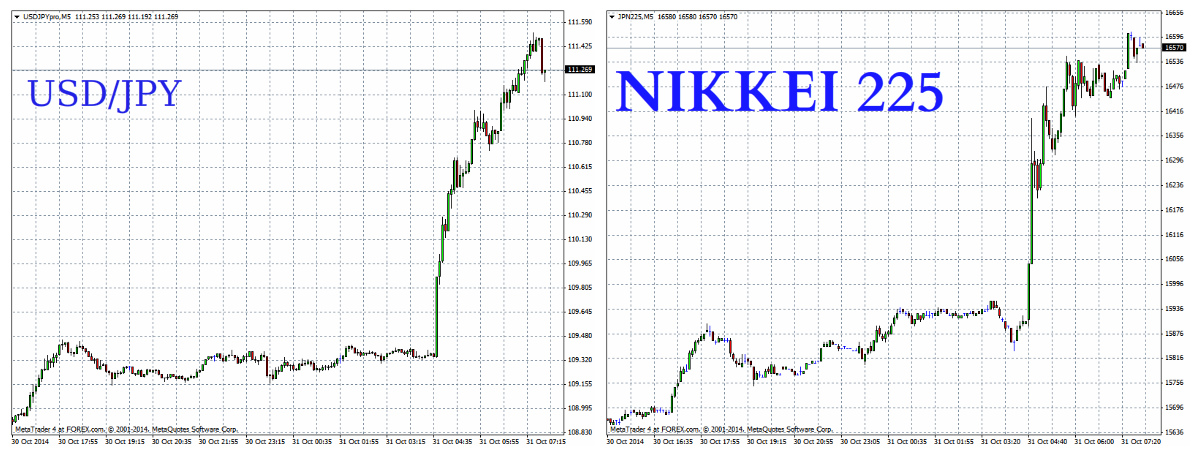
The dovish picture had a hugely negative effect on all JPY currency pairs and boosted the Nikkei 225 to new highs above 15,560. Against the US dollar, the yen depreciated from 109.30 to 111.80 while against the euro the yen depreciated by over 200 pips from 137.80 to 140.00.
With Japan's monetary base being inflated with increasingly larger doses of air, it is compounding the upward effect on USD/JPY as the Fed reigns in stimulus measures and prepares to embark on a rate tightening cycle next year.
Two Peas in a Pod: USD/JPY and Nikkei Correlation Strong as Ever Following the BoJ Meeting
The Bigger Picture
The BoJ’s assessment of the broader economy is that it is “continuing moderate recovery and is expected to continue growing at a pace above its potential."
Optimism is abundant on the growth story, but in terms of inflation the BoJ is a lot more pragmatic, “On the price front, somewhat weak developments in demand following the consumption tax hike and a substantial decline in crude oil prices have been exerting downward pressure recently." In an official statement, the central bank put strong emphasis on oil prices in particular by referencing the inflationary impact of lower oil prices several times.
The BoJ says it is concerned about the “risk that conversion of deflationary mind-set might be delayed.” Clearly a reference to the root goal for the BoJ – expunging the deflationary mind-set from Japanese consumers and market participants who have become accustomed to waiting for lower consumer prices rather than consuming.
The BoJ has quite a mission on the psychological front because Japan is historically and culturally predisposed to higher savings rates and a perceivably higher aversion to risk compared to other developed countries.
The Bank of Japan (BoJ) has announced an unexpected extension of its monetary policy in the form of more asset purchases, as well as expanding the scope of what assets the central bank intends to acquire in addition to existing JGB purchases. In a slight quirk to the standard terminology of Quantitative Easing (QE), the BoJ references its stimulus measures as Quantitative and Qualitative Easing (QQE).
In a narrow 5 to 4 vote, BoJ Policy Board members opted to increase the annual pace of growth in Japan‘s monetary base by ¥10-20 trillion up to at least ¥80 trillion (~$718 billion). The BoJ also announced it will include Exchange Traded Funds (ETFs) and Japanese Real Estate Investment Trusts (J-REITs) when composing the basket of assets to be purchased from market participants.
The move to include ETFs and J-REITs requires the BoJ to seek authorization from the Minister of Finance and the Commissioner of the Financial Services Agency. Forex Magnates' research suggests that this aspect is merely a formality as the policy has already been agreed upon by BoJ and Ministry of Finance (MoF) officials.
A Slippery Slope
In one of the biggest surprises for investors was the BoJ’s decision to include ETFs and J-REITs. For the first time in the global QE arena a central bank has officially embarked on purchasing stocks or equity market linked asset classes. Supporting economies via QE is becoming more intensive and less effective - it is not a huge surprise that stocks have been targeted, given Japan’s troubles with deflation with memories of the 1990-2000 ‘Lost Decade’ still fresh among the Japanese.
The Size of Quantitative Easing Does Not Matter - Its What You Do with It That Counts
The move intends to widen the scope of BoJ QE activity in the hope of stimulating economic activity in a broader fashion. The only potential issue is that QE policies tend to have a diminishing effect on interest rates and their expectations, i.e. it takes increasing amounts of Liquidity to have the same suppressive effect on bond yields. Japan will have to reload and fire larger calibre bullets (and more often) if Japanese policy makers expect to meet their 2% inflation target and 1.5% growth targets over the next 18 months.
The underlying purpose for the BoJ’s machine gunner monetary policy is to “encourage a decline in interest rates across the entire yield curve." Historic lessons relating to investor confidence and central bank credibility being core influences on interest rate expectations has seemingly escaped the bank’s attention.
According to the BoJ, “The average remaining maturity of the Bank’s JGB purchases will be extended by a maximum of 3 years to about 7-10 years." Central bank liquidity is suppressing short-term bond yields but the counter-effect is that existing funding shortages are factored out into the long-term via debt rebalancing and duration extension. Kicking the can down the road or alternatively, building extensions to the road.
The dovish picture had a hugely negative effect on all JPY currency pairs and boosted the Nikkei 225 to new highs above 15,560. Against the US dollar, the yen depreciated from 109.30 to 111.80 while against the euro the yen depreciated by over 200 pips from 137.80 to 140.00.
With Japan's monetary base being inflated with increasingly larger doses of air, it is compounding the upward effect on USD/JPY as the Fed reigns in stimulus measures and prepares to embark on a rate tightening cycle next year.
Two Peas in a Pod: USD/JPY and Nikkei Correlation Strong as Ever Following the BoJ Meeting
The Bigger Picture
The BoJ’s assessment of the broader economy is that it is “continuing moderate recovery and is expected to continue growing at a pace above its potential."
Optimism is abundant on the growth story, but in terms of inflation the BoJ is a lot more pragmatic, “On the price front, somewhat weak developments in demand following the consumption tax hike and a substantial decline in crude oil prices have been exerting downward pressure recently." In an official statement, the central bank put strong emphasis on oil prices in particular by referencing the inflationary impact of lower oil prices several times.
The BoJ says it is concerned about the “risk that conversion of deflationary mind-set might be delayed.” Clearly a reference to the root goal for the BoJ – expunging the deflationary mind-set from Japanese consumers and market participants who have become accustomed to waiting for lower consumer prices rather than consuming.
The BoJ has quite a mission on the psychological front because Japan is historically and culturally predisposed to higher savings rates and a perceivably higher aversion to risk compared to other developed countries.
Italy’s Consob Tightens Net on AI-Fueled Scams With Fresh Website Bans
FP Markets Winner Spotlight 🏆 | Global Broker of the Year 2025 #Trading #Broker #Innovation #Shorts
FP Markets Winner Spotlight 🏆 | Global Broker of the Year 2025 #Trading #Broker #Innovation #Shorts
FP Markets takes the spotlight as Global Broker of the Year 2025 at the Finance Magnates Awards.
Martin Stoilov, Head of Client Experience, shares that trust, innovation, and people played a key role in the company’s success, supported by a strong foundation of integrity and client-centricity.
Following this milestone, FP Markets continues to focus on growth, technology investment, and its core values of transparency and excellence.
👉 Be part of FM Awards 2026: https://awards.financemagnates.com/#nominate
FP Markets takes the spotlight as Global Broker of the Year 2025 at the Finance Magnates Awards.
Martin Stoilov, Head of Client Experience, shares that trust, innovation, and people played a key role in the company’s success, supported by a strong foundation of integrity and client-centricity.
Following this milestone, FP Markets continues to focus on growth, technology investment, and its core values of transparency and excellence.
👉 Be part of FM Awards 2026: https://awards.financemagnates.com/#nominate
In this video, we review @HolaPrimeMarketsOfficial, a multi-asset forex and CFDs broker offering different account types, trading platforms, and flexible trading conditions.
We cover the broker’s overall offering, including account options, trading environment, platforms like MT4 and MT5, and additional services such as managed accounts and fast withdrawals.
Watch the full video to see if Hola Prime Markets fits your trading needs.
📣 Stay up to date with the latest in finance and trading. Follow Finance Magnates for industry news, insights, and global event coverage.
Connect with us:
🔗 LinkedIn: /financemagnates
👍 Facebook: /financemagnates
📸 Instagram: https://www.instagram.com/financemagnates
🐦 X: https://x.com/financemagnates
🎥 TikTok: https://www.tiktok.com/tag/financemagnates
▶️ YouTube: /@financemagnates_official
#HolaPrime #ForexBroker #CFDTrading #FinanceMagnates #Trading #Forex #BrokerReview
In this video, we review @HolaPrimeMarketsOfficial, a multi-asset forex and CFDs broker offering different account types, trading platforms, and flexible trading conditions.
We cover the broker’s overall offering, including account options, trading environment, platforms like MT4 and MT5, and additional services such as managed accounts and fast withdrawals.
Watch the full video to see if Hola Prime Markets fits your trading needs.
📣 Stay up to date with the latest in finance and trading. Follow Finance Magnates for industry news, insights, and global event coverage.
Connect with us:
🔗 LinkedIn: /financemagnates
👍 Facebook: /financemagnates
📸 Instagram: https://www.instagram.com/financemagnates
🐦 X: https://x.com/financemagnates
🎥 TikTok: https://www.tiktok.com/tag/financemagnates
▶️ YouTube: /@financemagnates_official
#HolaPrime #ForexBroker #CFDTrading #FinanceMagnates #Trading #Forex #BrokerReview
Hola Prime Review: What You Need to Know | Full Breakdown by Finance Magnates
Hola Prime Review: What You Need to Know | Full Breakdown by Finance Magnates
In this video, we review @HolaPrime_Global, a proprietary trading firm offering evaluation programs and performance-based payouts in simulated market environments.
We cover how the challenge model works, including account types, profit splits (up to 95%), trading rules, and what it takes to reach a funded account. You’ll also learn about available platforms like MT4, MT5, cTrader, and more, along with insights into payouts, support, and trading conditions.
Watch the full video to see if Hola Prime fits your trading style.
📣 Stay up to date with the latest in finance and trading. Follow Finance Magnates for industry news, insights, and global event coverage.
Connect with us:
🔗 LinkedIn: /financemagnates
👍 Facebook: /financemagnates
📸 Instagram: https://www.instagram.com/financemagnates
🐦 X: https://x.com/financemagnates
🎥 TikTok: https://www.tiktok.com/tag/financemagnates
▶️ YouTube: /@financemagnates_official
#HolaPrime #PropFirm #Trading #FinanceMagnates #Forex #FuturesTrading #TradingReview #PropFirmReview
In this video, we review @HolaPrime_Global, a proprietary trading firm offering evaluation programs and performance-based payouts in simulated market environments.
We cover how the challenge model works, including account types, profit splits (up to 95%), trading rules, and what it takes to reach a funded account. You’ll also learn about available platforms like MT4, MT5, cTrader, and more, along with insights into payouts, support, and trading conditions.
Watch the full video to see if Hola Prime fits your trading style.
📣 Stay up to date with the latest in finance and trading. Follow Finance Magnates for industry news, insights, and global event coverage.
Connect with us:
🔗 LinkedIn: /financemagnates
👍 Facebook: /financemagnates
📸 Instagram: https://www.instagram.com/financemagnates
🐦 X: https://x.com/financemagnates
🎥 TikTok: https://www.tiktok.com/tag/financemagnates
▶️ YouTube: /@financemagnates_official
#HolaPrime #PropFirm #Trading #FinanceMagnates #Forex #FuturesTrading #TradingReview #PropFirmReview
Axi Winner Spotlight 🏆 | Global Most Innovative Broker 2025 #Innovation #Trading #Fintech #Broker
Axi Winner Spotlight 🏆 | Global Most Innovative Broker 2025 #Innovation #Trading #Fintech #Broker
Axi takes the spotlight at the Finance Magnates Awards, winning Global Most Innovative Broker 2025.
Olivia Xenofontos and Ivanna Openko share how the team will feel: proud, motivated, and ready to keep delivering.
They also describe the night as well-organized, focused, and enjoyable for all.
👉 Be part of FM Awards 2026.
Axi takes the spotlight at the Finance Magnates Awards, winning Global Most Innovative Broker 2025.
Olivia Xenofontos and Ivanna Openko share how the team will feel: proud, motivated, and ready to keep delivering.
They also describe the night as well-organized, focused, and enjoyable for all.
👉 Be part of FM Awards 2026.
Recognition that matters.
Built on transparency.
Driven by the industry.
The Finance Magnates Awards 2026.
Nominations are now open.
🔗 https://awards.financemagnates.com/?utm_source=SM&utm_medium=social&utm_campaign=recognition-matters
Recognition that matters.
Built on transparency.
Driven by the industry.
The Finance Magnates Awards 2026.
Nominations are now open.
🔗 https://awards.financemagnates.com/?utm_source=SM&utm_medium=social&utm_campaign=recognition-matters