Analysis: Australian Binary Options Industry Looking for Quality Rather than Quantity
Wednesday,24/09/2014|23:45GMTby
George Tchetvertakov
Binary Options are gaining popularity, clients and criticism in equal measure. Forex Magnates provides a snapshot of the growing industry in Australia, outlining its major players and regulatory challenges.
Binary options burst onto the financial scene around the same time as the global financial crisis was wreaking havoc on all asset classes in 2008.
Binaries allow traders to speculate on the outcome of markets in a much more simplified way compared to traditional trading. The added simplicity combined with inflated returns and fueled by ultra-volatile markets set the scene for binary options to claim a sizable chunk of the retail trading industry, albeit under a cloud of controversy.
Australia's national regulator, The Australian Securities and Investments Commission (ASIC), alongside many others from Europe and North America are finding elements of regulatory arbitrage and malpractice in the mushrooming field of binary providers. Retail clients have been attracted by the ‘gaming’ nature of binary options which do not require a high level of technical knowledge or sophistication, yet provide instant market access akin to traditional trading.
Trial by Regulation
Due to their novelty, non-exchange binary options are not regulated directly by any regulatory agency. Regulators see the product differently depending on the region. The Cyprus Securities and Exchange Commission (CySEC) was the first EU MiFID member regulator to treat binary options as financial instruments in 2012.
In the US, binary options fall under the jurisdiction of the U.S. Commodity Futures Trading Commission (CFTC) that only regulates listed binary options such as Forex, commodities and equity index binary options listed on the North American Derivatives Exchange (Nadex). In the UK and Australia, both the Financial Conduct Authority (FCA) and ASIC do not regulate binary options directly, although any firm offering financial services must have a regulatory license to operate legally.
Some binary options are listed on registered exchanges that are subject to oversight by regulators but this is only a portion (and diminishing) of the total binary options market. The majority of binary options providers offer their services exclusively online through trading platforms that do not necessarily comply with applicable regulatory requirements.
The number of binary brokers has surged in recent years across the globe with Cyprus becoming a prime location for many new binary startups, although the amount of platforms has not, i.e. brokers are operating under white-label agreements. The increase in the number of brokers has resulted in an increase in the number of complaints aimed at binary platforms and their operators. This is hardly surprising, because in a similar fashion to the FX market, operators can enter the market with minimal regulatory oversight, limited startup capital and next to nothing staff, as this is provided as part of the white-label agreement. In such lax conditions, impropriety has flourished.
The CFTC and SEC have received numerous complaints of fraud associated with binary options. The complaints fall into several categories including: refusal to reimburse funds to customers; identity theft; and manipulation of software to generate losing trades. However, the malpractice is assumed to only occur at unregulated venues that are not subject to regulatory oversight and are not required to keep funds segregated in trust accounts.
In the Land down Under
According to Forex Magnates' research, the binary options market in Australia only has a handful of regulated brokers with offices based in the country.
Probably the largest provider by volume and market capitalization is IG Markets, a UK-based company with sizable operations in Australia. The other notable regulated entities are MXT Global, (formerly known as Enfinium/Vantage FX), HighLow (operated by Realtime Capital Markets) and PowerOption (AVA Capital Markets). All offer a similar range of traded binary options including FX, commodities and equities.
Forex Magnates' research and analysis suggest that the larger firms that tend to obtain regulatory approval before offering binary options, are currently seeing double-digit percentage growth in both live active accounts and volume traded, month-on-month. A similar trend is prevailing among unregulated providers as well, which suggests new clients do not discriminate between providers based on the presence of regulatory approval. This is despite hundreds of cases of customer complaints and regulatory action assisted by public relations campaigns to raise awareness among current and future binary options customers.
It is worth noting that all regulated Australian binary option brokers already have existing operations in FX/CFD markets and have started offering binary options as an extension of their current ASIC license. If a broker already has an ASIC license to offer margin FX trading services, they are able to offer binary options as well.
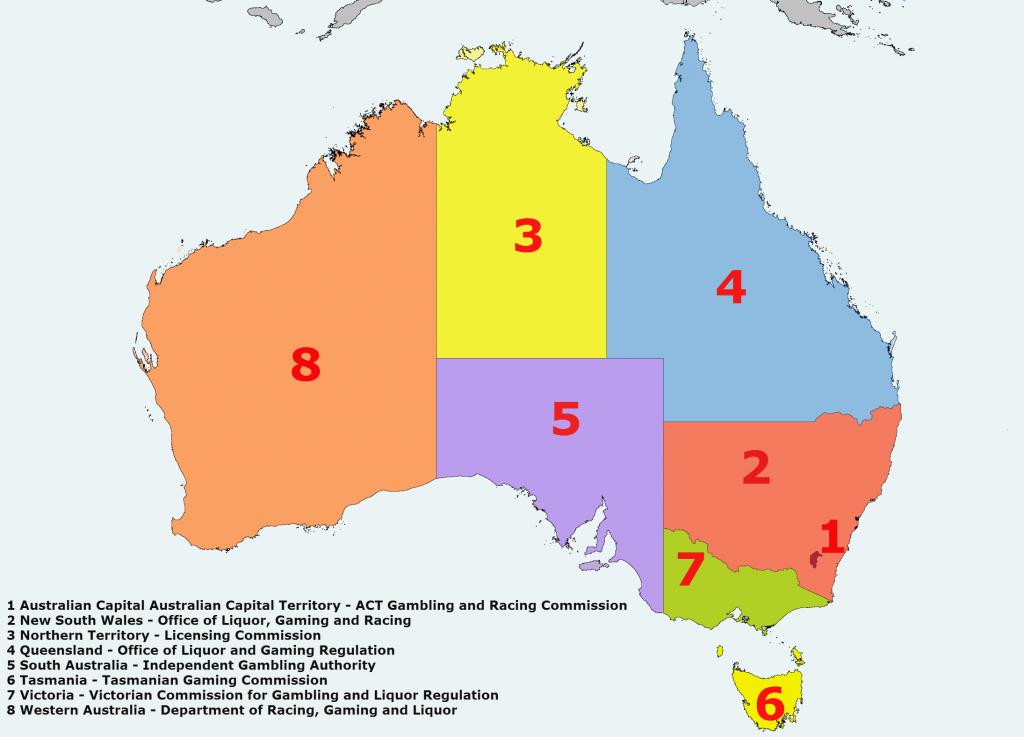
The big issue ASIC (and other regulators) have with binary options is that they are not a traditional asset class. They are essentially a betting game on the outcome of an event. The payout structure is also unlike any other financial asset. If a binary option expires ‘out-of-the-money’ the client loses 100% of his investment, but if the client’s option expires ‘in-the-money’, the client can expect to earn around 80% or less. A negative cumulative payout is achieved and the broker can expect to ‘beat’ the client the more the client plays. This has led to calls from across the financial services industry for binary options to be classified as ‘gaming’ platforms in a similar vein to sports betting. In this case, all regulatory oversight falls under the jurisdiction of the applicable Gaming Commission. In Australia, each of the country’s eight states has a separate gaming commission:
Map of Australia Showing All States and Associated Gaming Commissions
There’s very little ASIC can do to stop jackpot hunting retail traders from participating in binary options trading. Clients can open accounts outside of Australia in regions such as New Zealand or Cyprus but forego all regulatory protection. Given that most binary option buyers are retail clients on the hungrier side of the risk appetite scale, it's highly likely that unregulated brokers from across the world will continue to tap the Australian market because of the tendency of retail clients to overlook stability in favor of profit potential. Oftentimes, retail clients are not even aware from which country their binary broker is operating from.
Financial regulators oversee finance and trading while gaming commissions oversee gambling and betting. Now that a financial instrument overlaps both sectors, the regulatory tangle couldn't get any messier.
Binary options burst onto the financial scene around the same time as the global financial crisis was wreaking havoc on all asset classes in 2008.
Binaries allow traders to speculate on the outcome of markets in a much more simplified way compared to traditional trading. The added simplicity combined with inflated returns and fueled by ultra-volatile markets set the scene for binary options to claim a sizable chunk of the retail trading industry, albeit under a cloud of controversy.
Australia's national regulator, The Australian Securities and Investments Commission (ASIC), alongside many others from Europe and North America are finding elements of regulatory arbitrage and malpractice in the mushrooming field of binary providers. Retail clients have been attracted by the ‘gaming’ nature of binary options which do not require a high level of technical knowledge or sophistication, yet provide instant market access akin to traditional trading.
Trial by Regulation
Due to their novelty, non-exchange binary options are not regulated directly by any regulatory agency. Regulators see the product differently depending on the region. The Cyprus Securities and Exchange Commission (CySEC) was the first EU MiFID member regulator to treat binary options as financial instruments in 2012.
In the US, binary options fall under the jurisdiction of the U.S. Commodity Futures Trading Commission (CFTC) that only regulates listed binary options such as Forex, commodities and equity index binary options listed on the North American Derivatives Exchange (Nadex). In the UK and Australia, both the Financial Conduct Authority (FCA) and ASIC do not regulate binary options directly, although any firm offering financial services must have a regulatory license to operate legally.
Some binary options are listed on registered exchanges that are subject to oversight by regulators but this is only a portion (and diminishing) of the total binary options market. The majority of binary options providers offer their services exclusively online through trading platforms that do not necessarily comply with applicable regulatory requirements.
The number of binary brokers has surged in recent years across the globe with Cyprus becoming a prime location for many new binary startups, although the amount of platforms has not, i.e. brokers are operating under white-label agreements. The increase in the number of brokers has resulted in an increase in the number of complaints aimed at binary platforms and their operators. This is hardly surprising, because in a similar fashion to the FX market, operators can enter the market with minimal regulatory oversight, limited startup capital and next to nothing staff, as this is provided as part of the white-label agreement. In such lax conditions, impropriety has flourished.
The CFTC and SEC have received numerous complaints of fraud associated with binary options. The complaints fall into several categories including: refusal to reimburse funds to customers; identity theft; and manipulation of software to generate losing trades. However, the malpractice is assumed to only occur at unregulated venues that are not subject to regulatory oversight and are not required to keep funds segregated in trust accounts.
In the Land down Under
According to Forex Magnates' research, the binary options market in Australia only has a handful of regulated brokers with offices based in the country.
Probably the largest provider by volume and market capitalization is IG Markets, a UK-based company with sizable operations in Australia. The other notable regulated entities are MXT Global, (formerly known as Enfinium/Vantage FX), HighLow (operated by Realtime Capital Markets) and PowerOption (AVA Capital Markets). All offer a similar range of traded binary options including FX, commodities and equities.
Forex Magnates' research and analysis suggest that the larger firms that tend to obtain regulatory approval before offering binary options, are currently seeing double-digit percentage growth in both live active accounts and volume traded, month-on-month. A similar trend is prevailing among unregulated providers as well, which suggests new clients do not discriminate between providers based on the presence of regulatory approval. This is despite hundreds of cases of customer complaints and regulatory action assisted by public relations campaigns to raise awareness among current and future binary options customers.
It is worth noting that all regulated Australian binary option brokers already have existing operations in FX/CFD markets and have started offering binary options as an extension of their current ASIC license. If a broker already has an ASIC license to offer margin FX trading services, they are able to offer binary options as well.
The big issue ASIC (and other regulators) have with binary options is that they are not a traditional asset class. They are essentially a betting game on the outcome of an event. The payout structure is also unlike any other financial asset. If a binary option expires ‘out-of-the-money’ the client loses 100% of his investment, but if the client’s option expires ‘in-the-money’, the client can expect to earn around 80% or less. A negative cumulative payout is achieved and the broker can expect to ‘beat’ the client the more the client plays. This has led to calls from across the financial services industry for binary options to be classified as ‘gaming’ platforms in a similar vein to sports betting. In this case, all regulatory oversight falls under the jurisdiction of the applicable Gaming Commission. In Australia, each of the country’s eight states has a separate gaming commission:
Map of Australia Showing All States and Associated Gaming Commissions
There’s very little ASIC can do to stop jackpot hunting retail traders from participating in binary options trading. Clients can open accounts outside of Australia in regions such as New Zealand or Cyprus but forego all regulatory protection. Given that most binary option buyers are retail clients on the hungrier side of the risk appetite scale, it's highly likely that unregulated brokers from across the world will continue to tap the Australian market because of the tendency of retail clients to overlook stability in favor of profit potential. Oftentimes, retail clients are not even aware from which country their binary broker is operating from.
Financial regulators oversee finance and trading while gaming commissions oversee gambling and betting. Now that a financial instrument overlaps both sectors, the regulatory tangle couldn't get any messier.
90% Adoption: How AI Is Reshaping French Investment Firms
CMC Markets’ Artur Delijergijevs on Metals Demand, Volatility, & Stable Execution
CMC Markets’ Artur Delijergijevs on Metals Demand, Volatility, & Stable Execution
In this exclusive Executive Interview, Finance Magnates speaks with Artur Delijergijevs, Head of Systematic Market Making at CMC Markets, about the current state of metals demand and market volatility.
Delijergijevs offers a desk-level view on:
- Metals Demand: Why metals are seeing the strongest demand from both retail and institutional clients right now.
- The Safe-Haven Debate: Questioning whether gold still fits the classic safe-haven definition given large daily price movements.
- Volatile Market Prep: How a market-making desk prepares its systems and pricing for stressed market conditions and high-impact economic events.
- Hybrid Execution: Why the best execution model combines electronic speed with human relationship support, especially during volatility.
- AI in Workflow: Where CMC Markets is integrating machine learning for risk management and pricing, and the limitations of AI during stressed markets.
- Dubai's Role: The strategic importance of Dubai’s location for covering global trading sessions across Asia, Europe, and the US.
Watch to understand how CMC Markets maintains stable pricing and reliable execution quality in high-volatility environments.
#CMCmarkets #forex #metals #gold #trading #volatility #MarketMaking #iFXDubai #FinanceMagnates #Finance #Fintech #Execution #AlgorithmicTrading #RiskManagement
In this exclusive Executive Interview, Finance Magnates speaks with Artur Delijergijevs, Head of Systematic Market Making at CMC Markets, about the current state of metals demand and market volatility.
Delijergijevs offers a desk-level view on:
- Metals Demand: Why metals are seeing the strongest demand from both retail and institutional clients right now.
- The Safe-Haven Debate: Questioning whether gold still fits the classic safe-haven definition given large daily price movements.
- Volatile Market Prep: How a market-making desk prepares its systems and pricing for stressed market conditions and high-impact economic events.
- Hybrid Execution: Why the best execution model combines electronic speed with human relationship support, especially during volatility.
- AI in Workflow: Where CMC Markets is integrating machine learning for risk management and pricing, and the limitations of AI during stressed markets.
- Dubai's Role: The strategic importance of Dubai’s location for covering global trading sessions across Asia, Europe, and the US.
Watch to understand how CMC Markets maintains stable pricing and reliable execution quality in high-volatility environments.
#CMCmarkets #forex #metals #gold #trading #volatility #MarketMaking #iFXDubai #FinanceMagnates #Finance #Fintech #Execution #AlgorithmicTrading #RiskManagement
Finance Magnates Awards 2026 – Nominations Now Open
Finance Magnates Awards 2026 – Nominations Now Open
The Finance Magnates Awards 2026 nominations are now open. 🏆
From fintech innovators to leading brokers, this is where the finance industry celebrates its biggest achievements.
Winners will be announced at the Cyprus Gala Dinner on November 6, 2026.
Nominate your brand now.
https://awards.financemagnates.com/?utm_source=linkedin&utm_medium=video&utm_campaign=nominations-open
#FMAwards #FinanceMagnates #FintechAwards #Fintech #FinanceIndustry
The Finance Magnates Awards 2026 nominations are now open. 🏆
From fintech innovators to leading brokers, this is where the finance industry celebrates its biggest achievements.
Winners will be announced at the Cyprus Gala Dinner on November 6, 2026.
Nominate your brand now.
https://awards.financemagnates.com/?utm_source=linkedin&utm_medium=video&utm_campaign=nominations-open
#FMAwards #FinanceMagnates #FintechAwards #Fintech #FinanceIndustry
Finance Magnates Awards 2026 | Nominations Now Open 🏆#Fintech #FMAwards #TradingIndustry
Finance Magnates Awards 2026 | Nominations Now Open 🏆#Fintech #FMAwards #TradingIndustry
Lights on. Cameras ready. 🎬
Finance Magnates Awards 2026 nominations are now open. 🏆
#FMAwards #FinanceMagnates #FintechAwards #Fintech
Lights on. Cameras ready. 🎬
Finance Magnates Awards 2026 nominations are now open. 🏆
#FMAwards #FinanceMagnates #FintechAwards #Fintech
Exness sees trust as the key theme for growth in MENA Trading Growth for 2026
Exness sees trust as the key theme for growth in MENA Trading Growth for 2026
Mohammad Amer, Regional Commercial Director at Exness, sits down to discuss the booming MENA financial trading market. Find out why Dubai is key to the company's growth strategy, how a mobile-first generation is changing expectations, and why trust will be the defining theme for traders in 2026.
In this interview, you'll learn:
* Why Dubai and the MENA region are critical growth markets for fintech and online trading.
* How Exness is addressing the demands of mobile-first, younger traders through engineering, platform stability, and transparent conditions.
* The essential role local talent plays in providing a culturally relevant and compliant user experience.
* Mohammad Amer's outlook on the future of the online trading industry and why stronger controls and systems are necessary.
* Why "trust" isn't just a brand value, but has commercial value—and why he predicts 2026 will be the "Year of Trust."
Key Takeaways:
➡️ The MENA region is rapidly shaping global financial markets.
➡️ New traders expect stability, precise execution, and transparency.
➡️ Local expertise is key to regulatory compliance and user experience.
➡️ Future success belongs to firms capable of meeting rising standards across regulation and platform consistency.
Read the full article at: https://www.financemagnates.com/thought-leadership/exness-sees-trust-as-the-key-theme-for-growth-in-mena-trading-growth-for-2026/
#Exness #MENA #Trading #FinTech #Dubai #OnlineTrading #FinanceMagnates #MohammadAmer #Trust #MobileTrading
Mohammad Amer, Regional Commercial Director at Exness, sits down to discuss the booming MENA financial trading market. Find out why Dubai is key to the company's growth strategy, how a mobile-first generation is changing expectations, and why trust will be the defining theme for traders in 2026.
In this interview, you'll learn:
* Why Dubai and the MENA region are critical growth markets for fintech and online trading.
* How Exness is addressing the demands of mobile-first, younger traders through engineering, platform stability, and transparent conditions.
* The essential role local talent plays in providing a culturally relevant and compliant user experience.
* Mohammad Amer's outlook on the future of the online trading industry and why stronger controls and systems are necessary.
* Why "trust" isn't just a brand value, but has commercial value—and why he predicts 2026 will be the "Year of Trust."
Key Takeaways:
➡️ The MENA region is rapidly shaping global financial markets.
➡️ New traders expect stability, precise execution, and transparency.
➡️ Local expertise is key to regulatory compliance and user experience.
➡️ Future success belongs to firms capable of meeting rising standards across regulation and platform consistency.
Read the full article at: https://www.financemagnates.com/thought-leadership/exness-sees-trust-as-the-key-theme-for-growth-in-mena-trading-growth-for-2026/
#Exness #MENA #Trading #FinTech #Dubai #OnlineTrading #FinanceMagnates #MohammadAmer #Trust #MobileTrading
Paytiko CEO Razi Salih on Why Payment Orchestration is a MUST-HAVE for Brokers in 2026
Paytiko CEO Razi Salih on Why Payment Orchestration is a MUST-HAVE for Brokers in 2026
At iFX Expo Dubai, Finance Magnates spoke with Razi Salih, CEO at Paytiko, about the evolution of the payments ecosystem and why payment orchestration has shifted from an option to a necessity for brokers, prop firms, and exchanges.
Mr. Salih explains how global expansion, the need for deep localisation, and the sheer number of new payment methods, from instant banking to stablecoins, are driving this critical infrastructure shift.
#PaymentOrchestration #Fintech #Brokerage #TradingPayments #RaziSalih #Paytiko #iFXExpoDubai #Stablecoins #AIinFintech
At iFX Expo Dubai, Finance Magnates spoke with Razi Salih, CEO at Paytiko, about the evolution of the payments ecosystem and why payment orchestration has shifted from an option to a necessity for brokers, prop firms, and exchanges.
Mr. Salih explains how global expansion, the need for deep localisation, and the sheer number of new payment methods, from instant banking to stablecoins, are driving this critical infrastructure shift.
#PaymentOrchestration #Fintech #Brokerage #TradingPayments #RaziSalih #Paytiko #iFXExpoDubai #Stablecoins #AIinFintech