The broker is pursuing an IPO on the London Stock Exchange after losing 20% of clients and seeing profits drop by 75% in two years.
The broker hopes to reduce its dependence on Japan and India, which currently generate over 50% of its revenue.
Despite the name, iForex is no longer a forex-only business: In 2024, only 37% of client transactions involved currency pairs.
iForex is pursuing an IPO on the London Stock Exchange after profits dropped by 75% in two years.
In just two
years, iForex has lost 20% of its active clients, with trading income shrinking
by 35% and profits plummeting by over 75%. Looking to solve this problem, the
broker aims to expand into new markets to reduce its dependence on revenue that
is currently generated more than 50% from just two countries.
To achieve
this goal, the company has decided to transform into a publicly traded entity
to raise capital from external investors. However, the question remains: will
the costs of going public outweigh the potential benefits?
iForex Turns to IPO to
Salvage Key Financial Metrics
According
to the registration document filed with the UK Financial Conduct Authority
(FCA), iForex's financial performance has deteriorated steadily in recent
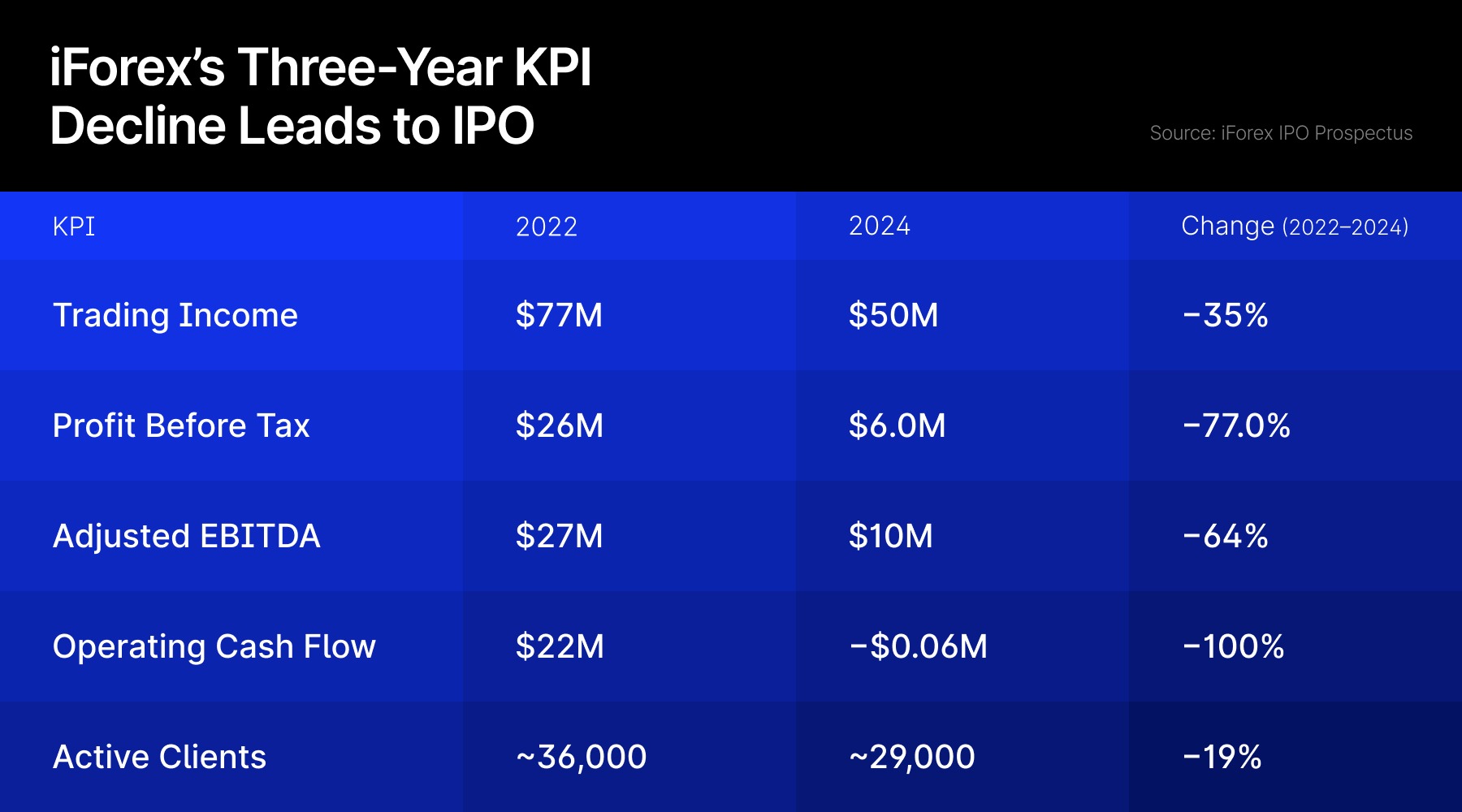
years. Trading income dropped from $76.8 million in 2022 to $50.1 million in
2024, a decline of over 34%.
Profit
before tax fell even more sharply, from $26.1 million to $6.0 million, while
adjusted EBITDA margins halved over the same period. In 2024, cash flow from
operations turned negative, coming in at just under minus $60,000.
The broker
attributes this decline to a combination of external pressures and internal
limitations. Lower volatility in global markets reduced client trading
appetite, particularly in FX, while competitive pressures forced tighter
spreads.
iForex's
client base also shrank, from approximately 36,000 active clients in 2022 to
29,000 in 2024. This contraction was most visible in Europe and Latin America,
offset only partially by resilience in Asian markets.
However,
the company claims the beginning of 2025 showed positive signs: "3,558 new
clients were added in Q1 2025, which is more than in the equivalent period last
year and the previous quarter, which is an encouraging sign that the business
is making progress."
Going Public as a
Strategic Reset
Faced with
declining key performance indicators (KPIs), iForex is turning to equity
markets for a reset. The company is seeking admission to the LSE with a
proposed capital raise of around £5 million. It plans to use these funds to
expand into new markets.
According
to its prospectus, iForex intends to use the funds to secure regulatory
licenses in Australia, Malaysia, the UAE, Chile, and the UK. These
jurisdictions represent both growth opportunities and a hedge against
overreliance on existing markets.
Currently,
iForex operates through two companies: offshore Formula Investment House Ltd
established in the British Virgin Islands and iCFD Ltd, licensed by Cyprus's
CySEC.
50% of Revenue from Just
Two Countries
In 2024,
more than 50% of the company's revenue came from Asia, specifically two
countries: Japan (35.3%) and India (17%). Such concentration poses significant
regulatory and macroeconomic risks.
This heavy
geographic dependence exposes the firm to substantial regulatory and economic
vulnerabilities. Changes in local laws, enforcement practices, or client
behaviors in either market could dramatically affect performance. Japan is
considered the Group's "core market," and India, while significant,
currently lacks a formal legal framework for CFD trading, adding another layer
of uncertainty.
"Given
that a large proportion of the Group's revenue is generated from clients based
in a small number of jurisdictions... the impact of receiving a challenge or
enforcement action in relation to one or more of those jurisdictions would be
particularly significant," the company acknowledges.
Over Half of Revenue Not
From Forex
Despite the
name, iForex is no longer a forex-only business. According to the company's
2024 data, only 37% of client transactions involved currency pairs. In
contrast, commodities and indices accounted for 52% of all trading activity,
with the remaining 11% coming from stocks, ETFs, and cryptocurrencies.
The
company's business model relies primarily on dealing spreads, which contributed
$47.5 million (around 70%) to total revenue in 2024. An additional $12.7
million came from overnight financing charges, while $6.2 million was derived
from net profits and losses on client positions.
Moreover,
client behavior at iForex is overwhelmingly mobile-first. In 2024, out of
approximately $406.9 billion in total trading volume, a staggering $317.3
billion (78%) was conducted via mobile devices. By comparison, only $89.6
billion came through desktop web platforms.
New client
trends mirror this shift: over 10,300 new clients joined the platform via
mobile, versus just 3,000 through the web version.
This year, the company presented the “Vault,” a new fund management feature that allows traders to secure portions of their capital away from market exposure while maintaining instant access when needed.
A Risky Bet or a Timely
Repositioning?
iForex
believes that becoming a publicly traded company will "position it to
compete more directly with its global listed competitors."
The company
is candid about the risks of the planned IPO. It warns in its prospectus that
if it does not deliver the expected benefits, enhanced capital access, brand
credibility, and market entry, the costs of going public could outweigh the
advantages. The firm is also exposed to fluctuations in client activity,
ongoing regulatory scrutiny, and rising competition from larger, better-funded
peers.
"However,
there are no assurances that this will be the case," iForex says about the
risks. "If this expected benefit does not materialize, the costs
associated with the listing may outweigh the benefits and this could have a
material adverse effect on the Group's business, prospects, financial condition
and/or results of operations."
Competing
with other publicly listed brokers may also prove challenging. In terms of
scale, iForex remains a relatively small player in the global brokerage space.
Its estimated 2024 revenue of $50 million compares to approximately $400
million for Polish broker XTB and over $300 million for CMC Markets in the UK.
Both rivals are already publicly listed and operate under multiple licenses
across the EU, Asia, and Latin America.
Nevertheless,
for iForex, the IPO appears to be a necessary step. With profitability under
pressure and growth flattening in legacy markets, the move to tap public
capital could determine whether the company rebounds or continues to contract.
The broker
is attempting to halt a downward trajectory through strategic reinvention,
geographic diversification, including potential acquisitions of other entities,
and a long-awaited injection of fresh capital.
In just two
years, iForex has lost 20% of its active clients, with trading income shrinking
by 35% and profits plummeting by over 75%. Looking to solve this problem, the
broker aims to expand into new markets to reduce its dependence on revenue that
is currently generated more than 50% from just two countries.
To achieve
this goal, the company has decided to transform into a publicly traded entity
to raise capital from external investors. However, the question remains: will
the costs of going public outweigh the potential benefits?
iForex Turns to IPO to
Salvage Key Financial Metrics
According
to the registration document filed with the UK Financial Conduct Authority
(FCA), iForex's financial performance has deteriorated steadily in recent
years. Trading income dropped from $76.8 million in 2022 to $50.1 million in
2024, a decline of over 34%.
Profit
before tax fell even more sharply, from $26.1 million to $6.0 million, while
adjusted EBITDA margins halved over the same period. In 2024, cash flow from
operations turned negative, coming in at just under minus $60,000.
The broker
attributes this decline to a combination of external pressures and internal
limitations. Lower volatility in global markets reduced client trading
appetite, particularly in FX, while competitive pressures forced tighter
spreads.
iForex's
client base also shrank, from approximately 36,000 active clients in 2022 to
29,000 in 2024. This contraction was most visible in Europe and Latin America,
offset only partially by resilience in Asian markets.
However,
the company claims the beginning of 2025 showed positive signs: "3,558 new
clients were added in Q1 2025, which is more than in the equivalent period last
year and the previous quarter, which is an encouraging sign that the business
is making progress."
Going Public as a
Strategic Reset
Faced with
declining key performance indicators (KPIs), iForex is turning to equity
markets for a reset. The company is seeking admission to the LSE with a
proposed capital raise of around £5 million. It plans to use these funds to
expand into new markets.
According
to its prospectus, iForex intends to use the funds to secure regulatory
licenses in Australia, Malaysia, the UAE, Chile, and the UK. These
jurisdictions represent both growth opportunities and a hedge against
overreliance on existing markets.
Currently,
iForex operates through two companies: offshore Formula Investment House Ltd
established in the British Virgin Islands and iCFD Ltd, licensed by Cyprus's
CySEC.
50% of Revenue from Just
Two Countries
In 2024,
more than 50% of the company's revenue came from Asia, specifically two
countries: Japan (35.3%) and India (17%). Such concentration poses significant
regulatory and macroeconomic risks.
This heavy
geographic dependence exposes the firm to substantial regulatory and economic
vulnerabilities. Changes in local laws, enforcement practices, or client
behaviors in either market could dramatically affect performance. Japan is
considered the Group's "core market," and India, while significant,
currently lacks a formal legal framework for CFD trading, adding another layer
of uncertainty.
"Given
that a large proportion of the Group's revenue is generated from clients based
in a small number of jurisdictions... the impact of receiving a challenge or
enforcement action in relation to one or more of those jurisdictions would be
particularly significant," the company acknowledges.
Over Half of Revenue Not
From Forex
Despite the
name, iForex is no longer a forex-only business. According to the company's
2024 data, only 37% of client transactions involved currency pairs. In
contrast, commodities and indices accounted for 52% of all trading activity,
with the remaining 11% coming from stocks, ETFs, and cryptocurrencies.
The
company's business model relies primarily on dealing spreads, which contributed
$47.5 million (around 70%) to total revenue in 2024. An additional $12.7
million came from overnight financing charges, while $6.2 million was derived
from net profits and losses on client positions.
Moreover,
client behavior at iForex is overwhelmingly mobile-first. In 2024, out of
approximately $406.9 billion in total trading volume, a staggering $317.3
billion (78%) was conducted via mobile devices. By comparison, only $89.6
billion came through desktop web platforms.
New client
trends mirror this shift: over 10,300 new clients joined the platform via
mobile, versus just 3,000 through the web version.
This year, the company presented the “Vault,” a new fund management feature that allows traders to secure portions of their capital away from market exposure while maintaining instant access when needed.
A Risky Bet or a Timely
Repositioning?
iForex
believes that becoming a publicly traded company will "position it to
compete more directly with its global listed competitors."
The company
is candid about the risks of the planned IPO. It warns in its prospectus that
if it does not deliver the expected benefits, enhanced capital access, brand
credibility, and market entry, the costs of going public could outweigh the
advantages. The firm is also exposed to fluctuations in client activity,
ongoing regulatory scrutiny, and rising competition from larger, better-funded
peers.
"However,
there are no assurances that this will be the case," iForex says about the
risks. "If this expected benefit does not materialize, the costs
associated with the listing may outweigh the benefits and this could have a
material adverse effect on the Group's business, prospects, financial condition
and/or results of operations."
Competing
with other publicly listed brokers may also prove challenging. In terms of
scale, iForex remains a relatively small player in the global brokerage space.
Its estimated 2024 revenue of $50 million compares to approximately $400
million for Polish broker XTB and over $300 million for CMC Markets in the UK.
Both rivals are already publicly listed and operate under multiple licenses
across the EU, Asia, and Latin America.
Nevertheless,
for iForex, the IPO appears to be a necessary step. With profitability under
pressure and growth flattening in legacy markets, the move to tap public
capital could determine whether the company rebounds or continues to contract.
The broker
is attempting to halt a downward trajectory through strategic reinvention,
geographic diversification, including potential acquisitions of other entities,
and a long-awaited injection of fresh capital.
Damian Chmiel is a Senior Analyst & Editor at Finance Magnates with more than 15 years of experience in the CFD and online trading industry. Active as both a trader and journalist since 2010, he focuses on broker coverage, fintech innovation, and regulatory developments across Europe, the Middle East, and Asia.
His work includes interviews with C-level leaders at major brokerages and fintech platforms, as well as co-authoring Finance Magnates’ quarterly industry benchmarking reports. Damian’s reporting is data-driven, market-aware, and grounded in direct industry engagement. His analysis and commentary have also been cited by external media outlets, including Investing.com, Binance, The Asset, Stockhead, and Dispatch.
Education:
MA in Finance and Accounting, Cracow University of Economics
Italy’s Consob Tightens Net on AI-Fueled Scams With Fresh Website Bans
FP Markets Winner Spotlight 🏆 | Global Broker of the Year 2025 #Trading #Broker #Innovation #Shorts
FP Markets Winner Spotlight 🏆 | Global Broker of the Year 2025 #Trading #Broker #Innovation #Shorts
FP Markets takes the spotlight as Global Broker of the Year 2025 at the Finance Magnates Awards.
Martin Stoilov, Head of Client Experience, shares that trust, innovation, and people played a key role in the company’s success, supported by a strong foundation of integrity and client-centricity.
Following this milestone, FP Markets continues to focus on growth, technology investment, and its core values of transparency and excellence.
👉 Be part of FM Awards 2026: https://awards.financemagnates.com/#nominate
FP Markets takes the spotlight as Global Broker of the Year 2025 at the Finance Magnates Awards.
Martin Stoilov, Head of Client Experience, shares that trust, innovation, and people played a key role in the company’s success, supported by a strong foundation of integrity and client-centricity.
Following this milestone, FP Markets continues to focus on growth, technology investment, and its core values of transparency and excellence.
👉 Be part of FM Awards 2026: https://awards.financemagnates.com/#nominate
In this video, we review @HolaPrimeMarketsOfficial, a multi-asset forex and CFDs broker offering different account types, trading platforms, and flexible trading conditions.
We cover the broker’s overall offering, including account options, trading environment, platforms like MT4 and MT5, and additional services such as managed accounts and fast withdrawals.
Watch the full video to see if Hola Prime Markets fits your trading needs.
📣 Stay up to date with the latest in finance and trading. Follow Finance Magnates for industry news, insights, and global event coverage.
Connect with us:
🔗 LinkedIn: /financemagnates
👍 Facebook: /financemagnates
📸 Instagram: https://www.instagram.com/financemagnates
🐦 X: https://x.com/financemagnates
🎥 TikTok: https://www.tiktok.com/tag/financemagnates
▶️ YouTube: /@financemagnates_official
#HolaPrime #ForexBroker #CFDTrading #FinanceMagnates #Trading #Forex #BrokerReview
In this video, we review @HolaPrimeMarketsOfficial, a multi-asset forex and CFDs broker offering different account types, trading platforms, and flexible trading conditions.
We cover the broker’s overall offering, including account options, trading environment, platforms like MT4 and MT5, and additional services such as managed accounts and fast withdrawals.
Watch the full video to see if Hola Prime Markets fits your trading needs.
📣 Stay up to date with the latest in finance and trading. Follow Finance Magnates for industry news, insights, and global event coverage.
Connect with us:
🔗 LinkedIn: /financemagnates
👍 Facebook: /financemagnates
📸 Instagram: https://www.instagram.com/financemagnates
🐦 X: https://x.com/financemagnates
🎥 TikTok: https://www.tiktok.com/tag/financemagnates
▶️ YouTube: /@financemagnates_official
#HolaPrime #ForexBroker #CFDTrading #FinanceMagnates #Trading #Forex #BrokerReview
Hola Prime Review: What You Need to Know | Full Breakdown by Finance Magnates
Hola Prime Review: What You Need to Know | Full Breakdown by Finance Magnates
In this video, we review @HolaPrime_Global, a proprietary trading firm offering evaluation programs and performance-based payouts in simulated market environments.
We cover how the challenge model works, including account types, profit splits (up to 95%), trading rules, and what it takes to reach a funded account. You’ll also learn about available platforms like MT4, MT5, cTrader, and more, along with insights into payouts, support, and trading conditions.
Watch the full video to see if Hola Prime fits your trading style.
📣 Stay up to date with the latest in finance and trading. Follow Finance Magnates for industry news, insights, and global event coverage.
Connect with us:
🔗 LinkedIn: /financemagnates
👍 Facebook: /financemagnates
📸 Instagram: https://www.instagram.com/financemagnates
🐦 X: https://x.com/financemagnates
🎥 TikTok: https://www.tiktok.com/tag/financemagnates
▶️ YouTube: /@financemagnates_official
#HolaPrime #PropFirm #Trading #FinanceMagnates #Forex #FuturesTrading #TradingReview #PropFirmReview
In this video, we review @HolaPrime_Global, a proprietary trading firm offering evaluation programs and performance-based payouts in simulated market environments.
We cover how the challenge model works, including account types, profit splits (up to 95%), trading rules, and what it takes to reach a funded account. You’ll also learn about available platforms like MT4, MT5, cTrader, and more, along with insights into payouts, support, and trading conditions.
Watch the full video to see if Hola Prime fits your trading style.
📣 Stay up to date with the latest in finance and trading. Follow Finance Magnates for industry news, insights, and global event coverage.
Connect with us:
🔗 LinkedIn: /financemagnates
👍 Facebook: /financemagnates
📸 Instagram: https://www.instagram.com/financemagnates
🐦 X: https://x.com/financemagnates
🎥 TikTok: https://www.tiktok.com/tag/financemagnates
▶️ YouTube: /@financemagnates_official
#HolaPrime #PropFirm #Trading #FinanceMagnates #Forex #FuturesTrading #TradingReview #PropFirmReview
Axi Winner Spotlight 🏆 | Global Most Innovative Broker 2025 #Innovation #Trading #Fintech #Broker
Axi Winner Spotlight 🏆 | Global Most Innovative Broker 2025 #Innovation #Trading #Fintech #Broker
Axi takes the spotlight at the Finance Magnates Awards, winning Global Most Innovative Broker 2025.
Olivia Xenofontos and Ivanna Openko share how the team will feel: proud, motivated, and ready to keep delivering.
They also describe the night as well-organized, focused, and enjoyable for all.
👉 Be part of FM Awards 2026.
Axi takes the spotlight at the Finance Magnates Awards, winning Global Most Innovative Broker 2025.
Olivia Xenofontos and Ivanna Openko share how the team will feel: proud, motivated, and ready to keep delivering.
They also describe the night as well-organized, focused, and enjoyable for all.
👉 Be part of FM Awards 2026.
Recognition that matters.
Built on transparency.
Driven by the industry.
The Finance Magnates Awards 2026.
Nominations are now open.
🔗 https://awards.financemagnates.com/?utm_source=SM&utm_medium=social&utm_campaign=recognition-matters
Recognition that matters.
Built on transparency.
Driven by the industry.
The Finance Magnates Awards 2026.
Nominations are now open.
🔗 https://awards.financemagnates.com/?utm_source=SM&utm_medium=social&utm_campaign=recognition-matters