Acting as Counterparty to Clients in South Africa Costs a Broker Almost 3 Times More

Thursday, 29/10/2026 | 05:06 GMT by Damian Chmiel
  • An FM Intelligence scenario puts the first year at about R68.5 million ($3.8 million), against R24.6 million ($1.4 million) as an agent.
  • Of about 70 non-bank firms on the dealer register, 26 withdrew applications and four handed back licenses.
info

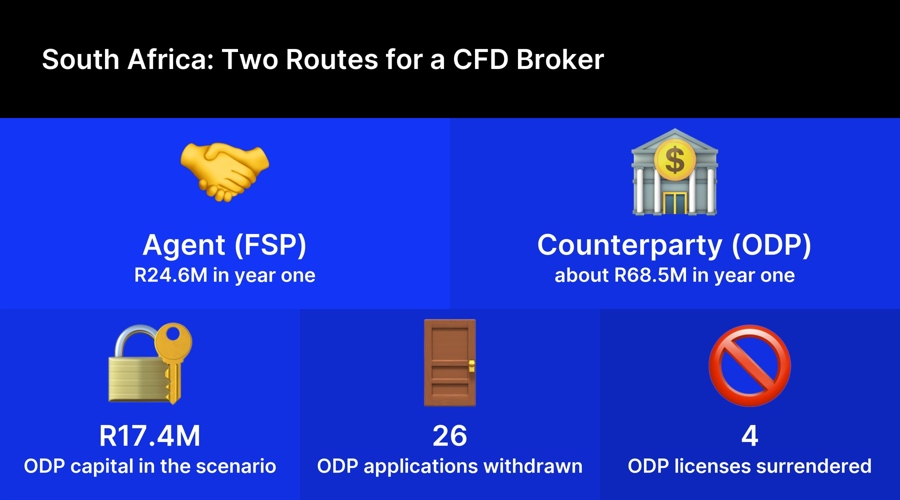
A retail broker that acts as its clients' counterparty in South Africa needs about R68.5 million ($3.8 million) in its first year, FM Intelligence estimates. An agent with the same marketing budget needs R24.6 million ($1.4 million), according to an analysis published today (Wednesday).

The gap starts with the license. In South Africa, a financial services provider (FSP) license lets a firm market CFDs but not take the other side of a client's trade.

That requires authorization from the Financial Sector Conduct Authority (FSCA) as an over-the-counter derivative provider (ODP).

Of about 70 non-bank entries on that register, 26 were withdrawn applications and four were licenses handed back, according to the FM Intelligence Featured Country: South Africa analysis.

London's trading industry is coming home!

Exits Outnumber the Named Entrants

The register shows how the principal route has played out. The count of about 70 entries is cumulative and comes from a FinanceMagnates.com review in June, not from an FSCA list.

Few holders are named: Exness, ATFX, Scope Markets, VALR and Capital.com, which took both permissions in June.

The departures are better documented. IG closed its Sandton office in February, nine months after ending rand accounts, and now supplies its IG Prime platform to Investec under the bank's own brand.

Deal activity sits on the cheaper permission. CXM Group agreed to buy TD Markets, an FSP with more than 50,000 active clients across Africa, and XTB sold a licensed South African unit that never traded for $645,000.

Six Months of Costs Held as Capital

The largest single item between the two routes is money that cannot be spent. FSCA Conduct Standard 1 of 2018 requires an ODP to hold equity capital in South Africa equal to at least six months of operating expenses.

Shreelin Naicker, Departmental Head of Markets, Issuers & Intermediaries at the FSCA

In the FM Intelligence scenario, with both routes spending the same R6 million on marketing, that ties up R17.4 million on top of R51.1 million of setup and running costs.

The standard also asks for a fixed local address and a South African bank account.

Providers "cannot simply operate as a 'letterbox' entity," Shreelin Naicker, departmental head for markets, issuers and intermediaries at the FSCA, told FinanceMagnates.com in June.

The two builds still differ by design, with the principal route at the high end of the staff, platform and office inputs. With marketing tripled to R18 million, it reaches R90.4 million ($5.1 million), including R24.3 million of capital.

Demand Leads the Continent
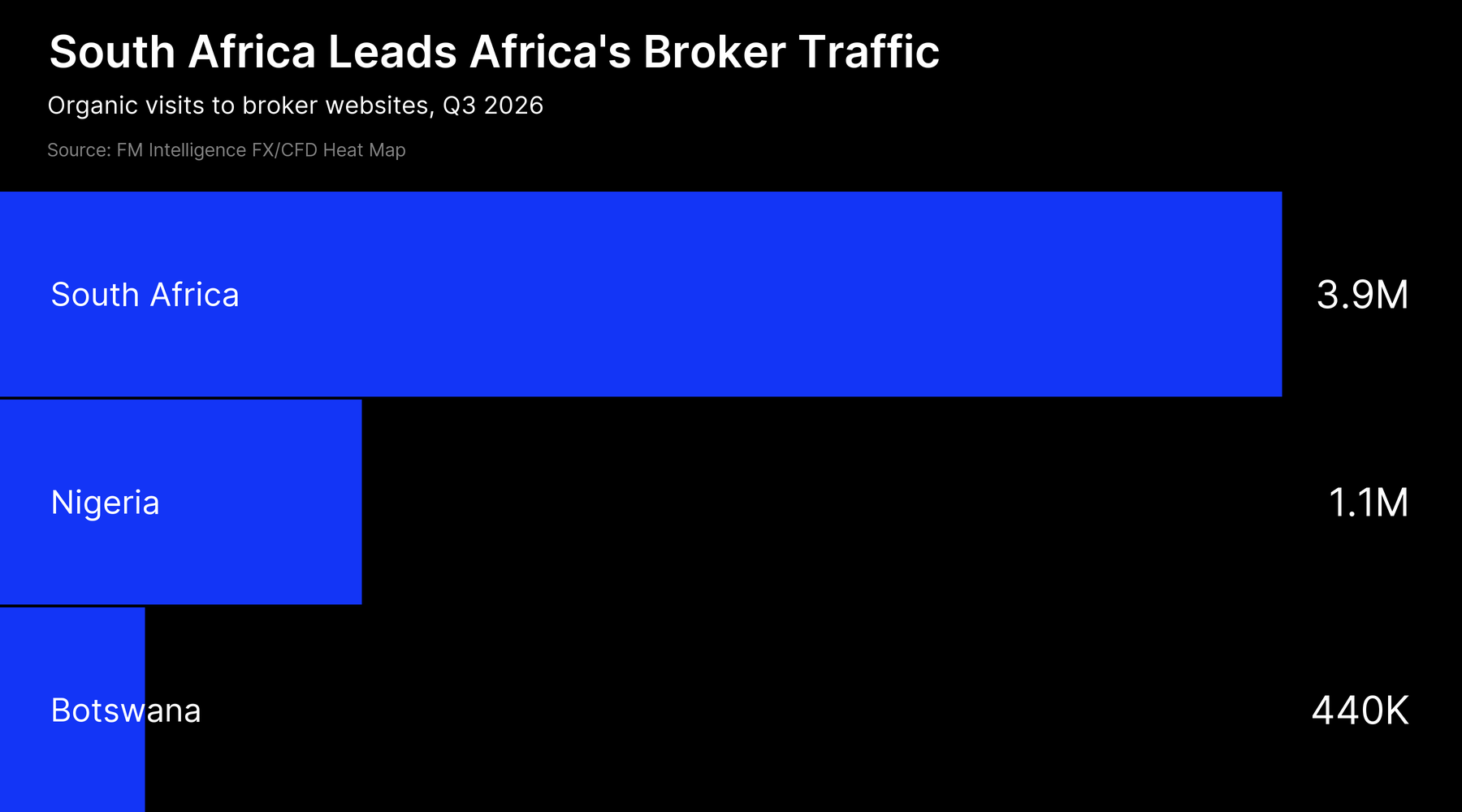
The interest behind either route is measurable. South Africa produced 3.9 million organic visits to broker websites in Q3 2026, more than half of Africa's 6.7 million, according to FM Intelligence's heat map.

Scaled to population, South African desktop users visit broker sites at close to the French rate. No regulator counts the active CFD traders behind it.

The full FM Intelligence analysis sets out the cost model line by line, the client numbers needed to break even at four revenue levels and how South Africa's rules compare with Kenya and Nigeria.

A retail broker that acts as its clients' counterparty in South Africa needs about R68.5 million ($3.8 million) in its first year, FM Intelligence estimates. An agent with the same marketing budget needs R24.6 million ($1.4 million), according to an analysis published today (Wednesday).

The gap starts with the license. In South Africa, a financial services provider (FSP) license lets a firm market CFDs but not take the other side of a client's trade.

That requires authorization from the Financial Sector Conduct Authority (FSCA) as an over-the-counter derivative provider (ODP).

Of about 70 non-bank entries on that register, 26 were withdrawn applications and four were licenses handed back, according to the FM Intelligence Featured Country: South Africa analysis.

London's trading industry is coming home!

Exits Outnumber the Named Entrants

The register shows how the principal route has played out. The count of about 70 entries is cumulative and comes from a FinanceMagnates.com review in June, not from an FSCA list.

Few holders are named: Exness, ATFX, Scope Markets, VALR and Capital.com, which took both permissions in June.

The departures are better documented. IG closed its Sandton office in February, nine months after ending rand accounts, and now supplies its IG Prime platform to Investec under the bank's own brand.

Deal activity sits on the cheaper permission. CXM Group agreed to buy TD Markets, an FSP with more than 50,000 active clients across Africa, and XTB sold a licensed South African unit that never traded for $645,000.

Six Months of Costs Held as Capital

The largest single item between the two routes is money that cannot be spent. FSCA Conduct Standard 1 of 2018 requires an ODP to hold equity capital in South Africa equal to at least six months of operating expenses.

Shreelin Naicker, Departmental Head of Markets, Issuers & Intermediaries at the FSCA

In the FM Intelligence scenario, with both routes spending the same R6 million on marketing, that ties up R17.4 million on top of R51.1 million of setup and running costs.

The standard also asks for a fixed local address and a South African bank account.

Providers "cannot simply operate as a 'letterbox' entity," Shreelin Naicker, departmental head for markets, issuers and intermediaries at the FSCA, told FinanceMagnates.com in June.

The two builds still differ by design, with the principal route at the high end of the staff, platform and office inputs. With marketing tripled to R18 million, it reaches R90.4 million ($5.1 million), including R24.3 million of capital.

Demand Leads the Continent

The interest behind either route is measurable. South Africa produced 3.9 million organic visits to broker websites in Q3 2026, more than half of Africa's 6.7 million, according to FM Intelligence's heat map.

Scaled to population, South African desktop users visit broker sites at close to the French rate. No regulator counts the active CFD traders behind it.

The full FM Intelligence analysis sets out the cost model line by line, the client numbers needed to break even at four revenue levels and how South Africa's rules compare with Kenya and Nigeria.

About the Author: Damian Chmiel
Damian Chmiel
  • 4119 Articles
  • 119 Followers
About the Author: Damian Chmiel
Damian Chmiel is a Senior Analyst & Editor at Finance Magnates with more than 15 years of experience in the CFD and online trading industry. Active as both a trader and journalist since 2010, he focuses on broker coverage, fintech innovation, and regulatory developments across Europe, the Middle East, and Asia. His work includes interviews with C-level leaders at major brokerages and fintech platforms, as well as co-authoring Finance Magnates’ quarterly industry benchmarking reports. Damian’s reporting is data-driven, market-aware, and grounded in direct industry engagement. His analysis and commentary have also been cited by external media outlets, including Investing.com, Binance, The Asset, Stockhead, and Dispatch. Education: MA in Finance and Accounting, Cracow University of Economics
  • 4119 Articles
  • 119 Followers

More from the Author

Retail FX

!"#$%&'()*+,-./0123456789:;<=>?@ABCDEFGHIJKLMNOPQRSTUVWXYZ[\]^_`abcdefghijklmnopqrstuvwxyz{|} !"#$%&'()*+,-./0123456789:;<=>?@ABCDEFGHIJKLMNOPQRSTUVWXYZ[\]^_`abcdefghijklmnopqrstuvwxyz{|}