Finance Magnates looks at the sad statistics and tries to figure out the causes of forex brokerage demise.
The history of the retail Forex industry starts in the late nineties. Since then, some companies have grown to positions of hegemony while others quickly faded away, leaving no legacy behind. Finance Magnates takes a look at the industry, trying to understand the lifecycle of forex companies and the hazards that they face.
Read the full article in the latest Quarterly Intelligence Report
As with many popular business theories, the lifecycle theory has roots which can be traced. According to popular opinion, the first footprints of this theory can be seen in the works of Mason Haire, who in 1959 published “Modern Organization Theory”. He was one of the first to notice that organizations evolve in a way which can be described as a path, a path which governs the evolution of most organizations. The others were W.W. Rostow and Roger Penrose. Dennis C. Mueller is another expert to whom lifecycle theory is often attributed. In 1972 he published “A Life Cycle Theory of the Firm”.
Today, the lifecycle of a company is believed to have many stages, although experts differ on the exact number. To boil it down to the simplest possible definition, the lifecycle of a company in the forex industry can be described by the following stages: growth, maturity, decline (ending in Bankruptcy).
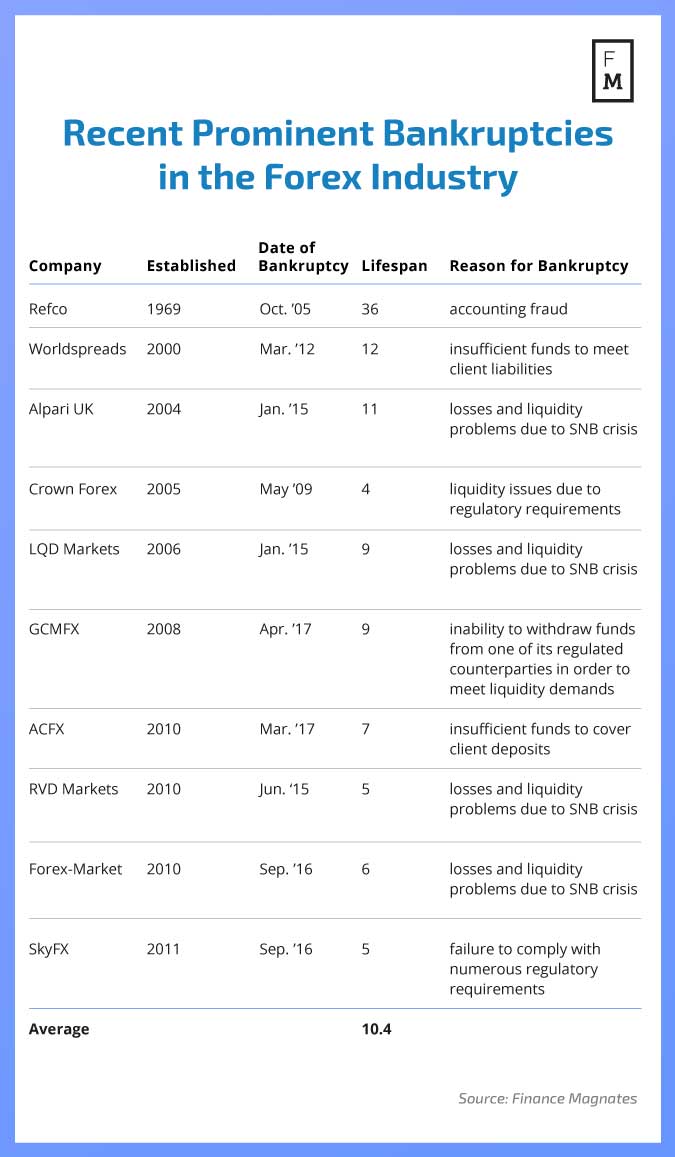
Bankruptcy is the worst case scenario for any business, and it happens in the FX industry too. Finance Magnates conducted some brief research on this subject which gives a taste of how the FX industry deals with bankruptcy. We used analytical and marketing data to reach our conclusions.
We noticed that in 2014, roughly 1.8% of brokers went out of business, while in the last 2 years, the share of bankrupt brokers has reached a level of around 17% - that’s 1 out of every 6 brokers.
Understanding the typical lifecycle of an FX company remains a challenging task. Firstly, the nature of the offered product is unique, and does not leave much room for brokers to create new products. Secondly, the rules of engagement are very often altered, and regulations force firms to make decisions which would not be taken were the market forces of supply and demand the only drivers. Lastly, the retail FX industry itself is relatively young. Firms are still around which actually invented some of the key products that the industry is based on.
For all the new firms which aim to replicate the success of the largest market players like Plus500 and CMC Markets, there is left only the path of hard work, discipline and competitive trading terms, combined with superb customer care and constant rivalry.
“We definitely saw a few examples when forex and CFD dealers went bankrupt or just closed their operations due to continuing loses. The main problem which can easily kick out an FX dealer is undercapitalization. Increasingly often, people start their FX dealerships, underestimate the real costs and overlap themselves.”- Peter Tatarnikov, Chairman of the Board at The Financial Commission
The history of the retail Forex industry starts in the late nineties. Since then, some companies have grown to positions of hegemony while others quickly faded away, leaving no legacy behind. Finance Magnates takes a look at the industry, trying to understand the lifecycle of forex companies and the hazards that they face.
Read the full article in the latest Quarterly Intelligence Report
As with many popular business theories, the lifecycle theory has roots which can be traced. According to popular opinion, the first footprints of this theory can be seen in the works of Mason Haire, who in 1959 published “Modern Organization Theory”. He was one of the first to notice that organizations evolve in a way which can be described as a path, a path which governs the evolution of most organizations. The others were W.W. Rostow and Roger Penrose. Dennis C. Mueller is another expert to whom lifecycle theory is often attributed. In 1972 he published “A Life Cycle Theory of the Firm”.
Today, the lifecycle of a company is believed to have many stages, although experts differ on the exact number. To boil it down to the simplest possible definition, the lifecycle of a company in the forex industry can be described by the following stages: growth, maturity, decline (ending in Bankruptcy).
Bankruptcy is the worst case scenario for any business, and it happens in the FX industry too. Finance Magnates conducted some brief research on this subject which gives a taste of how the FX industry deals with bankruptcy. We used analytical and marketing data to reach our conclusions.
We noticed that in 2014, roughly 1.8% of brokers went out of business, while in the last 2 years, the share of bankrupt brokers has reached a level of around 17% - that’s 1 out of every 6 brokers.
Understanding the typical lifecycle of an FX company remains a challenging task. Firstly, the nature of the offered product is unique, and does not leave much room for brokers to create new products. Secondly, the rules of engagement are very often altered, and regulations force firms to make decisions which would not be taken were the market forces of supply and demand the only drivers. Lastly, the retail FX industry itself is relatively young. Firms are still around which actually invented some of the key products that the industry is based on.
For all the new firms which aim to replicate the success of the largest market players like Plus500 and CMC Markets, there is left only the path of hard work, discipline and competitive trading terms, combined with superb customer care and constant rivalry.
“We definitely saw a few examples when forex and CFD dealers went bankrupt or just closed their operations due to continuing loses. The main problem which can easily kick out an FX dealer is undercapitalization. Increasingly often, people start their FX dealerships, underestimate the real costs and overlap themselves.”- Peter Tatarnikov, Chairman of the Board at The Financial Commission
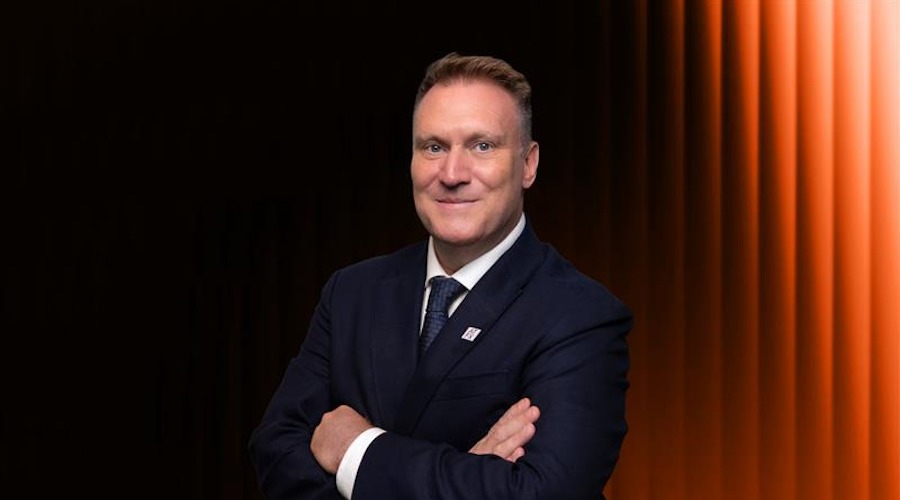
Sylwester is a graduate of the Warsaw School of Economics, holding an MA in Finance and Banking. He currently serves as Head of the Insights & Reporting Hub at Finance Magnates. He is also a former minority partner in an NFA-registered US forex broker and has been involved in numerous forex and trading industry projects since 2003.
Privately, Sylwester is a husband and father to a 7-year-old daughter, as well as an enthusiast of trading and Formula 1.
Weekly Focus: Binance Joins Prediction Markets; Is Bad Tech Driving Traders Over the Edge?
FP Markets Winner Spotlight 🏆 | Global Broker of the Year 2025 #Trading #Broker #Innovation #Shorts
FP Markets Winner Spotlight 🏆 | Global Broker of the Year 2025 #Trading #Broker #Innovation #Shorts
FP Markets takes the spotlight as Global Broker of the Year 2025 at the Finance Magnates Awards.
Martin Stoilov, Head of Client Experience, shares that trust, innovation, and people played a key role in the company’s success, supported by a strong foundation of integrity and client-centricity.
Following this milestone, FP Markets continues to focus on growth, technology investment, and its core values of transparency and excellence.
👉 Be part of FM Awards 2026: https://awards.financemagnates.com/#nominate
FP Markets takes the spotlight as Global Broker of the Year 2025 at the Finance Magnates Awards.
Martin Stoilov, Head of Client Experience, shares that trust, innovation, and people played a key role in the company’s success, supported by a strong foundation of integrity and client-centricity.
Following this milestone, FP Markets continues to focus on growth, technology investment, and its core values of transparency and excellence.
👉 Be part of FM Awards 2026: https://awards.financemagnates.com/#nominate
In this video, we review @HolaPrimeMarketsOfficial, a multi-asset forex and CFDs broker offering different account types, trading platforms, and flexible trading conditions.
We cover the broker’s overall offering, including account options, trading environment, platforms like MT4 and MT5, and additional services such as managed accounts and fast withdrawals.
Watch the full video to see if Hola Prime Markets fits your trading needs.
📣 Stay up to date with the latest in finance and trading. Follow Finance Magnates for industry news, insights, and global event coverage.
Connect with us:
🔗 LinkedIn: /financemagnates
👍 Facebook: /financemagnates
📸 Instagram: https://www.instagram.com/financemagnates
🐦 X: https://x.com/financemagnates
🎥 TikTok: https://www.tiktok.com/tag/financemagnates
▶️ YouTube: /@financemagnates_official
#HolaPrime #ForexBroker #CFDTrading #FinanceMagnates #Trading #Forex #BrokerReview
In this video, we review @HolaPrimeMarketsOfficial, a multi-asset forex and CFDs broker offering different account types, trading platforms, and flexible trading conditions.
We cover the broker’s overall offering, including account options, trading environment, platforms like MT4 and MT5, and additional services such as managed accounts and fast withdrawals.
Watch the full video to see if Hola Prime Markets fits your trading needs.
📣 Stay up to date with the latest in finance and trading. Follow Finance Magnates for industry news, insights, and global event coverage.
Connect with us:
🔗 LinkedIn: /financemagnates
👍 Facebook: /financemagnates
📸 Instagram: https://www.instagram.com/financemagnates
🐦 X: https://x.com/financemagnates
🎥 TikTok: https://www.tiktok.com/tag/financemagnates
▶️ YouTube: /@financemagnates_official
#HolaPrime #ForexBroker #CFDTrading #FinanceMagnates #Trading #Forex #BrokerReview
Hola Prime Review: What You Need to Know | Full Breakdown by Finance Magnates
Hola Prime Review: What You Need to Know | Full Breakdown by Finance Magnates
In this video, we review @HolaPrime_Global, a proprietary trading firm offering evaluation programs and performance-based payouts in simulated market environments.
We cover how the challenge model works, including account types, profit splits (up to 95%), trading rules, and what it takes to reach a funded account. You’ll also learn about available platforms like MT4, MT5, cTrader, and more, along with insights into payouts, support, and trading conditions.
Watch the full video to see if Hola Prime fits your trading style.
📣 Stay up to date with the latest in finance and trading. Follow Finance Magnates for industry news, insights, and global event coverage.
Connect with us:
🔗 LinkedIn: /financemagnates
👍 Facebook: /financemagnates
📸 Instagram: https://www.instagram.com/financemagnates
🐦 X: https://x.com/financemagnates
🎥 TikTok: https://www.tiktok.com/tag/financemagnates
▶️ YouTube: /@financemagnates_official
#HolaPrime #PropFirm #Trading #FinanceMagnates #Forex #FuturesTrading #TradingReview #PropFirmReview
In this video, we review @HolaPrime_Global, a proprietary trading firm offering evaluation programs and performance-based payouts in simulated market environments.
We cover how the challenge model works, including account types, profit splits (up to 95%), trading rules, and what it takes to reach a funded account. You’ll also learn about available platforms like MT4, MT5, cTrader, and more, along with insights into payouts, support, and trading conditions.
Watch the full video to see if Hola Prime fits your trading style.
📣 Stay up to date with the latest in finance and trading. Follow Finance Magnates for industry news, insights, and global event coverage.
Connect with us:
🔗 LinkedIn: /financemagnates
👍 Facebook: /financemagnates
📸 Instagram: https://www.instagram.com/financemagnates
🐦 X: https://x.com/financemagnates
🎥 TikTok: https://www.tiktok.com/tag/financemagnates
▶️ YouTube: /@financemagnates_official
#HolaPrime #PropFirm #Trading #FinanceMagnates #Forex #FuturesTrading #TradingReview #PropFirmReview
Axi Winner Spotlight 🏆 | Global Most Innovative Broker 2025 #Innovation #Trading #Fintech #Broker
Axi Winner Spotlight 🏆 | Global Most Innovative Broker 2025 #Innovation #Trading #Fintech #Broker
Axi takes the spotlight at the Finance Magnates Awards, winning Global Most Innovative Broker 2025.
Olivia Xenofontos and Ivanna Openko share how the team will feel: proud, motivated, and ready to keep delivering.
They also describe the night as well-organized, focused, and enjoyable for all.
👉 Be part of FM Awards 2026.
Axi takes the spotlight at the Finance Magnates Awards, winning Global Most Innovative Broker 2025.
Olivia Xenofontos and Ivanna Openko share how the team will feel: proud, motivated, and ready to keep delivering.
They also describe the night as well-organized, focused, and enjoyable for all.
👉 Be part of FM Awards 2026.
Recognition that matters.
Built on transparency.
Driven by the industry.
The Finance Magnates Awards 2026.
Nominations are now open.
🔗 https://awards.financemagnates.com/?utm_source=SM&utm_medium=social&utm_campaign=recognition-matters
Recognition that matters.
Built on transparency.
Driven by the industry.
The Finance Magnates Awards 2026.
Nominations are now open.
🔗 https://awards.financemagnates.com/?utm_source=SM&utm_medium=social&utm_campaign=recognition-matters