Finance professionals fear for their future due to AI.
According to industry workers, as many as 30% of people may lose their jobs within three years.
Three out
of four representatives of the financial industry fear that artificial
intelligence (AI) may take away their jobs sooner or later. Moreover, 20% of
finance professionals are "terrified" by AI tools' current
capabilities and the pace of development.
Financial Specialists Are Afraid AI Will Take Their Jobs
As shown by
the latest research conducted by FintechOS, almost 73% of financial
industry employees from Great Britain and the USA are convinced that generative
artificial intelligence (GAI) will make their work redundant.
GAI is a
type of AI focused on creating new, original content, such as text, images,
audio, and video. It leverages techniques like neural networks and transformers
to analyze patterns in data and generate new output that mimics the style and
structure of that data.
Nearly 60%
believe the technology will lead to job losses within the next three
years, and employment could be reduced by up to 30%.
"GAI
will boost revenues but inevitably reshape the workforce and displace jobs,"
said Teodor Blidarus, the Co-Founder and CEO at FintechOS.
Currently,
almost every second company invests in GAI research and implementation of
solutions based on artificial intelligence. On average, financial companies in
Great Britain allocate between £800,000 and £1.6 million for this purpose.
Younger Employees Are Excited, Older
Terrified
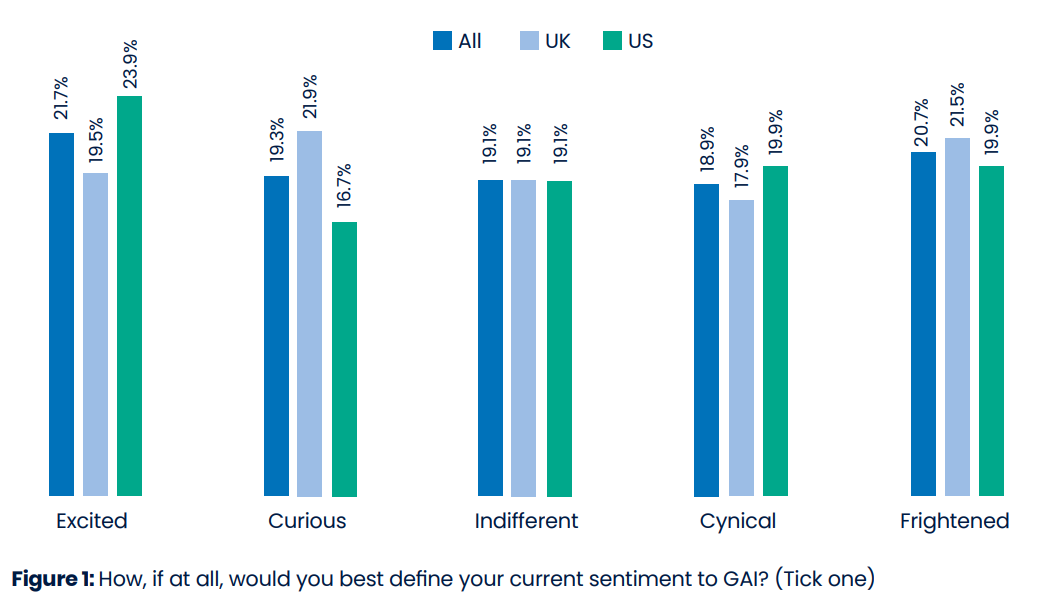
The paper
titled "Generative Artificial Intelligence: The Technology Polarising the
Financial Services Industry" showed that it is mainly older employees who
are concerned about their future. Younger industry representatives suggest,
however, that the new technology is "exciting."
Most
representatives of the age group up to 44 called artificial intelligence a
"friend.” In the case of financiers over this age, the majority described
AI as a "foe."
Source: FintechOS
"Every
financial institution has started its GAI journey, and it's imperative to take
the first step – even if it's a small one – to avoid being left behind,"
Bildarus concluded.
The report
appears when there is a loud reshuffle in the AI market. Sam Altman, the
creator of ChatGPT and the Co-Founder of OpenAI, was fired from his project, only
to be reappointed as the CEO shortly after. The game is played for big money, as
according to experts, the industry will be worth $2.6-4.4 trillion in the near
future.
Three out
of four representatives of the financial industry fear that artificial
intelligence (AI) may take away their jobs sooner or later. Moreover, 20% of
finance professionals are "terrified" by AI tools' current
capabilities and the pace of development.
Financial Specialists Are Afraid AI Will Take Their Jobs
As shown by
the latest research conducted by FintechOS, almost 73% of financial
industry employees from Great Britain and the USA are convinced that generative
artificial intelligence (GAI) will make their work redundant.
GAI is a
type of AI focused on creating new, original content, such as text, images,
audio, and video. It leverages techniques like neural networks and transformers
to analyze patterns in data and generate new output that mimics the style and
structure of that data.
Nearly 60%
believe the technology will lead to job losses within the next three
years, and employment could be reduced by up to 30%.
"GAI
will boost revenues but inevitably reshape the workforce and displace jobs,"
said Teodor Blidarus, the Co-Founder and CEO at FintechOS.
Currently,
almost every second company invests in GAI research and implementation of
solutions based on artificial intelligence. On average, financial companies in
Great Britain allocate between £800,000 and £1.6 million for this purpose.
Younger Employees Are Excited, Older
Terrified
The paper
titled "Generative Artificial Intelligence: The Technology Polarising the
Financial Services Industry" showed that it is mainly older employees who
are concerned about their future. Younger industry representatives suggest,
however, that the new technology is "exciting."
Most
representatives of the age group up to 44 called artificial intelligence a
"friend.” In the case of financiers over this age, the majority described
AI as a "foe."
Source: FintechOS
"Every
financial institution has started its GAI journey, and it's imperative to take
the first step – even if it's a small one – to avoid being left behind,"
Bildarus concluded.
The report
appears when there is a loud reshuffle in the AI market. Sam Altman, the
creator of ChatGPT and the Co-Founder of OpenAI, was fired from his project, only
to be reappointed as the CEO shortly after. The game is played for big money, as
according to experts, the industry will be worth $2.6-4.4 trillion in the near
future.
Damian Chmiel is a Senior Analyst & Editor at Finance Magnates with more than 15 years of experience in the CFD and online trading industry. Active as both a trader and journalist since 2010, he focuses on broker coverage, fintech innovation, and regulatory developments across Europe, the Middle East, and Asia.
His work includes interviews with C-level leaders at major brokerages and fintech platforms, as well as co-authoring Finance Magnates’ quarterly industry benchmarking reports. Damian’s reporting is data-driven, market-aware, and grounded in direct industry engagement. His analysis and commentary have also been cited by external media outlets, including Investing.com, Binance, The Asset, Stockhead, and Dispatch.
Education:
MA in Finance and Accounting, Cracow University of Economics
Retail Traders Can Now Access Prediction Markets Through Binance Wallet
FP Markets Winner Spotlight 🏆 | Global Broker of the Year 2025 #Trading #Broker #Innovation #Shorts
FP Markets Winner Spotlight 🏆 | Global Broker of the Year 2025 #Trading #Broker #Innovation #Shorts
FP Markets takes the spotlight as Global Broker of the Year 2025 at the Finance Magnates Awards.
Martin Stoilov, Head of Client Experience, shares that trust, innovation, and people played a key role in the company’s success, supported by a strong foundation of integrity and client-centricity.
Following this milestone, FP Markets continues to focus on growth, technology investment, and its core values of transparency and excellence.
👉 Be part of FM Awards 2026: https://awards.financemagnates.com/#nominate
FP Markets takes the spotlight as Global Broker of the Year 2025 at the Finance Magnates Awards.
Martin Stoilov, Head of Client Experience, shares that trust, innovation, and people played a key role in the company’s success, supported by a strong foundation of integrity and client-centricity.
Following this milestone, FP Markets continues to focus on growth, technology investment, and its core values of transparency and excellence.
👉 Be part of FM Awards 2026: https://awards.financemagnates.com/#nominate
In this video, we review @HolaPrimeMarketsOfficial, a multi-asset forex and CFDs broker offering different account types, trading platforms, and flexible trading conditions.
We cover the broker’s overall offering, including account options, trading environment, platforms like MT4 and MT5, and additional services such as managed accounts and fast withdrawals.
Watch the full video to see if Hola Prime Markets fits your trading needs.
📣 Stay up to date with the latest in finance and trading. Follow Finance Magnates for industry news, insights, and global event coverage.
Connect with us:
🔗 LinkedIn: /financemagnates
👍 Facebook: /financemagnates
📸 Instagram: https://www.instagram.com/financemagnates
🐦 X: https://x.com/financemagnates
🎥 TikTok: https://www.tiktok.com/tag/financemagnates
▶️ YouTube: /@financemagnates_official
#HolaPrime #ForexBroker #CFDTrading #FinanceMagnates #Trading #Forex #BrokerReview
In this video, we review @HolaPrimeMarketsOfficial, a multi-asset forex and CFDs broker offering different account types, trading platforms, and flexible trading conditions.
We cover the broker’s overall offering, including account options, trading environment, platforms like MT4 and MT5, and additional services such as managed accounts and fast withdrawals.
Watch the full video to see if Hola Prime Markets fits your trading needs.
📣 Stay up to date with the latest in finance and trading. Follow Finance Magnates for industry news, insights, and global event coverage.
Connect with us:
🔗 LinkedIn: /financemagnates
👍 Facebook: /financemagnates
📸 Instagram: https://www.instagram.com/financemagnates
🐦 X: https://x.com/financemagnates
🎥 TikTok: https://www.tiktok.com/tag/financemagnates
▶️ YouTube: /@financemagnates_official
#HolaPrime #ForexBroker #CFDTrading #FinanceMagnates #Trading #Forex #BrokerReview
Hola Prime Review: What You Need to Know | Full Breakdown by Finance Magnates
Hola Prime Review: What You Need to Know | Full Breakdown by Finance Magnates
In this video, we review @HolaPrime_Global, a proprietary trading firm offering evaluation programs and performance-based payouts in simulated market environments.
We cover how the challenge model works, including account types, profit splits (up to 95%), trading rules, and what it takes to reach a funded account. You’ll also learn about available platforms like MT4, MT5, cTrader, and more, along with insights into payouts, support, and trading conditions.
Watch the full video to see if Hola Prime fits your trading style.
📣 Stay up to date with the latest in finance and trading. Follow Finance Magnates for industry news, insights, and global event coverage.
Connect with us:
🔗 LinkedIn: /financemagnates
👍 Facebook: /financemagnates
📸 Instagram: https://www.instagram.com/financemagnates
🐦 X: https://x.com/financemagnates
🎥 TikTok: https://www.tiktok.com/tag/financemagnates
▶️ YouTube: /@financemagnates_official
#HolaPrime #PropFirm #Trading #FinanceMagnates #Forex #FuturesTrading #TradingReview #PropFirmReview
In this video, we review @HolaPrime_Global, a proprietary trading firm offering evaluation programs and performance-based payouts in simulated market environments.
We cover how the challenge model works, including account types, profit splits (up to 95%), trading rules, and what it takes to reach a funded account. You’ll also learn about available platforms like MT4, MT5, cTrader, and more, along with insights into payouts, support, and trading conditions.
Watch the full video to see if Hola Prime fits your trading style.
📣 Stay up to date with the latest in finance and trading. Follow Finance Magnates for industry news, insights, and global event coverage.
Connect with us:
🔗 LinkedIn: /financemagnates
👍 Facebook: /financemagnates
📸 Instagram: https://www.instagram.com/financemagnates
🐦 X: https://x.com/financemagnates
🎥 TikTok: https://www.tiktok.com/tag/financemagnates
▶️ YouTube: /@financemagnates_official
#HolaPrime #PropFirm #Trading #FinanceMagnates #Forex #FuturesTrading #TradingReview #PropFirmReview
Axi Winner Spotlight 🏆 | Global Most Innovative Broker 2025 #Innovation #Trading #Fintech #Broker
Axi Winner Spotlight 🏆 | Global Most Innovative Broker 2025 #Innovation #Trading #Fintech #Broker
Axi takes the spotlight at the Finance Magnates Awards, winning Global Most Innovative Broker 2025.
Olivia Xenofontos and Ivanna Openko share how the team will feel: proud, motivated, and ready to keep delivering.
They also describe the night as well-organized, focused, and enjoyable for all.
👉 Be part of FM Awards 2026.
Axi takes the spotlight at the Finance Magnates Awards, winning Global Most Innovative Broker 2025.
Olivia Xenofontos and Ivanna Openko share how the team will feel: proud, motivated, and ready to keep delivering.
They also describe the night as well-organized, focused, and enjoyable for all.
👉 Be part of FM Awards 2026.
Recognition that matters.
Built on transparency.
Driven by the industry.
The Finance Magnates Awards 2026.
Nominations are now open.
🔗 https://awards.financemagnates.com/?utm_source=SM&utm_medium=social&utm_campaign=recognition-matters
Recognition that matters.
Built on transparency.
Driven by the industry.
The Finance Magnates Awards 2026.
Nominations are now open.
🔗 https://awards.financemagnates.com/?utm_source=SM&utm_medium=social&utm_campaign=recognition-matters