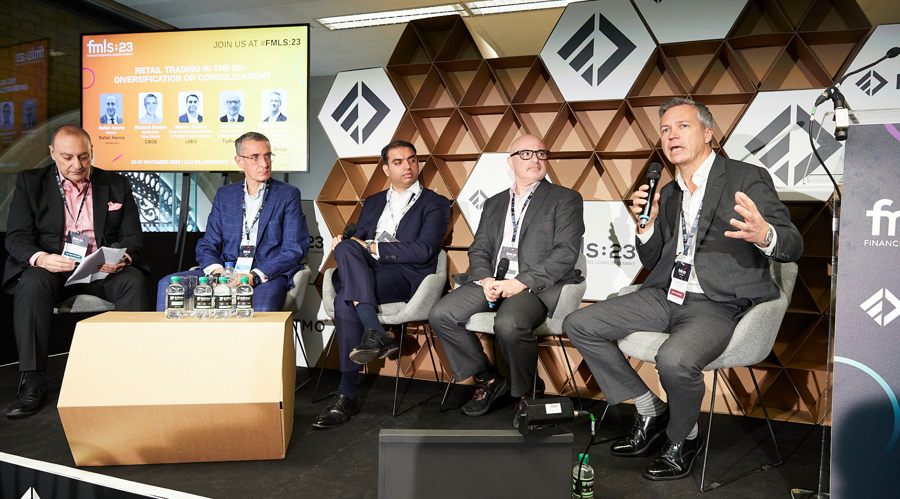
Panelists of "Retail Trading in the EU” at FMLS highlighted unprecedented regulatory changes in retail trading within the EU.
The discussion noted a shift to advanced data sets, signaling increased respect for professional retail investors.
FMLS 23
In
a recent panel discussion at Finance Magnates London Summit 2023, moderated by
Rafah Hanna, the Director at Rafah Hanna, prominent industry figures gathered to
delve into the ever-evolving landscape of retail trading within the European
Union (EU).
The esteemed panel included Richard Barden, the Market Data Sales
Director at CBOE; Mazhar Saleem, the Sales Director for Enterprise Data & Platform
at LSEG; Joe Craven, the Global Head of Enterprise Solutions at TipRanks; and
Richard Stoker, an Executive
Director, the EMEA Head of Proprietary and Retail Trading, and the Global Head of Platform
Solutions at CME Group.
Market
Dynamics: Consolidation, Diversification, and the Role of White-Label Services
The
central theme of the discussion revolved around the question of "Retail
Trading in the EU: Diversification or Consolidation?" Hanna kickstarted
the conversation by addressing the anticipated 40% growth in the retail trading
market over the next five years, setting the stage for the exploration of
unique characteristics, opportunities, and potential winners and losers in this
dynamic landscape.
Richard Barden, Market Data Sales Director at CBOE
Stoker
highlighted the ongoing changes in the retail trading sector, underscoring the
significance of Regulation headwinds. He stated: "The changes we're
witnessing now in terms of regulatory headwinds are unprecedented. I believe
this holds more significance than the ESMA rules introduced in
2016.”
Mazhar Saleem, Sales Director, Enterprise Data & Platform at LSEG
“Some
firms, relying on an extensive marketing approach and trading against their
clients, may find their business model unsustainable. Clients seek diversified
product offerings and educational resources. True access to the underlying market is crucial for
long-term success. Moreover, success lies in diversifying into other asset
classes, whether it's crypto, options, futures, or any other, and that's where
substantial achievements are observed."
Saleem
acknowledged the simultaneous trends of consolidation and diversification in
the market. He noted a shift from supporting smaller players to larger firms
taking up market share. Saleem mentioned the growing interest in white-label
services, allowing larger players to offer solutions to smaller organizations
aiming to enter new markets.
Craven,
sharing insights from TipRanks,
provided a unique perspective, serving millions of retail end-users monthly.
He echoed sentiments of consolidation and predicted that well-established
firms would absorb more clients while late entrants might face challenges. He
noted a shift in product diversification, with increased interest in equities
and alternative investments like ETFs and cryptocurrencies.
Barden
discussed the interest in derivative products among retail brokers in Europe,
particularly options. He speculated that this could be driven by a belief that
options might serve as a regulatory hedge if leverage trading requirements
tighten. He also touched upon the consolidation trend, observing smaller brokers being
integrated into larger networks.
Barden
mentioned: "Perhaps it's a mix of diversification and consolidation. In
terms of diversification, especially coming from a derivatives-heavy exchange,
we're witnessing increased interest from European retail brokers in derivative
products. Notably, options have entered the conversation, marking a noteworthy
trend.”
“Retail
brokers are considering introducing options as a product set next year, and
it's unclear whether this stems from the belief that options are a valuable
product for retail trading or if it's a cautious move to use options as a
potential regulatory hedge. The uncertainty lies in whether regulators will
tighten leverage trading requirements, making options an easier option for
leverage products."
Navigating
the Future: Trends and Considerations in Retail Trading
The
collective insights from the panelists pointed to increased accessibility of
professional-level data for retail traders. The impact of the COVID-19 pandemic,
leading to a surge in stay-at-home trading, was discussed. The resulting influx
of new traders, combined with changes in commission structures and market data
licensing, reshaped the dynamics of the retail trading landscape.
Joe Craven, Global Head of Enterprise Solutions at TipRanks
Looking
towards the future, the experts refrained from explicitly naming winners and
losers, but they emphasized the importance of staying attuned to client needs
and offering relevant products. The growth of options trading emerged as a
notable trend, with micro-sized products gaining popularity among self-directed
retail traders.
In
a deeper exploration of TipRanks' perspective, Craven shed light on the
company's mission to empower retail investors. TipRanks consolidates analyst
recommendations from major financial institutions, synthesizes the information,
and presents it through graphical tools. The goal is to offer retail investors the ability
to conduct self-directed research with the same accuracy and data integrity as
professionals but at a significantly lower cost.
Richard Stoker, Executive Director at CME Group
Craven
emphasized the disruption TipRanks brings to the alternative data space,
offering their platform at $20 per month for individual users compared to
competitors charging $1,500 to $2,000 per terminal. On the B2B side, they
provide cost-effective solutions for enterprise clients like Santander and
Morgan Stanley.
The
moderator underscored the significance of these new businesses, which did not
exist to this extent 20 years ago. The discussion then shifted to Barden, who
shared insights on the exchange's retail-friendly data licensing policies,
emphasizing the absence of end-user fees. He noted the evolution in
policies across various exchanges, highlighting the diverse approaches and the
competitive nature of the industry.
Barden also discussed the company's growth and
retail-friendly product innovations, particularly in the zero days to expiry
market for S&P 500
Index options. He emphasized their efforts to make real-time data freely
available in Europe to facilitate low-cost and simple trading.
Saleem,
representing the data feed side, shared his views on the changing landscape over the past
five years, where there is greater respect for the professional retail
investor. He additionally noted a shift from providing raw data to delivering more
advanced data sets, such as news sentiment and analyst recommendations. This
evolution has allowed brokers to offer better tools to retail investors, instilling
confidence in their decision-making process. The regulatory perspective is further considered, with a focus on ensuring fair treatment for customers.
Saleem
stated: "On the data feed side, our insights focus on points of interest,
not volumes. With global asset class connections, we provide advanced data,
including news sentiment and analyst recommendations, fostering a confident
decision-making environment. This shift recognizes and respects the
professional retail investor, allowing brokers to offer better tools for
informed decisions."
Disruption
and Adaptation: Evolution of Retail Trading Tools and Platforms
The
discussion highlighted the industry's evolution, with companies like TipRanks
disrupting the space by providing affordable and sophisticated tools for retail
investors. Exchanges, such as CBOE, are adapting with
retail-friendly policies and innovative product offerings. The data feed side,
represented by Saleem, underscores the importance of providing advanced data
sets to enhance decision-making for retail investors and foster a fair and confident
trading environment.
The
conversation continued with questions about the correlation between Forex and Contract for Difference (CFD) volumes and whether
one subsidizes the other. Richard Bon from CME Group emphasized the evolving
landscape, with brokers recognizing the need to pay for data and understanding
the importance of transparency and data integrity.
The
complexity of market data pricing models was also discussed, with a shift from
flat fees to more sophisticated structures. The importance of understanding
market data intricacies was emphasized, and the challenges faced by brokers in
this dynamic environment were acknowledged.
Craven
remarked: "Our focus is on retail investors and breaking down entry
barriers. Through our B2C platform, we offer free access to a wealth of tools.
Our mission is to democratize self-directed research and level the playing
field for retail investors. At the most sophisticated level, our raw data,
traditionally institutional, is now utilized by hedge funds, enabling them to
trade off it with their algorithmic systems and generate Alpha."
The
discussion involved various viewpoints on market data pricing, especially in
the context of foreign
exchange. The participants mentioned challenges related to wide
spreads in currency markets and the importance of accurate pricing. Stoker
emphasized the disparity between underlying prices and those on wider platforms
during times of stress, citing examples such as the truss mini-budget and the
Swiss de-pegging.
The moderator
prompted for a quick response, and Craven briefly discussed the relationship
between volumes in the underlying market and CFD trading. He noted that volumes typically flow through the underlying market
first, and CFDs are now more widely available on various financial instruments.
Additionally, Craven mentioned the tax benefits of trading CFDs, which may
attract institutional investors.
In
conclusion, the panel discussion provided valuable insights into the current
state of retail trading in the EU, emphasizing the need for adaptation,
diversification, and a keen understanding of regulatory changes to navigate the
evolving landscape successfully. The collective expertise of the panelists shed
light on industry trends, challenges, and opportunities, offering a
comprehensive view of the intricate world of retail trading in the European Union.
In
a recent panel discussion at Finance Magnates London Summit 2023, moderated by
Rafah Hanna, the Director at Rafah Hanna, prominent industry figures gathered to
delve into the ever-evolving landscape of retail trading within the European
Union (EU).
The esteemed panel included Richard Barden, the Market Data Sales
Director at CBOE; Mazhar Saleem, the Sales Director for Enterprise Data & Platform
at LSEG; Joe Craven, the Global Head of Enterprise Solutions at TipRanks; and
Richard Stoker, an Executive
Director, the EMEA Head of Proprietary and Retail Trading, and the Global Head of Platform
Solutions at CME Group.
Market
Dynamics: Consolidation, Diversification, and the Role of White-Label Services
The
central theme of the discussion revolved around the question of "Retail
Trading in the EU: Diversification or Consolidation?" Hanna kickstarted
the conversation by addressing the anticipated 40% growth in the retail trading
market over the next five years, setting the stage for the exploration of
unique characteristics, opportunities, and potential winners and losers in this
dynamic landscape.
Richard Barden, Market Data Sales Director at CBOE
Stoker
highlighted the ongoing changes in the retail trading sector, underscoring the
significance of Regulation headwinds. He stated: "The changes we're
witnessing now in terms of regulatory headwinds are unprecedented. I believe
this holds more significance than the ESMA rules introduced in
2016.”
Mazhar Saleem, Sales Director, Enterprise Data & Platform at LSEG
“Some
firms, relying on an extensive marketing approach and trading against their
clients, may find their business model unsustainable. Clients seek diversified
product offerings and educational resources. True access to the underlying market is crucial for
long-term success. Moreover, success lies in diversifying into other asset
classes, whether it's crypto, options, futures, or any other, and that's where
substantial achievements are observed."
Saleem
acknowledged the simultaneous trends of consolidation and diversification in
the market. He noted a shift from supporting smaller players to larger firms
taking up market share. Saleem mentioned the growing interest in white-label
services, allowing larger players to offer solutions to smaller organizations
aiming to enter new markets.
Craven,
sharing insights from TipRanks,
provided a unique perspective, serving millions of retail end-users monthly.
He echoed sentiments of consolidation and predicted that well-established
firms would absorb more clients while late entrants might face challenges. He
noted a shift in product diversification, with increased interest in equities
and alternative investments like ETFs and cryptocurrencies.
Barden
discussed the interest in derivative products among retail brokers in Europe,
particularly options. He speculated that this could be driven by a belief that
options might serve as a regulatory hedge if leverage trading requirements
tighten. He also touched upon the consolidation trend, observing smaller brokers being
integrated into larger networks.
Barden
mentioned: "Perhaps it's a mix of diversification and consolidation. In
terms of diversification, especially coming from a derivatives-heavy exchange,
we're witnessing increased interest from European retail brokers in derivative
products. Notably, options have entered the conversation, marking a noteworthy
trend.”
“Retail
brokers are considering introducing options as a product set next year, and
it's unclear whether this stems from the belief that options are a valuable
product for retail trading or if it's a cautious move to use options as a
potential regulatory hedge. The uncertainty lies in whether regulators will
tighten leverage trading requirements, making options an easier option for
leverage products."
Navigating
the Future: Trends and Considerations in Retail Trading
The
collective insights from the panelists pointed to increased accessibility of
professional-level data for retail traders. The impact of the COVID-19 pandemic,
leading to a surge in stay-at-home trading, was discussed. The resulting influx
of new traders, combined with changes in commission structures and market data
licensing, reshaped the dynamics of the retail trading landscape.
Joe Craven, Global Head of Enterprise Solutions at TipRanks
Looking
towards the future, the experts refrained from explicitly naming winners and
losers, but they emphasized the importance of staying attuned to client needs
and offering relevant products. The growth of options trading emerged as a
notable trend, with micro-sized products gaining popularity among self-directed
retail traders.
In
a deeper exploration of TipRanks' perspective, Craven shed light on the
company's mission to empower retail investors. TipRanks consolidates analyst
recommendations from major financial institutions, synthesizes the information,
and presents it through graphical tools. The goal is to offer retail investors the ability
to conduct self-directed research with the same accuracy and data integrity as
professionals but at a significantly lower cost.
Richard Stoker, Executive Director at CME Group
Craven
emphasized the disruption TipRanks brings to the alternative data space,
offering their platform at $20 per month for individual users compared to
competitors charging $1,500 to $2,000 per terminal. On the B2B side, they
provide cost-effective solutions for enterprise clients like Santander and
Morgan Stanley.
The
moderator underscored the significance of these new businesses, which did not
exist to this extent 20 years ago. The discussion then shifted to Barden, who
shared insights on the exchange's retail-friendly data licensing policies,
emphasizing the absence of end-user fees. He noted the evolution in
policies across various exchanges, highlighting the diverse approaches and the
competitive nature of the industry.
Barden also discussed the company's growth and
retail-friendly product innovations, particularly in the zero days to expiry
market for S&P 500
Index options. He emphasized their efforts to make real-time data freely
available in Europe to facilitate low-cost and simple trading.
Saleem,
representing the data feed side, shared his views on the changing landscape over the past
five years, where there is greater respect for the professional retail
investor. He additionally noted a shift from providing raw data to delivering more
advanced data sets, such as news sentiment and analyst recommendations. This
evolution has allowed brokers to offer better tools to retail investors, instilling
confidence in their decision-making process. The regulatory perspective is further considered, with a focus on ensuring fair treatment for customers.
Saleem
stated: "On the data feed side, our insights focus on points of interest,
not volumes. With global asset class connections, we provide advanced data,
including news sentiment and analyst recommendations, fostering a confident
decision-making environment. This shift recognizes and respects the
professional retail investor, allowing brokers to offer better tools for
informed decisions."
Disruption
and Adaptation: Evolution of Retail Trading Tools and Platforms
The
discussion highlighted the industry's evolution, with companies like TipRanks
disrupting the space by providing affordable and sophisticated tools for retail
investors. Exchanges, such as CBOE, are adapting with
retail-friendly policies and innovative product offerings. The data feed side,
represented by Saleem, underscores the importance of providing advanced data
sets to enhance decision-making for retail investors and foster a fair and confident
trading environment.
The
conversation continued with questions about the correlation between Forex and Contract for Difference (CFD) volumes and whether
one subsidizes the other. Richard Bon from CME Group emphasized the evolving
landscape, with brokers recognizing the need to pay for data and understanding
the importance of transparency and data integrity.
The
complexity of market data pricing models was also discussed, with a shift from
flat fees to more sophisticated structures. The importance of understanding
market data intricacies was emphasized, and the challenges faced by brokers in
this dynamic environment were acknowledged.
Craven
remarked: "Our focus is on retail investors and breaking down entry
barriers. Through our B2C platform, we offer free access to a wealth of tools.
Our mission is to democratize self-directed research and level the playing
field for retail investors. At the most sophisticated level, our raw data,
traditionally institutional, is now utilized by hedge funds, enabling them to
trade off it with their algorithmic systems and generate Alpha."
The
discussion involved various viewpoints on market data pricing, especially in
the context of foreign
exchange. The participants mentioned challenges related to wide
spreads in currency markets and the importance of accurate pricing. Stoker
emphasized the disparity between underlying prices and those on wider platforms
during times of stress, citing examples such as the truss mini-budget and the
Swiss de-pegging.
The moderator
prompted for a quick response, and Craven briefly discussed the relationship
between volumes in the underlying market and CFD trading. He noted that volumes typically flow through the underlying market
first, and CFDs are now more widely available on various financial instruments.
Additionally, Craven mentioned the tax benefits of trading CFDs, which may
attract institutional investors.
In
conclusion, the panel discussion provided valuable insights into the current
state of retail trading in the EU, emphasizing the need for adaptation,
diversification, and a keen understanding of regulatory changes to navigate the
evolving landscape successfully. The collective expertise of the panelists shed
light on industry trends, challenges, and opportunities, offering a
comprehensive view of the intricate world of retail trading in the European Union.
Tareq is a financial writer with 15 years of experience covering global markets. His work spans technical analysis, forex broker reviews, and market sentiment, with a focus on topics relevant to retail traders. He joined Finance Magnates in 2023.
At Finance Magnates, he serves as News Editor, covering retail forex and CFD brokers, cryptocurrency exchanges, fintech firms, and regulatory developments shaping the trading industry. He holds an Honours degree in Information Technology from Anfell College, London.
Education:
Honours degree Information Technology, Anfell College, London
Most Axi Clients Now Trade on MetaTrader 5 as Broker Rolls Out MetaQuotes' Order Engine
Featured Videos
AvaTrade to Acquire Most of FXCM; NAGA Raises $8M
AvaTrade to Acquire Most of FXCM; NAGA Raises $8M
AvaTrade to Acquire Most of FXCM; NAGA Raises $8M
AvaTrade to Acquire Most of FXCM; NAGA Raises $8M
Today’s financial news recap covers AvaTrade agrees to acquire most of FXCM, NAGA secures eight million dollars in new financing, and Wise seeks a tax settlement in the UK.
Finance Magnates Daily Recap brings you the latest news from forex and CFD brokers, fintech, payments, cryptocurrency, digital assets, trading platforms, financial regulation and global markets.
Get the key company news, executive moves, deals, regulatory updates and market developments of the day, in just a few minutes. New episodes published every weekday.
Read more: https://www.financemagnates.com
#FinanceMagnates #ForexNews #FintechNews
Today’s financial news recap covers AvaTrade agrees to acquire most of FXCM, NAGA secures eight million dollars in new financing, and Wise seeks a tax settlement in the UK.
Finance Magnates Daily Recap brings you the latest news from forex and CFD brokers, fintech, payments, cryptocurrency, digital assets, trading platforms, financial regulation and global markets.
Get the key company news, executive moves, deals, regulatory updates and market developments of the day, in just a few minutes. New episodes published every weekday.
Read more: https://www.financemagnates.com
#FinanceMagnates #ForexNews #FintechNews
Today’s financial news recap covers AvaTrade agrees to acquire most of FXCM, NAGA secures eight million dollars in new financing, and Wise seeks a tax settlement in the UK.
Finance Magnates Daily Recap brings you the latest news from forex and CFD brokers, fintech, payments, cryptocurrency, digital assets, trading platforms, financial regulation and global markets.
Get the key company news, executive moves, deals, regulatory updates and market developments of the day, in just a few minutes. New episodes published every weekday.
Read more: https://www.financemagnates.com
#FinanceMagnates #ForexNews #FintechNews
Today’s financial news recap covers AvaTrade agrees to acquire most of FXCM, NAGA secures eight million dollars in new financing, and Wise seeks a tax settlement in the UK.
Finance Magnates Daily Recap brings you the latest news from forex and CFD brokers, fintech, payments, cryptocurrency, digital assets, trading platforms, financial regulation and global markets.
Get the key company news, executive moves, deals, regulatory updates and market developments of the day, in just a few minutes. New episodes published every weekday.
Read more: https://www.financemagnates.com
#FinanceMagnates #ForexNews #FintechNews
XTB Adds Overnight US Stock Trading; Nasdaq Ventures Invests in One Trading
XTB Adds Overnight US Stock Trading; Nasdaq Ventures Invests in One Trading
XTB Adds Overnight US Stock Trading; Nasdaq Ventures Invests in One Trading
XTB Adds Overnight US Stock Trading; Nasdaq Ventures Invests in One Trading
XTB Adds Overnight US Stock Trading; Nasdaq Ventures Invests in One Trading
XTB Adds Overnight US Stock Trading; Nasdaq Ventures Invests in One Trading
Today’s financial news recap covers XTB expands overnight US stock trading, Fortrade reports higher revenue, Nasdaq backs One Trading, and Vest Labs raises 13 million dollars.
Finance Magnates Daily Recap brings you the latest news from forex and CFD brokers, fintech, payments, cryptocurrency, digital assets, trading platforms, financial regulation and global markets.
Get the key company news, executive moves, deals, regulatory updates and market developments of the day, in just a few minutes. New episodes published every weekday.
Read more: https://www.financemagnates.com
#FinanceMagnates #ForexNews #FintechNews
Today’s financial news recap covers XTB expands overnight US stock trading, Fortrade reports higher revenue, Nasdaq backs One Trading, and Vest Labs raises 13 million dollars.
Finance Magnates Daily Recap brings you the latest news from forex and CFD brokers, fintech, payments, cryptocurrency, digital assets, trading platforms, financial regulation and global markets.
Get the key company news, executive moves, deals, regulatory updates and market developments of the day, in just a few minutes. New episodes published every weekday.
Read more: https://www.financemagnates.com
#FinanceMagnates #ForexNews #FintechNews
Today’s financial news recap covers XTB expands overnight US stock trading, Fortrade reports higher revenue, Nasdaq backs One Trading, and Vest Labs raises 13 million dollars.
Finance Magnates Daily Recap brings you the latest news from forex and CFD brokers, fintech, payments, cryptocurrency, digital assets, trading platforms, financial regulation and global markets.
Get the key company news, executive moves, deals, regulatory updates and market developments of the day, in just a few minutes. New episodes published every weekday.
Read more: https://www.financemagnates.com
#FinanceMagnates #ForexNews #FintechNews
Today’s financial news recap covers XTB expands overnight US stock trading, Fortrade reports higher revenue, Nasdaq backs One Trading, and Vest Labs raises 13 million dollars.
Finance Magnates Daily Recap brings you the latest news from forex and CFD brokers, fintech, payments, cryptocurrency, digital assets, trading platforms, financial regulation and global markets.
Get the key company news, executive moves, deals, regulatory updates and market developments of the day, in just a few minutes. New episodes published every weekday.
Read more: https://www.financemagnates.com
#FinanceMagnates #ForexNews #FintechNews
Today’s financial news recap covers XTB expands overnight US stock trading, Fortrade reports higher revenue, Nasdaq backs One Trading, and Vest Labs raises 13 million dollars.
Finance Magnates Daily Recap brings you the latest news from forex and CFD brokers, fintech, payments, cryptocurrency, digital assets, trading platforms, financial regulation and global markets.
Get the key company news, executive moves, deals, regulatory updates and market developments of the day, in just a few minutes. New episodes published every weekday.
Read more: https://www.financemagnates.com
#FinanceMagnates #ForexNews #FintechNews
Today’s financial news recap covers XTB expands overnight US stock trading, Fortrade reports higher revenue, Nasdaq backs One Trading, and Vest Labs raises 13 million dollars.
Finance Magnates Daily Recap brings you the latest news from forex and CFD brokers, fintech, payments, cryptocurrency, digital assets, trading platforms, financial regulation and global markets.
Get the key company news, executive moves, deals, regulatory updates and market developments of the day, in just a few minutes. New episodes published every weekday.
Read more: https://www.financemagnates.com
#FinanceMagnates #ForexNews #FintechNews
CMC Founder Downplays Volatility Hit; Devexperts Names CEO
CMC Founder Downplays Volatility Hit; Devexperts Names CEO
CMC Founder Downplays Volatility Hit; Devexperts Names CEO
CMC Founder Downplays Volatility Hit; Devexperts Names CEO
CMC Founder Downplays Volatility Hit; Devexperts Names CEO
CMC Founder Downplays Volatility Hit; Devexperts Names CEO
Today’s financial news recap covers low volatility pressures brokers, Devexperts names a new CEO, Saxo cuts onboarding time, and OKX reaches a 25 billion dollar valuation.
Finance Magnates Daily Recap brings you the latest news from forex and CFD brokers, fintech, payments, cryptocurrency, digital assets, trading platforms, financial regulation and global markets.
Get the key company news, executive moves, deals, regulatory updates and market developments of the day, in just a few minutes. New episodes published every weekday.
Read more: https://www.financemagnates.com
#FinanceMagnates #ForexNews #FintechNews
Today’s financial news recap covers low volatility pressures brokers, Devexperts names a new CEO, Saxo cuts onboarding time, and OKX reaches a 25 billion dollar valuation.
Finance Magnates Daily Recap brings you the latest news from forex and CFD brokers, fintech, payments, cryptocurrency, digital assets, trading platforms, financial regulation and global markets.
Get the key company news, executive moves, deals, regulatory updates and market developments of the day, in just a few minutes. New episodes published every weekday.
Read more: https://www.financemagnates.com
#FinanceMagnates #ForexNews #FintechNews
Today’s financial news recap covers low volatility pressures brokers, Devexperts names a new CEO, Saxo cuts onboarding time, and OKX reaches a 25 billion dollar valuation.
Finance Magnates Daily Recap brings you the latest news from forex and CFD brokers, fintech, payments, cryptocurrency, digital assets, trading platforms, financial regulation and global markets.
Get the key company news, executive moves, deals, regulatory updates and market developments of the day, in just a few minutes. New episodes published every weekday.
Read more: https://www.financemagnates.com
#FinanceMagnates #ForexNews #FintechNews
Today’s financial news recap covers low volatility pressures brokers, Devexperts names a new CEO, Saxo cuts onboarding time, and OKX reaches a 25 billion dollar valuation.
Finance Magnates Daily Recap brings you the latest news from forex and CFD brokers, fintech, payments, cryptocurrency, digital assets, trading platforms, financial regulation and global markets.
Get the key company news, executive moves, deals, regulatory updates and market developments of the day, in just a few minutes. New episodes published every weekday.
Read more: https://www.financemagnates.com
#FinanceMagnates #ForexNews #FintechNews
Today’s financial news recap covers low volatility pressures brokers, Devexperts names a new CEO, Saxo cuts onboarding time, and OKX reaches a 25 billion dollar valuation.
Finance Magnates Daily Recap brings you the latest news from forex and CFD brokers, fintech, payments, cryptocurrency, digital assets, trading platforms, financial regulation and global markets.
Get the key company news, executive moves, deals, regulatory updates and market developments of the day, in just a few minutes. New episodes published every weekday.
Read more: https://www.financemagnates.com
#FinanceMagnates #ForexNews #FintechNews
Today’s financial news recap covers low volatility pressures brokers, Devexperts names a new CEO, Saxo cuts onboarding time, and OKX reaches a 25 billion dollar valuation.
Finance Magnates Daily Recap brings you the latest news from forex and CFD brokers, fintech, payments, cryptocurrency, digital assets, trading platforms, financial regulation and global markets.
Get the key company news, executive moves, deals, regulatory updates and market developments of the day, in just a few minutes. New episodes published every weekday.
Read more: https://www.financemagnates.com
#FinanceMagnates #ForexNews #FintechNews
Today’s financial news recap covers Trade Nation buys FXCM's UK client book, Trading 212 reports higher revenue, the CFTC's move to allow perpetual index futures.
Finance Magnates Daily Recap brings you the latest news from forex and CFD brokers, fintech, payments, cryptocurrency, digital assets, trading platforms, financial regulation and global markets.
Get the key company news, executive moves, deals, regulatory updates and market developments of the day, in just a few minutes. New episodes published every weekday.
Read more: https://www.financemagnates.com
#FinanceMagnates #ForexNews #FintechNews
Today’s financial news recap covers Trade Nation buys FXCM's UK client book, Trading 212 reports higher revenue, the CFTC's move to allow perpetual index futures.
Finance Magnates Daily Recap brings you the latest news from forex and CFD brokers, fintech, payments, cryptocurrency, digital assets, trading platforms, financial regulation and global markets.
Get the key company news, executive moves, deals, regulatory updates and market developments of the day, in just a few minutes. New episodes published every weekday.
Read more: https://www.financemagnates.com
#FinanceMagnates #ForexNews #FintechNews
Today’s financial news recap covers Trade Nation buys FXCM's UK client book, Trading 212 reports higher revenue, the CFTC's move to allow perpetual index futures.
Finance Magnates Daily Recap brings you the latest news from forex and CFD brokers, fintech, payments, cryptocurrency, digital assets, trading platforms, financial regulation and global markets.
Get the key company news, executive moves, deals, regulatory updates and market developments of the day, in just a few minutes. New episodes published every weekday.
Read more: https://www.financemagnates.com
#FinanceMagnates #ForexNews #FintechNews
Today’s financial news recap covers Trade Nation buys FXCM's UK client book, Trading 212 reports higher revenue, the CFTC's move to allow perpetual index futures.
Finance Magnates Daily Recap brings you the latest news from forex and CFD brokers, fintech, payments, cryptocurrency, digital assets, trading platforms, financial regulation and global markets.
Get the key company news, executive moves, deals, regulatory updates and market developments of the day, in just a few minutes. New episodes published every weekday.
Read more: https://www.financemagnates.com
#FinanceMagnates #ForexNews #FintechNews
Today’s financial news recap covers Trade Nation buys FXCM's UK client book, Trading 212 reports higher revenue, the CFTC's move to allow perpetual index futures.
Finance Magnates Daily Recap brings you the latest news from forex and CFD brokers, fintech, payments, cryptocurrency, digital assets, trading platforms, financial regulation and global markets.
Get the key company news, executive moves, deals, regulatory updates and market developments of the day, in just a few minutes. New episodes published every weekday.
Read more: https://www.financemagnates.com
#FinanceMagnates #ForexNews #FintechNews
Today’s financial news recap covers Trade Nation buys FXCM's UK client book, Trading 212 reports higher revenue, the CFTC's move to allow perpetual index futures.
Finance Magnates Daily Recap brings you the latest news from forex and CFD brokers, fintech, payments, cryptocurrency, digital assets, trading platforms, financial regulation and global markets.
Get the key company news, executive moves, deals, regulatory updates and market developments of the day, in just a few minutes. New episodes published every weekday.
Read more: https://www.financemagnates.com
#FinanceMagnates #ForexNews #FintechNews
Your career isn’t a linear path.
Your career isn’t a linear path.
Your career isn’t a linear path.
Your career isn’t a linear path.
Your career isn’t a linear path.
Your career isn’t a linear path.
Roles change. Career goals change. Sometimes you want a completely new challenge.
But the skills and knowledge you build along the way can stay with you and give you something to build on.
For Jeff Patterson, that continued growth is key to long-term career development.
You bring the skills. FM Academy helps you build the knowledge.
#FMAcademy #FinanceMagnates #FinanceCareers #ProfessionalDevelopment #Fintech
Roles change. Career goals change. Sometimes you want a completely new challenge.
But the skills and knowledge you build along the way can stay with you and give you something to build on.
For Jeff Patterson, that continued growth is key to long-term career development.
You bring the skills. FM Academy helps you build the knowledge.
#FMAcademy #FinanceMagnates #FinanceCareers #ProfessionalDevelopment #Fintech
Roles change. Career goals change. Sometimes you want a completely new challenge.
But the skills and knowledge you build along the way can stay with you and give you something to build on.
For Jeff Patterson, that continued growth is key to long-term career development.
You bring the skills. FM Academy helps you build the knowledge.
#FMAcademy #FinanceMagnates #FinanceCareers #ProfessionalDevelopment #Fintech
Roles change. Career goals change. Sometimes you want a completely new challenge.
But the skills and knowledge you build along the way can stay with you and give you something to build on.
For Jeff Patterson, that continued growth is key to long-term career development.
You bring the skills. FM Academy helps you build the knowledge.
#FMAcademy #FinanceMagnates #FinanceCareers #ProfessionalDevelopment #Fintech
Roles change. Career goals change. Sometimes you want a completely new challenge.
But the skills and knowledge you build along the way can stay with you and give you something to build on.
For Jeff Patterson, that continued growth is key to long-term career development.
You bring the skills. FM Academy helps you build the knowledge.
#FMAcademy #FinanceMagnates #FinanceCareers #ProfessionalDevelopment #Fintech
Roles change. Career goals change. Sometimes you want a completely new challenge.
But the skills and knowledge you build along the way can stay with you and give you something to build on.
For Jeff Patterson, that continued growth is key to long-term career development.
You bring the skills. FM Academy helps you build the knowledge.
#FMAcademy #FinanceMagnates #FinanceCareers #ProfessionalDevelopment #Fintech