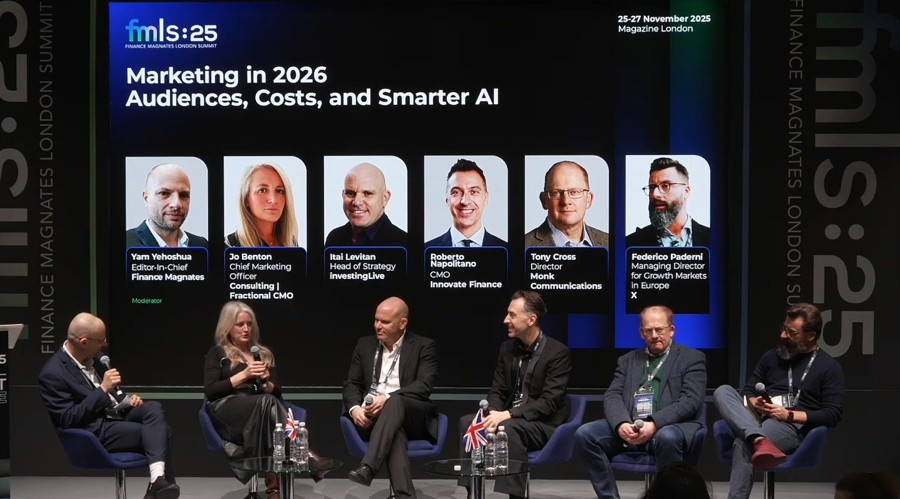
The panel on “AI and Marketing in Fintech” concluded that only strong brands and human judgement can keep firms visible in an AI-mediated landscape.
Organic traffic has already fallen by 30–50% for many fintech publishers as AI gateways intercept user journeys.
At FMLS 2025 industry panel on “AI and Marketing in Fintech”, senior marketers from Investing Live, Innovate Finance, ADSS and X delivered a blunt message: artificial intelligence is rewriting the rules of acquisition in finance – and many firms are not ready.
The End of the Google Era?
For more than two decades, digital marketing in finance has been built around Google – organic search at the top of the funnel and paid search further down. That model is now under pressure.
“For 20-plus years, the world of marketing was used to the very successful Google model,” said Itai Levitan, Head of Strategy at Investing Live. “Google was the 900lb gorilla. And we can start seeing a possibility that in the future that will be almost completely gone. ”
He noted that AI gateways like Gemini or ChatGPT changed the journey and many publishers had already seen organic traffic fall 30–50% as AI overlays intercept queries.
Jo Benton, the former ADSS executive, argued that the shift is exposing broader weaknesses:
“Performance masked weak brands for years. AI is just exposing it faster.”
Platforms are witnessing the same behavioural pivot. Federico Paderni, Managing Director for Growth Markets in Europe at X, said users now discover information differently from the search-led habits of the past decade.
“AI surfaces answers before they reach the source — discovery has moved up the stack,” he noted.
For content sites and even brokers, this raises a blunt strategic question: if users can get what they need from an AI interface, “what is the reason for them to come to me?”
From left: Yam Yehoshua, Jo Benton, Roberto Napolitano, Tony Cross, Federico Paderni
Infinite Content, Finite Trust
If discovery is changing, so is the content itself. AI has made it trivial to generate copy at scale – and that, several speakers warned, is creating a new kind of risk.
“We’ve now got the ability to create almost infinite content at close to zero cost,” said Tony Cross, Director at Monk Communications. “If we’re not careful about this, there’s going to be so much rubbish out there, people aren’t going to be able to find the truth in the noise.”
Levitan cited another cautionary tale: a site called AI Invest, which he said had grown rapidly on Google thanks to fully AI-generated content. “They dominated so much placement there, it was crazy,” he said. “And then Google did the spam update, and now their traffic is zero.”
Platforms, too, are struggling to maintain signal over noise. Federico Paderni, Managing Director for Growth Markets in Europe at X, noted that Grok now scans more than 100 million posts and videos per day to distinguish relevance from clutter.
Governance, Education and Uneven AI Adoption
The panel’s enthusiasm for AI was tempered by repeated calls for governance and internal education.
“There are some really strong commercial use cases,” Benton said, pointing to scaling production, automating optimisation and testing campaigns against synthetic audiences. “But what [AI] can’t replace and shouldn’t replace is that strategic thinking and judgement. That framework and governance around it is really, really important.”
Gross warned that organisations often adopt AI for the wrong reasons. “Someone senior hears ‘we can do more for less’ and pushes for automation without thinking about the quality implications,” he said. “And that’s how bad content slips out the door.”
Beyond Clicks: Reputation, Partnerships and Payback
Asked what marketers should measure “beyond clicks”, Roberto Napolitano, CMO at Innovate Finance, argued that traditional performance metrics are no longer sufficient.
“For us, KPIs are, first, reputation,” he said. “We know reputation is very hard to build but very easy to kill. It’s not just how many clicks you get, how many impressions you get, but what the sentiment in the market is about your organisation or your product.”
The second pillar, he added, is strategic partnerships. “Fintechs are partnering with other fintechs; they’re partnering with banks,” he said. “We need to be better at measuring the impact and the return on investment on partnerships.”
Other speakers agreed that narrow metrics no longer capture true performance. Benton noted that rigid CPA targets can limit growth. “Some of the most important channels in the funnel are the hardest to measure,” she said. “If you only reward last-click conversion, you underinvest in the activity that creates demand in the first place.”
Platforms are experiencing the same shift. Paderni said advertisers on X are moving away from pure CPA and towards longer-horizon metrics: “More partners are now looking at lifetime value and brand lift. They want to know how activity influences the whole journey, not just the final click.”
Measuring those effects remains difficult, particularly given the long time horizons and reputational risks if a partner runs into trouble. But Napolitano believes AI will eventually help firms quantify partnership value more precisely.
FMLS:25
Affiliates, Ambassadors and Broken Attribution
AI is also complicating longstanding acquisition models, not least in affiliates.
He predicted more publishers and comparison sites would favour hybrid or fixed-fee arrangements, while brands that cling to last-click, CPA-only models will “create a void” that better-funded competitors can fill.
Paderni, by contrast, highlighted X’s “affiliate programmes” as a way to turn customers into brand ambassadors rather than simple lead sources. Companies can assign badges to clients or employees, making their posts visibly associated with the brand. He cited eToro’s use of badges for “popular investors” as an example of “branding the content of their own clients to increase visibility and message”.
The broader point, echoed by several speakers, was that marketers should think less about buying clicks and more about mobilising their customer base as advocates – with or without financial incentives.
Looking Ahead: New Marketing Environment
For marketers, the immediate challenge is balancing AI’s advantages with its risks: discovery bottlenecks, content dilution and trust erosion.
AI may accelerate workflows and reshape acquisition paths, but it cannot replace the human judgement that underpins financial decision-making. The panel returned repeatedly to that tension.
“We’ve lost sight that we’re actually selling to human beings,” Benton reflected — a reminder that trust, clarity and authenticity still determine whether a customer engages or walks away. Firms that rebuild around those principles will remain visible in an AI-driven ecosystem; those that don’t may simply disappear from it.
At FMLS 2025 industry panel on “AI and Marketing in Fintech”, senior marketers from Investing Live, Innovate Finance, ADSS and X delivered a blunt message: artificial intelligence is rewriting the rules of acquisition in finance – and many firms are not ready.
The End of the Google Era?
For more than two decades, digital marketing in finance has been built around Google – organic search at the top of the funnel and paid search further down. That model is now under pressure.
“For 20-plus years, the world of marketing was used to the very successful Google model,” said Itai Levitan, Head of Strategy at Investing Live. “Google was the 900lb gorilla. And we can start seeing a possibility that in the future that will be almost completely gone. ”
He noted that AI gateways like Gemini or ChatGPT changed the journey and many publishers had already seen organic traffic fall 30–50% as AI overlays intercept queries.
Jo Benton, the former ADSS executive, argued that the shift is exposing broader weaknesses:
“Performance masked weak brands for years. AI is just exposing it faster.”
Platforms are witnessing the same behavioural pivot. Federico Paderni, Managing Director for Growth Markets in Europe at X, said users now discover information differently from the search-led habits of the past decade.
“AI surfaces answers before they reach the source — discovery has moved up the stack,” he noted.
For content sites and even brokers, this raises a blunt strategic question: if users can get what they need from an AI interface, “what is the reason for them to come to me?”
From left: Yam Yehoshua, Jo Benton, Roberto Napolitano, Tony Cross, Federico Paderni
Infinite Content, Finite Trust
If discovery is changing, so is the content itself. AI has made it trivial to generate copy at scale – and that, several speakers warned, is creating a new kind of risk.
“We’ve now got the ability to create almost infinite content at close to zero cost,” said Tony Cross, Director at Monk Communications. “If we’re not careful about this, there’s going to be so much rubbish out there, people aren’t going to be able to find the truth in the noise.”
Levitan cited another cautionary tale: a site called AI Invest, which he said had grown rapidly on Google thanks to fully AI-generated content. “They dominated so much placement there, it was crazy,” he said. “And then Google did the spam update, and now their traffic is zero.”
Platforms, too, are struggling to maintain signal over noise. Federico Paderni, Managing Director for Growth Markets in Europe at X, noted that Grok now scans more than 100 million posts and videos per day to distinguish relevance from clutter.
Governance, Education and Uneven AI Adoption
The panel’s enthusiasm for AI was tempered by repeated calls for governance and internal education.
“There are some really strong commercial use cases,” Benton said, pointing to scaling production, automating optimisation and testing campaigns against synthetic audiences. “But what [AI] can’t replace and shouldn’t replace is that strategic thinking and judgement. That framework and governance around it is really, really important.”
Gross warned that organisations often adopt AI for the wrong reasons. “Someone senior hears ‘we can do more for less’ and pushes for automation without thinking about the quality implications,” he said. “And that’s how bad content slips out the door.”
Beyond Clicks: Reputation, Partnerships and Payback
Asked what marketers should measure “beyond clicks”, Roberto Napolitano, CMO at Innovate Finance, argued that traditional performance metrics are no longer sufficient.
“For us, KPIs are, first, reputation,” he said. “We know reputation is very hard to build but very easy to kill. It’s not just how many clicks you get, how many impressions you get, but what the sentiment in the market is about your organisation or your product.”
The second pillar, he added, is strategic partnerships. “Fintechs are partnering with other fintechs; they’re partnering with banks,” he said. “We need to be better at measuring the impact and the return on investment on partnerships.”
Other speakers agreed that narrow metrics no longer capture true performance. Benton noted that rigid CPA targets can limit growth. “Some of the most important channels in the funnel are the hardest to measure,” she said. “If you only reward last-click conversion, you underinvest in the activity that creates demand in the first place.”
Platforms are experiencing the same shift. Paderni said advertisers on X are moving away from pure CPA and towards longer-horizon metrics: “More partners are now looking at lifetime value and brand lift. They want to know how activity influences the whole journey, not just the final click.”
Measuring those effects remains difficult, particularly given the long time horizons and reputational risks if a partner runs into trouble. But Napolitano believes AI will eventually help firms quantify partnership value more precisely.
FMLS:25
Affiliates, Ambassadors and Broken Attribution
AI is also complicating longstanding acquisition models, not least in affiliates.
He predicted more publishers and comparison sites would favour hybrid or fixed-fee arrangements, while brands that cling to last-click, CPA-only models will “create a void” that better-funded competitors can fill.
Paderni, by contrast, highlighted X’s “affiliate programmes” as a way to turn customers into brand ambassadors rather than simple lead sources. Companies can assign badges to clients or employees, making their posts visibly associated with the brand. He cited eToro’s use of badges for “popular investors” as an example of “branding the content of their own clients to increase visibility and message”.
The broader point, echoed by several speakers, was that marketers should think less about buying clicks and more about mobilising their customer base as advocates – with or without financial incentives.
Looking Ahead: New Marketing Environment
For marketers, the immediate challenge is balancing AI’s advantages with its risks: discovery bottlenecks, content dilution and trust erosion.
AI may accelerate workflows and reshape acquisition paths, but it cannot replace the human judgement that underpins financial decision-making. The panel returned repeatedly to that tension.
“We’ve lost sight that we’re actually selling to human beings,” Benton reflected — a reminder that trust, clarity and authenticity still determine whether a customer engages or walks away. Firms that rebuild around those principles will remain visible in an AI-driven ecosystem; those that don’t may simply disappear from it.
Tanya Chepkova is a News Editor at Finance Magnates with more than 16 years of experience in financial journalism, covering forex, crypto, and digital asset markets. Her work spans daily industry reporting and data-driven, long-form explainers focused on market structure, trading models, and regulatory shifts.
Before joining Finance Magnates, she led the editorial team of a cryptocurrency-focused media outlet for six years. Her reporting combines analytical depth with clear storytelling, with particular attention to how structural changes in trading, stablecoin infrastructure, and emerging products such as prediction markets reshape the broader financial ecosystem. She covers global developments and provides additional insight into CIS markets.
Areas of Coverage:
Crypto and digital asset markets
Prediction markets
Stablecoins and cross-border payments
Industry analysis and long-form explainers
Airwallex Wins Key Malaysian License for Full Services, Including Payments and FX Platform
Featured Videos
FP Markets Winner Spotlight 🏆 | Global Broker of the Year 2025 #Trading #Broker #Innovation #Shorts
FP Markets Winner Spotlight 🏆 | Global Broker of the Year 2025 #Trading #Broker #Innovation #Shorts
FP Markets Winner Spotlight 🏆 | Global Broker of the Year 2025 #Trading #Broker #Innovation #Shorts
FP Markets Winner Spotlight 🏆 | Global Broker of the Year 2025 #Trading #Broker #Innovation #Shorts
FP Markets takes the spotlight as Global Broker of the Year 2025 at the Finance Magnates Awards.
Martin Stoilov, Head of Client Experience, shares that trust, innovation, and people played a key role in the company’s success, supported by a strong foundation of integrity and client-centricity.
Following this milestone, FP Markets continues to focus on growth, technology investment, and its core values of transparency and excellence.
👉 Be part of FM Awards 2026: https://awards.financemagnates.com/#nominate
FP Markets takes the spotlight as Global Broker of the Year 2025 at the Finance Magnates Awards.
Martin Stoilov, Head of Client Experience, shares that trust, innovation, and people played a key role in the company’s success, supported by a strong foundation of integrity and client-centricity.
Following this milestone, FP Markets continues to focus on growth, technology investment, and its core values of transparency and excellence.
👉 Be part of FM Awards 2026: https://awards.financemagnates.com/#nominate
FP Markets takes the spotlight as Global Broker of the Year 2025 at the Finance Magnates Awards.
Martin Stoilov, Head of Client Experience, shares that trust, innovation, and people played a key role in the company’s success, supported by a strong foundation of integrity and client-centricity.
Following this milestone, FP Markets continues to focus on growth, technology investment, and its core values of transparency and excellence.
👉 Be part of FM Awards 2026: https://awards.financemagnates.com/#nominate
FP Markets takes the spotlight as Global Broker of the Year 2025 at the Finance Magnates Awards.
Martin Stoilov, Head of Client Experience, shares that trust, innovation, and people played a key role in the company’s success, supported by a strong foundation of integrity and client-centricity.
Following this milestone, FP Markets continues to focus on growth, technology investment, and its core values of transparency and excellence.
👉 Be part of FM Awards 2026: https://awards.financemagnates.com/#nominate
In this video, we review @HolaPrimeMarketsOfficial, a multi-asset forex and CFDs broker offering different account types, trading platforms, and flexible trading conditions.
We cover the broker’s overall offering, including account options, trading environment, platforms like MT4 and MT5, and additional services such as managed accounts and fast withdrawals.
Watch the full video to see if Hola Prime Markets fits your trading needs.
📣 Stay up to date with the latest in finance and trading. Follow Finance Magnates for industry news, insights, and global event coverage.
Connect with us:
🔗 LinkedIn: /financemagnates
👍 Facebook: /financemagnates
📸 Instagram: https://www.instagram.com/financemagnates
🐦 X: https://x.com/financemagnates
🎥 TikTok: https://www.tiktok.com/tag/financemagnates
▶️ YouTube: /@financemagnates_official
#HolaPrime #ForexBroker #CFDTrading #FinanceMagnates #Trading #Forex #BrokerReview
In this video, we review @HolaPrimeMarketsOfficial, a multi-asset forex and CFDs broker offering different account types, trading platforms, and flexible trading conditions.
We cover the broker’s overall offering, including account options, trading environment, platforms like MT4 and MT5, and additional services such as managed accounts and fast withdrawals.
Watch the full video to see if Hola Prime Markets fits your trading needs.
📣 Stay up to date with the latest in finance and trading. Follow Finance Magnates for industry news, insights, and global event coverage.
Connect with us:
🔗 LinkedIn: /financemagnates
👍 Facebook: /financemagnates
📸 Instagram: https://www.instagram.com/financemagnates
🐦 X: https://x.com/financemagnates
🎥 TikTok: https://www.tiktok.com/tag/financemagnates
▶️ YouTube: /@financemagnates_official
#HolaPrime #ForexBroker #CFDTrading #FinanceMagnates #Trading #Forex #BrokerReview
In this video, we review @HolaPrimeMarketsOfficial, a multi-asset forex and CFDs broker offering different account types, trading platforms, and flexible trading conditions.
We cover the broker’s overall offering, including account options, trading environment, platforms like MT4 and MT5, and additional services such as managed accounts and fast withdrawals.
Watch the full video to see if Hola Prime Markets fits your trading needs.
📣 Stay up to date with the latest in finance and trading. Follow Finance Magnates for industry news, insights, and global event coverage.
Connect with us:
🔗 LinkedIn: /financemagnates
👍 Facebook: /financemagnates
📸 Instagram: https://www.instagram.com/financemagnates
🐦 X: https://x.com/financemagnates
🎥 TikTok: https://www.tiktok.com/tag/financemagnates
▶️ YouTube: /@financemagnates_official
#HolaPrime #ForexBroker #CFDTrading #FinanceMagnates #Trading #Forex #BrokerReview
In this video, we review @HolaPrimeMarketsOfficial, a multi-asset forex and CFDs broker offering different account types, trading platforms, and flexible trading conditions.
We cover the broker’s overall offering, including account options, trading environment, platforms like MT4 and MT5, and additional services such as managed accounts and fast withdrawals.
Watch the full video to see if Hola Prime Markets fits your trading needs.
📣 Stay up to date with the latest in finance and trading. Follow Finance Magnates for industry news, insights, and global event coverage.
Connect with us:
🔗 LinkedIn: /financemagnates
👍 Facebook: /financemagnates
📸 Instagram: https://www.instagram.com/financemagnates
🐦 X: https://x.com/financemagnates
🎥 TikTok: https://www.tiktok.com/tag/financemagnates
▶️ YouTube: /@financemagnates_official
#HolaPrime #ForexBroker #CFDTrading #FinanceMagnates #Trading #Forex #BrokerReview
In this video, we review @HolaPrimeMarketsOfficial, a multi-asset forex and CFDs broker offering different account types, trading platforms, and flexible trading conditions.
We cover the broker’s overall offering, including account options, trading environment, platforms like MT4 and MT5, and additional services such as managed accounts and fast withdrawals.
Watch the full video to see if Hola Prime Markets fits your trading needs.
📣 Stay up to date with the latest in finance and trading. Follow Finance Magnates for industry news, insights, and global event coverage.
Connect with us:
🔗 LinkedIn: /financemagnates
👍 Facebook: /financemagnates
📸 Instagram: https://www.instagram.com/financemagnates
🐦 X: https://x.com/financemagnates
🎥 TikTok: https://www.tiktok.com/tag/financemagnates
▶️ YouTube: /@financemagnates_official
#HolaPrime #ForexBroker #CFDTrading #FinanceMagnates #Trading #Forex #BrokerReview
In this video, we review @HolaPrimeMarketsOfficial, a multi-asset forex and CFDs broker offering different account types, trading platforms, and flexible trading conditions.
We cover the broker’s overall offering, including account options, trading environment, platforms like MT4 and MT5, and additional services such as managed accounts and fast withdrawals.
Watch the full video to see if Hola Prime Markets fits your trading needs.
📣 Stay up to date with the latest in finance and trading. Follow Finance Magnates for industry news, insights, and global event coverage.
Connect with us:
🔗 LinkedIn: /financemagnates
👍 Facebook: /financemagnates
📸 Instagram: https://www.instagram.com/financemagnates
🐦 X: https://x.com/financemagnates
🎥 TikTok: https://www.tiktok.com/tag/financemagnates
▶️ YouTube: /@financemagnates_official
#HolaPrime #ForexBroker #CFDTrading #FinanceMagnates #Trading #Forex #BrokerReview
Hola Prime Review: What You Need to Know | Full Breakdown by Finance Magnates
Hola Prime Review: What You Need to Know | Full Breakdown by Finance Magnates
Hola Prime Review: What You Need to Know | Full Breakdown by Finance Magnates
Hola Prime Review: What You Need to Know | Full Breakdown by Finance Magnates
Hola Prime Review: What You Need to Know | Full Breakdown by Finance Magnates
Hola Prime Review: What You Need to Know | Full Breakdown by Finance Magnates
In this video, we review @HolaPrime_Global, a proprietary trading firm offering evaluation programs and performance-based payouts in simulated market environments.
We cover how the challenge model works, including account types, profit splits (up to 95%), trading rules, and what it takes to reach a funded account. You’ll also learn about available platforms like MT4, MT5, cTrader, and more, along with insights into payouts, support, and trading conditions.
Watch the full video to see if Hola Prime fits your trading style.
📣 Stay up to date with the latest in finance and trading. Follow Finance Magnates for industry news, insights, and global event coverage.
Connect with us:
🔗 LinkedIn: /financemagnates
👍 Facebook: /financemagnates
📸 Instagram: https://www.instagram.com/financemagnates
🐦 X: https://x.com/financemagnates
🎥 TikTok: https://www.tiktok.com/tag/financemagnates
▶️ YouTube: /@financemagnates_official
#HolaPrime #PropFirm #Trading #FinanceMagnates #Forex #FuturesTrading #TradingReview #PropFirmReview
In this video, we review @HolaPrime_Global, a proprietary trading firm offering evaluation programs and performance-based payouts in simulated market environments.
We cover how the challenge model works, including account types, profit splits (up to 95%), trading rules, and what it takes to reach a funded account. You’ll also learn about available platforms like MT4, MT5, cTrader, and more, along with insights into payouts, support, and trading conditions.
Watch the full video to see if Hola Prime fits your trading style.
📣 Stay up to date with the latest in finance and trading. Follow Finance Magnates for industry news, insights, and global event coverage.
Connect with us:
🔗 LinkedIn: /financemagnates
👍 Facebook: /financemagnates
📸 Instagram: https://www.instagram.com/financemagnates
🐦 X: https://x.com/financemagnates
🎥 TikTok: https://www.tiktok.com/tag/financemagnates
▶️ YouTube: /@financemagnates_official
#HolaPrime #PropFirm #Trading #FinanceMagnates #Forex #FuturesTrading #TradingReview #PropFirmReview
In this video, we review @HolaPrime_Global, a proprietary trading firm offering evaluation programs and performance-based payouts in simulated market environments.
We cover how the challenge model works, including account types, profit splits (up to 95%), trading rules, and what it takes to reach a funded account. You’ll also learn about available platforms like MT4, MT5, cTrader, and more, along with insights into payouts, support, and trading conditions.
Watch the full video to see if Hola Prime fits your trading style.
📣 Stay up to date with the latest in finance and trading. Follow Finance Magnates for industry news, insights, and global event coverage.
Connect with us:
🔗 LinkedIn: /financemagnates
👍 Facebook: /financemagnates
📸 Instagram: https://www.instagram.com/financemagnates
🐦 X: https://x.com/financemagnates
🎥 TikTok: https://www.tiktok.com/tag/financemagnates
▶️ YouTube: /@financemagnates_official
#HolaPrime #PropFirm #Trading #FinanceMagnates #Forex #FuturesTrading #TradingReview #PropFirmReview
In this video, we review @HolaPrime_Global, a proprietary trading firm offering evaluation programs and performance-based payouts in simulated market environments.
We cover how the challenge model works, including account types, profit splits (up to 95%), trading rules, and what it takes to reach a funded account. You’ll also learn about available platforms like MT4, MT5, cTrader, and more, along with insights into payouts, support, and trading conditions.
Watch the full video to see if Hola Prime fits your trading style.
📣 Stay up to date with the latest in finance and trading. Follow Finance Magnates for industry news, insights, and global event coverage.
Connect with us:
🔗 LinkedIn: /financemagnates
👍 Facebook: /financemagnates
📸 Instagram: https://www.instagram.com/financemagnates
🐦 X: https://x.com/financemagnates
🎥 TikTok: https://www.tiktok.com/tag/financemagnates
▶️ YouTube: /@financemagnates_official
#HolaPrime #PropFirm #Trading #FinanceMagnates #Forex #FuturesTrading #TradingReview #PropFirmReview
In this video, we review @HolaPrime_Global, a proprietary trading firm offering evaluation programs and performance-based payouts in simulated market environments.
We cover how the challenge model works, including account types, profit splits (up to 95%), trading rules, and what it takes to reach a funded account. You’ll also learn about available platforms like MT4, MT5, cTrader, and more, along with insights into payouts, support, and trading conditions.
Watch the full video to see if Hola Prime fits your trading style.
📣 Stay up to date with the latest in finance and trading. Follow Finance Magnates for industry news, insights, and global event coverage.
Connect with us:
🔗 LinkedIn: /financemagnates
👍 Facebook: /financemagnates
📸 Instagram: https://www.instagram.com/financemagnates
🐦 X: https://x.com/financemagnates
🎥 TikTok: https://www.tiktok.com/tag/financemagnates
▶️ YouTube: /@financemagnates_official
#HolaPrime #PropFirm #Trading #FinanceMagnates #Forex #FuturesTrading #TradingReview #PropFirmReview
In this video, we review @HolaPrime_Global, a proprietary trading firm offering evaluation programs and performance-based payouts in simulated market environments.
We cover how the challenge model works, including account types, profit splits (up to 95%), trading rules, and what it takes to reach a funded account. You’ll also learn about available platforms like MT4, MT5, cTrader, and more, along with insights into payouts, support, and trading conditions.
Watch the full video to see if Hola Prime fits your trading style.
📣 Stay up to date with the latest in finance and trading. Follow Finance Magnates for industry news, insights, and global event coverage.
Connect with us:
🔗 LinkedIn: /financemagnates
👍 Facebook: /financemagnates
📸 Instagram: https://www.instagram.com/financemagnates
🐦 X: https://x.com/financemagnates
🎥 TikTok: https://www.tiktok.com/tag/financemagnates
▶️ YouTube: /@financemagnates_official
#HolaPrime #PropFirm #Trading #FinanceMagnates #Forex #FuturesTrading #TradingReview #PropFirmReview
Axi Winner Spotlight 🏆 | Global Most Innovative Broker 2025 #Innovation #Trading #Fintech #Broker
Axi Winner Spotlight 🏆 | Global Most Innovative Broker 2025 #Innovation #Trading #Fintech #Broker
Axi Winner Spotlight 🏆 | Global Most Innovative Broker 2025 #Innovation #Trading #Fintech #Broker
Axi Winner Spotlight 🏆 | Global Most Innovative Broker 2025 #Innovation #Trading #Fintech #Broker
Axi Winner Spotlight 🏆 | Global Most Innovative Broker 2025 #Innovation #Trading #Fintech #Broker
Axi Winner Spotlight 🏆 | Global Most Innovative Broker 2025 #Innovation #Trading #Fintech #Broker
Axi takes the spotlight at the Finance Magnates Awards, winning Global Most Innovative Broker 2025.
Olivia Xenofontos and Ivanna Openko share how the team will feel: proud, motivated, and ready to keep delivering.
They also describe the night as well-organized, focused, and enjoyable for all.
👉 Be part of FM Awards 2026.
Axi takes the spotlight at the Finance Magnates Awards, winning Global Most Innovative Broker 2025.
Olivia Xenofontos and Ivanna Openko share how the team will feel: proud, motivated, and ready to keep delivering.
They also describe the night as well-organized, focused, and enjoyable for all.
👉 Be part of FM Awards 2026.
Axi takes the spotlight at the Finance Magnates Awards, winning Global Most Innovative Broker 2025.
Olivia Xenofontos and Ivanna Openko share how the team will feel: proud, motivated, and ready to keep delivering.
They also describe the night as well-organized, focused, and enjoyable for all.
👉 Be part of FM Awards 2026.
Axi takes the spotlight at the Finance Magnates Awards, winning Global Most Innovative Broker 2025.
Olivia Xenofontos and Ivanna Openko share how the team will feel: proud, motivated, and ready to keep delivering.
They also describe the night as well-organized, focused, and enjoyable for all.
👉 Be part of FM Awards 2026.
Axi takes the spotlight at the Finance Magnates Awards, winning Global Most Innovative Broker 2025.
Olivia Xenofontos and Ivanna Openko share how the team will feel: proud, motivated, and ready to keep delivering.
They also describe the night as well-organized, focused, and enjoyable for all.
👉 Be part of FM Awards 2026.
Axi takes the spotlight at the Finance Magnates Awards, winning Global Most Innovative Broker 2025.
Olivia Xenofontos and Ivanna Openko share how the team will feel: proud, motivated, and ready to keep delivering.
They also describe the night as well-organized, focused, and enjoyable for all.
👉 Be part of FM Awards 2026.
Recognition that matters.
Built on transparency.
Driven by the industry.
The Finance Magnates Awards 2026.
Nominations are now open.
🔗 https://awards.financemagnates.com/?utm_source=SM&utm_medium=social&utm_campaign=recognition-matters
Recognition that matters.
Built on transparency.
Driven by the industry.
The Finance Magnates Awards 2026.
Nominations are now open.
🔗 https://awards.financemagnates.com/?utm_source=SM&utm_medium=social&utm_campaign=recognition-matters
Recognition that matters.
Built on transparency.
Driven by the industry.
The Finance Magnates Awards 2026.
Nominations are now open.
🔗 https://awards.financemagnates.com/?utm_source=SM&utm_medium=social&utm_campaign=recognition-matters
Recognition that matters.
Built on transparency.
Driven by the industry.
The Finance Magnates Awards 2026.
Nominations are now open.
🔗 https://awards.financemagnates.com/?utm_source=SM&utm_medium=social&utm_campaign=recognition-matters
Recognition that matters.
Built on transparency.
Driven by the industry.
The Finance Magnates Awards 2026.
Nominations are now open.
🔗 https://awards.financemagnates.com/?utm_source=SM&utm_medium=social&utm_campaign=recognition-matters
Recognition that matters.
Built on transparency.
Driven by the industry.
The Finance Magnates Awards 2026.
Nominations are now open.
🔗 https://awards.financemagnates.com/?utm_source=SM&utm_medium=social&utm_campaign=recognition-matters