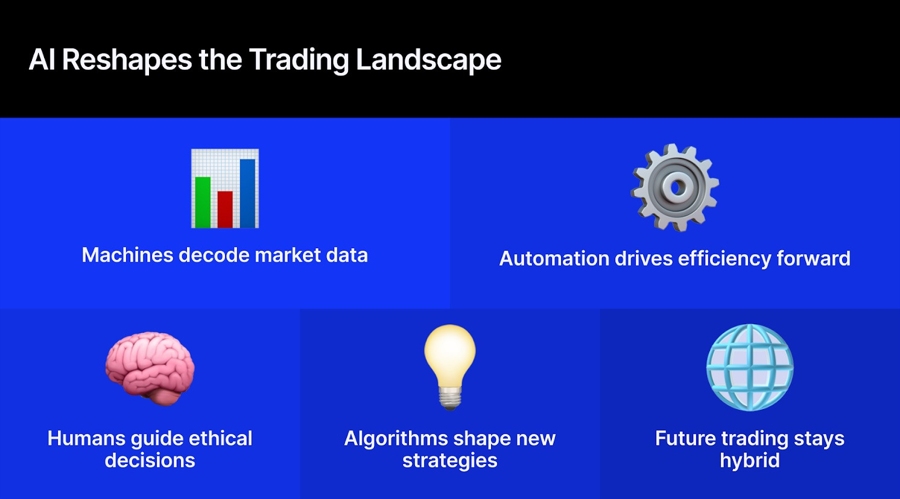
AI is redefining how traders analyze markets, automate decisions, and execute strategies.
Oversight remains essential to maintain trust, explain decisions, manage risks AI can’t.
The next era of trading will be hybrid, machines driving efficiency, people monitoring.
AI is transforming trading, automating execution, decoding data, and
amplifying strategy. But as machines gain autonomy, brokers and traders must
balance efficiency with ethics, keeping human judgment at the core.
The
question facing brokers, platform providers and traders alike is no longer
whether AI will transform the way markets function, but how far that
transformation can realistically go, and where the limits must be drawn.
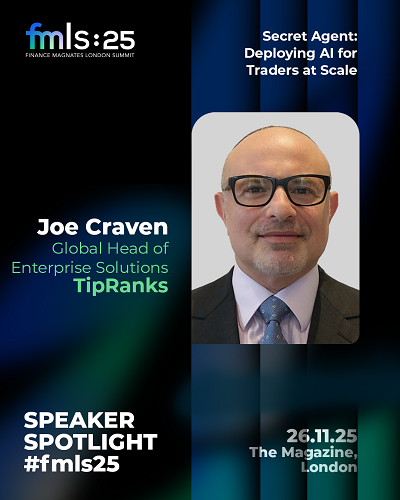
At this year’s Finance Magnates London Summit (FMLS:25), the
panel “Secret Agent: Deploying AI for Traders at Scale” will bring together
leading voices shaping the next frontier of AI in financial services. Moderated
by Joe Craven, Global Head of Enterprise Solutions at TipRanks, the session will
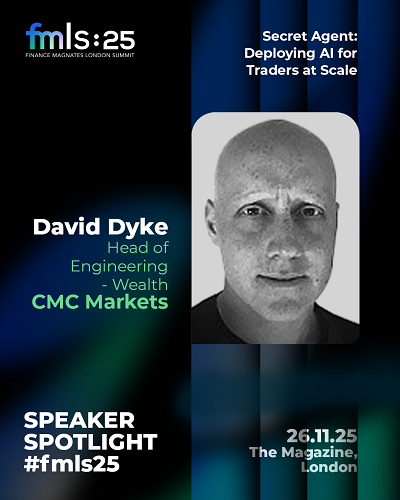
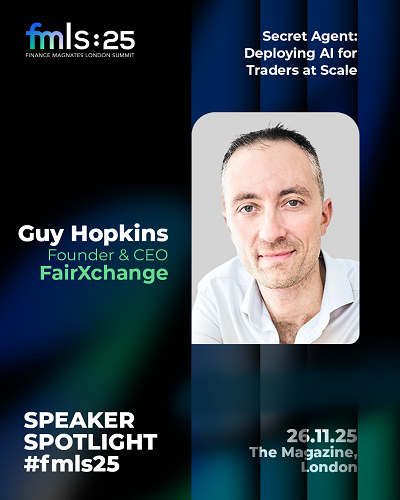
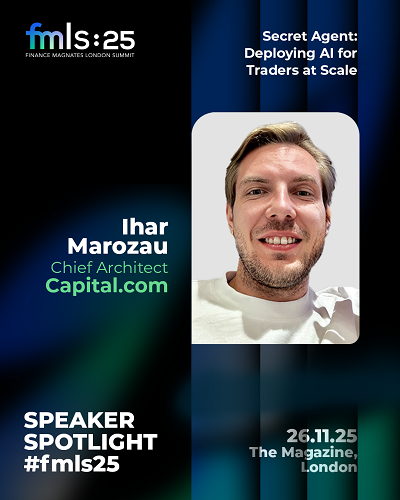
feature David Dyke, Head of engineering,- Wealth, CMC Markets, Guy Hopkins, Founder and CEO, FairXchange, and Ihar Marozau,
Chief Architect, Capital.com
Together, they’ll explore how AI is
redefining the boundaries of trading and investment, from the ethics of
automation and the realities of implementation to what human intuition still
does best. Expect a frank, forward-looking discussion on tech, trust, and
trader behavior in an era where algorithms are the new secret agents of
finance.
What AI Can (and Cannot) Replace
At its best, AI serves as a powerful co-pilot for traders. Machine
learning systems excel at processing vast quantities of market data,
identifying patterns, and generating signals that could be invisible to human
eyes.
Platforms such as Capitalise.ai,
which lets traders automate strategies using natural language commands, show
how AI can take over repetitive execution tasks and strip emotion out of
decisions. Similarly, Trade Ideas has popularized its “Holly” AI
engine, which scans markets in real time and generates actionable trade
suggestions according to various strategies.
Human
traders and advisors remain indispensable when narratives change abruptly, during
geopolitical shocks, unexpected regulatory interventions, or crises of
confidence that can never be fully modelled. Trust, accountability, and the
ability to interpret nuance continue to sit firmly with people.
Across the trading landscape, AI is moving from experimental tools to
everyday use. Retail traders are increasingly turning to accessible platforms
like Tickeron, which provides AI-driven
forecasts and price predictions.
Social trading services such as ZuluTrade or eToro allow users to follow and replicate
algorithmic strategies designed by experienced signal providers in the logical
advancement of copy trading.
In China, Tiger Brokers has gone a step further by
embedding
the DeepSeek AI model into its services, offering clients enhanced research
and risk analysis capabilities. These are but a few examples of how AI is
rapidly changing the nature of the industry.
🚨BREAKING: A new Python library for algorithmic trading.
Introducing TensorTrade: An open-source Python framework for trading using Reinforcement Learning (AI) pic.twitter.com/d9QWRBj1iT
This lack of explainability risks
undermining trust among both regulators and clients. Ethical risks, from biased
models to the potential for destabilizing feedback loops, must also be
addressed at the design stage. Bodies such as FINRA have issued guidelines
on how AI systems must be tailored toward transparency.
Beyond regulation, there are practical challenges. Models must be
retrained to stay relevant as market regimes evolve, requiring continuous
investment in data infrastructure and talent. Legacy systems at many brokerages
are
poorly equipped to integrate modular AI tools, slowing adoption.
Even when
models work well, persuading clients to trust them is another barrier. Behavioral
resistance, whether from retail users wary of losing control, or advisors
reluctant to cede authority, remains a persistent drag on adoption.
Ethics and the Human Boundary
This tension between machine intelligence and human judgment brings
ethical boundaries into sharp focus. AI can streamline execution and enhance
efficiency, but decisions about fairness, market integrity, and client trust
must remain human. Clients might expect to know when recommendations are
generated by AI, what assumptions underpin them, and where the risks lie.
Equally, firms must guard against the risk of over-dependence, ensuring that
human expertise does not atrophy as machines take on greater responsibility.
The ultimate safeguard is clear human oversight: protocols for intervention,
override and accountability when systems go wrong.
🤔 What Are AI Ethics?
As AI continues to evolve, so do the ethical questions surrounding its use. AI ethics is a framework of principles designed to ensure AI technologies are developed and deployed responsibly.
Looking forward, the future of AI in trading is likely to be hybrid.
Brokers will continue to develop ecosystems in which algorithms provide
efficiency, scale, and precision, while humans deliver oversight, trust, and
narrative interpretation. Platforms are already hinting at this shift. Nansen recently launched an AI chatbot
designed for crypto traders that was built on Anthropic’s Claude.
The move
represents an early step toward fully autonomous, user-defined portfolio management,
though at present it’s billed as an assistant. Zerodha’s
CEO has argued that brokers may evolve into infrastructure providers,
offering pipes that connect clients to markets while AI tools handle much of
the interaction.
The likely trajectory points toward the use of configurable, focused AI
modules, explainable systems designed to satisfy regulators, and new user
interfaces where investors interact with AI advisors through voice, chat or
even immersive environments. What will matter most is not raw technological
horsepower, but the ability to integrate machine insights with human oversight
in a way that builds durable trust.
Final Thoughts
AI has already changed the way traders approach markets, from retail
platforms that democratize access to chatbots to institutional agents being
able to test strategies at scale. But its true role should not be to replace human
intelligence, it should be a partner that can augment, accelerate and
discipline decision-making.
The brokers and platforms that succeed in the
coming years will be those that strike the right balance between algorithmic
precision and human judgment, embedding ethical boundaries and transparency at
every step. In doing so, they will not only shape the future of advice,
autonomy and algorithms, but also redefine what it means to trade in an age
where the secret agent on your side is artificial intelligence itself.
AI is transforming trading, automating execution, decoding data, and
amplifying strategy. But as machines gain autonomy, brokers and traders must
balance efficiency with ethics, keeping human judgment at the core.
The
question facing brokers, platform providers and traders alike is no longer
whether AI will transform the way markets function, but how far that
transformation can realistically go, and where the limits must be drawn.
At this year’s Finance Magnates London Summit (FMLS:25), the
panel “Secret Agent: Deploying AI for Traders at Scale” will bring together
leading voices shaping the next frontier of AI in financial services. Moderated
by Joe Craven, Global Head of Enterprise Solutions at TipRanks, the session will
feature David Dyke, Head of engineering,- Wealth, CMC Markets, Guy Hopkins, Founder and CEO, FairXchange, and Ihar Marozau,
Chief Architect, Capital.com
Together, they’ll explore how AI is
redefining the boundaries of trading and investment, from the ethics of
automation and the realities of implementation to what human intuition still
does best. Expect a frank, forward-looking discussion on tech, trust, and
trader behavior in an era where algorithms are the new secret agents of
finance.
What AI Can (and Cannot) Replace
At its best, AI serves as a powerful co-pilot for traders. Machine
learning systems excel at processing vast quantities of market data,
identifying patterns, and generating signals that could be invisible to human
eyes.
Platforms such as Capitalise.ai,
which lets traders automate strategies using natural language commands, show
how AI can take over repetitive execution tasks and strip emotion out of
decisions. Similarly, Trade Ideas has popularized its “Holly” AI
engine, which scans markets in real time and generates actionable trade
suggestions according to various strategies.
Human
traders and advisors remain indispensable when narratives change abruptly, during
geopolitical shocks, unexpected regulatory interventions, or crises of
confidence that can never be fully modelled. Trust, accountability, and the
ability to interpret nuance continue to sit firmly with people.
Across the trading landscape, AI is moving from experimental tools to
everyday use. Retail traders are increasingly turning to accessible platforms
like Tickeron, which provides AI-driven
forecasts and price predictions.
Social trading services such as ZuluTrade or eToro allow users to follow and replicate
algorithmic strategies designed by experienced signal providers in the logical
advancement of copy trading.
In China, Tiger Brokers has gone a step further by
embedding
the DeepSeek AI model into its services, offering clients enhanced research
and risk analysis capabilities. These are but a few examples of how AI is
rapidly changing the nature of the industry.
🚨BREAKING: A new Python library for algorithmic trading.
Introducing TensorTrade: An open-source Python framework for trading using Reinforcement Learning (AI) pic.twitter.com/d9QWRBj1iT
This lack of explainability risks
undermining trust among both regulators and clients. Ethical risks, from biased
models to the potential for destabilizing feedback loops, must also be
addressed at the design stage. Bodies such as FINRA have issued guidelines
on how AI systems must be tailored toward transparency.
Beyond regulation, there are practical challenges. Models must be
retrained to stay relevant as market regimes evolve, requiring continuous
investment in data infrastructure and talent. Legacy systems at many brokerages
are
poorly equipped to integrate modular AI tools, slowing adoption.
Even when
models work well, persuading clients to trust them is another barrier. Behavioral
resistance, whether from retail users wary of losing control, or advisors
reluctant to cede authority, remains a persistent drag on adoption.
Ethics and the Human Boundary
This tension between machine intelligence and human judgment brings
ethical boundaries into sharp focus. AI can streamline execution and enhance
efficiency, but decisions about fairness, market integrity, and client trust
must remain human. Clients might expect to know when recommendations are
generated by AI, what assumptions underpin them, and where the risks lie.
Equally, firms must guard against the risk of over-dependence, ensuring that
human expertise does not atrophy as machines take on greater responsibility.
The ultimate safeguard is clear human oversight: protocols for intervention,
override and accountability when systems go wrong.
🤔 What Are AI Ethics?
As AI continues to evolve, so do the ethical questions surrounding its use. AI ethics is a framework of principles designed to ensure AI technologies are developed and deployed responsibly.
Looking forward, the future of AI in trading is likely to be hybrid.
Brokers will continue to develop ecosystems in which algorithms provide
efficiency, scale, and precision, while humans deliver oversight, trust, and
narrative interpretation. Platforms are already hinting at this shift. Nansen recently launched an AI chatbot
designed for crypto traders that was built on Anthropic’s Claude.
The move
represents an early step toward fully autonomous, user-defined portfolio management,
though at present it’s billed as an assistant. Zerodha’s
CEO has argued that brokers may evolve into infrastructure providers,
offering pipes that connect clients to markets while AI tools handle much of
the interaction.
The likely trajectory points toward the use of configurable, focused AI
modules, explainable systems designed to satisfy regulators, and new user
interfaces where investors interact with AI advisors through voice, chat or
even immersive environments. What will matter most is not raw technological
horsepower, but the ability to integrate machine insights with human oversight
in a way that builds durable trust.
Final Thoughts
AI has already changed the way traders approach markets, from retail
platforms that democratize access to chatbots to institutional agents being
able to test strategies at scale. But its true role should not be to replace human
intelligence, it should be a partner that can augment, accelerate and
discipline decision-making.
The brokers and platforms that succeed in the
coming years will be those that strike the right balance between algorithmic
precision and human judgment, embedding ethical boundaries and transparency at
every step. In doing so, they will not only shape the future of advice,
autonomy and algorithms, but also redefine what it means to trade in an age
where the secret agent on your side is artificial intelligence itself.
Louis Parks has lived and worked in and around the Middle East for much of his professional career. He writes about the meeting of the tech and finance worlds.
Polymarket Adds Self-Exclusion and Deposit Limits for Prediction Traders
Featured Videos
AvaTrade to Acquire Most of FXCM; NAGA Raises $8M
AvaTrade to Acquire Most of FXCM; NAGA Raises $8M
AvaTrade to Acquire Most of FXCM; NAGA Raises $8M
AvaTrade to Acquire Most of FXCM; NAGA Raises $8M
Today’s financial news recap covers AvaTrade agrees to acquire most of FXCM, NAGA secures eight million dollars in new financing, and Wise seeks a tax settlement in the UK.
Finance Magnates Daily Recap brings you the latest news from forex and CFD brokers, fintech, payments, cryptocurrency, digital assets, trading platforms, financial regulation and global markets.
Get the key company news, executive moves, deals, regulatory updates and market developments of the day, in just a few minutes. New episodes published every weekday.
Read more: https://www.financemagnates.com
#FinanceMagnates #ForexNews #FintechNews
Today’s financial news recap covers AvaTrade agrees to acquire most of FXCM, NAGA secures eight million dollars in new financing, and Wise seeks a tax settlement in the UK.
Finance Magnates Daily Recap brings you the latest news from forex and CFD brokers, fintech, payments, cryptocurrency, digital assets, trading platforms, financial regulation and global markets.
Get the key company news, executive moves, deals, regulatory updates and market developments of the day, in just a few minutes. New episodes published every weekday.
Read more: https://www.financemagnates.com
#FinanceMagnates #ForexNews #FintechNews
Today’s financial news recap covers AvaTrade agrees to acquire most of FXCM, NAGA secures eight million dollars in new financing, and Wise seeks a tax settlement in the UK.
Finance Magnates Daily Recap brings you the latest news from forex and CFD brokers, fintech, payments, cryptocurrency, digital assets, trading platforms, financial regulation and global markets.
Get the key company news, executive moves, deals, regulatory updates and market developments of the day, in just a few minutes. New episodes published every weekday.
Read more: https://www.financemagnates.com
#FinanceMagnates #ForexNews #FintechNews
Today’s financial news recap covers AvaTrade agrees to acquire most of FXCM, NAGA secures eight million dollars in new financing, and Wise seeks a tax settlement in the UK.
Finance Magnates Daily Recap brings you the latest news from forex and CFD brokers, fintech, payments, cryptocurrency, digital assets, trading platforms, financial regulation and global markets.
Get the key company news, executive moves, deals, regulatory updates and market developments of the day, in just a few minutes. New episodes published every weekday.
Read more: https://www.financemagnates.com
#FinanceMagnates #ForexNews #FintechNews
XTB Adds Overnight US Stock Trading; Nasdaq Ventures Invests in One Trading
XTB Adds Overnight US Stock Trading; Nasdaq Ventures Invests in One Trading
XTB Adds Overnight US Stock Trading; Nasdaq Ventures Invests in One Trading
XTB Adds Overnight US Stock Trading; Nasdaq Ventures Invests in One Trading
XTB Adds Overnight US Stock Trading; Nasdaq Ventures Invests in One Trading
XTB Adds Overnight US Stock Trading; Nasdaq Ventures Invests in One Trading
Today’s financial news recap covers XTB expands overnight US stock trading, Fortrade reports higher revenue, Nasdaq backs One Trading, and Vest Labs raises 13 million dollars.
Finance Magnates Daily Recap brings you the latest news from forex and CFD brokers, fintech, payments, cryptocurrency, digital assets, trading platforms, financial regulation and global markets.
Get the key company news, executive moves, deals, regulatory updates and market developments of the day, in just a few minutes. New episodes published every weekday.
Read more: https://www.financemagnates.com
#FinanceMagnates #ForexNews #FintechNews
Today’s financial news recap covers XTB expands overnight US stock trading, Fortrade reports higher revenue, Nasdaq backs One Trading, and Vest Labs raises 13 million dollars.
Finance Magnates Daily Recap brings you the latest news from forex and CFD brokers, fintech, payments, cryptocurrency, digital assets, trading platforms, financial regulation and global markets.
Get the key company news, executive moves, deals, regulatory updates and market developments of the day, in just a few minutes. New episodes published every weekday.
Read more: https://www.financemagnates.com
#FinanceMagnates #ForexNews #FintechNews
Today’s financial news recap covers XTB expands overnight US stock trading, Fortrade reports higher revenue, Nasdaq backs One Trading, and Vest Labs raises 13 million dollars.
Finance Magnates Daily Recap brings you the latest news from forex and CFD brokers, fintech, payments, cryptocurrency, digital assets, trading platforms, financial regulation and global markets.
Get the key company news, executive moves, deals, regulatory updates and market developments of the day, in just a few minutes. New episodes published every weekday.
Read more: https://www.financemagnates.com
#FinanceMagnates #ForexNews #FintechNews
Today’s financial news recap covers XTB expands overnight US stock trading, Fortrade reports higher revenue, Nasdaq backs One Trading, and Vest Labs raises 13 million dollars.
Finance Magnates Daily Recap brings you the latest news from forex and CFD brokers, fintech, payments, cryptocurrency, digital assets, trading platforms, financial regulation and global markets.
Get the key company news, executive moves, deals, regulatory updates and market developments of the day, in just a few minutes. New episodes published every weekday.
Read more: https://www.financemagnates.com
#FinanceMagnates #ForexNews #FintechNews
Today’s financial news recap covers XTB expands overnight US stock trading, Fortrade reports higher revenue, Nasdaq backs One Trading, and Vest Labs raises 13 million dollars.
Finance Magnates Daily Recap brings you the latest news from forex and CFD brokers, fintech, payments, cryptocurrency, digital assets, trading platforms, financial regulation and global markets.
Get the key company news, executive moves, deals, regulatory updates and market developments of the day, in just a few minutes. New episodes published every weekday.
Read more: https://www.financemagnates.com
#FinanceMagnates #ForexNews #FintechNews
Today’s financial news recap covers XTB expands overnight US stock trading, Fortrade reports higher revenue, Nasdaq backs One Trading, and Vest Labs raises 13 million dollars.
Finance Magnates Daily Recap brings you the latest news from forex and CFD brokers, fintech, payments, cryptocurrency, digital assets, trading platforms, financial regulation and global markets.
Get the key company news, executive moves, deals, regulatory updates and market developments of the day, in just a few minutes. New episodes published every weekday.
Read more: https://www.financemagnates.com
#FinanceMagnates #ForexNews #FintechNews
CMC Founder Downplays Volatility Hit; Devexperts Names CEO
CMC Founder Downplays Volatility Hit; Devexperts Names CEO
CMC Founder Downplays Volatility Hit; Devexperts Names CEO
CMC Founder Downplays Volatility Hit; Devexperts Names CEO
CMC Founder Downplays Volatility Hit; Devexperts Names CEO
CMC Founder Downplays Volatility Hit; Devexperts Names CEO
Today’s financial news recap covers low volatility pressures brokers, Devexperts names a new CEO, Saxo cuts onboarding time, and OKX reaches a 25 billion dollar valuation.
Finance Magnates Daily Recap brings you the latest news from forex and CFD brokers, fintech, payments, cryptocurrency, digital assets, trading platforms, financial regulation and global markets.
Get the key company news, executive moves, deals, regulatory updates and market developments of the day, in just a few minutes. New episodes published every weekday.
Read more: https://www.financemagnates.com
#FinanceMagnates #ForexNews #FintechNews
Today’s financial news recap covers low volatility pressures brokers, Devexperts names a new CEO, Saxo cuts onboarding time, and OKX reaches a 25 billion dollar valuation.
Finance Magnates Daily Recap brings you the latest news from forex and CFD brokers, fintech, payments, cryptocurrency, digital assets, trading platforms, financial regulation and global markets.
Get the key company news, executive moves, deals, regulatory updates and market developments of the day, in just a few minutes. New episodes published every weekday.
Read more: https://www.financemagnates.com
#FinanceMagnates #ForexNews #FintechNews
Today’s financial news recap covers low volatility pressures brokers, Devexperts names a new CEO, Saxo cuts onboarding time, and OKX reaches a 25 billion dollar valuation.
Finance Magnates Daily Recap brings you the latest news from forex and CFD brokers, fintech, payments, cryptocurrency, digital assets, trading platforms, financial regulation and global markets.
Get the key company news, executive moves, deals, regulatory updates and market developments of the day, in just a few minutes. New episodes published every weekday.
Read more: https://www.financemagnates.com
#FinanceMagnates #ForexNews #FintechNews
Today’s financial news recap covers low volatility pressures brokers, Devexperts names a new CEO, Saxo cuts onboarding time, and OKX reaches a 25 billion dollar valuation.
Finance Magnates Daily Recap brings you the latest news from forex and CFD brokers, fintech, payments, cryptocurrency, digital assets, trading platforms, financial regulation and global markets.
Get the key company news, executive moves, deals, regulatory updates and market developments of the day, in just a few minutes. New episodes published every weekday.
Read more: https://www.financemagnates.com
#FinanceMagnates #ForexNews #FintechNews
Today’s financial news recap covers low volatility pressures brokers, Devexperts names a new CEO, Saxo cuts onboarding time, and OKX reaches a 25 billion dollar valuation.
Finance Magnates Daily Recap brings you the latest news from forex and CFD brokers, fintech, payments, cryptocurrency, digital assets, trading platforms, financial regulation and global markets.
Get the key company news, executive moves, deals, regulatory updates and market developments of the day, in just a few minutes. New episodes published every weekday.
Read more: https://www.financemagnates.com
#FinanceMagnates #ForexNews #FintechNews
Today’s financial news recap covers low volatility pressures brokers, Devexperts names a new CEO, Saxo cuts onboarding time, and OKX reaches a 25 billion dollar valuation.
Finance Magnates Daily Recap brings you the latest news from forex and CFD brokers, fintech, payments, cryptocurrency, digital assets, trading platforms, financial regulation and global markets.
Get the key company news, executive moves, deals, regulatory updates and market developments of the day, in just a few minutes. New episodes published every weekday.
Read more: https://www.financemagnates.com
#FinanceMagnates #ForexNews #FintechNews
Today’s financial news recap covers Trade Nation buys FXCM's UK client book, Trading 212 reports higher revenue, the CFTC's move to allow perpetual index futures.
Finance Magnates Daily Recap brings you the latest news from forex and CFD brokers, fintech, payments, cryptocurrency, digital assets, trading platforms, financial regulation and global markets.
Get the key company news, executive moves, deals, regulatory updates and market developments of the day, in just a few minutes. New episodes published every weekday.
Read more: https://www.financemagnates.com
#FinanceMagnates #ForexNews #FintechNews
Today’s financial news recap covers Trade Nation buys FXCM's UK client book, Trading 212 reports higher revenue, the CFTC's move to allow perpetual index futures.
Finance Magnates Daily Recap brings you the latest news from forex and CFD brokers, fintech, payments, cryptocurrency, digital assets, trading platforms, financial regulation and global markets.
Get the key company news, executive moves, deals, regulatory updates and market developments of the day, in just a few minutes. New episodes published every weekday.
Read more: https://www.financemagnates.com
#FinanceMagnates #ForexNews #FintechNews
Today’s financial news recap covers Trade Nation buys FXCM's UK client book, Trading 212 reports higher revenue, the CFTC's move to allow perpetual index futures.
Finance Magnates Daily Recap brings you the latest news from forex and CFD brokers, fintech, payments, cryptocurrency, digital assets, trading platforms, financial regulation and global markets.
Get the key company news, executive moves, deals, regulatory updates and market developments of the day, in just a few minutes. New episodes published every weekday.
Read more: https://www.financemagnates.com
#FinanceMagnates #ForexNews #FintechNews
Today’s financial news recap covers Trade Nation buys FXCM's UK client book, Trading 212 reports higher revenue, the CFTC's move to allow perpetual index futures.
Finance Magnates Daily Recap brings you the latest news from forex and CFD brokers, fintech, payments, cryptocurrency, digital assets, trading platforms, financial regulation and global markets.
Get the key company news, executive moves, deals, regulatory updates and market developments of the day, in just a few minutes. New episodes published every weekday.
Read more: https://www.financemagnates.com
#FinanceMagnates #ForexNews #FintechNews
Today’s financial news recap covers Trade Nation buys FXCM's UK client book, Trading 212 reports higher revenue, the CFTC's move to allow perpetual index futures.
Finance Magnates Daily Recap brings you the latest news from forex and CFD brokers, fintech, payments, cryptocurrency, digital assets, trading platforms, financial regulation and global markets.
Get the key company news, executive moves, deals, regulatory updates and market developments of the day, in just a few minutes. New episodes published every weekday.
Read more: https://www.financemagnates.com
#FinanceMagnates #ForexNews #FintechNews
Today’s financial news recap covers Trade Nation buys FXCM's UK client book, Trading 212 reports higher revenue, the CFTC's move to allow perpetual index futures.
Finance Magnates Daily Recap brings you the latest news from forex and CFD brokers, fintech, payments, cryptocurrency, digital assets, trading platforms, financial regulation and global markets.
Get the key company news, executive moves, deals, regulatory updates and market developments of the day, in just a few minutes. New episodes published every weekday.
Read more: https://www.financemagnates.com
#FinanceMagnates #ForexNews #FintechNews
Your career isn’t a linear path.
Your career isn’t a linear path.
Your career isn’t a linear path.
Your career isn’t a linear path.
Your career isn’t a linear path.
Your career isn’t a linear path.
Roles change. Career goals change. Sometimes you want a completely new challenge.
But the skills and knowledge you build along the way can stay with you and give you something to build on.
For Jeff Patterson, that continued growth is key to long-term career development.
You bring the skills. FM Academy helps you build the knowledge.
#FMAcademy #FinanceMagnates #FinanceCareers #ProfessionalDevelopment #Fintech
Roles change. Career goals change. Sometimes you want a completely new challenge.
But the skills and knowledge you build along the way can stay with you and give you something to build on.
For Jeff Patterson, that continued growth is key to long-term career development.
You bring the skills. FM Academy helps you build the knowledge.
#FMAcademy #FinanceMagnates #FinanceCareers #ProfessionalDevelopment #Fintech
Roles change. Career goals change. Sometimes you want a completely new challenge.
But the skills and knowledge you build along the way can stay with you and give you something to build on.
For Jeff Patterson, that continued growth is key to long-term career development.
You bring the skills. FM Academy helps you build the knowledge.
#FMAcademy #FinanceMagnates #FinanceCareers #ProfessionalDevelopment #Fintech
Roles change. Career goals change. Sometimes you want a completely new challenge.
But the skills and knowledge you build along the way can stay with you and give you something to build on.
For Jeff Patterson, that continued growth is key to long-term career development.
You bring the skills. FM Academy helps you build the knowledge.
#FMAcademy #FinanceMagnates #FinanceCareers #ProfessionalDevelopment #Fintech
Roles change. Career goals change. Sometimes you want a completely new challenge.
But the skills and knowledge you build along the way can stay with you and give you something to build on.
For Jeff Patterson, that continued growth is key to long-term career development.
You bring the skills. FM Academy helps you build the knowledge.
#FMAcademy #FinanceMagnates #FinanceCareers #ProfessionalDevelopment #Fintech
Roles change. Career goals change. Sometimes you want a completely new challenge.
But the skills and knowledge you build along the way can stay with you and give you something to build on.
For Jeff Patterson, that continued growth is key to long-term career development.
You bring the skills. FM Academy helps you build the knowledge.
#FMAcademy #FinanceMagnates #FinanceCareers #ProfessionalDevelopment #Fintech