ACI Worldwide’s research showed that real-time payments contributed $164 billion to global GDP.
Real-time payments are also promoting financial inclusion, with over 167 million new bank accounts expected to be created by 2028.
Real-time payment is now an important factor in the global economic growth. According to the latest research, these instant transactions could increase global GDP by $285.8 billion by 2028 and create over 167 million new bank account holders worldwide.
Economic Impact
According to ACI Worldwide, real-time payments are improving economies by
allowing money to flow between consumers and businesses in seconds instead of
days. This efficiency cuts transaction costs and helps bring segments of the
informal economy into the formal financial system.
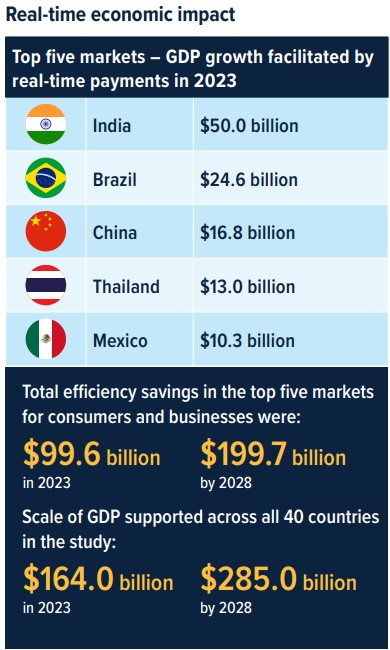
In 2023 alone, these transactions reportedly contributed $164
billion to global GDP, equivalent to the labor of 12 million workers. By 2028,
this contribution is projected to jump to $285.8 billion, a 74.2% increase over
five years.
The growth is driven by the fact that real-time
payments save money. Consumers and businesses globally saved $116.9 billion in
transaction costs in 2023, a figure expected to reach $245.8 billion by 2028. As the adoption of real-time payments grows, these
savings could fuel economic productivity and create a ripple effect globally.
Source: ACI Worldwide
By 2028, over 167 million people who were previously
unbanked are expected to have opened accounts in the 28 countries studied for
financial inclusion. Emerging markets stand to gain the most. In countries
like Pakistan, India, and the Philippines, the expansion of real-time payments
is projected to create millions of new bank account holders, the report highlighted.
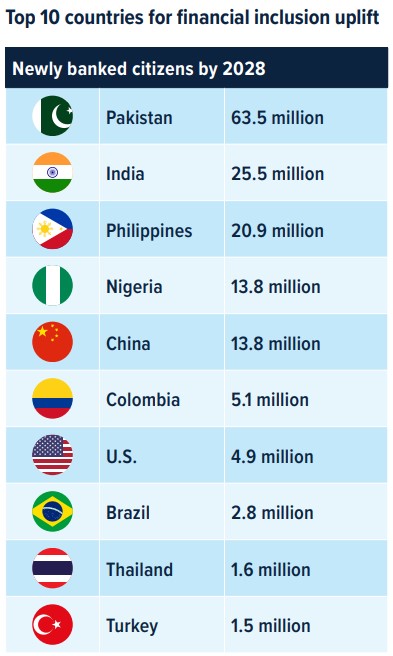
Pakistan leads with 63.5 million new accounts expected, followed by India with 25.5
million and the Philippines with 20.9 million. These newly banked citizens
represent new opportunities for financial institutions.
Profitable Opportunities for Banks
Financial institutions stand to benefit enormously
from the rise of real-time payments. The expansion of real-time payments,
especially in emerging markets, creates a significant revenue opportunity for
banks.
The profit potential from this transformation is estimated at $173 billion in Pakistan alone by 2028. Other countries such as
Nigeria ($40.4 billion), the Philippines ($28.7 billion), and India ($24.6
billion) also present massive opportunities.
Source: ACI Worldwide
Banks are also benefiting from regulatory frameworks
that promote real-time payments. For instance, Brazil’s central bank mandates
real-time payment services for all banks through its PIX system. In India, real-time payments added $50 million to GDP
in 2023, with forecasts predicting $3.6 billion in additional GDP by 2028 in
Indonesia, one of the fastest-growing markets.
Nigeria, Africa’s largest real-time payments market,
experienced $7 billion in GDP growth from these transactions in 2023. The country
leads in profit potential for banks and is projected to generate $40.4
billion in profit opportunities by 2028.
Real-time payment is now an important factor in the global economic growth. According to the latest research, these instant transactions could increase global GDP by $285.8 billion by 2028 and create over 167 million new bank account holders worldwide.
Economic Impact
According to ACI Worldwide, real-time payments are improving economies by
allowing money to flow between consumers and businesses in seconds instead of
days. This efficiency cuts transaction costs and helps bring segments of the
informal economy into the formal financial system.
In 2023 alone, these transactions reportedly contributed $164
billion to global GDP, equivalent to the labor of 12 million workers. By 2028,
this contribution is projected to jump to $285.8 billion, a 74.2% increase over
five years.
The growth is driven by the fact that real-time
payments save money. Consumers and businesses globally saved $116.9 billion in
transaction costs in 2023, a figure expected to reach $245.8 billion by 2028. As the adoption of real-time payments grows, these
savings could fuel economic productivity and create a ripple effect globally.
Source: ACI Worldwide
By 2028, over 167 million people who were previously
unbanked are expected to have opened accounts in the 28 countries studied for
financial inclusion. Emerging markets stand to gain the most. In countries
like Pakistan, India, and the Philippines, the expansion of real-time payments
is projected to create millions of new bank account holders, the report highlighted.
Pakistan leads with 63.5 million new accounts expected, followed by India with 25.5
million and the Philippines with 20.9 million. These newly banked citizens
represent new opportunities for financial institutions.
Profitable Opportunities for Banks
Financial institutions stand to benefit enormously
from the rise of real-time payments. The expansion of real-time payments,
especially in emerging markets, creates a significant revenue opportunity for
banks.
The profit potential from this transformation is estimated at $173 billion in Pakistan alone by 2028. Other countries such as
Nigeria ($40.4 billion), the Philippines ($28.7 billion), and India ($24.6
billion) also present massive opportunities.
Source: ACI Worldwide
Banks are also benefiting from regulatory frameworks
that promote real-time payments. For instance, Brazil’s central bank mandates
real-time payment services for all banks through its PIX system. In India, real-time payments added $50 million to GDP
in 2023, with forecasts predicting $3.6 billion in additional GDP by 2028 in
Indonesia, one of the fastest-growing markets.
Nigeria, Africa’s largest real-time payments market,
experienced $7 billion in GDP growth from these transactions in 2023. The country
leads in profit potential for banks and is projected to generate $40.4
billion in profit opportunities by 2028.
Jared Kirui is an Editor at Finance Magnates with more than five years of experience in financial journalism. He covers online trading, fintech, payments, and crypto industries with a focus on companies, regulation and compliance, executive moves, trading technology, and market analysis.
His work has been featured in other media outlets, including Benzinga, ZyCrypto, The Distributed, and The Daily Hodl.
Education:
Bachelor of Commerce degree (Finance option), University of Nairobi
Retail Investors Shift to Energy, Rare Earths, and AI Amid Tensions, eToro Finds
FP Markets Winner Spotlight 🏆 | Global Broker of the Year 2025 #Trading #Broker #Innovation #Shorts
FP Markets Winner Spotlight 🏆 | Global Broker of the Year 2025 #Trading #Broker #Innovation #Shorts
FP Markets takes the spotlight as Global Broker of the Year 2025 at the Finance Magnates Awards.
Martin Stoilov, Head of Client Experience, shares that trust, innovation, and people played a key role in the company’s success, supported by a strong foundation of integrity and client-centricity.
Following this milestone, FP Markets continues to focus on growth, technology investment, and its core values of transparency and excellence.
👉 Be part of FM Awards 2026: https://awards.financemagnates.com/#nominate
FP Markets takes the spotlight as Global Broker of the Year 2025 at the Finance Magnates Awards.
Martin Stoilov, Head of Client Experience, shares that trust, innovation, and people played a key role in the company’s success, supported by a strong foundation of integrity and client-centricity.
Following this milestone, FP Markets continues to focus on growth, technology investment, and its core values of transparency and excellence.
👉 Be part of FM Awards 2026: https://awards.financemagnates.com/#nominate
In this video, we review @HolaPrimeMarketsOfficial, a multi-asset forex and CFDs broker offering different account types, trading platforms, and flexible trading conditions.
We cover the broker’s overall offering, including account options, trading environment, platforms like MT4 and MT5, and additional services such as managed accounts and fast withdrawals.
Watch the full video to see if Hola Prime Markets fits your trading needs.
📣 Stay up to date with the latest in finance and trading. Follow Finance Magnates for industry news, insights, and global event coverage.
Connect with us:
🔗 LinkedIn: /financemagnates
👍 Facebook: /financemagnates
📸 Instagram: https://www.instagram.com/financemagnates
🐦 X: https://x.com/financemagnates
🎥 TikTok: https://www.tiktok.com/tag/financemagnates
▶️ YouTube: /@financemagnates_official
#HolaPrime #ForexBroker #CFDTrading #FinanceMagnates #Trading #Forex #BrokerReview
In this video, we review @HolaPrimeMarketsOfficial, a multi-asset forex and CFDs broker offering different account types, trading platforms, and flexible trading conditions.
We cover the broker’s overall offering, including account options, trading environment, platforms like MT4 and MT5, and additional services such as managed accounts and fast withdrawals.
Watch the full video to see if Hola Prime Markets fits your trading needs.
📣 Stay up to date with the latest in finance and trading. Follow Finance Magnates for industry news, insights, and global event coverage.
Connect with us:
🔗 LinkedIn: /financemagnates
👍 Facebook: /financemagnates
📸 Instagram: https://www.instagram.com/financemagnates
🐦 X: https://x.com/financemagnates
🎥 TikTok: https://www.tiktok.com/tag/financemagnates
▶️ YouTube: /@financemagnates_official
#HolaPrime #ForexBroker #CFDTrading #FinanceMagnates #Trading #Forex #BrokerReview
Hola Prime Review: What You Need to Know | Full Breakdown by Finance Magnates
Hola Prime Review: What You Need to Know | Full Breakdown by Finance Magnates
In this video, we review @HolaPrime_Global, a proprietary trading firm offering evaluation programs and performance-based payouts in simulated market environments.
We cover how the challenge model works, including account types, profit splits (up to 95%), trading rules, and what it takes to reach a funded account. You’ll also learn about available platforms like MT4, MT5, cTrader, and more, along with insights into payouts, support, and trading conditions.
Watch the full video to see if Hola Prime fits your trading style.
📣 Stay up to date with the latest in finance and trading. Follow Finance Magnates for industry news, insights, and global event coverage.
Connect with us:
🔗 LinkedIn: /financemagnates
👍 Facebook: /financemagnates
📸 Instagram: https://www.instagram.com/financemagnates
🐦 X: https://x.com/financemagnates
🎥 TikTok: https://www.tiktok.com/tag/financemagnates
▶️ YouTube: /@financemagnates_official
#HolaPrime #PropFirm #Trading #FinanceMagnates #Forex #FuturesTrading #TradingReview #PropFirmReview
In this video, we review @HolaPrime_Global, a proprietary trading firm offering evaluation programs and performance-based payouts in simulated market environments.
We cover how the challenge model works, including account types, profit splits (up to 95%), trading rules, and what it takes to reach a funded account. You’ll also learn about available platforms like MT4, MT5, cTrader, and more, along with insights into payouts, support, and trading conditions.
Watch the full video to see if Hola Prime fits your trading style.
📣 Stay up to date with the latest in finance and trading. Follow Finance Magnates for industry news, insights, and global event coverage.
Connect with us:
🔗 LinkedIn: /financemagnates
👍 Facebook: /financemagnates
📸 Instagram: https://www.instagram.com/financemagnates
🐦 X: https://x.com/financemagnates
🎥 TikTok: https://www.tiktok.com/tag/financemagnates
▶️ YouTube: /@financemagnates_official
#HolaPrime #PropFirm #Trading #FinanceMagnates #Forex #FuturesTrading #TradingReview #PropFirmReview
Axi Winner Spotlight 🏆 | Global Most Innovative Broker 2025 #Innovation #Trading #Fintech #Broker
Axi Winner Spotlight 🏆 | Global Most Innovative Broker 2025 #Innovation #Trading #Fintech #Broker
Axi takes the spotlight at the Finance Magnates Awards, winning Global Most Innovative Broker 2025.
Olivia Xenofontos and Ivanna Openko share how the team will feel: proud, motivated, and ready to keep delivering.
They also describe the night as well-organized, focused, and enjoyable for all.
👉 Be part of FM Awards 2026.
Axi takes the spotlight at the Finance Magnates Awards, winning Global Most Innovative Broker 2025.
Olivia Xenofontos and Ivanna Openko share how the team will feel: proud, motivated, and ready to keep delivering.
They also describe the night as well-organized, focused, and enjoyable for all.
👉 Be part of FM Awards 2026.
Recognition that matters.
Built on transparency.
Driven by the industry.
The Finance Magnates Awards 2026.
Nominations are now open.
🔗 https://awards.financemagnates.com/?utm_source=SM&utm_medium=social&utm_campaign=recognition-matters
Recognition that matters.
Built on transparency.
Driven by the industry.
The Finance Magnates Awards 2026.
Nominations are now open.
🔗 https://awards.financemagnates.com/?utm_source=SM&utm_medium=social&utm_campaign=recognition-matters