Israel’s tech industry is adapting to the impact from the war.
Despite challenges, attendees at Fintech Junction 2024 were positive about the future.
AI will have a role in financial services, but it has to find a place.
Much of the talk at Fintech Junction 2024 was about the role AI can play in finance
Soon after October 7th, Israeli tech was split between
“no, everything is not ok” and “we deliver NO MATTER WHAT.” While the end of
the war is nowhere in sight, and in fact it’s more likely to spiral into a
wider regional conflict (spiraling into a regional conflict is a more likely
scenario), things seem to morph into some sort of a “new normal.”
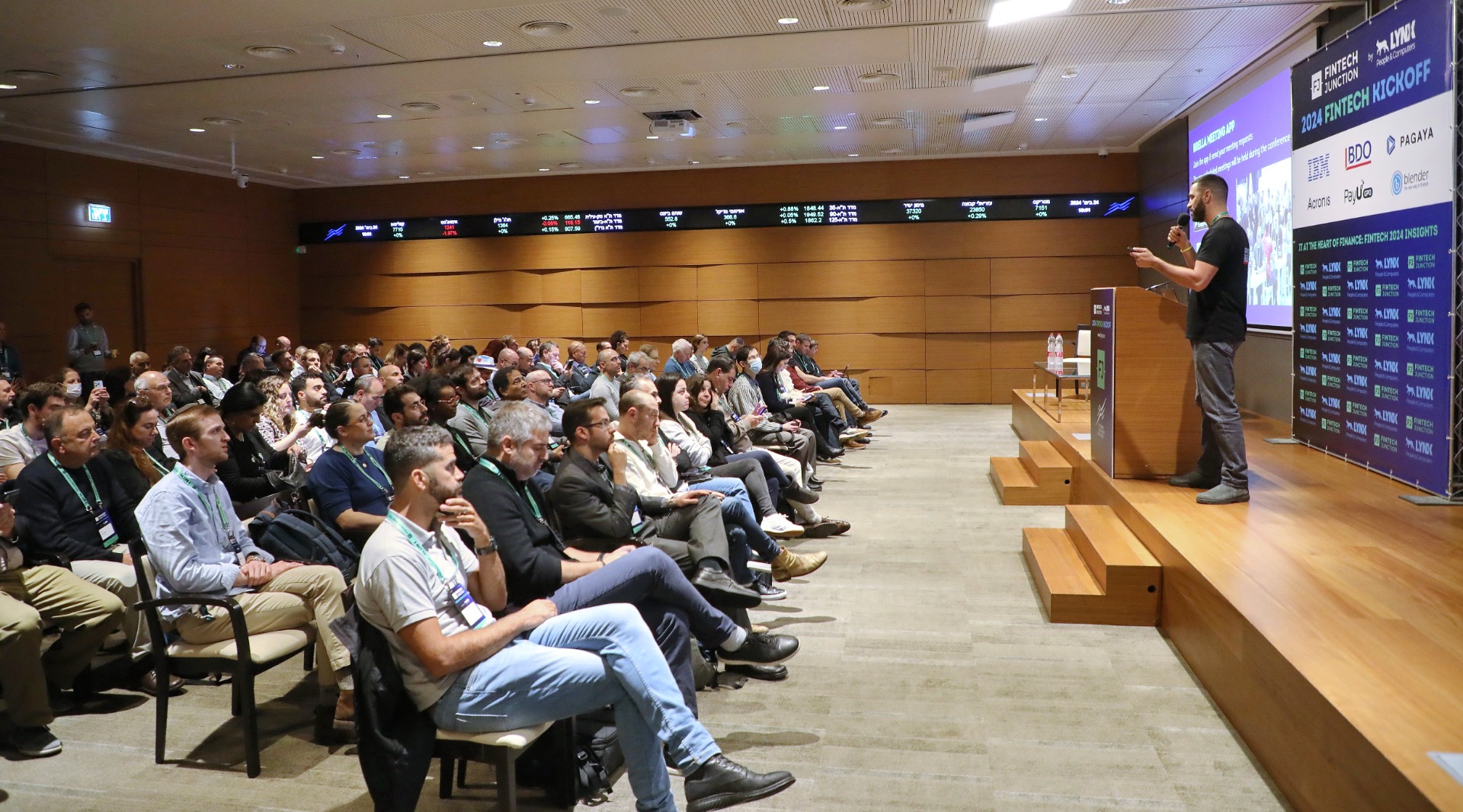
That, at least, was the sentiment at the recent Fintech
Junction 2024, an Israeli tech conference held on Wednesday at the Tel Aviv Stock
Exchange.
Hope amid Challenging Times
Ben Pelled of Lynx Events
Speaking as the event wrapped up, Ben Pelled of Lynx
Events, the conference organizers, was unreservedly enthusiastic: “In these
tough times in Israel, fintech cast a blinding light of possibility. This conference
wasn't just about business, it was about people, collaboration, and building a
brighter financial future for all.”
Gathering over 250 attendees from the local fintech
industry, the event brought together unicorns like Pagaya and Melio, banks, and
startups at various levels of stealth and fundraising rounds.
Conversation both on and off stage revolved around
fintech’s current state of maturation, traditional and generative AI (and what
each can and cannot do in financial services), and, naturally, adapting to the constant
disruption brought about by the war.
A Fintech Tipping Point
A decade since entering the financial conversation,
fintech’s mission seems to be finally shifting from disruption to collaboration.
“In 2013, [banks] thought 'I’m building to sell and do
an exit'; then they thought 'I’m planning an IPO.' Now there seems to be a
better understanding of the role fintechs play,” said Gal Aviv, the Founder and CEO
of Blender.
His fireside chat with Or Kaplinsky from Amdocs, who shared pain points from his experience propping up a banking startup, touched
upon the upside for startups.
“Fintechs, on the other hand, need vast funding to
handle vast data, and can’t handle so easily integrations with the IT
departments in banks,” Aviv said.
The opportunities they recognized for fintech firms lie
precisely in this gap, between core banking and cutting-edge. Lean and mean startups
are “the middle layer of stuff like operations, compliance, and operations,”
according to Aviv.
Nothing to Generate Yet?
Another big topic was, quite obviously, generative AI
and its applications in financial services. Showcasing the capabilities of
IBM’s WatsonX, Tal Schahar, the tech veteran's World Wide Data & AI
Delivery Leader, pinpointed the importance of tailored training of LLMs for the
needs of financial services.
Tal Schahar, Senior Product Manager Fraud and Identity, IBM Security Trusteer.
"GPT is great for generating poems and homework,"
he said. "But it can't cover everything."
A later panel echoed this opinion, parceling out the
challenges in implementing generative AI in dealing with sensitive data.
"In hard-core payments and fintech, at the moment
there is not much to generate," said Shiri Schnieder, the CTO at PayU.
GenAI can be particularly useful in improving efficiency, especially within development team
Shiri Schneider, CTO of PayU (LinkedIn).
"It is not suitable for every developer,
though," Schiender said, highlighting that senior staff members should have
a better understanding of how to deal with LLMs' shenanigans.
If a fully-fledged generative AI is the future of
payments, the present is dominated by a more traditional iteration: Machine
learning.
Schneider presented two notable use cases: increasing
transaction approval rates, and detecting broader anomalies. While the former
is focused on choosing the best pathway within the processing ecosystem, the
latter can help firms with breaches of behavioural patterns.
While today is certainly a challenge, and the road
ahead seems uncertain, the future is promising and, despite all the uncertainty, Schahar got it right when he said: “In finance, yesterday's buzz is today's
reality."
Participate in Our Fraud Survey: Your Opinion Matters!
We invite you to participate in our joint survey conducted
by FXStreet and Finance Magnates Group, which explores prevalent online
financial fraud types, platforms used for fraudulent activities, effectiveness
of countermeasures, and challenges faced by companies in tackling such fraud. Your
valuable insights will help inform future strategies and resource allocation in
combating financial fraud.
Soon after October 7th, Israeli tech was split between
“no, everything is not ok” and “we deliver NO MATTER WHAT.” While the end of
the war is nowhere in sight, and in fact it’s more likely to spiral into a
wider regional conflict (spiraling into a regional conflict is a more likely
scenario), things seem to morph into some sort of a “new normal.”
That, at least, was the sentiment at the recent Fintech
Junction 2024, an Israeli tech conference held on Wednesday at the Tel Aviv Stock
Exchange.
Hope amid Challenging Times
Ben Pelled of Lynx Events
Speaking as the event wrapped up, Ben Pelled of Lynx
Events, the conference organizers, was unreservedly enthusiastic: “In these
tough times in Israel, fintech cast a blinding light of possibility. This conference
wasn't just about business, it was about people, collaboration, and building a
brighter financial future for all.”
Gathering over 250 attendees from the local fintech
industry, the event brought together unicorns like Pagaya and Melio, banks, and
startups at various levels of stealth and fundraising rounds.
Conversation both on and off stage revolved around
fintech’s current state of maturation, traditional and generative AI (and what
each can and cannot do in financial services), and, naturally, adapting to the constant
disruption brought about by the war.
A Fintech Tipping Point
A decade since entering the financial conversation,
fintech’s mission seems to be finally shifting from disruption to collaboration.
“In 2013, [banks] thought 'I’m building to sell and do
an exit'; then they thought 'I’m planning an IPO.' Now there seems to be a
better understanding of the role fintechs play,” said Gal Aviv, the Founder and CEO
of Blender.
His fireside chat with Or Kaplinsky from Amdocs, who shared pain points from his experience propping up a banking startup, touched
upon the upside for startups.
“Fintechs, on the other hand, need vast funding to
handle vast data, and can’t handle so easily integrations with the IT
departments in banks,” Aviv said.
The opportunities they recognized for fintech firms lie
precisely in this gap, between core banking and cutting-edge. Lean and mean startups
are “the middle layer of stuff like operations, compliance, and operations,”
according to Aviv.
Nothing to Generate Yet?
Another big topic was, quite obviously, generative AI
and its applications in financial services. Showcasing the capabilities of
IBM’s WatsonX, Tal Schahar, the tech veteran's World Wide Data & AI
Delivery Leader, pinpointed the importance of tailored training of LLMs for the
needs of financial services.
Tal Schahar, Senior Product Manager Fraud and Identity, IBM Security Trusteer.
"GPT is great for generating poems and homework,"
he said. "But it can't cover everything."
A later panel echoed this opinion, parceling out the
challenges in implementing generative AI in dealing with sensitive data.
"In hard-core payments and fintech, at the moment
there is not much to generate," said Shiri Schnieder, the CTO at PayU.
GenAI can be particularly useful in improving efficiency, especially within development team
Shiri Schneider, CTO of PayU (LinkedIn).
"It is not suitable for every developer,
though," Schiender said, highlighting that senior staff members should have
a better understanding of how to deal with LLMs' shenanigans.
If a fully-fledged generative AI is the future of
payments, the present is dominated by a more traditional iteration: Machine
learning.
Schneider presented two notable use cases: increasing
transaction approval rates, and detecting broader anomalies. While the former
is focused on choosing the best pathway within the processing ecosystem, the
latter can help firms with breaches of behavioural patterns.
While today is certainly a challenge, and the road
ahead seems uncertain, the future is promising and, despite all the uncertainty, Schahar got it right when he said: “In finance, yesterday's buzz is today's
reality."
Participate in Our Fraud Survey: Your Opinion Matters!
We invite you to participate in our joint survey conducted
by FXStreet and Finance Magnates Group, which explores prevalent online
financial fraud types, platforms used for fraudulent activities, effectiveness
of countermeasures, and challenges faced by companies in tackling such fraud. Your
valuable insights will help inform future strategies and resource allocation in
combating financial fraud.
Retail Investors Shift to Energy, Rare Earths, and AI Amid Tensions, eToro Finds
FP Markets Winner Spotlight 🏆 | Global Broker of the Year 2025 #Trading #Broker #Innovation #Shorts
FP Markets Winner Spotlight 🏆 | Global Broker of the Year 2025 #Trading #Broker #Innovation #Shorts
FP Markets takes the spotlight as Global Broker of the Year 2025 at the Finance Magnates Awards.
Martin Stoilov, Head of Client Experience, shares that trust, innovation, and people played a key role in the company’s success, supported by a strong foundation of integrity and client-centricity.
Following this milestone, FP Markets continues to focus on growth, technology investment, and its core values of transparency and excellence.
👉 Be part of FM Awards 2026: https://awards.financemagnates.com/#nominate
FP Markets takes the spotlight as Global Broker of the Year 2025 at the Finance Magnates Awards.
Martin Stoilov, Head of Client Experience, shares that trust, innovation, and people played a key role in the company’s success, supported by a strong foundation of integrity and client-centricity.
Following this milestone, FP Markets continues to focus on growth, technology investment, and its core values of transparency and excellence.
👉 Be part of FM Awards 2026: https://awards.financemagnates.com/#nominate
In this video, we review @HolaPrimeMarketsOfficial, a multi-asset forex and CFDs broker offering different account types, trading platforms, and flexible trading conditions.
We cover the broker’s overall offering, including account options, trading environment, platforms like MT4 and MT5, and additional services such as managed accounts and fast withdrawals.
Watch the full video to see if Hola Prime Markets fits your trading needs.
📣 Stay up to date with the latest in finance and trading. Follow Finance Magnates for industry news, insights, and global event coverage.
Connect with us:
🔗 LinkedIn: /financemagnates
👍 Facebook: /financemagnates
📸 Instagram: https://www.instagram.com/financemagnates
🐦 X: https://x.com/financemagnates
🎥 TikTok: https://www.tiktok.com/tag/financemagnates
▶️ YouTube: /@financemagnates_official
#HolaPrime #ForexBroker #CFDTrading #FinanceMagnates #Trading #Forex #BrokerReview
In this video, we review @HolaPrimeMarketsOfficial, a multi-asset forex and CFDs broker offering different account types, trading platforms, and flexible trading conditions.
We cover the broker’s overall offering, including account options, trading environment, platforms like MT4 and MT5, and additional services such as managed accounts and fast withdrawals.
Watch the full video to see if Hola Prime Markets fits your trading needs.
📣 Stay up to date with the latest in finance and trading. Follow Finance Magnates for industry news, insights, and global event coverage.
Connect with us:
🔗 LinkedIn: /financemagnates
👍 Facebook: /financemagnates
📸 Instagram: https://www.instagram.com/financemagnates
🐦 X: https://x.com/financemagnates
🎥 TikTok: https://www.tiktok.com/tag/financemagnates
▶️ YouTube: /@financemagnates_official
#HolaPrime #ForexBroker #CFDTrading #FinanceMagnates #Trading #Forex #BrokerReview
Hola Prime Review: What You Need to Know | Full Breakdown by Finance Magnates
Hola Prime Review: What You Need to Know | Full Breakdown by Finance Magnates
In this video, we review @HolaPrime_Global, a proprietary trading firm offering evaluation programs and performance-based payouts in simulated market environments.
We cover how the challenge model works, including account types, profit splits (up to 95%), trading rules, and what it takes to reach a funded account. You’ll also learn about available platforms like MT4, MT5, cTrader, and more, along with insights into payouts, support, and trading conditions.
Watch the full video to see if Hola Prime fits your trading style.
📣 Stay up to date with the latest in finance and trading. Follow Finance Magnates for industry news, insights, and global event coverage.
Connect with us:
🔗 LinkedIn: /financemagnates
👍 Facebook: /financemagnates
📸 Instagram: https://www.instagram.com/financemagnates
🐦 X: https://x.com/financemagnates
🎥 TikTok: https://www.tiktok.com/tag/financemagnates
▶️ YouTube: /@financemagnates_official
#HolaPrime #PropFirm #Trading #FinanceMagnates #Forex #FuturesTrading #TradingReview #PropFirmReview
In this video, we review @HolaPrime_Global, a proprietary trading firm offering evaluation programs and performance-based payouts in simulated market environments.
We cover how the challenge model works, including account types, profit splits (up to 95%), trading rules, and what it takes to reach a funded account. You’ll also learn about available platforms like MT4, MT5, cTrader, and more, along with insights into payouts, support, and trading conditions.
Watch the full video to see if Hola Prime fits your trading style.
📣 Stay up to date with the latest in finance and trading. Follow Finance Magnates for industry news, insights, and global event coverage.
Connect with us:
🔗 LinkedIn: /financemagnates
👍 Facebook: /financemagnates
📸 Instagram: https://www.instagram.com/financemagnates
🐦 X: https://x.com/financemagnates
🎥 TikTok: https://www.tiktok.com/tag/financemagnates
▶️ YouTube: /@financemagnates_official
#HolaPrime #PropFirm #Trading #FinanceMagnates #Forex #FuturesTrading #TradingReview #PropFirmReview
Axi Winner Spotlight 🏆 | Global Most Innovative Broker 2025 #Innovation #Trading #Fintech #Broker
Axi Winner Spotlight 🏆 | Global Most Innovative Broker 2025 #Innovation #Trading #Fintech #Broker
Axi takes the spotlight at the Finance Magnates Awards, winning Global Most Innovative Broker 2025.
Olivia Xenofontos and Ivanna Openko share how the team will feel: proud, motivated, and ready to keep delivering.
They also describe the night as well-organized, focused, and enjoyable for all.
👉 Be part of FM Awards 2026.
Axi takes the spotlight at the Finance Magnates Awards, winning Global Most Innovative Broker 2025.
Olivia Xenofontos and Ivanna Openko share how the team will feel: proud, motivated, and ready to keep delivering.
They also describe the night as well-organized, focused, and enjoyable for all.
👉 Be part of FM Awards 2026.
Recognition that matters.
Built on transparency.
Driven by the industry.
The Finance Magnates Awards 2026.
Nominations are now open.
🔗 https://awards.financemagnates.com/?utm_source=SM&utm_medium=social&utm_campaign=recognition-matters
Recognition that matters.
Built on transparency.
Driven by the industry.
The Finance Magnates Awards 2026.
Nominations are now open.
🔗 https://awards.financemagnates.com/?utm_source=SM&utm_medium=social&utm_campaign=recognition-matters