RBI talks of plans during the India Fintech Day event as a new report emerged.
Bloomberg
Before India Fintech Day 2016 which took place yesterday at the Grand Hyatt in Mumbai, Indian startup Accelerator NASSCOM partnered with KPMG to produce a report entitled 'Fintech in India' announced during the event and where the country's central bank regulator revealed related fintech plans.
NASSCOM has an initiative called ‘10000 Startups' which aims to incubate, fund and provide ambient support to help 10,000 technology startups in India by 2023, according to a description of the program.
During the event yesterday, Reserve Bank of India (RBI) Executive Director N S Vishwanathan said: “RBI is in the process of setting up a multi-disciplinary committee with representatives from all financial regulators, stakeholders and banks to conduct an exploratory study of what kind of fintech is happening in the country, what can be allowed and create the right ecosystem for it."
Creating the 'right ecosystem' for fintech could be a hint of a regulatory sandbox or new guidelines and reforms to help support firms while having the right rules in place for relevant laws to be followed.
The news follows as the Reserve Bank of India (RBI) had referenced fintech in its June 2nd circular, which noted "the need to keep abreast of Fintech and digital innovations and peer-to-peer lending, the need to regulate credit guarantee schemes," as part of matters discussed during the 17th Meeting of the FSDC Sub-Committee in Mumbai.
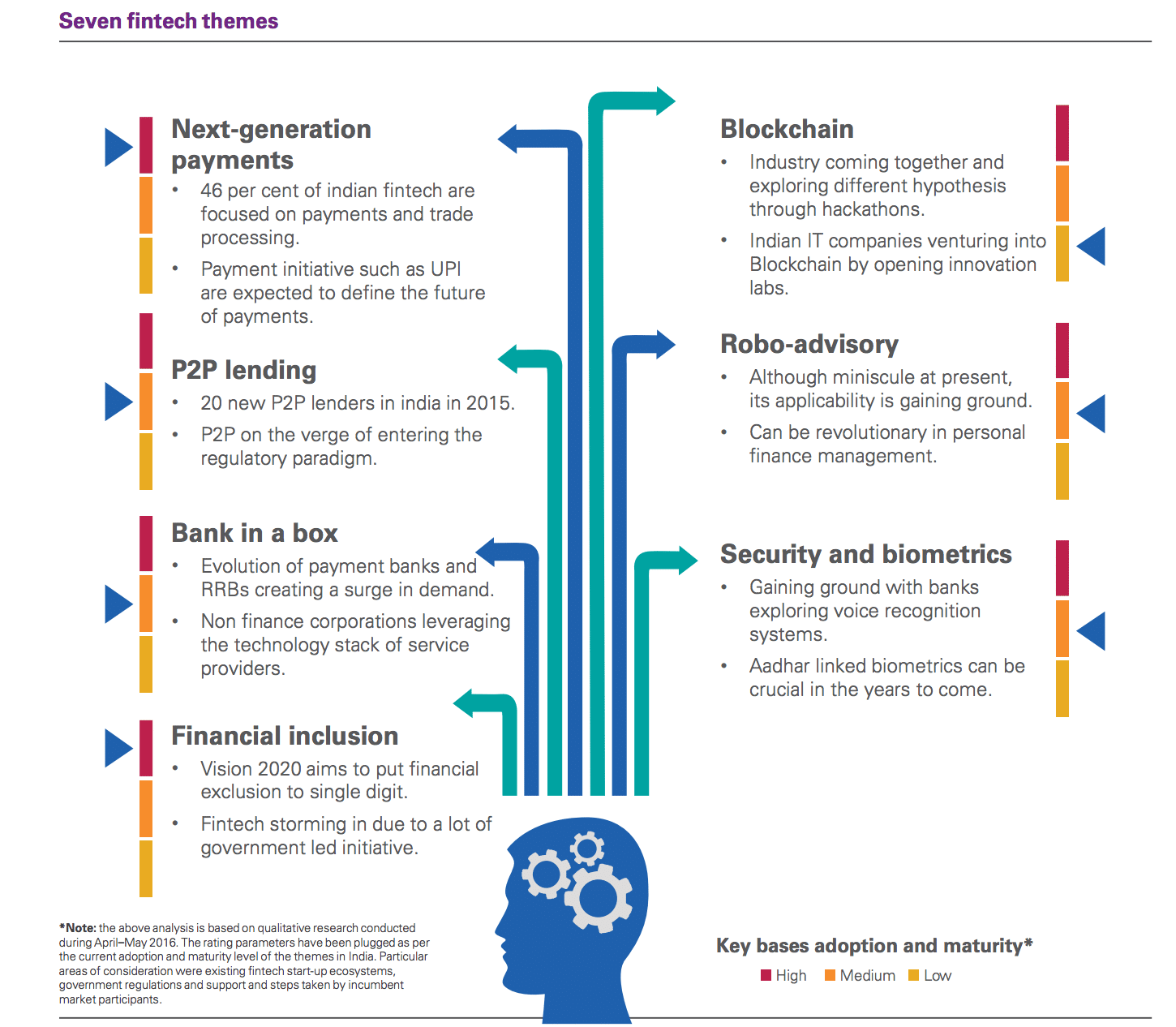
An excerpt of the joint report published by KPMG and NASSCOM can be seen below, highlighting the weightings of seven key themes in India, as the prospects for fintech in India appears to gain further momentum from its early stages of maturity across the Asia-Pacific (APAC)) region and compared globally:
Source: KPMG/Nasscom 2016 Fintech in India report
Before India Fintech Day 2016 which took place yesterday at the Grand Hyatt in Mumbai, Indian startup Accelerator NASSCOM partnered with KPMG to produce a report entitled 'Fintech in India' announced during the event and where the country's central bank regulator revealed related fintech plans.
NASSCOM has an initiative called ‘10000 Startups' which aims to incubate, fund and provide ambient support to help 10,000 technology startups in India by 2023, according to a description of the program.
During the event yesterday, Reserve Bank of India (RBI) Executive Director N S Vishwanathan said: “RBI is in the process of setting up a multi-disciplinary committee with representatives from all financial regulators, stakeholders and banks to conduct an exploratory study of what kind of fintech is happening in the country, what can be allowed and create the right ecosystem for it."
Creating the 'right ecosystem' for fintech could be a hint of a regulatory sandbox or new guidelines and reforms to help support firms while having the right rules in place for relevant laws to be followed.
The news follows as the Reserve Bank of India (RBI) had referenced fintech in its June 2nd circular, which noted "the need to keep abreast of Fintech and digital innovations and peer-to-peer lending, the need to regulate credit guarantee schemes," as part of matters discussed during the 17th Meeting of the FSDC Sub-Committee in Mumbai.
An excerpt of the joint report published by KPMG and NASSCOM can be seen below, highlighting the weightings of seven key themes in India, as the prospects for fintech in India appears to gain further momentum from its early stages of maturity across the Asia-Pacific (APAC)) region and compared globally:
Retail Investors Shift to Energy, Rare Earths, and AI Amid Tensions, eToro Finds
FP Markets Winner Spotlight 🏆 | Global Broker of the Year 2025 #Trading #Broker #Innovation #Shorts
FP Markets Winner Spotlight 🏆 | Global Broker of the Year 2025 #Trading #Broker #Innovation #Shorts
FP Markets takes the spotlight as Global Broker of the Year 2025 at the Finance Magnates Awards.
Martin Stoilov, Head of Client Experience, shares that trust, innovation, and people played a key role in the company’s success, supported by a strong foundation of integrity and client-centricity.
Following this milestone, FP Markets continues to focus on growth, technology investment, and its core values of transparency and excellence.
👉 Be part of FM Awards 2026: https://awards.financemagnates.com/#nominate
FP Markets takes the spotlight as Global Broker of the Year 2025 at the Finance Magnates Awards.
Martin Stoilov, Head of Client Experience, shares that trust, innovation, and people played a key role in the company’s success, supported by a strong foundation of integrity and client-centricity.
Following this milestone, FP Markets continues to focus on growth, technology investment, and its core values of transparency and excellence.
👉 Be part of FM Awards 2026: https://awards.financemagnates.com/#nominate
In this video, we review @HolaPrimeMarketsOfficial, a multi-asset forex and CFDs broker offering different account types, trading platforms, and flexible trading conditions.
We cover the broker’s overall offering, including account options, trading environment, platforms like MT4 and MT5, and additional services such as managed accounts and fast withdrawals.
Watch the full video to see if Hola Prime Markets fits your trading needs.
📣 Stay up to date with the latest in finance and trading. Follow Finance Magnates for industry news, insights, and global event coverage.
Connect with us:
🔗 LinkedIn: /financemagnates
👍 Facebook: /financemagnates
📸 Instagram: https://www.instagram.com/financemagnates
🐦 X: https://x.com/financemagnates
🎥 TikTok: https://www.tiktok.com/tag/financemagnates
▶️ YouTube: /@financemagnates_official
#HolaPrime #ForexBroker #CFDTrading #FinanceMagnates #Trading #Forex #BrokerReview
In this video, we review @HolaPrimeMarketsOfficial, a multi-asset forex and CFDs broker offering different account types, trading platforms, and flexible trading conditions.
We cover the broker’s overall offering, including account options, trading environment, platforms like MT4 and MT5, and additional services such as managed accounts and fast withdrawals.
Watch the full video to see if Hola Prime Markets fits your trading needs.
📣 Stay up to date with the latest in finance and trading. Follow Finance Magnates for industry news, insights, and global event coverage.
Connect with us:
🔗 LinkedIn: /financemagnates
👍 Facebook: /financemagnates
📸 Instagram: https://www.instagram.com/financemagnates
🐦 X: https://x.com/financemagnates
🎥 TikTok: https://www.tiktok.com/tag/financemagnates
▶️ YouTube: /@financemagnates_official
#HolaPrime #ForexBroker #CFDTrading #FinanceMagnates #Trading #Forex #BrokerReview
Hola Prime Review: What You Need to Know | Full Breakdown by Finance Magnates
Hola Prime Review: What You Need to Know | Full Breakdown by Finance Magnates
In this video, we review @HolaPrime_Global, a proprietary trading firm offering evaluation programs and performance-based payouts in simulated market environments.
We cover how the challenge model works, including account types, profit splits (up to 95%), trading rules, and what it takes to reach a funded account. You’ll also learn about available platforms like MT4, MT5, cTrader, and more, along with insights into payouts, support, and trading conditions.
Watch the full video to see if Hola Prime fits your trading style.
📣 Stay up to date with the latest in finance and trading. Follow Finance Magnates for industry news, insights, and global event coverage.
Connect with us:
🔗 LinkedIn: /financemagnates
👍 Facebook: /financemagnates
📸 Instagram: https://www.instagram.com/financemagnates
🐦 X: https://x.com/financemagnates
🎥 TikTok: https://www.tiktok.com/tag/financemagnates
▶️ YouTube: /@financemagnates_official
#HolaPrime #PropFirm #Trading #FinanceMagnates #Forex #FuturesTrading #TradingReview #PropFirmReview
In this video, we review @HolaPrime_Global, a proprietary trading firm offering evaluation programs and performance-based payouts in simulated market environments.
We cover how the challenge model works, including account types, profit splits (up to 95%), trading rules, and what it takes to reach a funded account. You’ll also learn about available platforms like MT4, MT5, cTrader, and more, along with insights into payouts, support, and trading conditions.
Watch the full video to see if Hola Prime fits your trading style.
📣 Stay up to date with the latest in finance and trading. Follow Finance Magnates for industry news, insights, and global event coverage.
Connect with us:
🔗 LinkedIn: /financemagnates
👍 Facebook: /financemagnates
📸 Instagram: https://www.instagram.com/financemagnates
🐦 X: https://x.com/financemagnates
🎥 TikTok: https://www.tiktok.com/tag/financemagnates
▶️ YouTube: /@financemagnates_official
#HolaPrime #PropFirm #Trading #FinanceMagnates #Forex #FuturesTrading #TradingReview #PropFirmReview
Axi Winner Spotlight 🏆 | Global Most Innovative Broker 2025 #Innovation #Trading #Fintech #Broker
Axi Winner Spotlight 🏆 | Global Most Innovative Broker 2025 #Innovation #Trading #Fintech #Broker
Axi takes the spotlight at the Finance Magnates Awards, winning Global Most Innovative Broker 2025.
Olivia Xenofontos and Ivanna Openko share how the team will feel: proud, motivated, and ready to keep delivering.
They also describe the night as well-organized, focused, and enjoyable for all.
👉 Be part of FM Awards 2026.
Axi takes the spotlight at the Finance Magnates Awards, winning Global Most Innovative Broker 2025.
Olivia Xenofontos and Ivanna Openko share how the team will feel: proud, motivated, and ready to keep delivering.
They also describe the night as well-organized, focused, and enjoyable for all.
👉 Be part of FM Awards 2026.
Recognition that matters.
Built on transparency.
Driven by the industry.
The Finance Magnates Awards 2026.
Nominations are now open.
🔗 https://awards.financemagnates.com/?utm_source=SM&utm_medium=social&utm_campaign=recognition-matters
Recognition that matters.
Built on transparency.
Driven by the industry.
The Finance Magnates Awards 2026.
Nominations are now open.
🔗 https://awards.financemagnates.com/?utm_source=SM&utm_medium=social&utm_campaign=recognition-matters