Islamic finance embracing fintech according to Malaysia's Central Bank Governor.
Steven Hatzakis, Locals and tourists observe a light show at the foot of Kuala Lumpur's two largest towers
The 2016 Global Islamic Finance Forum (GIFF) 5.0 concluded this week in Kuala Lumpur, Malaysia, after the three-day event saw an array of panels and discussions focused on the future of Islamic Finance, including topics related to Fintech innovations and a keynote from the country's Central Bank Governor.
Islamic financial activities are regulated in Malaysia and based on a comprehensive contract-based framework which aims to help institutions achieve end-to-end Shariah compliance in their product offerings to clients.
Malaysia’s financial markets regulators participated in the GIFF event, which was attended by over a thousand people this week, and on its third day a panel featured participation from the Malaysia's Securities Commission and included representatives from PwC, BNP Paribas Investment Partners, and OCBC Malaysia. A further keynote, from Goh Peng Ooi, Chairman of Silverlake Group, discussed the theme of predicting future global solutions.
There was also a pitch session, where new startups had 6 minutes to sell their product ideas to a packed audience. A subsequent session in the final day of the event included participation from the country’s central bank, Bank Negara Malaysia, and aimed to answer questions related to value-based finance.
The panel was moderated by Mohamed Ashraf bin Mohamed Iqbal, Director at HSBC Amanah, and the panel included JAK Medlemsbank CEO, Dennis Craig, Head of Capital Financing Solutions, and CEO of Bangladesh International Arbitration Centre (BIAC) Muhammad A. Rumee Ali, and David Korslund, Senior Advisor to the Global Alliance on Banking on Values.
Central bank governor keynote
During a keynote speech at the event, the country’s central bank Governor Datuk Muhammad bin Ibrahim, said: “Islamic finance is one of the fastest growing segments of the financial industry in many parts of the world. It registered double-digit growth rates in the past decade despite challenging circumstances globally.”
“To elevate the Islamic finance industry to the next level, the formulation of game-changing strategies must bring in elements that Leverage on technology, accelerate innovation and develop well-rounded talent to meet future needs of Islamic finance.”
In addition, the governor said during the speech: “Bank Negara Malaysia has been actively engaging with fintech firms to better understand their activities and provide guidance on the regulations that may apply to them. The adoption of fintech is clearly not without risks, particularly in the wake of rising cybersecurity threats that could compromise safeguards that protect financial assets and customer data. The Bank has commenced a review of the changes and additional guidance needed to ensure that the regulatory framework remains appropriate to manage the risks, while encouraging productive innovation that will drive costs down and improve the quality of service to consumers.”
Mr. Bin Ibrahim had recently taken on his role as deputy governor at the end of last month, and holds a Master's degree from Harvard University, a Bachelor’s degree in accounting from the University of Malaya, and obtained a post-graduate diploma from the International Islamic University of Malaysia, according to a profile description on the central bank's website.
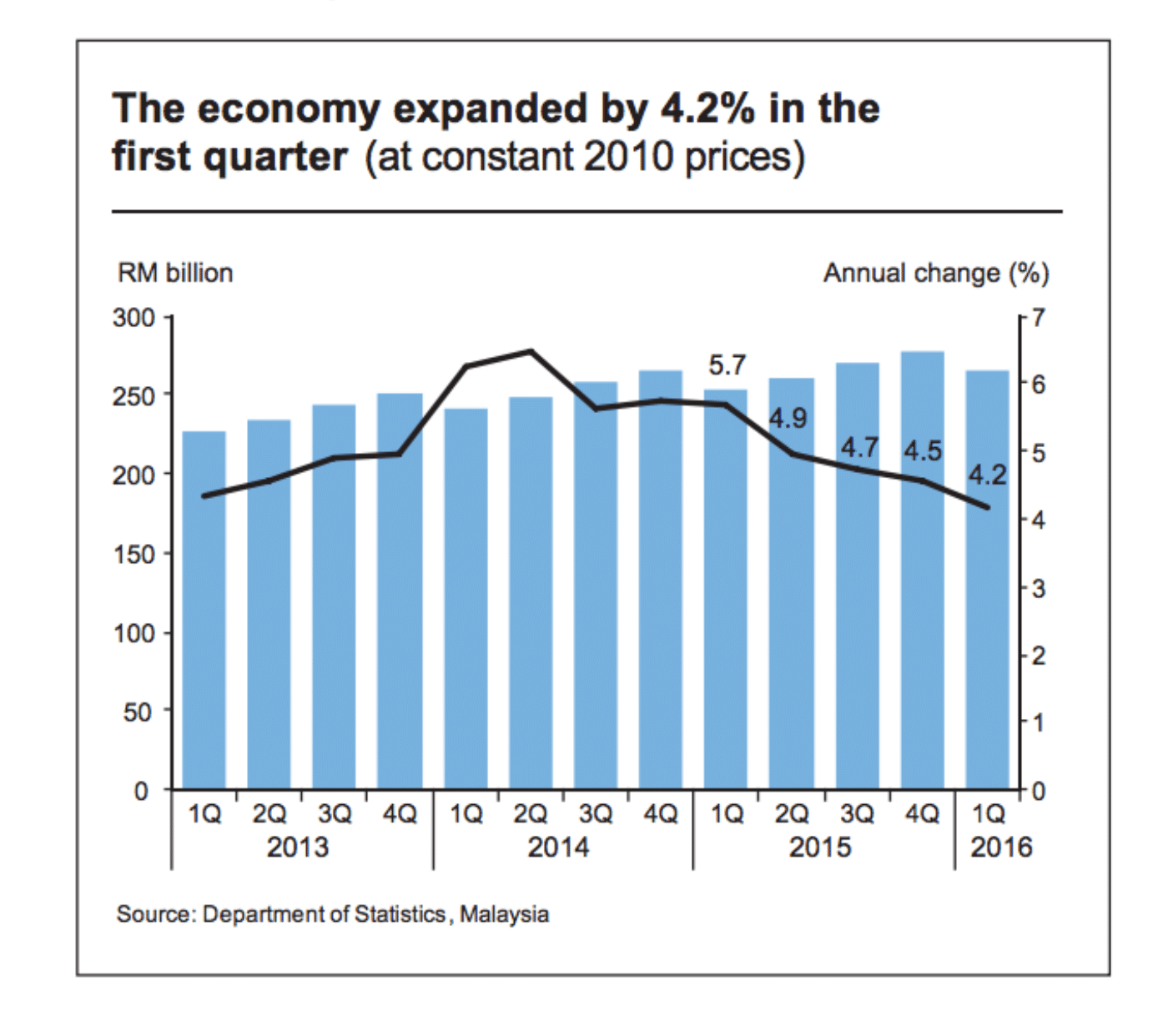
An excerpt from results for the first quarter released by the central bank earlier today in Asia showed a small decline in growth for the Malaysian economy from the prior quarter - yet it continued to grow at 4.2% for the first three months of the year:
Source: Bank Negara Malaysia Q1 2016 statistics
The 2016 Global Islamic Finance Forum (GIFF) 5.0 concluded this week in Kuala Lumpur, Malaysia, after the three-day event saw an array of panels and discussions focused on the future of Islamic Finance, including topics related to Fintech innovations and a keynote from the country's Central Bank Governor.
Islamic financial activities are regulated in Malaysia and based on a comprehensive contract-based framework which aims to help institutions achieve end-to-end Shariah compliance in their product offerings to clients.
Malaysia’s financial markets regulators participated in the GIFF event, which was attended by over a thousand people this week, and on its third day a panel featured participation from the Malaysia's Securities Commission and included representatives from PwC, BNP Paribas Investment Partners, and OCBC Malaysia. A further keynote, from Goh Peng Ooi, Chairman of Silverlake Group, discussed the theme of predicting future global solutions.
There was also a pitch session, where new startups had 6 minutes to sell their product ideas to a packed audience. A subsequent session in the final day of the event included participation from the country’s central bank, Bank Negara Malaysia, and aimed to answer questions related to value-based finance.
The panel was moderated by Mohamed Ashraf bin Mohamed Iqbal, Director at HSBC Amanah, and the panel included JAK Medlemsbank CEO, Dennis Craig, Head of Capital Financing Solutions, and CEO of Bangladesh International Arbitration Centre (BIAC) Muhammad A. Rumee Ali, and David Korslund, Senior Advisor to the Global Alliance on Banking on Values.
Central bank governor keynote
During a keynote speech at the event, the country’s central bank Governor Datuk Muhammad bin Ibrahim, said: “Islamic finance is one of the fastest growing segments of the financial industry in many parts of the world. It registered double-digit growth rates in the past decade despite challenging circumstances globally.”
“To elevate the Islamic finance industry to the next level, the formulation of game-changing strategies must bring in elements that Leverage on technology, accelerate innovation and develop well-rounded talent to meet future needs of Islamic finance.”
In addition, the governor said during the speech: “Bank Negara Malaysia has been actively engaging with fintech firms to better understand their activities and provide guidance on the regulations that may apply to them. The adoption of fintech is clearly not without risks, particularly in the wake of rising cybersecurity threats that could compromise safeguards that protect financial assets and customer data. The Bank has commenced a review of the changes and additional guidance needed to ensure that the regulatory framework remains appropriate to manage the risks, while encouraging productive innovation that will drive costs down and improve the quality of service to consumers.”
Mr. Bin Ibrahim had recently taken on his role as deputy governor at the end of last month, and holds a Master's degree from Harvard University, a Bachelor’s degree in accounting from the University of Malaya, and obtained a post-graduate diploma from the International Islamic University of Malaysia, according to a profile description on the central bank's website.
An excerpt from results for the first quarter released by the central bank earlier today in Asia showed a small decline in growth for the Malaysian economy from the prior quarter - yet it continued to grow at 4.2% for the first three months of the year:
Retail Investors Shift to Energy, Rare Earths, and AI Amid Tensions, eToro Finds
FP Markets Winner Spotlight 🏆 | Global Broker of the Year 2025 #Trading #Broker #Innovation #Shorts
FP Markets Winner Spotlight 🏆 | Global Broker of the Year 2025 #Trading #Broker #Innovation #Shorts
FP Markets takes the spotlight as Global Broker of the Year 2025 at the Finance Magnates Awards.
Martin Stoilov, Head of Client Experience, shares that trust, innovation, and people played a key role in the company’s success, supported by a strong foundation of integrity and client-centricity.
Following this milestone, FP Markets continues to focus on growth, technology investment, and its core values of transparency and excellence.
👉 Be part of FM Awards 2026: https://awards.financemagnates.com/#nominate
FP Markets takes the spotlight as Global Broker of the Year 2025 at the Finance Magnates Awards.
Martin Stoilov, Head of Client Experience, shares that trust, innovation, and people played a key role in the company’s success, supported by a strong foundation of integrity and client-centricity.
Following this milestone, FP Markets continues to focus on growth, technology investment, and its core values of transparency and excellence.
👉 Be part of FM Awards 2026: https://awards.financemagnates.com/#nominate
In this video, we review @HolaPrimeMarketsOfficial, a multi-asset forex and CFDs broker offering different account types, trading platforms, and flexible trading conditions.
We cover the broker’s overall offering, including account options, trading environment, platforms like MT4 and MT5, and additional services such as managed accounts and fast withdrawals.
Watch the full video to see if Hola Prime Markets fits your trading needs.
📣 Stay up to date with the latest in finance and trading. Follow Finance Magnates for industry news, insights, and global event coverage.
Connect with us:
🔗 LinkedIn: /financemagnates
👍 Facebook: /financemagnates
📸 Instagram: https://www.instagram.com/financemagnates
🐦 X: https://x.com/financemagnates
🎥 TikTok: https://www.tiktok.com/tag/financemagnates
▶️ YouTube: /@financemagnates_official
#HolaPrime #ForexBroker #CFDTrading #FinanceMagnates #Trading #Forex #BrokerReview
In this video, we review @HolaPrimeMarketsOfficial, a multi-asset forex and CFDs broker offering different account types, trading platforms, and flexible trading conditions.
We cover the broker’s overall offering, including account options, trading environment, platforms like MT4 and MT5, and additional services such as managed accounts and fast withdrawals.
Watch the full video to see if Hola Prime Markets fits your trading needs.
📣 Stay up to date with the latest in finance and trading. Follow Finance Magnates for industry news, insights, and global event coverage.
Connect with us:
🔗 LinkedIn: /financemagnates
👍 Facebook: /financemagnates
📸 Instagram: https://www.instagram.com/financemagnates
🐦 X: https://x.com/financemagnates
🎥 TikTok: https://www.tiktok.com/tag/financemagnates
▶️ YouTube: /@financemagnates_official
#HolaPrime #ForexBroker #CFDTrading #FinanceMagnates #Trading #Forex #BrokerReview
Hola Prime Review: What You Need to Know | Full Breakdown by Finance Magnates
Hola Prime Review: What You Need to Know | Full Breakdown by Finance Magnates
In this video, we review @HolaPrime_Global, a proprietary trading firm offering evaluation programs and performance-based payouts in simulated market environments.
We cover how the challenge model works, including account types, profit splits (up to 95%), trading rules, and what it takes to reach a funded account. You’ll also learn about available platforms like MT4, MT5, cTrader, and more, along with insights into payouts, support, and trading conditions.
Watch the full video to see if Hola Prime fits your trading style.
📣 Stay up to date with the latest in finance and trading. Follow Finance Magnates for industry news, insights, and global event coverage.
Connect with us:
🔗 LinkedIn: /financemagnates
👍 Facebook: /financemagnates
📸 Instagram: https://www.instagram.com/financemagnates
🐦 X: https://x.com/financemagnates
🎥 TikTok: https://www.tiktok.com/tag/financemagnates
▶️ YouTube: /@financemagnates_official
#HolaPrime #PropFirm #Trading #FinanceMagnates #Forex #FuturesTrading #TradingReview #PropFirmReview
In this video, we review @HolaPrime_Global, a proprietary trading firm offering evaluation programs and performance-based payouts in simulated market environments.
We cover how the challenge model works, including account types, profit splits (up to 95%), trading rules, and what it takes to reach a funded account. You’ll also learn about available platforms like MT4, MT5, cTrader, and more, along with insights into payouts, support, and trading conditions.
Watch the full video to see if Hola Prime fits your trading style.
📣 Stay up to date with the latest in finance and trading. Follow Finance Magnates for industry news, insights, and global event coverage.
Connect with us:
🔗 LinkedIn: /financemagnates
👍 Facebook: /financemagnates
📸 Instagram: https://www.instagram.com/financemagnates
🐦 X: https://x.com/financemagnates
🎥 TikTok: https://www.tiktok.com/tag/financemagnates
▶️ YouTube: /@financemagnates_official
#HolaPrime #PropFirm #Trading #FinanceMagnates #Forex #FuturesTrading #TradingReview #PropFirmReview
Axi Winner Spotlight 🏆 | Global Most Innovative Broker 2025 #Innovation #Trading #Fintech #Broker
Axi Winner Spotlight 🏆 | Global Most Innovative Broker 2025 #Innovation #Trading #Fintech #Broker
Axi takes the spotlight at the Finance Magnates Awards, winning Global Most Innovative Broker 2025.
Olivia Xenofontos and Ivanna Openko share how the team will feel: proud, motivated, and ready to keep delivering.
They also describe the night as well-organized, focused, and enjoyable for all.
👉 Be part of FM Awards 2026.
Axi takes the spotlight at the Finance Magnates Awards, winning Global Most Innovative Broker 2025.
Olivia Xenofontos and Ivanna Openko share how the team will feel: proud, motivated, and ready to keep delivering.
They also describe the night as well-organized, focused, and enjoyable for all.
👉 Be part of FM Awards 2026.
Recognition that matters.
Built on transparency.
Driven by the industry.
The Finance Magnates Awards 2026.
Nominations are now open.
🔗 https://awards.financemagnates.com/?utm_source=SM&utm_medium=social&utm_campaign=recognition-matters
Recognition that matters.
Built on transparency.
Driven by the industry.
The Finance Magnates Awards 2026.
Nominations are now open.
🔗 https://awards.financemagnates.com/?utm_source=SM&utm_medium=social&utm_campaign=recognition-matters