We checked how this technology is applied and what the future holds for it.
FM Studio
Every serious progress requires changes. While institutional and retail Forex brokerages, startups, Fintech companies and a number of other financial entities know that fact very well, the traditional banks have maintained a very conservative attitude towards changes in recent years.
Banks at this point have access to the largest amount of financial data, but on the other hand they play the role of the most tightly closed institutions in the whole industry. Access to customers’ banking data is highly desirable for a number of organizations and software developers. And in most cases by the customer himself. This explains, in a simple way, why the fintech startups that lead cooperation with banks and which allow this type of access to customer information are evolving so rapidly.
This year should be a turning point in which the entire financial industry will undergo significant changes. All thanks to the expansion of data access outside the closed sector. This will be possible due to the banking API.
What is banking API?
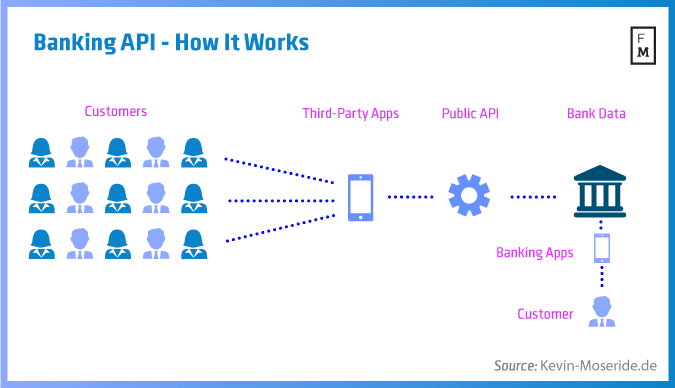
In the simplest terms, banking API is a tool that allows access to the financial data of the user, with his consent. The whole process can be viewed as the 'Login with Facebook', but with respect to the reality and complexity of financial services.
Of course, the system in the case of banking API is different, due to the more advanced financial security measures. Nowadays, however, we do not need to go through the registration process on a particular website – the browser can pull the data from previous sessions. Once the client authenticates, an application gets read-only access to registration, account and transactional data.
While the topic seems to be very exiting for the average user, the market is still underdeveloped and premature due to the small number of companies operating in this new industry and the lack of an adequate legal framework. Having said that, banking APIs is available in many major financial centers and in larger countries.
Who can use banking API, and where?
The technology of data aggregation can help retail and institutional brokers, social lenders and fintech companies in a number of different ways. Firstly, it is just another way to optimize the registration of a trader and reduce the stress on the compliance department. Regulated forex brokers are required to complete KYC, and often dry brokers operate without branches, resulting in a time and energy consuming on-boarding process. A potential trader has to make a copy of his ID and utility bills, which can often be a show stopper. With banking API, a broker can identify a trader simply by requesting that he authenticate using an internet banking login.
After the trader’s authorization, the brokerage receives access to his account and transaction data which can be extremely important in the further lead assignation process. Information from other brokerages allows the evaluation of the experience and profitability of potential customers.
Want to learn more about the usage of banking API, its legal status and implementation in order to improve the functioning of financial services? A detailed article on this topic can be found inside our Industry Report for the first quarter of 2016.
Every serious progress requires changes. While institutional and retail Forex brokerages, startups, Fintech companies and a number of other financial entities know that fact very well, the traditional banks have maintained a very conservative attitude towards changes in recent years.
Banks at this point have access to the largest amount of financial data, but on the other hand they play the role of the most tightly closed institutions in the whole industry. Access to customers’ banking data is highly desirable for a number of organizations and software developers. And in most cases by the customer himself. This explains, in a simple way, why the fintech startups that lead cooperation with banks and which allow this type of access to customer information are evolving so rapidly.
This year should be a turning point in which the entire financial industry will undergo significant changes. All thanks to the expansion of data access outside the closed sector. This will be possible due to the banking API.
What is banking API?
In the simplest terms, banking API is a tool that allows access to the financial data of the user, with his consent. The whole process can be viewed as the 'Login with Facebook', but with respect to the reality and complexity of financial services.
Of course, the system in the case of banking API is different, due to the more advanced financial security measures. Nowadays, however, we do not need to go through the registration process on a particular website – the browser can pull the data from previous sessions. Once the client authenticates, an application gets read-only access to registration, account and transactional data.
While the topic seems to be very exiting for the average user, the market is still underdeveloped and premature due to the small number of companies operating in this new industry and the lack of an adequate legal framework. Having said that, banking APIs is available in many major financial centers and in larger countries.
Who can use banking API, and where?
The technology of data aggregation can help retail and institutional brokers, social lenders and fintech companies in a number of different ways. Firstly, it is just another way to optimize the registration of a trader and reduce the stress on the compliance department. Regulated forex brokers are required to complete KYC, and often dry brokers operate without branches, resulting in a time and energy consuming on-boarding process. A potential trader has to make a copy of his ID and utility bills, which can often be a show stopper. With banking API, a broker can identify a trader simply by requesting that he authenticate using an internet banking login.
After the trader’s authorization, the brokerage receives access to his account and transaction data which can be extremely important in the further lead assignation process. Information from other brokerages allows the evaluation of the experience and profitability of potential customers.
Want to learn more about the usage of banking API, its legal status and implementation in order to improve the functioning of financial services? A detailed article on this topic can be found inside our Industry Report for the first quarter of 2016.
Konstantin has been working in the retail FX industry for over 3 years. In 2014 he was occupying a position of the CMO Deputy in one of the leading Forex brokers. Even though Konstantin is a marketing expert, his passion has always been in the technology and projects. This is why later in 2015 Konstantin has switched the industry and starting working as a Head of Marketing at Kontomatik, a leading banking API provider. Konstantin will be covering the updates of banking API for Finance Magnates from the angle of technology, legislation and emerging markets expansion.
In this video, we review @HolaPrimeMarketsOfficial, a multi-asset forex and CFDs broker offering different account types, trading platforms, and flexible trading conditions.
We cover the broker’s overall offering, including account options, trading environment, platforms like MT4 and MT5, and additional services such as managed accounts and fast withdrawals.
Watch the full video to see if Hola Prime Markets fits your trading needs.
📣 Stay up to date with the latest in finance and trading. Follow Finance Magnates for industry news, insights, and global event coverage.
Connect with us:
🔗 LinkedIn: /financemagnates
👍 Facebook: /financemagnates
📸 Instagram: https://www.instagram.com/financemagnates
🐦 X: https://x.com/financemagnates
🎥 TikTok: https://www.tiktok.com/tag/financemagnates
▶️ YouTube: /@financemagnates_official
#HolaPrime #ForexBroker #CFDTrading #FinanceMagnates #Trading #Forex #BrokerReview
In this video, we review @HolaPrimeMarketsOfficial, a multi-asset forex and CFDs broker offering different account types, trading platforms, and flexible trading conditions.
We cover the broker’s overall offering, including account options, trading environment, platforms like MT4 and MT5, and additional services such as managed accounts and fast withdrawals.
Watch the full video to see if Hola Prime Markets fits your trading needs.
📣 Stay up to date with the latest in finance and trading. Follow Finance Magnates for industry news, insights, and global event coverage.
Connect with us:
🔗 LinkedIn: /financemagnates
👍 Facebook: /financemagnates
📸 Instagram: https://www.instagram.com/financemagnates
🐦 X: https://x.com/financemagnates
🎥 TikTok: https://www.tiktok.com/tag/financemagnates
▶️ YouTube: /@financemagnates_official
#HolaPrime #ForexBroker #CFDTrading #FinanceMagnates #Trading #Forex #BrokerReview
Hola Prime Review: What You Need to Know | Full Breakdown by Finance Magnates
Hola Prime Review: What You Need to Know | Full Breakdown by Finance Magnates
In this video, we review @HolaPrime_Global, a proprietary trading firm offering evaluation programs and performance-based payouts in simulated market environments.
We cover how the challenge model works, including account types, profit splits (up to 95%), trading rules, and what it takes to reach a funded account. You’ll also learn about available platforms like MT4, MT5, cTrader, and more, along with insights into payouts, support, and trading conditions.
Watch the full video to see if Hola Prime fits your trading style.
📣 Stay up to date with the latest in finance and trading. Follow Finance Magnates for industry news, insights, and global event coverage.
Connect with us:
🔗 LinkedIn: /financemagnates
👍 Facebook: /financemagnates
📸 Instagram: https://www.instagram.com/financemagnates
🐦 X: https://x.com/financemagnates
🎥 TikTok: https://www.tiktok.com/tag/financemagnates
▶️ YouTube: /@financemagnates_official
#HolaPrime #PropFirm #Trading #FinanceMagnates #Forex #FuturesTrading #TradingReview #PropFirmReview
In this video, we review @HolaPrime_Global, a proprietary trading firm offering evaluation programs and performance-based payouts in simulated market environments.
We cover how the challenge model works, including account types, profit splits (up to 95%), trading rules, and what it takes to reach a funded account. You’ll also learn about available platforms like MT4, MT5, cTrader, and more, along with insights into payouts, support, and trading conditions.
Watch the full video to see if Hola Prime fits your trading style.
📣 Stay up to date with the latest in finance and trading. Follow Finance Magnates for industry news, insights, and global event coverage.
Connect with us:
🔗 LinkedIn: /financemagnates
👍 Facebook: /financemagnates
📸 Instagram: https://www.instagram.com/financemagnates
🐦 X: https://x.com/financemagnates
🎥 TikTok: https://www.tiktok.com/tag/financemagnates
▶️ YouTube: /@financemagnates_official
#HolaPrime #PropFirm #Trading #FinanceMagnates #Forex #FuturesTrading #TradingReview #PropFirmReview
Axi Winner Spotlight 🏆 | Global Most Innovative Broker 2025 #Innovation #Trading #Fintech #Broker
Axi Winner Spotlight 🏆 | Global Most Innovative Broker 2025 #Innovation #Trading #Fintech #Broker
Axi takes the spotlight at the Finance Magnates Awards, winning Global Most Innovative Broker 2025.
Olivia Xenofontos and Ivanna Openko share how the team will feel: proud, motivated, and ready to keep delivering.
They also describe the night as well-organized, focused, and enjoyable for all.
👉 Be part of FM Awards 2026.
Axi takes the spotlight at the Finance Magnates Awards, winning Global Most Innovative Broker 2025.
Olivia Xenofontos and Ivanna Openko share how the team will feel: proud, motivated, and ready to keep delivering.
They also describe the night as well-organized, focused, and enjoyable for all.
👉 Be part of FM Awards 2026.
Recognition that matters.
Built on transparency.
Driven by the industry.
The Finance Magnates Awards 2026.
Nominations are now open.
🔗 https://awards.financemagnates.com/?utm_source=SM&utm_medium=social&utm_campaign=recognition-matters
Recognition that matters.
Built on transparency.
Driven by the industry.
The Finance Magnates Awards 2026.
Nominations are now open.
🔗 https://awards.financemagnates.com/?utm_source=SM&utm_medium=social&utm_campaign=recognition-matters
Tickmill Winner Spotlight | Broker of the Year 2025 (LATAM) 🏆 | Finance Magnates Awards #Trading
Tickmill Winner Spotlight | Broker of the Year 2025 (LATAM) 🏆 | Finance Magnates Awards #Trading
What helped Tickmill stand out this year?
In this Winner Spotlight, Johnny Khalil, Executive Director at Tickmill Europe, shares how listening closely to clients and delivering strong trading conditions made the difference.
A big thank you to the community whose support continues to drive progress every day.
👉 Think your brand has what it takes? Nominate for the 2026 Finance Magnates Awards: https://awards.financemagnates.com/#nominate
What helped Tickmill stand out this year?
In this Winner Spotlight, Johnny Khalil, Executive Director at Tickmill Europe, shares how listening closely to clients and delivering strong trading conditions made the difference.
A big thank you to the community whose support continues to drive progress every day.
👉 Think your brand has what it takes? Nominate for the 2026 Finance Magnates Awards: https://awards.financemagnates.com/#nominate