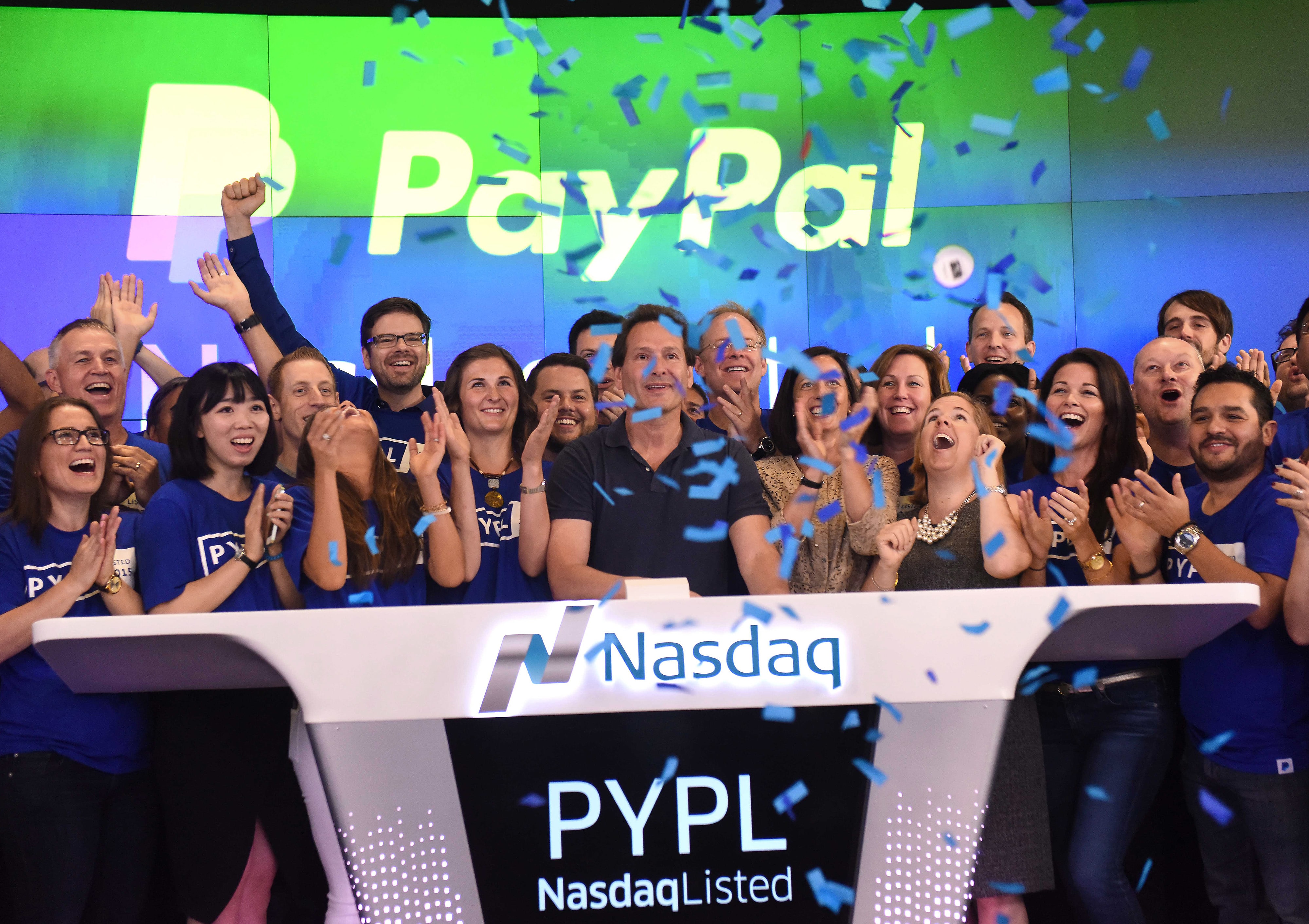
In this guest article, Paypal's biggest fan gives us his take on the company.
Bloomberg
This article was written by Phillip Cohen.
Notwithstanding the otherwise constant stream of disingenuous and delusional nonsense that flows from eBay/PayPal, the share price history of these two clunky operators demonstrates the reality:
Philip Cohen
Aug 2007 (pre John Donahoe): EBAY ~$40; AMZN ~$40;
PayPal (NASDAQ: PYPL) is still standing still, and eBay has for years been effectively going backwards.
Joined at the hip
Notwithstanding the spin-off of PayPal from eBay, eBay and "PreyPal" remain effectively joined at the hip—for at least the next five years—and anyone that thinks otherwise is simply uninformed; and, thanks to a continuation of most of the destructive policies introduced over the eight year reign (2007–2015) of the "Pain from Bain", John Joseph Donahoe II, the eBay marketplace is continuing on its slow journey down the toilet. Nevertheless, during Johnny Ho's occupation of the eBay corner office, this cretin and his gang of hand-picked Keystone Kops still managed to obtain for themselves massive, unearned, "performance" bonuses—while the company's shareholders received not one penny.
PayPal is, in its own words, "a merchant of sorts"; it is not a licensed "bank"; virtually everything that "PreyPal" does is done via "marketing" arrangements with licensed financial institutions—for example, look for the identity of the actual credit provider (in the micro print) on their credit providing instruments.
Merchants' funds received via "PreyPal" are at risk of being subjected to lengthy arbitrary holds; $18 billion of users' funds left "on deposit" with the PayPal faux "bank" are not FDIC deposit-insured. Even more perilous (for PayPal's shareholders), the great majority of PayPal's business originates from its (still) effectively mandated place on the eBay marketplace, so it logically follows that—with the destructive Johnny Ho-Ho-Ho now sitting at the head of the PayPal boardroom table—"PreyPal" will undoubtedly be accompanying eBay on its journey to the sewage farm.
"Effective October 1, 2015, we will remove the tiered merchant rates for US domestic and international Purchase Payments*. This means your rate will increase if you are currently receiving a merchant volume discount. Your new rate will be the standard rate of 2.9% + $0.30 USD for domestic transactions and 3.9% + fixed fee** for international transactions."—PayPal, 27 Aug 2015.
Mobile payments
The reality is, PayPal's parasitic, higher fee-charging payments operation has little long-term future—outside of its mandated place on the atrophying eBay marketplace—now that professional online/mobile payments offerings from MasterCard ('MasterPass') and Visa ('Visa Checkout') are available to any online merchant that has (or can obtain) a credit card merchant account with a real bank.
With respect particularly to mobile payments, notwithstanding Apple Pay's disappointing initial showing, methinks Apple Pay, Samsung Pay, Android Pay, 'MasterPass', and 'Visa Checkout', that is, those entities that have formal relationships with the world's retail banks and MasterCard/Visa, will eventually bury PayPal's parasitic operation.
By using PayPal you forego the usual statutory protections that apply to credit card transactions. Nevertheless, PayPal users should never give PayPal the authority to direct debit their bank account; PayPal should only ever be given access to funds via a real-bank credit card account; that way your credit card-issuing bank will be the final arbiter of any transaction dispute. Conversely, sellers should never accept payment via PayPal for goods that are going to be picked up by the buyer; in such circumstances PayPal offers sellers zero protection from 'item not received' scammers .
Payday lender
PayPal is effectively a payday lender. In May 2015, PayPal was fined $10 million over its 'Bill Me Later' service, in part for unfairly charging some customers deferred-interest fees. The company was also required to return $15 million to consumers who used the service, which is now called PayPal Credit.
PayPal's one-time adoptive parent, eBay, is likely the most unscrupulous commercial entity operating on this planet; but, have no fear, eBay is an equal-opportunity fraudster; demonstrably, they will knowingly aid and abet the defrauding of buyers by unscrupulous eBay merchants who bid on their own auctions, and, conversely, of honest sellers by unscrupulous buyers—as long as there is a financial benefit in such fraud for eBay.
And if anyone thinks that the clunky "PreyPal" is any more scrupulous than eBay—given their equally poor customer service and lack of any truly balanced mediation of transaction disputes by human beings, which effectively results in a hard-wired bias towards buyers/payers that they now necessarily have to pander to—good luck to all you small online merchants who may get burned in the process.
For a detailed analysis of the ugly reality of eBay’s demonstrable, calculated, facilitation of endemic shill bidding fraud on consumers on its auctions marketplace read "Shill Bidding on eBay: Case Study #5".
And, goodbye clunky PayPal—it's not been nice knowing you— "Retail Payments: The Reality".
The views and opinions expressed in this article are those of the author and do not necessarily reflect the position of Finance Magnates.
This article was written by Phillip Cohen.
Notwithstanding the otherwise constant stream of disingenuous and delusional nonsense that flows from eBay/PayPal, the share price history of these two clunky operators demonstrates the reality:
Philip Cohen
Aug 2007 (pre John Donahoe): EBAY ~$40; AMZN ~$40;
PayPal (NASDAQ: PYPL) is still standing still, and eBay has for years been effectively going backwards.
Joined at the hip
Notwithstanding the spin-off of PayPal from eBay, eBay and "PreyPal" remain effectively joined at the hip—for at least the next five years—and anyone that thinks otherwise is simply uninformed; and, thanks to a continuation of most of the destructive policies introduced over the eight year reign (2007–2015) of the "Pain from Bain", John Joseph Donahoe II, the eBay marketplace is continuing on its slow journey down the toilet. Nevertheless, during Johnny Ho's occupation of the eBay corner office, this cretin and his gang of hand-picked Keystone Kops still managed to obtain for themselves massive, unearned, "performance" bonuses—while the company's shareholders received not one penny.
PayPal is, in its own words, "a merchant of sorts"; it is not a licensed "bank"; virtually everything that "PreyPal" does is done via "marketing" arrangements with licensed financial institutions—for example, look for the identity of the actual credit provider (in the micro print) on their credit providing instruments.
Merchants' funds received via "PreyPal" are at risk of being subjected to lengthy arbitrary holds; $18 billion of users' funds left "on deposit" with the PayPal faux "bank" are not FDIC deposit-insured. Even more perilous (for PayPal's shareholders), the great majority of PayPal's business originates from its (still) effectively mandated place on the eBay marketplace, so it logically follows that—with the destructive Johnny Ho-Ho-Ho now sitting at the head of the PayPal boardroom table—"PreyPal" will undoubtedly be accompanying eBay on its journey to the sewage farm.
"Effective October 1, 2015, we will remove the tiered merchant rates for US domestic and international Purchase Payments*. This means your rate will increase if you are currently receiving a merchant volume discount. Your new rate will be the standard rate of 2.9% + $0.30 USD for domestic transactions and 3.9% + fixed fee** for international transactions."—PayPal, 27 Aug 2015.
Mobile payments
The reality is, PayPal's parasitic, higher fee-charging payments operation has little long-term future—outside of its mandated place on the atrophying eBay marketplace—now that professional online/mobile payments offerings from MasterCard ('MasterPass') and Visa ('Visa Checkout') are available to any online merchant that has (or can obtain) a credit card merchant account with a real bank.
With respect particularly to mobile payments, notwithstanding Apple Pay's disappointing initial showing, methinks Apple Pay, Samsung Pay, Android Pay, 'MasterPass', and 'Visa Checkout', that is, those entities that have formal relationships with the world's retail banks and MasterCard/Visa, will eventually bury PayPal's parasitic operation.
By using PayPal you forego the usual statutory protections that apply to credit card transactions. Nevertheless, PayPal users should never give PayPal the authority to direct debit their bank account; PayPal should only ever be given access to funds via a real-bank credit card account; that way your credit card-issuing bank will be the final arbiter of any transaction dispute. Conversely, sellers should never accept payment via PayPal for goods that are going to be picked up by the buyer; in such circumstances PayPal offers sellers zero protection from 'item not received' scammers .
Payday lender
PayPal is effectively a payday lender. In May 2015, PayPal was fined $10 million over its 'Bill Me Later' service, in part for unfairly charging some customers deferred-interest fees. The company was also required to return $15 million to consumers who used the service, which is now called PayPal Credit.
PayPal's one-time adoptive parent, eBay, is likely the most unscrupulous commercial entity operating on this planet; but, have no fear, eBay is an equal-opportunity fraudster; demonstrably, they will knowingly aid and abet the defrauding of buyers by unscrupulous eBay merchants who bid on their own auctions, and, conversely, of honest sellers by unscrupulous buyers—as long as there is a financial benefit in such fraud for eBay.
And if anyone thinks that the clunky "PreyPal" is any more scrupulous than eBay—given their equally poor customer service and lack of any truly balanced mediation of transaction disputes by human beings, which effectively results in a hard-wired bias towards buyers/payers that they now necessarily have to pander to—good luck to all you small online merchants who may get burned in the process.
For a detailed analysis of the ugly reality of eBay’s demonstrable, calculated, facilitation of endemic shill bidding fraud on consumers on its auctions marketplace read "Shill Bidding on eBay: Case Study #5".
And, goodbye clunky PayPal—it's not been nice knowing you— "Retail Payments: The Reality".
The views and opinions expressed in this article are those of the author and do not necessarily reflect the position of Finance Magnates.
Revolut Reaches 5 Million Romanian Customers as 77% of Card Payments Turn Local
Featured Videos
AvaTrade to Acquire Most of FXCM; NAGA Raises $8M
AvaTrade to Acquire Most of FXCM; NAGA Raises $8M
AvaTrade to Acquire Most of FXCM; NAGA Raises $8M
AvaTrade to Acquire Most of FXCM; NAGA Raises $8M
Today’s financial news recap covers AvaTrade agrees to acquire most of FXCM, NAGA secures eight million dollars in new financing, and Wise seeks a tax settlement in the UK.
Finance Magnates Daily Recap brings you the latest news from forex and CFD brokers, fintech, payments, cryptocurrency, digital assets, trading platforms, financial regulation and global markets.
Get the key company news, executive moves, deals, regulatory updates and market developments of the day, in just a few minutes. New episodes published every weekday.
Read more: https://www.financemagnates.com
#FinanceMagnates #ForexNews #FintechNews
Today’s financial news recap covers AvaTrade agrees to acquire most of FXCM, NAGA secures eight million dollars in new financing, and Wise seeks a tax settlement in the UK.
Finance Magnates Daily Recap brings you the latest news from forex and CFD brokers, fintech, payments, cryptocurrency, digital assets, trading platforms, financial regulation and global markets.
Get the key company news, executive moves, deals, regulatory updates and market developments of the day, in just a few minutes. New episodes published every weekday.
Read more: https://www.financemagnates.com
#FinanceMagnates #ForexNews #FintechNews
Today’s financial news recap covers AvaTrade agrees to acquire most of FXCM, NAGA secures eight million dollars in new financing, and Wise seeks a tax settlement in the UK.
Finance Magnates Daily Recap brings you the latest news from forex and CFD brokers, fintech, payments, cryptocurrency, digital assets, trading platforms, financial regulation and global markets.
Get the key company news, executive moves, deals, regulatory updates and market developments of the day, in just a few minutes. New episodes published every weekday.
Read more: https://www.financemagnates.com
#FinanceMagnates #ForexNews #FintechNews
Today’s financial news recap covers AvaTrade agrees to acquire most of FXCM, NAGA secures eight million dollars in new financing, and Wise seeks a tax settlement in the UK.
Finance Magnates Daily Recap brings you the latest news from forex and CFD brokers, fintech, payments, cryptocurrency, digital assets, trading platforms, financial regulation and global markets.
Get the key company news, executive moves, deals, regulatory updates and market developments of the day, in just a few minutes. New episodes published every weekday.
Read more: https://www.financemagnates.com
#FinanceMagnates #ForexNews #FintechNews
XTB Adds Overnight US Stock Trading; Nasdaq Ventures Invests in One Trading
XTB Adds Overnight US Stock Trading; Nasdaq Ventures Invests in One Trading
XTB Adds Overnight US Stock Trading; Nasdaq Ventures Invests in One Trading
XTB Adds Overnight US Stock Trading; Nasdaq Ventures Invests in One Trading
XTB Adds Overnight US Stock Trading; Nasdaq Ventures Invests in One Trading
XTB Adds Overnight US Stock Trading; Nasdaq Ventures Invests in One Trading
Today’s financial news recap covers XTB expands overnight US stock trading, Fortrade reports higher revenue, Nasdaq backs One Trading, and Vest Labs raises 13 million dollars.
Finance Magnates Daily Recap brings you the latest news from forex and CFD brokers, fintech, payments, cryptocurrency, digital assets, trading platforms, financial regulation and global markets.
Get the key company news, executive moves, deals, regulatory updates and market developments of the day, in just a few minutes. New episodes published every weekday.
Read more: https://www.financemagnates.com
#FinanceMagnates #ForexNews #FintechNews
Today’s financial news recap covers XTB expands overnight US stock trading, Fortrade reports higher revenue, Nasdaq backs One Trading, and Vest Labs raises 13 million dollars.
Finance Magnates Daily Recap brings you the latest news from forex and CFD brokers, fintech, payments, cryptocurrency, digital assets, trading platforms, financial regulation and global markets.
Get the key company news, executive moves, deals, regulatory updates and market developments of the day, in just a few minutes. New episodes published every weekday.
Read more: https://www.financemagnates.com
#FinanceMagnates #ForexNews #FintechNews
Today’s financial news recap covers XTB expands overnight US stock trading, Fortrade reports higher revenue, Nasdaq backs One Trading, and Vest Labs raises 13 million dollars.
Finance Magnates Daily Recap brings you the latest news from forex and CFD brokers, fintech, payments, cryptocurrency, digital assets, trading platforms, financial regulation and global markets.
Get the key company news, executive moves, deals, regulatory updates and market developments of the day, in just a few minutes. New episodes published every weekday.
Read more: https://www.financemagnates.com
#FinanceMagnates #ForexNews #FintechNews
Today’s financial news recap covers XTB expands overnight US stock trading, Fortrade reports higher revenue, Nasdaq backs One Trading, and Vest Labs raises 13 million dollars.
Finance Magnates Daily Recap brings you the latest news from forex and CFD brokers, fintech, payments, cryptocurrency, digital assets, trading platforms, financial regulation and global markets.
Get the key company news, executive moves, deals, regulatory updates and market developments of the day, in just a few minutes. New episodes published every weekday.
Read more: https://www.financemagnates.com
#FinanceMagnates #ForexNews #FintechNews
Today’s financial news recap covers XTB expands overnight US stock trading, Fortrade reports higher revenue, Nasdaq backs One Trading, and Vest Labs raises 13 million dollars.
Finance Magnates Daily Recap brings you the latest news from forex and CFD brokers, fintech, payments, cryptocurrency, digital assets, trading platforms, financial regulation and global markets.
Get the key company news, executive moves, deals, regulatory updates and market developments of the day, in just a few minutes. New episodes published every weekday.
Read more: https://www.financemagnates.com
#FinanceMagnates #ForexNews #FintechNews
Today’s financial news recap covers XTB expands overnight US stock trading, Fortrade reports higher revenue, Nasdaq backs One Trading, and Vest Labs raises 13 million dollars.
Finance Magnates Daily Recap brings you the latest news from forex and CFD brokers, fintech, payments, cryptocurrency, digital assets, trading platforms, financial regulation and global markets.
Get the key company news, executive moves, deals, regulatory updates and market developments of the day, in just a few minutes. New episodes published every weekday.
Read more: https://www.financemagnates.com
#FinanceMagnates #ForexNews #FintechNews
CMC Founder Downplays Volatility Hit; Devexperts Names CEO
CMC Founder Downplays Volatility Hit; Devexperts Names CEO
CMC Founder Downplays Volatility Hit; Devexperts Names CEO
CMC Founder Downplays Volatility Hit; Devexperts Names CEO
CMC Founder Downplays Volatility Hit; Devexperts Names CEO
CMC Founder Downplays Volatility Hit; Devexperts Names CEO
Today’s financial news recap covers low volatility pressures brokers, Devexperts names a new CEO, Saxo cuts onboarding time, and OKX reaches a 25 billion dollar valuation.
Finance Magnates Daily Recap brings you the latest news from forex and CFD brokers, fintech, payments, cryptocurrency, digital assets, trading platforms, financial regulation and global markets.
Get the key company news, executive moves, deals, regulatory updates and market developments of the day, in just a few minutes. New episodes published every weekday.
Read more: https://www.financemagnates.com
#FinanceMagnates #ForexNews #FintechNews
Today’s financial news recap covers low volatility pressures brokers, Devexperts names a new CEO, Saxo cuts onboarding time, and OKX reaches a 25 billion dollar valuation.
Finance Magnates Daily Recap brings you the latest news from forex and CFD brokers, fintech, payments, cryptocurrency, digital assets, trading platforms, financial regulation and global markets.
Get the key company news, executive moves, deals, regulatory updates and market developments of the day, in just a few minutes. New episodes published every weekday.
Read more: https://www.financemagnates.com
#FinanceMagnates #ForexNews #FintechNews
Today’s financial news recap covers low volatility pressures brokers, Devexperts names a new CEO, Saxo cuts onboarding time, and OKX reaches a 25 billion dollar valuation.
Finance Magnates Daily Recap brings you the latest news from forex and CFD brokers, fintech, payments, cryptocurrency, digital assets, trading platforms, financial regulation and global markets.
Get the key company news, executive moves, deals, regulatory updates and market developments of the day, in just a few minutes. New episodes published every weekday.
Read more: https://www.financemagnates.com
#FinanceMagnates #ForexNews #FintechNews
Today’s financial news recap covers low volatility pressures brokers, Devexperts names a new CEO, Saxo cuts onboarding time, and OKX reaches a 25 billion dollar valuation.
Finance Magnates Daily Recap brings you the latest news from forex and CFD brokers, fintech, payments, cryptocurrency, digital assets, trading platforms, financial regulation and global markets.
Get the key company news, executive moves, deals, regulatory updates and market developments of the day, in just a few minutes. New episodes published every weekday.
Read more: https://www.financemagnates.com
#FinanceMagnates #ForexNews #FintechNews
Today’s financial news recap covers low volatility pressures brokers, Devexperts names a new CEO, Saxo cuts onboarding time, and OKX reaches a 25 billion dollar valuation.
Finance Magnates Daily Recap brings you the latest news from forex and CFD brokers, fintech, payments, cryptocurrency, digital assets, trading platforms, financial regulation and global markets.
Get the key company news, executive moves, deals, regulatory updates and market developments of the day, in just a few minutes. New episodes published every weekday.
Read more: https://www.financemagnates.com
#FinanceMagnates #ForexNews #FintechNews
Today’s financial news recap covers low volatility pressures brokers, Devexperts names a new CEO, Saxo cuts onboarding time, and OKX reaches a 25 billion dollar valuation.
Finance Magnates Daily Recap brings you the latest news from forex and CFD brokers, fintech, payments, cryptocurrency, digital assets, trading platforms, financial regulation and global markets.
Get the key company news, executive moves, deals, regulatory updates and market developments of the day, in just a few minutes. New episodes published every weekday.
Read more: https://www.financemagnates.com
#FinanceMagnates #ForexNews #FintechNews
Today’s financial news recap covers Trade Nation buys FXCM's UK client book, Trading 212 reports higher revenue, the CFTC's move to allow perpetual index futures.
Finance Magnates Daily Recap brings you the latest news from forex and CFD brokers, fintech, payments, cryptocurrency, digital assets, trading platforms, financial regulation and global markets.
Get the key company news, executive moves, deals, regulatory updates and market developments of the day, in just a few minutes. New episodes published every weekday.
Read more: https://www.financemagnates.com
#FinanceMagnates #ForexNews #FintechNews
Today’s financial news recap covers Trade Nation buys FXCM's UK client book, Trading 212 reports higher revenue, the CFTC's move to allow perpetual index futures.
Finance Magnates Daily Recap brings you the latest news from forex and CFD brokers, fintech, payments, cryptocurrency, digital assets, trading platforms, financial regulation and global markets.
Get the key company news, executive moves, deals, regulatory updates and market developments of the day, in just a few minutes. New episodes published every weekday.
Read more: https://www.financemagnates.com
#FinanceMagnates #ForexNews #FintechNews
Today’s financial news recap covers Trade Nation buys FXCM's UK client book, Trading 212 reports higher revenue, the CFTC's move to allow perpetual index futures.
Finance Magnates Daily Recap brings you the latest news from forex and CFD brokers, fintech, payments, cryptocurrency, digital assets, trading platforms, financial regulation and global markets.
Get the key company news, executive moves, deals, regulatory updates and market developments of the day, in just a few minutes. New episodes published every weekday.
Read more: https://www.financemagnates.com
#FinanceMagnates #ForexNews #FintechNews
Today’s financial news recap covers Trade Nation buys FXCM's UK client book, Trading 212 reports higher revenue, the CFTC's move to allow perpetual index futures.
Finance Magnates Daily Recap brings you the latest news from forex and CFD brokers, fintech, payments, cryptocurrency, digital assets, trading platforms, financial regulation and global markets.
Get the key company news, executive moves, deals, regulatory updates and market developments of the day, in just a few minutes. New episodes published every weekday.
Read more: https://www.financemagnates.com
#FinanceMagnates #ForexNews #FintechNews
Today’s financial news recap covers Trade Nation buys FXCM's UK client book, Trading 212 reports higher revenue, the CFTC's move to allow perpetual index futures.
Finance Magnates Daily Recap brings you the latest news from forex and CFD brokers, fintech, payments, cryptocurrency, digital assets, trading platforms, financial regulation and global markets.
Get the key company news, executive moves, deals, regulatory updates and market developments of the day, in just a few minutes. New episodes published every weekday.
Read more: https://www.financemagnates.com
#FinanceMagnates #ForexNews #FintechNews
Today’s financial news recap covers Trade Nation buys FXCM's UK client book, Trading 212 reports higher revenue, the CFTC's move to allow perpetual index futures.
Finance Magnates Daily Recap brings you the latest news from forex and CFD brokers, fintech, payments, cryptocurrency, digital assets, trading platforms, financial regulation and global markets.
Get the key company news, executive moves, deals, regulatory updates and market developments of the day, in just a few minutes. New episodes published every weekday.
Read more: https://www.financemagnates.com
#FinanceMagnates #ForexNews #FintechNews
Your career isn’t a linear path.
Your career isn’t a linear path.
Your career isn’t a linear path.
Your career isn’t a linear path.
Your career isn’t a linear path.
Your career isn’t a linear path.
Roles change. Career goals change. Sometimes you want a completely new challenge.
But the skills and knowledge you build along the way can stay with you and give you something to build on.
For Jeff Patterson, that continued growth is key to long-term career development.
You bring the skills. FM Academy helps you build the knowledge.
#FMAcademy #FinanceMagnates #FinanceCareers #ProfessionalDevelopment #Fintech
Roles change. Career goals change. Sometimes you want a completely new challenge.
But the skills and knowledge you build along the way can stay with you and give you something to build on.
For Jeff Patterson, that continued growth is key to long-term career development.
You bring the skills. FM Academy helps you build the knowledge.
#FMAcademy #FinanceMagnates #FinanceCareers #ProfessionalDevelopment #Fintech
Roles change. Career goals change. Sometimes you want a completely new challenge.
But the skills and knowledge you build along the way can stay with you and give you something to build on.
For Jeff Patterson, that continued growth is key to long-term career development.
You bring the skills. FM Academy helps you build the knowledge.
#FMAcademy #FinanceMagnates #FinanceCareers #ProfessionalDevelopment #Fintech
Roles change. Career goals change. Sometimes you want a completely new challenge.
But the skills and knowledge you build along the way can stay with you and give you something to build on.
For Jeff Patterson, that continued growth is key to long-term career development.
You bring the skills. FM Academy helps you build the knowledge.
#FMAcademy #FinanceMagnates #FinanceCareers #ProfessionalDevelopment #Fintech
Roles change. Career goals change. Sometimes you want a completely new challenge.
But the skills and knowledge you build along the way can stay with you and give you something to build on.
For Jeff Patterson, that continued growth is key to long-term career development.
You bring the skills. FM Academy helps you build the knowledge.
#FMAcademy #FinanceMagnates #FinanceCareers #ProfessionalDevelopment #Fintech
Roles change. Career goals change. Sometimes you want a completely new challenge.
But the skills and knowledge you build along the way can stay with you and give you something to build on.
For Jeff Patterson, that continued growth is key to long-term career development.
You bring the skills. FM Academy helps you build the knowledge.
#FMAcademy #FinanceMagnates #FinanceCareers #ProfessionalDevelopment #Fintech