Finance Magnates recently sat down with Darren Moffett, Global Chief Marketing Officer at OANDA, to discuss the marketing efforts of prop trading platforms.
“Trust becomes a critical factor for prop trading,” he said.
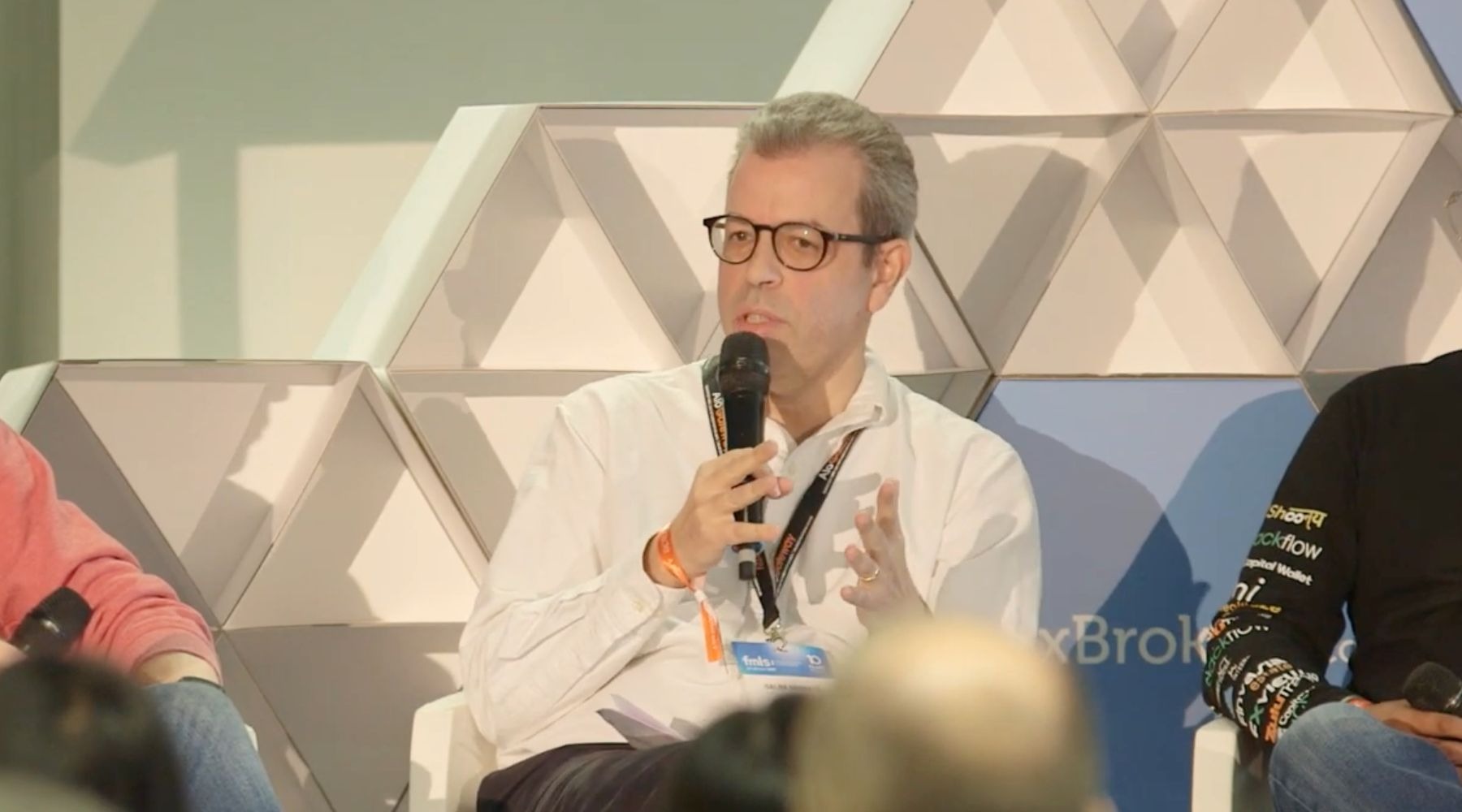
Darren Moffett, Global Chief Marketing Officer at OANDA
“Most of our prop trading traffic comes from organic channels followed by direct channels,” Darren Moffett, Global Chief Marketing Officer at OANDA, told Finance Magnates in an interview, adding: “This means that the majority of users either find us via search engines or already know our website.”
OANDA became one of the first established forex and contracts for differences (CFDs) brokers to launch prop trading services earlier this year. Although the services were initially offered under the brand OANDA Labs Trader, it was eventually rebranded to OANDA Prop Trader.
“While paid media campaigns are still effective, the biggest potential lies in building a meaningful connection with clients and adding value at every interaction,” Moffett said about the marketing strategies of the platform. “This means planning for the longer term and investing more in content and affiliate relationships, fostering an online community, and creating a compelling social media presence.”
Moffett further highlighted that “prop traders' appetite to pursue further opportunities by buying more challenges or keeping their funded accounts for longer needs to be stimulated. This is why our marketing aims to strike a balance between short-term tactical campaigns and long-term initiatives.”
“Trust Becomes Critical for Prop Trading”
When it comes to marketing for prop trading and CFDs, things are different. According to Moffett, “understanding the needs of each specific client base is crucial.”
He pointed out that the target client base for CFDs is experienced retail traders who want global market access with leveraged products. Prop trading, on the other hand, caters to a “different audience” with the “potential to attract a much broader market given the lower barriers to entry.”
Moffett highlighted that prop trading’s “expansion will depend on the maturation of the space, primarily through increased product awareness and understanding.”
“Marketing for CFDs centres on highlighting market opportunities, with a focus on simplicity, accessibility, and the flexibility of trading with smaller investments,” he continued. “Trust becomes a critical factor for prop trading, particularly as the space is often unregulated.”
“Both strategies focus on capturing and retaining active traders by addressing the unique needs of their respective audiences. CFD brokers emphasise compliance and education, ensuring that traders have a solid understanding of the risks and opportunities associated with leveraged products. In contrast, prop trading firms prioritise building trust and fostering community engagement. They leverage influencer-driven strategies that showcase trader success stories and provide valuable educational content, with influencers who possess genuine trading experience helping to enhance credibility and engagement within the trading community.”
Building trust is one of the biggest challenges for prop trading platforms. As this particular industry remains unregulated, anyone can start offering prop trading services simply by registering a company, arranging a tech stack, and onboarding a payment services provider. However, the industry became crowded in a short time and was plagued by customer complaints and shady practices by many firms.
Several prop trading companies have shuttered their services recently, citing various reasons. “The prop trading industry has experienced several upheavals in 2024, including the withdrawal of MetaTrader access by some providers and the closures of several firms,” OANDA’s CMO added. “We are going through a period of consolidation, and this has exacerbated the latent low-trust issue in the industry.”
“Prop trading often attracts scepticism from traders concerned about transparency, reliability, and hidden risks. Overcoming this requires a strong focus on credibility and clear communication.”
“Firms That Are Unprepared for This Will Be Caught Off Guard”
Although OANDA is well-regulated globally, it offers prop trading services under its offshore regulated entity. However, prop trading services are not regulated. Finance Magnates earlier reported that several regulators have been exploring prop trading: ESMA ran an initial check on such firms and also discussed possible regulations in the industry, while its Australian counterpart is also monitoring the space.
“Regulation in this space is very possible, and firms that are unprepared for this will be caught off guard,” Moffett added. “We operate the prop-trading stage from within a regulated entity, OANDA Global Markets, which positions us well for future regulatory intervention.”
“We’ve built our prop trading service with this possibility in mind.” Moffett further pointed out that OANDA has planned its prop trading marketing efforts with its “regulatory hats on,” adding that “we tested a variety of solutions with our partners across operations and channels. Now we are in a good position to scale in our core markets.”
“As this industry consolidates over time, I believe that only those firms that prioritise regulatory compliance and place user interests and experience at the core of their business model will survive.”
“A Strong Interest Among Generation Z”
There is also an increasing demand among retail traders for prop trading, and for OANDA, it’s the core Asian market. In an internal survey of 900 mid-to-high-income CFD traders across Taiwan, Thailand, and Malaysia, OANDA found that nearly half had considered applying for a prop trading account. Specifically, the interest is highest in Thailand at 59 percent, while in Taiwan and Malaysia, the numbers are 47 percent and 53 percent, respectively.
The broker additionally revealed that 26 percent of its prop trading funded accounts are profitable, while 24 percent of its repeat clients opt to upgrade and purchase larger challenges. Finance Magnates earlier reported that a mere 7% of investors manage to turn a profit.
“Our recent customer survey also revealed a strong interest among Generation Z in getting involved in prop trading,” Moffett added. “Interestingly, more than 80% of our prospects are under the age of 34.”
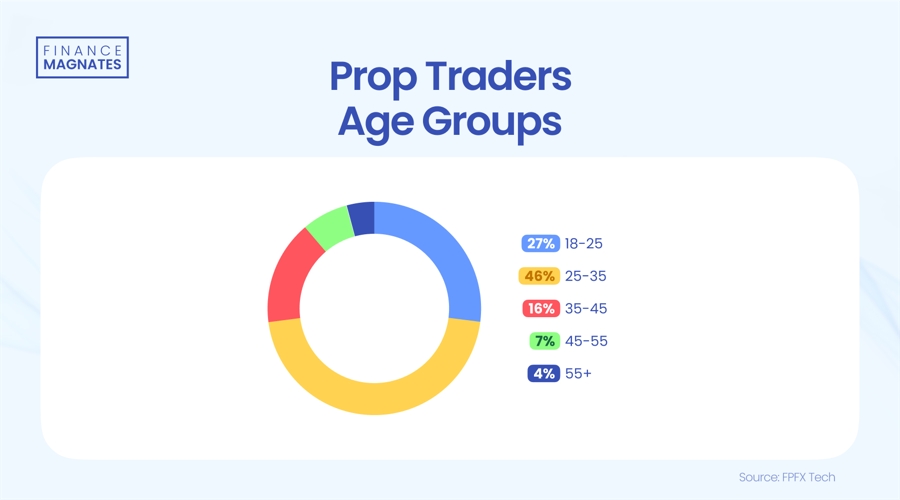
Justifying this demographic trend, the CMO pointed out that “this generation is really more tech-savvy and comfortable using platforms to trade, plus comfortable understanding the rules of prop trading.” The biggest chunk of followers on OANDA Prop Traders' Facebook page are in the 25-34 age bracket by a big margin. Dominance of this age-group also aligns with the data from FPFX Tech.
Prop traders by age group: Source: FPFX Tech
However, the broker’s internal survey also found prop trading interest among older age groups: about 60 percent of active retail traders on OANDA in Malaysia aged 25 to 34 years have considered opening a prop trading account, compared to 40 percent of those over 40 years. In Thailand, interest spans generations, with about 66 percent of traders aged 25 to 34 years considering it, and a significant 60 percent of those aged between 40 and 54 years showing interest.
“The landscape of CFD trading in Asia over the past decade has seen subtle shifts, particularly in demographics and awareness, but the core remains unchanged,” OANDA’s CMO added. “Brokers that have succeeded historically continue to do so by maintaining an ethos of supporting trader confidence and success. In contrast, prop trading challenges in the FX and CFD space have gained significant momentum in the past five years.”
“This shift is not just demographic but also indicative of broader opportunities and challenges in the industry. With increasing regulatory scrutiny, the future strength of prop trading will depend on firms that adopt robust business models, emphasising risk management, transparency, and compliance. For prop firms, the next 5-10 years represent a pivotal period.”
“Most of our prop trading traffic comes from organic channels followed by direct channels,” Darren Moffett, Global Chief Marketing Officer at OANDA, told Finance Magnates in an interview, adding: “This means that the majority of users either find us via search engines or already know our website.”
OANDA became one of the first established forex and contracts for differences (CFDs) brokers to launch prop trading services earlier this year. Although the services were initially offered under the brand OANDA Labs Trader, it was eventually rebranded to OANDA Prop Trader.
“While paid media campaigns are still effective, the biggest potential lies in building a meaningful connection with clients and adding value at every interaction,” Moffett said about the marketing strategies of the platform. “This means planning for the longer term and investing more in content and affiliate relationships, fostering an online community, and creating a compelling social media presence.”
Moffett further highlighted that “prop traders' appetite to pursue further opportunities by buying more challenges or keeping their funded accounts for longer needs to be stimulated. This is why our marketing aims to strike a balance between short-term tactical campaigns and long-term initiatives.”
“Trust Becomes Critical for Prop Trading”
When it comes to marketing for prop trading and CFDs, things are different. According to Moffett, “understanding the needs of each specific client base is crucial.”
He pointed out that the target client base for CFDs is experienced retail traders who want global market access with leveraged products. Prop trading, on the other hand, caters to a “different audience” with the “potential to attract a much broader market given the lower barriers to entry.”
Moffett highlighted that prop trading’s “expansion will depend on the maturation of the space, primarily through increased product awareness and understanding.”
“Marketing for CFDs centres on highlighting market opportunities, with a focus on simplicity, accessibility, and the flexibility of trading with smaller investments,” he continued. “Trust becomes a critical factor for prop trading, particularly as the space is often unregulated.”
“Both strategies focus on capturing and retaining active traders by addressing the unique needs of their respective audiences. CFD brokers emphasise compliance and education, ensuring that traders have a solid understanding of the risks and opportunities associated with leveraged products. In contrast, prop trading firms prioritise building trust and fostering community engagement. They leverage influencer-driven strategies that showcase trader success stories and provide valuable educational content, with influencers who possess genuine trading experience helping to enhance credibility and engagement within the trading community.”
Building trust is one of the biggest challenges for prop trading platforms. As this particular industry remains unregulated, anyone can start offering prop trading services simply by registering a company, arranging a tech stack, and onboarding a payment services provider. However, the industry became crowded in a short time and was plagued by customer complaints and shady practices by many firms.
Several prop trading companies have shuttered their services recently, citing various reasons. “The prop trading industry has experienced several upheavals in 2024, including the withdrawal of MetaTrader access by some providers and the closures of several firms,” OANDA’s CMO added. “We are going through a period of consolidation, and this has exacerbated the latent low-trust issue in the industry.”
“Prop trading often attracts scepticism from traders concerned about transparency, reliability, and hidden risks. Overcoming this requires a strong focus on credibility and clear communication.”
“Firms That Are Unprepared for This Will Be Caught Off Guard”
Although OANDA is well-regulated globally, it offers prop trading services under its offshore regulated entity. However, prop trading services are not regulated. Finance Magnates earlier reported that several regulators have been exploring prop trading: ESMA ran an initial check on such firms and also discussed possible regulations in the industry, while its Australian counterpart is also monitoring the space.
“Regulation in this space is very possible, and firms that are unprepared for this will be caught off guard,” Moffett added. “We operate the prop-trading stage from within a regulated entity, OANDA Global Markets, which positions us well for future regulatory intervention.”
“We’ve built our prop trading service with this possibility in mind.” Moffett further pointed out that OANDA has planned its prop trading marketing efforts with its “regulatory hats on,” adding that “we tested a variety of solutions with our partners across operations and channels. Now we are in a good position to scale in our core markets.”
“As this industry consolidates over time, I believe that only those firms that prioritise regulatory compliance and place user interests and experience at the core of their business model will survive.”
“A Strong Interest Among Generation Z”
There is also an increasing demand among retail traders for prop trading, and for OANDA, it’s the core Asian market. In an internal survey of 900 mid-to-high-income CFD traders across Taiwan, Thailand, and Malaysia, OANDA found that nearly half had considered applying for a prop trading account. Specifically, the interest is highest in Thailand at 59 percent, while in Taiwan and Malaysia, the numbers are 47 percent and 53 percent, respectively.
The broker additionally revealed that 26 percent of its prop trading funded accounts are profitable, while 24 percent of its repeat clients opt to upgrade and purchase larger challenges. Finance Magnates earlier reported that a mere 7% of investors manage to turn a profit.
“Our recent customer survey also revealed a strong interest among Generation Z in getting involved in prop trading,” Moffett added. “Interestingly, more than 80% of our prospects are under the age of 34.”
Justifying this demographic trend, the CMO pointed out that “this generation is really more tech-savvy and comfortable using platforms to trade, plus comfortable understanding the rules of prop trading.” The biggest chunk of followers on OANDA Prop Traders' Facebook page are in the 25-34 age bracket by a big margin. Dominance of this age-group also aligns with the data from FPFX Tech.
Prop traders by age group: Source: FPFX Tech
However, the broker’s internal survey also found prop trading interest among older age groups: about 60 percent of active retail traders on OANDA in Malaysia aged 25 to 34 years have considered opening a prop trading account, compared to 40 percent of those over 40 years. In Thailand, interest spans generations, with about 66 percent of traders aged 25 to 34 years considering it, and a significant 60 percent of those aged between 40 and 54 years showing interest.
“The landscape of CFD trading in Asia over the past decade has seen subtle shifts, particularly in demographics and awareness, but the core remains unchanged,” OANDA’s CMO added. “Brokers that have succeeded historically continue to do so by maintaining an ethos of supporting trader confidence and success. In contrast, prop trading challenges in the FX and CFD space have gained significant momentum in the past five years.”
“This shift is not just demographic but also indicative of broader opportunities and challenges in the industry. With increasing regulatory scrutiny, the future strength of prop trading will depend on firms that adopt robust business models, emphasising risk management, transparency, and compliance. For prop firms, the next 5-10 years represent a pivotal period.”
Arnab Shome is an electronics engineer-turned-financial editor. He holds a Bachelor of Technology from the National Institute of Technology, Agartala. He entered the retail trading industry about a decade ago, covering the cryptocurrency market for Finance Magnates, and later expanded his coverage to include forex and CFDs as well.
His work at Finance Magnates includes C-level interviews, data-driven analysis, opinion pieces, and scoops of industry exclusives. He also contributes to Finance Magnates’ quarterly industry report.
Area of coverage:
1. CFD broker-related news
2. Industry-related Regulatory updates and developments
3. New retail trading trends
4. Prop trading industry updates
5. Executive interviews
Education:
Bachelor of Technology - National Institute of Technology, Agartala (India)
EBC Financial’s UK CEO David Barrett Steps Down After Six Years
FP Markets Winner Spotlight 🏆 | Global Broker of the Year 2025 #Trading #Broker #Innovation #Shorts
FP Markets Winner Spotlight 🏆 | Global Broker of the Year 2025 #Trading #Broker #Innovation #Shorts
FP Markets takes the spotlight as Global Broker of the Year 2025 at the Finance Magnates Awards.
Martin Stoilov, Head of Client Experience, shares that trust, innovation, and people played a key role in the company’s success, supported by a strong foundation of integrity and client-centricity.
Following this milestone, FP Markets continues to focus on growth, technology investment, and its core values of transparency and excellence.
👉 Be part of FM Awards 2026: https://awards.financemagnates.com/#nominate
FP Markets takes the spotlight as Global Broker of the Year 2025 at the Finance Magnates Awards.
Martin Stoilov, Head of Client Experience, shares that trust, innovation, and people played a key role in the company’s success, supported by a strong foundation of integrity and client-centricity.
Following this milestone, FP Markets continues to focus on growth, technology investment, and its core values of transparency and excellence.
👉 Be part of FM Awards 2026: https://awards.financemagnates.com/#nominate
In this video, we review @HolaPrimeMarketsOfficial, a multi-asset forex and CFDs broker offering different account types, trading platforms, and flexible trading conditions.
We cover the broker’s overall offering, including account options, trading environment, platforms like MT4 and MT5, and additional services such as managed accounts and fast withdrawals.
Watch the full video to see if Hola Prime Markets fits your trading needs.
📣 Stay up to date with the latest in finance and trading. Follow Finance Magnates for industry news, insights, and global event coverage.
Connect with us:
🔗 LinkedIn: /financemagnates
👍 Facebook: /financemagnates
📸 Instagram: https://www.instagram.com/financemagnates
🐦 X: https://x.com/financemagnates
🎥 TikTok: https://www.tiktok.com/tag/financemagnates
▶️ YouTube: /@financemagnates_official
#HolaPrime #ForexBroker #CFDTrading #FinanceMagnates #Trading #Forex #BrokerReview
In this video, we review @HolaPrimeMarketsOfficial, a multi-asset forex and CFDs broker offering different account types, trading platforms, and flexible trading conditions.
We cover the broker’s overall offering, including account options, trading environment, platforms like MT4 and MT5, and additional services such as managed accounts and fast withdrawals.
Watch the full video to see if Hola Prime Markets fits your trading needs.
📣 Stay up to date with the latest in finance and trading. Follow Finance Magnates for industry news, insights, and global event coverage.
Connect with us:
🔗 LinkedIn: /financemagnates
👍 Facebook: /financemagnates
📸 Instagram: https://www.instagram.com/financemagnates
🐦 X: https://x.com/financemagnates
🎥 TikTok: https://www.tiktok.com/tag/financemagnates
▶️ YouTube: /@financemagnates_official
#HolaPrime #ForexBroker #CFDTrading #FinanceMagnates #Trading #Forex #BrokerReview
Hola Prime Review: What You Need to Know | Full Breakdown by Finance Magnates
Hola Prime Review: What You Need to Know | Full Breakdown by Finance Magnates
In this video, we review @HolaPrime_Global, a proprietary trading firm offering evaluation programs and performance-based payouts in simulated market environments.
We cover how the challenge model works, including account types, profit splits (up to 95%), trading rules, and what it takes to reach a funded account. You’ll also learn about available platforms like MT4, MT5, cTrader, and more, along with insights into payouts, support, and trading conditions.
Watch the full video to see if Hola Prime fits your trading style.
📣 Stay up to date with the latest in finance and trading. Follow Finance Magnates for industry news, insights, and global event coverage.
Connect with us:
🔗 LinkedIn: /financemagnates
👍 Facebook: /financemagnates
📸 Instagram: https://www.instagram.com/financemagnates
🐦 X: https://x.com/financemagnates
🎥 TikTok: https://www.tiktok.com/tag/financemagnates
▶️ YouTube: /@financemagnates_official
#HolaPrime #PropFirm #Trading #FinanceMagnates #Forex #FuturesTrading #TradingReview #PropFirmReview
In this video, we review @HolaPrime_Global, a proprietary trading firm offering evaluation programs and performance-based payouts in simulated market environments.
We cover how the challenge model works, including account types, profit splits (up to 95%), trading rules, and what it takes to reach a funded account. You’ll also learn about available platforms like MT4, MT5, cTrader, and more, along with insights into payouts, support, and trading conditions.
Watch the full video to see if Hola Prime fits your trading style.
📣 Stay up to date with the latest in finance and trading. Follow Finance Magnates for industry news, insights, and global event coverage.
Connect with us:
🔗 LinkedIn: /financemagnates
👍 Facebook: /financemagnates
📸 Instagram: https://www.instagram.com/financemagnates
🐦 X: https://x.com/financemagnates
🎥 TikTok: https://www.tiktok.com/tag/financemagnates
▶️ YouTube: /@financemagnates_official
#HolaPrime #PropFirm #Trading #FinanceMagnates #Forex #FuturesTrading #TradingReview #PropFirmReview
Axi Winner Spotlight 🏆 | Global Most Innovative Broker 2025 #Innovation #Trading #Fintech #Broker
Axi Winner Spotlight 🏆 | Global Most Innovative Broker 2025 #Innovation #Trading #Fintech #Broker
Axi takes the spotlight at the Finance Magnates Awards, winning Global Most Innovative Broker 2025.
Olivia Xenofontos and Ivanna Openko share how the team will feel: proud, motivated, and ready to keep delivering.
They also describe the night as well-organized, focused, and enjoyable for all.
👉 Be part of FM Awards 2026.
Axi takes the spotlight at the Finance Magnates Awards, winning Global Most Innovative Broker 2025.
Olivia Xenofontos and Ivanna Openko share how the team will feel: proud, motivated, and ready to keep delivering.
They also describe the night as well-organized, focused, and enjoyable for all.
👉 Be part of FM Awards 2026.
Recognition that matters.
Built on transparency.
Driven by the industry.
The Finance Magnates Awards 2026.
Nominations are now open.
🔗 https://awards.financemagnates.com/?utm_source=SM&utm_medium=social&utm_campaign=recognition-matters
Recognition that matters.
Built on transparency.
Driven by the industry.
The Finance Magnates Awards 2026.
Nominations are now open.
🔗 https://awards.financemagnates.com/?utm_source=SM&utm_medium=social&utm_campaign=recognition-matters