The cryptocurrency’s liquidity indicators suggest reduced short-term trading.
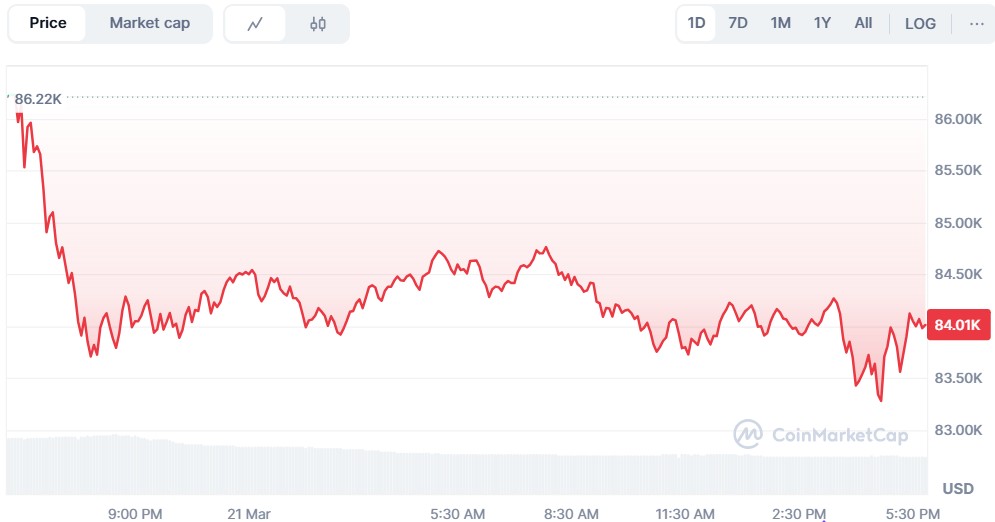
At the time of publication, BTC's price had dropped to $84K, levels last seen in November.
Speculative Bitcoin trading is cooling off as
investors shift their focus to safer digital assets. Market uncertainty, global
trade tensions, and recent memecoin scams have reportedly led to reduced risk
appetite. Key indicators show a decline in speculative trading,
suggesting a broader market shift that could shape Bitcoin’s trajectory in
2025.
Bitcoin Liquidity Drops as Investors Reassess Risks
Bitcoin’s hot supply, which measures the percentage of
BTC held for a week or less, has plummeted from 5.9% in late November to just
2.3% by March 20, according to Glassnode.
This sharp decline indicates that fewer investors are
trading Bitcoin aggressively, opting instead for more stable positions. Another
sign of waning speculation is the stablecoin supply ratio (SSR), which measures
Bitcoin’s supply relative to stablecoins.
The SSR has fallen to 8, its lowest level in over four
months. It was reportedly last seen when Bitcoin traded around $67,000 before its post-election
rally. Historically, an SSR below 10 suggests limited buying power for Bitcoin
compared to its market cap.
Bitcoin Still Outperforms Traditional Assets
Despite the growing cautious sentiment, Bitcoin has
outpaced traditional asset classes since the U.S. presidential election.
Compared to stocks, real estate, and precious metals, Bitcoin remains a
top-performing asset.
Bitcoin price, Source: CoinMarketCap
One key economic metric, the ICE/BofA U.S. High Yield
Index Option-Adjusted Spread (OAS), has dropped from 3.4% to 3.2%, signaling
temporary relief for risk assets, including Bitcoin and equities, Coindesk
reported.
Will Bitcoin’s Bull Run Continue?
This spread measures the difference in yields between
high-yield corporate bonds and U.S. Treasuries and serves as a gauge of
economic sentiment. However, some analysts warn that this relief may be
short-lived. As Trump’s tariff policies take effect, the OAS spread could
widen, triggering renewed risk aversion.
While speculative activity is slowing, long-term
investors remain optimistic about Bitcoin’s future. The Federal Reserve’s
monetary policy and global economic developments will play a key role in
shaping Bitcoin’s price action in the coming months. For now, Bitcoin’s trajectory remains uncertain, but
history suggests that periods of reduced speculation often set the stage for
the next major move.
Speculative Bitcoin trading is cooling off as
investors shift their focus to safer digital assets. Market uncertainty, global
trade tensions, and recent memecoin scams have reportedly led to reduced risk
appetite. Key indicators show a decline in speculative trading,
suggesting a broader market shift that could shape Bitcoin’s trajectory in
2025.
Bitcoin Liquidity Drops as Investors Reassess Risks
Bitcoin’s hot supply, which measures the percentage of
BTC held for a week or less, has plummeted from 5.9% in late November to just
2.3% by March 20, according to Glassnode.
This sharp decline indicates that fewer investors are
trading Bitcoin aggressively, opting instead for more stable positions. Another
sign of waning speculation is the stablecoin supply ratio (SSR), which measures
Bitcoin’s supply relative to stablecoins.
The SSR has fallen to 8, its lowest level in over four
months. It was reportedly last seen when Bitcoin traded around $67,000 before its post-election
rally. Historically, an SSR below 10 suggests limited buying power for Bitcoin
compared to its market cap.
Bitcoin Still Outperforms Traditional Assets
Despite the growing cautious sentiment, Bitcoin has
outpaced traditional asset classes since the U.S. presidential election.
Compared to stocks, real estate, and precious metals, Bitcoin remains a
top-performing asset.
Bitcoin price, Source: CoinMarketCap
One key economic metric, the ICE/BofA U.S. High Yield
Index Option-Adjusted Spread (OAS), has dropped from 3.4% to 3.2%, signaling
temporary relief for risk assets, including Bitcoin and equities, Coindesk
reported.
Will Bitcoin’s Bull Run Continue?
This spread measures the difference in yields between
high-yield corporate bonds and U.S. Treasuries and serves as a gauge of
economic sentiment. However, some analysts warn that this relief may be
short-lived. As Trump’s tariff policies take effect, the OAS spread could
widen, triggering renewed risk aversion.
While speculative activity is slowing, long-term
investors remain optimistic about Bitcoin’s future. The Federal Reserve’s
monetary policy and global economic developments will play a key role in
shaping Bitcoin’s price action in the coming months. For now, Bitcoin’s trajectory remains uncertain, but
history suggests that periods of reduced speculation often set the stage for
the next major move.
Jared Kirui is an Editor at Finance Magnates with more than five years of experience in financial journalism. He covers online trading, fintech, payments, and crypto industries with a focus on companies, regulation and compliance, executive moves, trading technology, and market analysis.
His work has been featured in other media outlets, including Benzinga, ZyCrypto, The Distributed, and The Daily Hodl.
Education:
Bachelor of Commerce degree (Finance option), University of Nairobi
WhiteBIT secures brokerage license in Georgia to launch regulated crypto derivatives
FP Markets Winner Spotlight 🏆 | Global Broker of the Year 2025 #Trading #Broker #Innovation #Shorts
FP Markets Winner Spotlight 🏆 | Global Broker of the Year 2025 #Trading #Broker #Innovation #Shorts
FP Markets takes the spotlight as Global Broker of the Year 2025 at the Finance Magnates Awards.
Martin Stoilov, Head of Client Experience, shares that trust, innovation, and people played a key role in the company’s success, supported by a strong foundation of integrity and client-centricity.
Following this milestone, FP Markets continues to focus on growth, technology investment, and its core values of transparency and excellence.
👉 Be part of FM Awards 2026: https://awards.financemagnates.com/#nominate
FP Markets takes the spotlight as Global Broker of the Year 2025 at the Finance Magnates Awards.
Martin Stoilov, Head of Client Experience, shares that trust, innovation, and people played a key role in the company’s success, supported by a strong foundation of integrity and client-centricity.
Following this milestone, FP Markets continues to focus on growth, technology investment, and its core values of transparency and excellence.
👉 Be part of FM Awards 2026: https://awards.financemagnates.com/#nominate
In this video, we review @HolaPrimeMarketsOfficial, a multi-asset forex and CFDs broker offering different account types, trading platforms, and flexible trading conditions.
We cover the broker’s overall offering, including account options, trading environment, platforms like MT4 and MT5, and additional services such as managed accounts and fast withdrawals.
Watch the full video to see if Hola Prime Markets fits your trading needs.
📣 Stay up to date with the latest in finance and trading. Follow Finance Magnates for industry news, insights, and global event coverage.
Connect with us:
🔗 LinkedIn: /financemagnates
👍 Facebook: /financemagnates
📸 Instagram: https://www.instagram.com/financemagnates
🐦 X: https://x.com/financemagnates
🎥 TikTok: https://www.tiktok.com/tag/financemagnates
▶️ YouTube: /@financemagnates_official
#HolaPrime #ForexBroker #CFDTrading #FinanceMagnates #Trading #Forex #BrokerReview
In this video, we review @HolaPrimeMarketsOfficial, a multi-asset forex and CFDs broker offering different account types, trading platforms, and flexible trading conditions.
We cover the broker’s overall offering, including account options, trading environment, platforms like MT4 and MT5, and additional services such as managed accounts and fast withdrawals.
Watch the full video to see if Hola Prime Markets fits your trading needs.
📣 Stay up to date with the latest in finance and trading. Follow Finance Magnates for industry news, insights, and global event coverage.
Connect with us:
🔗 LinkedIn: /financemagnates
👍 Facebook: /financemagnates
📸 Instagram: https://www.instagram.com/financemagnates
🐦 X: https://x.com/financemagnates
🎥 TikTok: https://www.tiktok.com/tag/financemagnates
▶️ YouTube: /@financemagnates_official
#HolaPrime #ForexBroker #CFDTrading #FinanceMagnates #Trading #Forex #BrokerReview
Hola Prime Review: What You Need to Know | Full Breakdown by Finance Magnates
Hola Prime Review: What You Need to Know | Full Breakdown by Finance Magnates
In this video, we review @HolaPrime_Global, a proprietary trading firm offering evaluation programs and performance-based payouts in simulated market environments.
We cover how the challenge model works, including account types, profit splits (up to 95%), trading rules, and what it takes to reach a funded account. You’ll also learn about available platforms like MT4, MT5, cTrader, and more, along with insights into payouts, support, and trading conditions.
Watch the full video to see if Hola Prime fits your trading style.
📣 Stay up to date with the latest in finance and trading. Follow Finance Magnates for industry news, insights, and global event coverage.
Connect with us:
🔗 LinkedIn: /financemagnates
👍 Facebook: /financemagnates
📸 Instagram: https://www.instagram.com/financemagnates
🐦 X: https://x.com/financemagnates
🎥 TikTok: https://www.tiktok.com/tag/financemagnates
▶️ YouTube: /@financemagnates_official
#HolaPrime #PropFirm #Trading #FinanceMagnates #Forex #FuturesTrading #TradingReview #PropFirmReview
In this video, we review @HolaPrime_Global, a proprietary trading firm offering evaluation programs and performance-based payouts in simulated market environments.
We cover how the challenge model works, including account types, profit splits (up to 95%), trading rules, and what it takes to reach a funded account. You’ll also learn about available platforms like MT4, MT5, cTrader, and more, along with insights into payouts, support, and trading conditions.
Watch the full video to see if Hola Prime fits your trading style.
📣 Stay up to date with the latest in finance and trading. Follow Finance Magnates for industry news, insights, and global event coverage.
Connect with us:
🔗 LinkedIn: /financemagnates
👍 Facebook: /financemagnates
📸 Instagram: https://www.instagram.com/financemagnates
🐦 X: https://x.com/financemagnates
🎥 TikTok: https://www.tiktok.com/tag/financemagnates
▶️ YouTube: /@financemagnates_official
#HolaPrime #PropFirm #Trading #FinanceMagnates #Forex #FuturesTrading #TradingReview #PropFirmReview
Axi Winner Spotlight 🏆 | Global Most Innovative Broker 2025 #Innovation #Trading #Fintech #Broker
Axi Winner Spotlight 🏆 | Global Most Innovative Broker 2025 #Innovation #Trading #Fintech #Broker
Axi takes the spotlight at the Finance Magnates Awards, winning Global Most Innovative Broker 2025.
Olivia Xenofontos and Ivanna Openko share how the team will feel: proud, motivated, and ready to keep delivering.
They also describe the night as well-organized, focused, and enjoyable for all.
👉 Be part of FM Awards 2026.
Axi takes the spotlight at the Finance Magnates Awards, winning Global Most Innovative Broker 2025.
Olivia Xenofontos and Ivanna Openko share how the team will feel: proud, motivated, and ready to keep delivering.
They also describe the night as well-organized, focused, and enjoyable for all.
👉 Be part of FM Awards 2026.
Recognition that matters.
Built on transparency.
Driven by the industry.
The Finance Magnates Awards 2026.
Nominations are now open.
🔗 https://awards.financemagnates.com/?utm_source=SM&utm_medium=social&utm_campaign=recognition-matters
Recognition that matters.
Built on transparency.
Driven by the industry.
The Finance Magnates Awards 2026.
Nominations are now open.
🔗 https://awards.financemagnates.com/?utm_source=SM&utm_medium=social&utm_campaign=recognition-matters