FTX's collapse, Terra-LUNA's failure and other events are haunting the crypto industry.
However, some think the nightmare may not be over yet as we head into 2023.
Analysis
No doubt, 2022 has been a hectic year
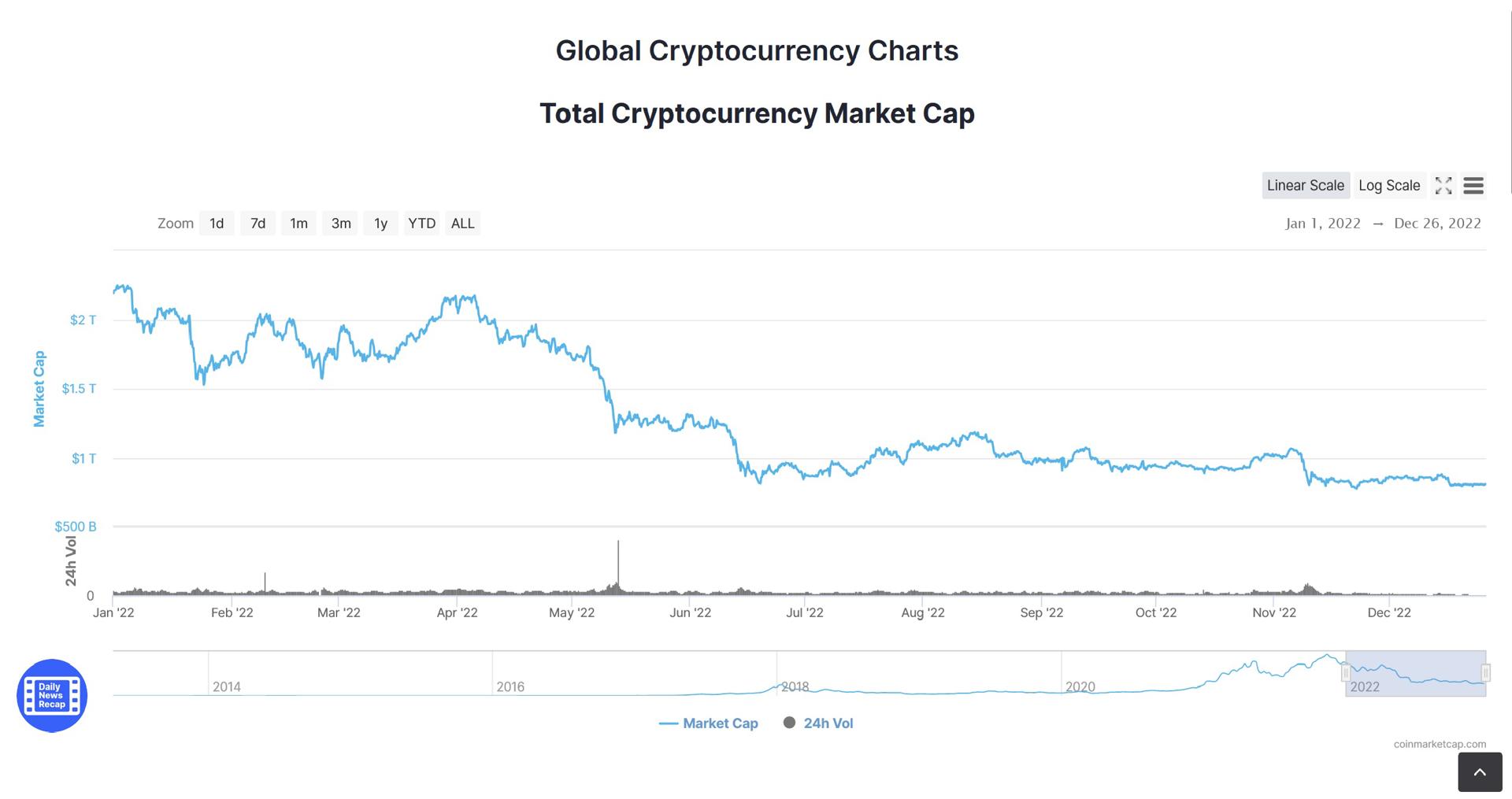
for the global cryptocurrency industry. At the start of the year, the market capitalization of the global
cryptocurrency industry stood at $2.19 trillion dollars. However,
the market cap collapsed by 63% to about $820.7 billion by mid-June, bearing
scars of the wide turn of events that had taken the industry by
storm.
This trails back to 2021, when central banks across the
world implemented expansionary fiscal policies to boost economic recovery
following the battering of COVID-19. These measures boosted the growth of the digital asset
economy, leading to record highs for leading cryptocurrencies, such as Bitcoin and
Ether.
However, by early 2022, the apex
authorities begin to implement contractionary fiscal policies to combat global inflation, thereby killing investors’ appetite for speculative assets. On June 13, for instance, the stock market entered a bear market, witnessing one of its worst performances in 40 years. This change in the macroeconomic climate spelt doom for the cryptocurrency industry as the pressure on
traditional assets rubbed off its digital currency counterparts.
Source: CoinMarketCap
The Terra-LUNA Nightmare
Following the breakout of the
Russian-Ukraine war in February and the role digital assets played in enabling
financial circumvention, came the first industry shock in March: the Axie
Infinity hack. The attack on the Ronin Network, the blockchain-based sidechain
that powers the non-fungible token-based online gaming video, saw hackers part way
with $625 million. Other hacks would follow in the year.
However, what truly shook the global
cryptocurrency industry was the collapse of the Terra-USD (UST) /LUNA.
In April 2022, TerraUSD capped its months-long growth, reaching a record high
of $119.20 in April. However, economic pressure took hold of the market and on
May 9, the UST started to fall below its $1 peg. By May 13th, the algorithmic
stablecoin had fallen as low as 35 cents for $1. The governance token LUNA,
which was used to maintain the stalecoin’s peg to the US dollar, also felt the
heat, sinking by 96% in a day to under 10 cents by May 12th.
Ryan Hansen, Head of Sales at Liquid Mercury
“The Terra Luna situation in the
spring was a poorly constructed stablecoin selling off steeply and quickly once
it lost its peg, and the lesson is that there has never been long-term success
story for an algorithmic stablecoin, so sticking to the ones that have real,
hard assets or provable fiat holdings underpinning the coin is likely the best
path forward for the category,” Ryan Hansen, the Head of Sales at Liquid Mercury,
told Finance Magnates.
The tides that swallowed Terra/LUNA swept crypto lenders Celsius Network and Voyager Digital which had lent
funds to crypto hedge funds such as Three Arrows Capital (3AC) that had taken
over leveraged positions during the market highs. As a result, the hedge funds
and crypto lenders went bankrupt, forced by the ensuing liquidity crisis and
withdrawal frenzy among customers.
“There was excessive optimism during
Bitcoin's bull market, with many in the industry expecting the Bitcoin price to
reach $100k by the middle of 2022. This led companies to hold Bitcoins rather
than dollars in their reserves, which unintentionally made them dependent on
each other's success,” the Lead Developer at Seasonal Tokens, who uses the pseudonym Ruadhan O., told Finance Magnates.
Ruadhan added: “When Terra/Luna got into trouble, it
was necessary to liquidate Bitcoins to try to survive. That destroyed the value
of the reserves of many other big players and led to a cascade of business failures
that further depressed the price."
FTX: Knight of the Crypto Winter?
In the aftermath of the collapse of
several crypto lenders, Sam Bankman-Fried, the Co-Founder and then-CEO of FTX,
went on several rescue missions to save collapsing crypto enterprises. The
exchange, once the fastest-growing, in July offered to provide
early liquidity to Voyager’s customers. Additionally, FTX.US, the exchange’s United States subsidiary, offered to buy American crypto lender BlockFi for $240,000. In addition,
the exchange acquired Liquid Group, Good
Luck Games and Bitvo.
Check out the recent Finance Magnates London Summit 2022 session on what the future holds for digital assets.
Furthermore, tough macroeconomic conditions contributed to the crypto winter, which saw the prices of cryptocurrencies sink to
record lows. For instance, the price of Bitcoin slumped 14% to under
$24,000, which is the lowest since December 2020. As a result, major crypto
actors, including Coinbase, Gemini and now-bankrupt BlockFi announced job
cuts. Experts who spoke to
Finance Magnates attributed the mass retrenchment to unpreparedness on the part
of these stakeholders. Regardless of this, the ‘deep pockets’ of FTX and Binance enabled
them to expand and thrive amidst the drought. But, who won during the crypto winter:
Binance or FTX? The answer would come in earnest.
However, in the midst of the crypto winter in summer, The Ethereum Merge, or
the hard fork of the Ethereum blockchain technology from Proof-of-Work to
Proof-of-Stake, was completed on September 15th. Finance Magnates
reported that investors continue to thread a cautious path despite the significant event.
The Fall of a Crypto Giant
While FTX appeared as if headed for
industry dominance, its bubble soon burst. In November, a CoinDesk report
revealed that the Bahamas-headquartered crypto firm was propping its business
with customers' funds from sister quantitative trading firm Alameda Research. The news, in addition to Binance’s decision to withdraw its FTX Tokens
holding, threw FTX into a liquidity crisis that saw the firm running
helter-skelter for rescue capital. Binance would later abandon a deal to take
over the exchange, citing concerns with its finances. Later, FTX filed for bankruptcy
protection in the US, and Bankman-Fried resigned as the crypto exchange’s CEO.
The collapse of the exchange is estimated to have cost investors over $8
billion in losses.
Pawel Andruszkiewicz, the
Chief Operating Officer of VAIOT, believes that the failure of FTX is evidence that "crypto business around the world
operates in a ‘wild west’ sort of style." He further explained: "They do not have to adhere to any
rules or standards. They are rarely audited from information security,
technical or financial management perspectives. They are often founded by
developers or technology enthusiasts who need to gain experience running
companies and their muti-faceted operations."
Pedro Isaac Lopez, Chief Growth Officer at THORWallet DEX
In the latest update, Bankman-Fried
was arrested in Bahamas and extradited to the US where he has been charged with
fraud by the US Securities and Exchange Commission and the Commodity Futures Trading Commission. However, he was recently released on a $250 million personal
recognizance bond.
Pedro Isaac Lopez, the Chief Growth Officer at THORWallet DEX, believes that "backlash and negative sentiment" that trailed the FTX scandal "will be tough to shake off." He added that "it is not a fatal blow." "There are brilliant people innovating in this space worthy of public trust. It
is their duty to prop up the authentic use cases in DeFi and regain that
trust,” Lopez said.
However, despite these events, a
recent study by Eurex, one of the world’s largest derivatives exchanges, found
that institutional adoption of cryptocurrency is still on track this year
despite extreme price declines and crypto businesses’ failures that defined the
market this year.
Sendi Young, the Managing Director for Europe at Ripple
“I would imagine that most
institutions believe that crypto is here to stay, and some may even be looking
at this crash as a buying opportunity. Crypto is no longer a completely taboo
or fringe asset class. Polygon just struck deals with Starbucks and Disney,”
Frank Corva, a Senior Analyst for Digital Assets at Finder, told Finance
Magnates.
Sendi Young, the Managing
Director for Europe at Ripple, also believes that institutional adoption of blockchain and digital assets will accelerate as
corporations launch pilots and continue to investigate the technology.
"Banks
are no longer questioning whether they require a crypto strategy but are
instead asking themselves what their crypto strategy should be. There is a
recognition from traditional financial institutions that the technology is here
to stay, creating opportunities to bring greater efficiencies, transparency and
speed to existing financial infrastructure,” Young explained
Crypto Regulation in 2022
For the most part, the events of 2022 are keeping regulators on their toes. On
June 30th, the European Union reached a provisional agreement on the
Markets in Crypto-Assets (MiCA) regulation which seeks to put an end to the
‘crypt wild west’ in Europe. However, Finance Magnates reports that the regulation first has to drive uniformity across the
continent’s fragmented crypto landscape.
In the United States, federal
lawmakers have introduced bills that are seeking to regulate stablecoins and other
cypto assets and enshrine consumer protection. This is even as President Joe Biden’s executive
order on digital asset regulation in March marked an important
phase of cryptocurrency regulation in the US. But, how will these shape out?
Jez Mohideen, Co-Founder and CEO of Laser Digital, the digital arm of Nomura Bank
Jez Mohideen, the Co-Founder and CEO of Laser Digital,
the digital arm of Nomura Bank, considers that what needs to happen is a push
toward standards across multiple jurisdictions to allow for crypto establishments to
work together "in well-defined, transparent ways."
"Lawmakers need to view Web3
and DeFi as extensions of the existing economy, rather than a separate entity.
The nuances of this space should be considered, as well as the
interdependencies of platforms both in cryptocurrency and their connection to
legacy offerings,” Mohideen explained.
Across the world, the race for
central banks' digital currencies continued with the launch of new experimental
projects in the United States and across Europe including in Spain. Central banks are also
looking to impose limits on banks’ exposure to crypto assets by 2025.
“It is important that a fine balance be struck between the
imposition of rules and a softer 'first do no harm' approach. Regulators must
be careful to ensure that the industry remains user friendly," Doug Brooks, a Senior Advisor at XinFin for the XDC Network,
told Finance Magnates. "Regulation is
right and much needed right now, but over-regulation will stifle future growth
and innovation,” Brooks added.
What’s Next for Crypto?
In a year like 2022, full of drama
and industry-defining events, how will the cryptocurrency industry play out in
2023? Experts who spoke to Finance Magnates believe that crypto regulation will
be a big part of 2023. Others think the storm might not be over just yet.
Simone Mazzuca, Director of Wallex Custody.
“I strongly believe that 2023 will be
the year for institutional adoption on a global scale of stablecoins and bigger
transparency in the market and we’re here for it,” Simone Mazzuca, the CEO & Co-Founder of Wallex Custody, told
Finance Magnates. "On the regulatory side, I
expect to see a speeded advance in regulatory measures, driven by all that
happened in 2022," Mazzuca added.
For Frank Corva, a Senior
Analyst for Digital Assets at Finder, it would not be surprising if a new handful of firms blow up in the next year. This might happen "before the dust in the crypto space
totally settles," Corva said.
"Many are still waiting anxiously to see whether crypto
borrowing and lending firm Genesis – the firm that powers crypto exchange
Gemini’s Earn program – will process the $900 million in redemptions that it
owes Gemini Earn customers. If it doesn’t process these redemptions and if it
goes under, these events may trigger the next wave of liquidations. So, there
may be more pain to come in the first quarter of 2023."
No doubt, 2022 has been a hectic year
for the global cryptocurrency industry. At the start of the year, the market capitalization of the global
cryptocurrency industry stood at $2.19 trillion dollars. However,
the market cap collapsed by 63% to about $820.7 billion by mid-June, bearing
scars of the wide turn of events that had taken the industry by
storm.
This trails back to 2021, when central banks across the
world implemented expansionary fiscal policies to boost economic recovery
following the battering of COVID-19. These measures boosted the growth of the digital asset
economy, leading to record highs for leading cryptocurrencies, such as Bitcoin and
Ether.
However, by early 2022, the apex
authorities begin to implement contractionary fiscal policies to combat global inflation, thereby killing investors’ appetite for speculative assets. On June 13, for instance, the stock market entered a bear market, witnessing one of its worst performances in 40 years. This change in the macroeconomic climate spelt doom for the cryptocurrency industry as the pressure on
traditional assets rubbed off its digital currency counterparts.
Source: CoinMarketCap
The Terra-LUNA Nightmare
Following the breakout of the
Russian-Ukraine war in February and the role digital assets played in enabling
financial circumvention, came the first industry shock in March: the Axie
Infinity hack. The attack on the Ronin Network, the blockchain-based sidechain
that powers the non-fungible token-based online gaming video, saw hackers part way
with $625 million. Other hacks would follow in the year.
However, what truly shook the global
cryptocurrency industry was the collapse of the Terra-USD (UST) /LUNA.
In April 2022, TerraUSD capped its months-long growth, reaching a record high
of $119.20 in April. However, economic pressure took hold of the market and on
May 9, the UST started to fall below its $1 peg. By May 13th, the algorithmic
stablecoin had fallen as low as 35 cents for $1. The governance token LUNA,
which was used to maintain the stalecoin’s peg to the US dollar, also felt the
heat, sinking by 96% in a day to under 10 cents by May 12th.
Ryan Hansen, Head of Sales at Liquid Mercury
“The Terra Luna situation in the
spring was a poorly constructed stablecoin selling off steeply and quickly once
it lost its peg, and the lesson is that there has never been long-term success
story for an algorithmic stablecoin, so sticking to the ones that have real,
hard assets or provable fiat holdings underpinning the coin is likely the best
path forward for the category,” Ryan Hansen, the Head of Sales at Liquid Mercury,
told Finance Magnates.
The tides that swallowed Terra/LUNA swept crypto lenders Celsius Network and Voyager Digital which had lent
funds to crypto hedge funds such as Three Arrows Capital (3AC) that had taken
over leveraged positions during the market highs. As a result, the hedge funds
and crypto lenders went bankrupt, forced by the ensuing liquidity crisis and
withdrawal frenzy among customers.
“There was excessive optimism during
Bitcoin's bull market, with many in the industry expecting the Bitcoin price to
reach $100k by the middle of 2022. This led companies to hold Bitcoins rather
than dollars in their reserves, which unintentionally made them dependent on
each other's success,” the Lead Developer at Seasonal Tokens, who uses the pseudonym Ruadhan O., told Finance Magnates.
Ruadhan added: “When Terra/Luna got into trouble, it
was necessary to liquidate Bitcoins to try to survive. That destroyed the value
of the reserves of many other big players and led to a cascade of business failures
that further depressed the price."
FTX: Knight of the Crypto Winter?
In the aftermath of the collapse of
several crypto lenders, Sam Bankman-Fried, the Co-Founder and then-CEO of FTX,
went on several rescue missions to save collapsing crypto enterprises. The
exchange, once the fastest-growing, in July offered to provide
early liquidity to Voyager’s customers. Additionally, FTX.US, the exchange’s United States subsidiary, offered to buy American crypto lender BlockFi for $240,000. In addition,
the exchange acquired Liquid Group, Good
Luck Games and Bitvo.
Check out the recent Finance Magnates London Summit 2022 session on what the future holds for digital assets.
Furthermore, tough macroeconomic conditions contributed to the crypto winter, which saw the prices of cryptocurrencies sink to
record lows. For instance, the price of Bitcoin slumped 14% to under
$24,000, which is the lowest since December 2020. As a result, major crypto
actors, including Coinbase, Gemini and now-bankrupt BlockFi announced job
cuts. Experts who spoke to
Finance Magnates attributed the mass retrenchment to unpreparedness on the part
of these stakeholders. Regardless of this, the ‘deep pockets’ of FTX and Binance enabled
them to expand and thrive amidst the drought. But, who won during the crypto winter:
Binance or FTX? The answer would come in earnest.
However, in the midst of the crypto winter in summer, The Ethereum Merge, or
the hard fork of the Ethereum blockchain technology from Proof-of-Work to
Proof-of-Stake, was completed on September 15th. Finance Magnates
reported that investors continue to thread a cautious path despite the significant event.
The Fall of a Crypto Giant
While FTX appeared as if headed for
industry dominance, its bubble soon burst. In November, a CoinDesk report
revealed that the Bahamas-headquartered crypto firm was propping its business
with customers' funds from sister quantitative trading firm Alameda Research. The news, in addition to Binance’s decision to withdraw its FTX Tokens
holding, threw FTX into a liquidity crisis that saw the firm running
helter-skelter for rescue capital. Binance would later abandon a deal to take
over the exchange, citing concerns with its finances. Later, FTX filed for bankruptcy
protection in the US, and Bankman-Fried resigned as the crypto exchange’s CEO.
The collapse of the exchange is estimated to have cost investors over $8
billion in losses.
Pawel Andruszkiewicz, the
Chief Operating Officer of VAIOT, believes that the failure of FTX is evidence that "crypto business around the world
operates in a ‘wild west’ sort of style." He further explained: "They do not have to adhere to any
rules or standards. They are rarely audited from information security,
technical or financial management perspectives. They are often founded by
developers or technology enthusiasts who need to gain experience running
companies and their muti-faceted operations."
Pedro Isaac Lopez, Chief Growth Officer at THORWallet DEX
In the latest update, Bankman-Fried
was arrested in Bahamas and extradited to the US where he has been charged with
fraud by the US Securities and Exchange Commission and the Commodity Futures Trading Commission. However, he was recently released on a $250 million personal
recognizance bond.
Pedro Isaac Lopez, the Chief Growth Officer at THORWallet DEX, believes that "backlash and negative sentiment" that trailed the FTX scandal "will be tough to shake off." He added that "it is not a fatal blow." "There are brilliant people innovating in this space worthy of public trust. It
is their duty to prop up the authentic use cases in DeFi and regain that
trust,” Lopez said.
However, despite these events, a
recent study by Eurex, one of the world’s largest derivatives exchanges, found
that institutional adoption of cryptocurrency is still on track this year
despite extreme price declines and crypto businesses’ failures that defined the
market this year.
Sendi Young, the Managing Director for Europe at Ripple
“I would imagine that most
institutions believe that crypto is here to stay, and some may even be looking
at this crash as a buying opportunity. Crypto is no longer a completely taboo
or fringe asset class. Polygon just struck deals with Starbucks and Disney,”
Frank Corva, a Senior Analyst for Digital Assets at Finder, told Finance
Magnates.
Sendi Young, the Managing
Director for Europe at Ripple, also believes that institutional adoption of blockchain and digital assets will accelerate as
corporations launch pilots and continue to investigate the technology.
"Banks
are no longer questioning whether they require a crypto strategy but are
instead asking themselves what their crypto strategy should be. There is a
recognition from traditional financial institutions that the technology is here
to stay, creating opportunities to bring greater efficiencies, transparency and
speed to existing financial infrastructure,” Young explained
Crypto Regulation in 2022
For the most part, the events of 2022 are keeping regulators on their toes. On
June 30th, the European Union reached a provisional agreement on the
Markets in Crypto-Assets (MiCA) regulation which seeks to put an end to the
‘crypt wild west’ in Europe. However, Finance Magnates reports that the regulation first has to drive uniformity across the
continent’s fragmented crypto landscape.
In the United States, federal
lawmakers have introduced bills that are seeking to regulate stablecoins and other
cypto assets and enshrine consumer protection. This is even as President Joe Biden’s executive
order on digital asset regulation in March marked an important
phase of cryptocurrency regulation in the US. But, how will these shape out?
Jez Mohideen, Co-Founder and CEO of Laser Digital, the digital arm of Nomura Bank
Jez Mohideen, the Co-Founder and CEO of Laser Digital,
the digital arm of Nomura Bank, considers that what needs to happen is a push
toward standards across multiple jurisdictions to allow for crypto establishments to
work together "in well-defined, transparent ways."
"Lawmakers need to view Web3
and DeFi as extensions of the existing economy, rather than a separate entity.
The nuances of this space should be considered, as well as the
interdependencies of platforms both in cryptocurrency and their connection to
legacy offerings,” Mohideen explained.
Across the world, the race for
central banks' digital currencies continued with the launch of new experimental
projects in the United States and across Europe including in Spain. Central banks are also
looking to impose limits on banks’ exposure to crypto assets by 2025.
“It is important that a fine balance be struck between the
imposition of rules and a softer 'first do no harm' approach. Regulators must
be careful to ensure that the industry remains user friendly," Doug Brooks, a Senior Advisor at XinFin for the XDC Network,
told Finance Magnates. "Regulation is
right and much needed right now, but over-regulation will stifle future growth
and innovation,” Brooks added.
What’s Next for Crypto?
In a year like 2022, full of drama
and industry-defining events, how will the cryptocurrency industry play out in
2023? Experts who spoke to Finance Magnates believe that crypto regulation will
be a big part of 2023. Others think the storm might not be over just yet.
Simone Mazzuca, Director of Wallex Custody.
“I strongly believe that 2023 will be
the year for institutional adoption on a global scale of stablecoins and bigger
transparency in the market and we’re here for it,” Simone Mazzuca, the CEO & Co-Founder of Wallex Custody, told
Finance Magnates. "On the regulatory side, I
expect to see a speeded advance in regulatory measures, driven by all that
happened in 2022," Mazzuca added.
For Frank Corva, a Senior
Analyst for Digital Assets at Finder, it would not be surprising if a new handful of firms blow up in the next year. This might happen "before the dust in the crypto space
totally settles," Corva said.
"Many are still waiting anxiously to see whether crypto
borrowing and lending firm Genesis – the firm that powers crypto exchange
Gemini’s Earn program – will process the $900 million in redemptions that it
owes Gemini Earn customers. If it doesn’t process these redemptions and if it
goes under, these events may trigger the next wave of liquidations. So, there
may be more pain to come in the first quarter of 2023."
Solomon Oladipupo is a journalist and editor from Nigeria that covers the tech, FX, fintech and cryptocurrency industries. He is a former assistant editor at AgroNigeria Magazine where he covered the agribusiness industry. Solomon holds a first-class degree in Journalism & Mass Communication from the University of Lagos where he graduated top of his class.
Kraken Steps Up Speed Race with New Equinix Colocation Service for Crypto Traders
Featured Videos
FP Markets Winner Spotlight 🏆 | Global Broker of the Year 2025 #Trading #Broker #Innovation #Shorts
FP Markets Winner Spotlight 🏆 | Global Broker of the Year 2025 #Trading #Broker #Innovation #Shorts
FP Markets Winner Spotlight 🏆 | Global Broker of the Year 2025 #Trading #Broker #Innovation #Shorts
FP Markets Winner Spotlight 🏆 | Global Broker of the Year 2025 #Trading #Broker #Innovation #Shorts
FP Markets takes the spotlight as Global Broker of the Year 2025 at the Finance Magnates Awards.
Martin Stoilov, Head of Client Experience, shares that trust, innovation, and people played a key role in the company’s success, supported by a strong foundation of integrity and client-centricity.
Following this milestone, FP Markets continues to focus on growth, technology investment, and its core values of transparency and excellence.
👉 Be part of FM Awards 2026: https://awards.financemagnates.com/#nominate
FP Markets takes the spotlight as Global Broker of the Year 2025 at the Finance Magnates Awards.
Martin Stoilov, Head of Client Experience, shares that trust, innovation, and people played a key role in the company’s success, supported by a strong foundation of integrity and client-centricity.
Following this milestone, FP Markets continues to focus on growth, technology investment, and its core values of transparency and excellence.
👉 Be part of FM Awards 2026: https://awards.financemagnates.com/#nominate
FP Markets takes the spotlight as Global Broker of the Year 2025 at the Finance Magnates Awards.
Martin Stoilov, Head of Client Experience, shares that trust, innovation, and people played a key role in the company’s success, supported by a strong foundation of integrity and client-centricity.
Following this milestone, FP Markets continues to focus on growth, technology investment, and its core values of transparency and excellence.
👉 Be part of FM Awards 2026: https://awards.financemagnates.com/#nominate
FP Markets takes the spotlight as Global Broker of the Year 2025 at the Finance Magnates Awards.
Martin Stoilov, Head of Client Experience, shares that trust, innovation, and people played a key role in the company’s success, supported by a strong foundation of integrity and client-centricity.
Following this milestone, FP Markets continues to focus on growth, technology investment, and its core values of transparency and excellence.
👉 Be part of FM Awards 2026: https://awards.financemagnates.com/#nominate
In this video, we review @HolaPrimeMarketsOfficial, a multi-asset forex and CFDs broker offering different account types, trading platforms, and flexible trading conditions.
We cover the broker’s overall offering, including account options, trading environment, platforms like MT4 and MT5, and additional services such as managed accounts and fast withdrawals.
Watch the full video to see if Hola Prime Markets fits your trading needs.
📣 Stay up to date with the latest in finance and trading. Follow Finance Magnates for industry news, insights, and global event coverage.
Connect with us:
🔗 LinkedIn: /financemagnates
👍 Facebook: /financemagnates
📸 Instagram: https://www.instagram.com/financemagnates
🐦 X: https://x.com/financemagnates
🎥 TikTok: https://www.tiktok.com/tag/financemagnates
▶️ YouTube: /@financemagnates_official
#HolaPrime #ForexBroker #CFDTrading #FinanceMagnates #Trading #Forex #BrokerReview
In this video, we review @HolaPrimeMarketsOfficial, a multi-asset forex and CFDs broker offering different account types, trading platforms, and flexible trading conditions.
We cover the broker’s overall offering, including account options, trading environment, platforms like MT4 and MT5, and additional services such as managed accounts and fast withdrawals.
Watch the full video to see if Hola Prime Markets fits your trading needs.
📣 Stay up to date with the latest in finance and trading. Follow Finance Magnates for industry news, insights, and global event coverage.
Connect with us:
🔗 LinkedIn: /financemagnates
👍 Facebook: /financemagnates
📸 Instagram: https://www.instagram.com/financemagnates
🐦 X: https://x.com/financemagnates
🎥 TikTok: https://www.tiktok.com/tag/financemagnates
▶️ YouTube: /@financemagnates_official
#HolaPrime #ForexBroker #CFDTrading #FinanceMagnates #Trading #Forex #BrokerReview
In this video, we review @HolaPrimeMarketsOfficial, a multi-asset forex and CFDs broker offering different account types, trading platforms, and flexible trading conditions.
We cover the broker’s overall offering, including account options, trading environment, platforms like MT4 and MT5, and additional services such as managed accounts and fast withdrawals.
Watch the full video to see if Hola Prime Markets fits your trading needs.
📣 Stay up to date with the latest in finance and trading. Follow Finance Magnates for industry news, insights, and global event coverage.
Connect with us:
🔗 LinkedIn: /financemagnates
👍 Facebook: /financemagnates
📸 Instagram: https://www.instagram.com/financemagnates
🐦 X: https://x.com/financemagnates
🎥 TikTok: https://www.tiktok.com/tag/financemagnates
▶️ YouTube: /@financemagnates_official
#HolaPrime #ForexBroker #CFDTrading #FinanceMagnates #Trading #Forex #BrokerReview
In this video, we review @HolaPrimeMarketsOfficial, a multi-asset forex and CFDs broker offering different account types, trading platforms, and flexible trading conditions.
We cover the broker’s overall offering, including account options, trading environment, platforms like MT4 and MT5, and additional services such as managed accounts and fast withdrawals.
Watch the full video to see if Hola Prime Markets fits your trading needs.
📣 Stay up to date with the latest in finance and trading. Follow Finance Magnates for industry news, insights, and global event coverage.
Connect with us:
🔗 LinkedIn: /financemagnates
👍 Facebook: /financemagnates
📸 Instagram: https://www.instagram.com/financemagnates
🐦 X: https://x.com/financemagnates
🎥 TikTok: https://www.tiktok.com/tag/financemagnates
▶️ YouTube: /@financemagnates_official
#HolaPrime #ForexBroker #CFDTrading #FinanceMagnates #Trading #Forex #BrokerReview
In this video, we review @HolaPrimeMarketsOfficial, a multi-asset forex and CFDs broker offering different account types, trading platforms, and flexible trading conditions.
We cover the broker’s overall offering, including account options, trading environment, platforms like MT4 and MT5, and additional services such as managed accounts and fast withdrawals.
Watch the full video to see if Hola Prime Markets fits your trading needs.
📣 Stay up to date with the latest in finance and trading. Follow Finance Magnates for industry news, insights, and global event coverage.
Connect with us:
🔗 LinkedIn: /financemagnates
👍 Facebook: /financemagnates
📸 Instagram: https://www.instagram.com/financemagnates
🐦 X: https://x.com/financemagnates
🎥 TikTok: https://www.tiktok.com/tag/financemagnates
▶️ YouTube: /@financemagnates_official
#HolaPrime #ForexBroker #CFDTrading #FinanceMagnates #Trading #Forex #BrokerReview
In this video, we review @HolaPrimeMarketsOfficial, a multi-asset forex and CFDs broker offering different account types, trading platforms, and flexible trading conditions.
We cover the broker’s overall offering, including account options, trading environment, platforms like MT4 and MT5, and additional services such as managed accounts and fast withdrawals.
Watch the full video to see if Hola Prime Markets fits your trading needs.
📣 Stay up to date with the latest in finance and trading. Follow Finance Magnates for industry news, insights, and global event coverage.
Connect with us:
🔗 LinkedIn: /financemagnates
👍 Facebook: /financemagnates
📸 Instagram: https://www.instagram.com/financemagnates
🐦 X: https://x.com/financemagnates
🎥 TikTok: https://www.tiktok.com/tag/financemagnates
▶️ YouTube: /@financemagnates_official
#HolaPrime #ForexBroker #CFDTrading #FinanceMagnates #Trading #Forex #BrokerReview
Hola Prime Review: What You Need to Know | Full Breakdown by Finance Magnates
Hola Prime Review: What You Need to Know | Full Breakdown by Finance Magnates
Hola Prime Review: What You Need to Know | Full Breakdown by Finance Magnates
Hola Prime Review: What You Need to Know | Full Breakdown by Finance Magnates
Hola Prime Review: What You Need to Know | Full Breakdown by Finance Magnates
Hola Prime Review: What You Need to Know | Full Breakdown by Finance Magnates
In this video, we review @HolaPrime_Global, a proprietary trading firm offering evaluation programs and performance-based payouts in simulated market environments.
We cover how the challenge model works, including account types, profit splits (up to 95%), trading rules, and what it takes to reach a funded account. You’ll also learn about available platforms like MT4, MT5, cTrader, and more, along with insights into payouts, support, and trading conditions.
Watch the full video to see if Hola Prime fits your trading style.
📣 Stay up to date with the latest in finance and trading. Follow Finance Magnates for industry news, insights, and global event coverage.
Connect with us:
🔗 LinkedIn: /financemagnates
👍 Facebook: /financemagnates
📸 Instagram: https://www.instagram.com/financemagnates
🐦 X: https://x.com/financemagnates
🎥 TikTok: https://www.tiktok.com/tag/financemagnates
▶️ YouTube: /@financemagnates_official
#HolaPrime #PropFirm #Trading #FinanceMagnates #Forex #FuturesTrading #TradingReview #PropFirmReview
In this video, we review @HolaPrime_Global, a proprietary trading firm offering evaluation programs and performance-based payouts in simulated market environments.
We cover how the challenge model works, including account types, profit splits (up to 95%), trading rules, and what it takes to reach a funded account. You’ll also learn about available platforms like MT4, MT5, cTrader, and more, along with insights into payouts, support, and trading conditions.
Watch the full video to see if Hola Prime fits your trading style.
📣 Stay up to date with the latest in finance and trading. Follow Finance Magnates for industry news, insights, and global event coverage.
Connect with us:
🔗 LinkedIn: /financemagnates
👍 Facebook: /financemagnates
📸 Instagram: https://www.instagram.com/financemagnates
🐦 X: https://x.com/financemagnates
🎥 TikTok: https://www.tiktok.com/tag/financemagnates
▶️ YouTube: /@financemagnates_official
#HolaPrime #PropFirm #Trading #FinanceMagnates #Forex #FuturesTrading #TradingReview #PropFirmReview
In this video, we review @HolaPrime_Global, a proprietary trading firm offering evaluation programs and performance-based payouts in simulated market environments.
We cover how the challenge model works, including account types, profit splits (up to 95%), trading rules, and what it takes to reach a funded account. You’ll also learn about available platforms like MT4, MT5, cTrader, and more, along with insights into payouts, support, and trading conditions.
Watch the full video to see if Hola Prime fits your trading style.
📣 Stay up to date with the latest in finance and trading. Follow Finance Magnates for industry news, insights, and global event coverage.
Connect with us:
🔗 LinkedIn: /financemagnates
👍 Facebook: /financemagnates
📸 Instagram: https://www.instagram.com/financemagnates
🐦 X: https://x.com/financemagnates
🎥 TikTok: https://www.tiktok.com/tag/financemagnates
▶️ YouTube: /@financemagnates_official
#HolaPrime #PropFirm #Trading #FinanceMagnates #Forex #FuturesTrading #TradingReview #PropFirmReview
In this video, we review @HolaPrime_Global, a proprietary trading firm offering evaluation programs and performance-based payouts in simulated market environments.
We cover how the challenge model works, including account types, profit splits (up to 95%), trading rules, and what it takes to reach a funded account. You’ll also learn about available platforms like MT4, MT5, cTrader, and more, along with insights into payouts, support, and trading conditions.
Watch the full video to see if Hola Prime fits your trading style.
📣 Stay up to date with the latest in finance and trading. Follow Finance Magnates for industry news, insights, and global event coverage.
Connect with us:
🔗 LinkedIn: /financemagnates
👍 Facebook: /financemagnates
📸 Instagram: https://www.instagram.com/financemagnates
🐦 X: https://x.com/financemagnates
🎥 TikTok: https://www.tiktok.com/tag/financemagnates
▶️ YouTube: /@financemagnates_official
#HolaPrime #PropFirm #Trading #FinanceMagnates #Forex #FuturesTrading #TradingReview #PropFirmReview
In this video, we review @HolaPrime_Global, a proprietary trading firm offering evaluation programs and performance-based payouts in simulated market environments.
We cover how the challenge model works, including account types, profit splits (up to 95%), trading rules, and what it takes to reach a funded account. You’ll also learn about available platforms like MT4, MT5, cTrader, and more, along with insights into payouts, support, and trading conditions.
Watch the full video to see if Hola Prime fits your trading style.
📣 Stay up to date with the latest in finance and trading. Follow Finance Magnates for industry news, insights, and global event coverage.
Connect with us:
🔗 LinkedIn: /financemagnates
👍 Facebook: /financemagnates
📸 Instagram: https://www.instagram.com/financemagnates
🐦 X: https://x.com/financemagnates
🎥 TikTok: https://www.tiktok.com/tag/financemagnates
▶️ YouTube: /@financemagnates_official
#HolaPrime #PropFirm #Trading #FinanceMagnates #Forex #FuturesTrading #TradingReview #PropFirmReview
In this video, we review @HolaPrime_Global, a proprietary trading firm offering evaluation programs and performance-based payouts in simulated market environments.
We cover how the challenge model works, including account types, profit splits (up to 95%), trading rules, and what it takes to reach a funded account. You’ll also learn about available platforms like MT4, MT5, cTrader, and more, along with insights into payouts, support, and trading conditions.
Watch the full video to see if Hola Prime fits your trading style.
📣 Stay up to date with the latest in finance and trading. Follow Finance Magnates for industry news, insights, and global event coverage.
Connect with us:
🔗 LinkedIn: /financemagnates
👍 Facebook: /financemagnates
📸 Instagram: https://www.instagram.com/financemagnates
🐦 X: https://x.com/financemagnates
🎥 TikTok: https://www.tiktok.com/tag/financemagnates
▶️ YouTube: /@financemagnates_official
#HolaPrime #PropFirm #Trading #FinanceMagnates #Forex #FuturesTrading #TradingReview #PropFirmReview
Axi Winner Spotlight 🏆 | Global Most Innovative Broker 2025 #Innovation #Trading #Fintech #Broker
Axi Winner Spotlight 🏆 | Global Most Innovative Broker 2025 #Innovation #Trading #Fintech #Broker
Axi Winner Spotlight 🏆 | Global Most Innovative Broker 2025 #Innovation #Trading #Fintech #Broker
Axi Winner Spotlight 🏆 | Global Most Innovative Broker 2025 #Innovation #Trading #Fintech #Broker
Axi Winner Spotlight 🏆 | Global Most Innovative Broker 2025 #Innovation #Trading #Fintech #Broker
Axi Winner Spotlight 🏆 | Global Most Innovative Broker 2025 #Innovation #Trading #Fintech #Broker
Axi takes the spotlight at the Finance Magnates Awards, winning Global Most Innovative Broker 2025.
Olivia Xenofontos and Ivanna Openko share how the team will feel: proud, motivated, and ready to keep delivering.
They also describe the night as well-organized, focused, and enjoyable for all.
👉 Be part of FM Awards 2026.
Axi takes the spotlight at the Finance Magnates Awards, winning Global Most Innovative Broker 2025.
Olivia Xenofontos and Ivanna Openko share how the team will feel: proud, motivated, and ready to keep delivering.
They also describe the night as well-organized, focused, and enjoyable for all.
👉 Be part of FM Awards 2026.
Axi takes the spotlight at the Finance Magnates Awards, winning Global Most Innovative Broker 2025.
Olivia Xenofontos and Ivanna Openko share how the team will feel: proud, motivated, and ready to keep delivering.
They also describe the night as well-organized, focused, and enjoyable for all.
👉 Be part of FM Awards 2026.
Axi takes the spotlight at the Finance Magnates Awards, winning Global Most Innovative Broker 2025.
Olivia Xenofontos and Ivanna Openko share how the team will feel: proud, motivated, and ready to keep delivering.
They also describe the night as well-organized, focused, and enjoyable for all.
👉 Be part of FM Awards 2026.
Axi takes the spotlight at the Finance Magnates Awards, winning Global Most Innovative Broker 2025.
Olivia Xenofontos and Ivanna Openko share how the team will feel: proud, motivated, and ready to keep delivering.
They also describe the night as well-organized, focused, and enjoyable for all.
👉 Be part of FM Awards 2026.
Axi takes the spotlight at the Finance Magnates Awards, winning Global Most Innovative Broker 2025.
Olivia Xenofontos and Ivanna Openko share how the team will feel: proud, motivated, and ready to keep delivering.
They also describe the night as well-organized, focused, and enjoyable for all.
👉 Be part of FM Awards 2026.
Recognition that matters.
Built on transparency.
Driven by the industry.
The Finance Magnates Awards 2026.
Nominations are now open.
🔗 https://awards.financemagnates.com/?utm_source=SM&utm_medium=social&utm_campaign=recognition-matters
Recognition that matters.
Built on transparency.
Driven by the industry.
The Finance Magnates Awards 2026.
Nominations are now open.
🔗 https://awards.financemagnates.com/?utm_source=SM&utm_medium=social&utm_campaign=recognition-matters
Recognition that matters.
Built on transparency.
Driven by the industry.
The Finance Magnates Awards 2026.
Nominations are now open.
🔗 https://awards.financemagnates.com/?utm_source=SM&utm_medium=social&utm_campaign=recognition-matters
Recognition that matters.
Built on transparency.
Driven by the industry.
The Finance Magnates Awards 2026.
Nominations are now open.
🔗 https://awards.financemagnates.com/?utm_source=SM&utm_medium=social&utm_campaign=recognition-matters
Recognition that matters.
Built on transparency.
Driven by the industry.
The Finance Magnates Awards 2026.
Nominations are now open.
🔗 https://awards.financemagnates.com/?utm_source=SM&utm_medium=social&utm_campaign=recognition-matters
Recognition that matters.
Built on transparency.
Driven by the industry.
The Finance Magnates Awards 2026.
Nominations are now open.
🔗 https://awards.financemagnates.com/?utm_source=SM&utm_medium=social&utm_campaign=recognition-matters