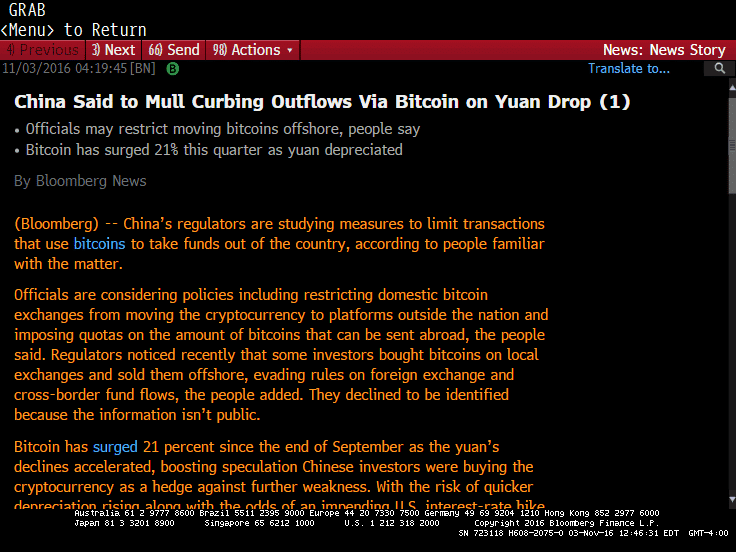
A Bloomberg Terminal screenshot posted on social media sparked a wave of rumors that China will ban Bitcoin again.
Finance Magnates
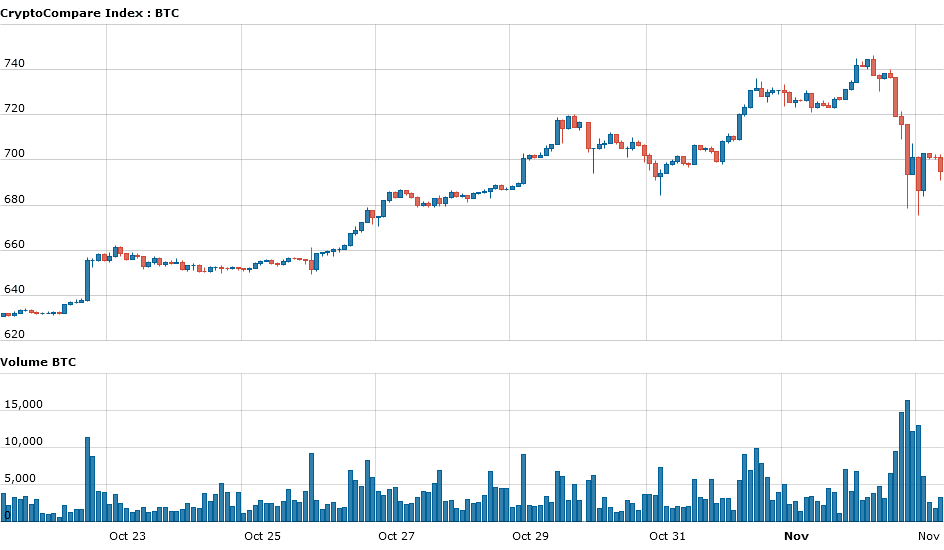
It seems the recent Bitcoin rally is not unstoppable after all. After the BTC/USD exchange rate reached as high as $744 per Bitcoin yesterday many expected it to very soon break the $750 benchmark. Instead, the price rapidly crashed to as low as $677 before settling back around the $700 level.
The reason for this unexpected drop is new rumors that Chinese regulators are set to limit Bitcoin trading. If this sounds familiar it is because we have seen this play out before a number of times already, when Chinese central bankers and financial authorities made some disparaging statements about the cryptocurrency.
What seems to have sparked the rumor mill this time are unconfirmed reports assigned to anonymous Bloomberg sources that China is looking to limit Bitcoin as a way to prevent people from moving their funds offshore. After a Bloomberg Terminal screenshot posted on social media first appeared with the story, many people doubted the validity of the report. However, soon after the popular financial doom and conspiracy blog ZeroHedge picked up the story and ran it to its considerable avid following giving it a higher level of credibility with many day traders.
Bloomberg Terminal Screenshot
Charles Hayter, the CEO of CryptoCompare.com, comments: “At this moment the rumours are unverifiable leading to a number of possible scenarios - With uncertainty comes Volatility.
A premium has been in existence on the Chinese markets for the past few weeks as the Yuan has depreciated - on peaks this has been as high as $30 between various markets. The average difference has now come off with the three largest Chinese exchanges trading on a par with the two largest USD exchanges, BitFinex and Bitstamp.
This would suggest more weakness on the CNY markets and a haltering of the optimism, for the time being, in China.
Either the story is true and Bitcoin will face trouble in China - or rumours are being created and circulated to move markets - which is not a stretch of the imagination.”
It seems the recent Bitcoin rally is not unstoppable after all. After the BTC/USD exchange rate reached as high as $744 per Bitcoin yesterday many expected it to very soon break the $750 benchmark. Instead, the price rapidly crashed to as low as $677 before settling back around the $700 level.
The reason for this unexpected drop is new rumors that Chinese regulators are set to limit Bitcoin trading. If this sounds familiar it is because we have seen this play out before a number of times already, when Chinese central bankers and financial authorities made some disparaging statements about the cryptocurrency.
What seems to have sparked the rumor mill this time are unconfirmed reports assigned to anonymous Bloomberg sources that China is looking to limit Bitcoin as a way to prevent people from moving their funds offshore. After a Bloomberg Terminal screenshot posted on social media first appeared with the story, many people doubted the validity of the report. However, soon after the popular financial doom and conspiracy blog ZeroHedge picked up the story and ran it to its considerable avid following giving it a higher level of credibility with many day traders.
Bloomberg Terminal Screenshot
Charles Hayter, the CEO of CryptoCompare.com, comments: “At this moment the rumours are unverifiable leading to a number of possible scenarios - With uncertainty comes Volatility.
A premium has been in existence on the Chinese markets for the past few weeks as the Yuan has depreciated - on peaks this has been as high as $30 between various markets. The average difference has now come off with the three largest Chinese exchanges trading on a par with the two largest USD exchanges, BitFinex and Bitstamp.
This would suggest more weakness on the CNY markets and a haltering of the optimism, for the time being, in China.
Either the story is true and Bitcoin will face trouble in China - or rumours are being created and circulated to move markets - which is not a stretch of the imagination.”
Crypto Built More Rails, but the Next Battle Is Over How Much Work a Dollar Can Do
FP Markets Winner Spotlight 🏆 | Global Broker of the Year 2025 #Trading #Broker #Innovation #Shorts
FP Markets Winner Spotlight 🏆 | Global Broker of the Year 2025 #Trading #Broker #Innovation #Shorts
FP Markets takes the spotlight as Global Broker of the Year 2025 at the Finance Magnates Awards.
Martin Stoilov, Head of Client Experience, shares that trust, innovation, and people played a key role in the company’s success, supported by a strong foundation of integrity and client-centricity.
Following this milestone, FP Markets continues to focus on growth, technology investment, and its core values of transparency and excellence.
👉 Be part of FM Awards 2026: https://awards.financemagnates.com/#nominate
FP Markets takes the spotlight as Global Broker of the Year 2025 at the Finance Magnates Awards.
Martin Stoilov, Head of Client Experience, shares that trust, innovation, and people played a key role in the company’s success, supported by a strong foundation of integrity and client-centricity.
Following this milestone, FP Markets continues to focus on growth, technology investment, and its core values of transparency and excellence.
👉 Be part of FM Awards 2026: https://awards.financemagnates.com/#nominate
In this video, we review @HolaPrimeMarketsOfficial, a multi-asset forex and CFDs broker offering different account types, trading platforms, and flexible trading conditions.
We cover the broker’s overall offering, including account options, trading environment, platforms like MT4 and MT5, and additional services such as managed accounts and fast withdrawals.
Watch the full video to see if Hola Prime Markets fits your trading needs.
📣 Stay up to date with the latest in finance and trading. Follow Finance Magnates for industry news, insights, and global event coverage.
Connect with us:
🔗 LinkedIn: /financemagnates
👍 Facebook: /financemagnates
📸 Instagram: https://www.instagram.com/financemagnates
🐦 X: https://x.com/financemagnates
🎥 TikTok: https://www.tiktok.com/tag/financemagnates
▶️ YouTube: /@financemagnates_official
#HolaPrime #ForexBroker #CFDTrading #FinanceMagnates #Trading #Forex #BrokerReview
In this video, we review @HolaPrimeMarketsOfficial, a multi-asset forex and CFDs broker offering different account types, trading platforms, and flexible trading conditions.
We cover the broker’s overall offering, including account options, trading environment, platforms like MT4 and MT5, and additional services such as managed accounts and fast withdrawals.
Watch the full video to see if Hola Prime Markets fits your trading needs.
📣 Stay up to date with the latest in finance and trading. Follow Finance Magnates for industry news, insights, and global event coverage.
Connect with us:
🔗 LinkedIn: /financemagnates
👍 Facebook: /financemagnates
📸 Instagram: https://www.instagram.com/financemagnates
🐦 X: https://x.com/financemagnates
🎥 TikTok: https://www.tiktok.com/tag/financemagnates
▶️ YouTube: /@financemagnates_official
#HolaPrime #ForexBroker #CFDTrading #FinanceMagnates #Trading #Forex #BrokerReview
Hola Prime Review: What You Need to Know | Full Breakdown by Finance Magnates
Hola Prime Review: What You Need to Know | Full Breakdown by Finance Magnates
In this video, we review @HolaPrime_Global, a proprietary trading firm offering evaluation programs and performance-based payouts in simulated market environments.
We cover how the challenge model works, including account types, profit splits (up to 95%), trading rules, and what it takes to reach a funded account. You’ll also learn about available platforms like MT4, MT5, cTrader, and more, along with insights into payouts, support, and trading conditions.
Watch the full video to see if Hola Prime fits your trading style.
📣 Stay up to date with the latest in finance and trading. Follow Finance Magnates for industry news, insights, and global event coverage.
Connect with us:
🔗 LinkedIn: /financemagnates
👍 Facebook: /financemagnates
📸 Instagram: https://www.instagram.com/financemagnates
🐦 X: https://x.com/financemagnates
🎥 TikTok: https://www.tiktok.com/tag/financemagnates
▶️ YouTube: /@financemagnates_official
#HolaPrime #PropFirm #Trading #FinanceMagnates #Forex #FuturesTrading #TradingReview #PropFirmReview
In this video, we review @HolaPrime_Global, a proprietary trading firm offering evaluation programs and performance-based payouts in simulated market environments.
We cover how the challenge model works, including account types, profit splits (up to 95%), trading rules, and what it takes to reach a funded account. You’ll also learn about available platforms like MT4, MT5, cTrader, and more, along with insights into payouts, support, and trading conditions.
Watch the full video to see if Hola Prime fits your trading style.
📣 Stay up to date with the latest in finance and trading. Follow Finance Magnates for industry news, insights, and global event coverage.
Connect with us:
🔗 LinkedIn: /financemagnates
👍 Facebook: /financemagnates
📸 Instagram: https://www.instagram.com/financemagnates
🐦 X: https://x.com/financemagnates
🎥 TikTok: https://www.tiktok.com/tag/financemagnates
▶️ YouTube: /@financemagnates_official
#HolaPrime #PropFirm #Trading #FinanceMagnates #Forex #FuturesTrading #TradingReview #PropFirmReview
Axi Winner Spotlight 🏆 | Global Most Innovative Broker 2025 #Innovation #Trading #Fintech #Broker
Axi Winner Spotlight 🏆 | Global Most Innovative Broker 2025 #Innovation #Trading #Fintech #Broker
Axi takes the spotlight at the Finance Magnates Awards, winning Global Most Innovative Broker 2025.
Olivia Xenofontos and Ivanna Openko share how the team will feel: proud, motivated, and ready to keep delivering.
They also describe the night as well-organized, focused, and enjoyable for all.
👉 Be part of FM Awards 2026.
Axi takes the spotlight at the Finance Magnates Awards, winning Global Most Innovative Broker 2025.
Olivia Xenofontos and Ivanna Openko share how the team will feel: proud, motivated, and ready to keep delivering.
They also describe the night as well-organized, focused, and enjoyable for all.
👉 Be part of FM Awards 2026.
Recognition that matters.
Built on transparency.
Driven by the industry.
The Finance Magnates Awards 2026.
Nominations are now open.
🔗 https://awards.financemagnates.com/?utm_source=SM&utm_medium=social&utm_campaign=recognition-matters
Recognition that matters.
Built on transparency.
Driven by the industry.
The Finance Magnates Awards 2026.
Nominations are now open.
🔗 https://awards.financemagnates.com/?utm_source=SM&utm_medium=social&utm_campaign=recognition-matters