According to Binance, on-chain addresses associated with tokenized stocks jumped from just 1,600 to over 90,000 within a month.
Meanwhile, DeFi rebounded in July, with total value locked rising 23.6% and stablecoin activity increasing by 5%.
FM
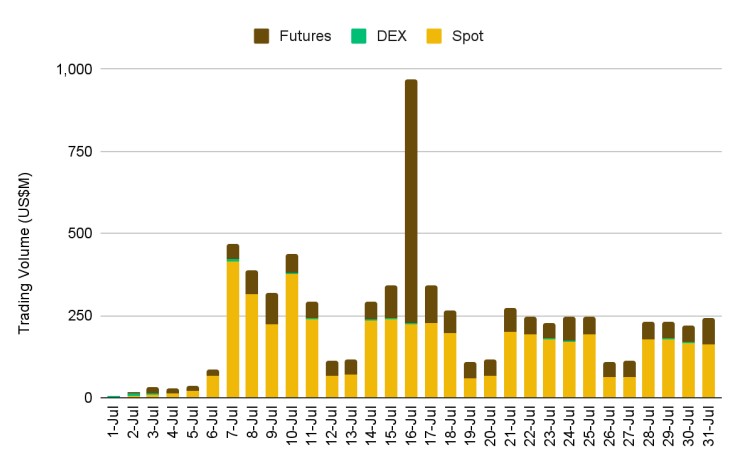
Interest in tokenized stocks surged sharply in July, with TSLA and
SPY reaching $53.6 million in market cap – up 220% since June, Binance highlighted
in its latest report.
On-chain addresses linked to these assets grew from
just 1,600 to over 90,000 in one month. Trading activity on centralized
exchanges dwarfs on-chain platforms by over 70 times, suggesting pent-up
demand beyond what blockchain data reveals.
Tokenized stocks volumes experienced notable growth in July, Source: Binance
The market is still small but gaining momentum fast.
Just 1% tokenization of global equities could push the sector to $1.3 trillion,
more than eight times DeFi’s peak.
xStocks by Backed Finance emerged as a key player,
capitalizing on Europe’s permissive rules but now eyeing the U.S. as regulatory
clarity improves.
After months of Bitcoin dominance, the crypto market
flipped in July — with altcoins surging ahead, Ethereum in particular breaking
away from the pack. Fueled by regulatory clarity, new treasury allocations, and
explosive interest in tokenized assets, digital markets posted their strongest
month of 2025 yet.
Ethereum Outpaces the Market with 51% Jump
Ethereum stole the spotlight in July, rallying 51%, outpacing
every other major digital asset. The spike followed a wave of inflows into spot
ETH ETFs and unprecedented corporate treasury adoption. Over 24 companies reportedly added
ETH to their balance sheets, lifting corporate holdings by more than 127% to
over 2.7 million ETH.
The preference for direct ETH exposure over passive
ETF structures grew stronger, supported by Ethereum’s deflationary model and
staking yields. This institutional shift marked the most significant monthly
increase in ETH treasury demand ever recorded.
While Bitcoin reached a new all-time high of $123,000,
its dominance fell to 60.6%, down 5.2 percentage points. Altcoins gained nearly
10% in dominance, led by Ethereum’s rise but also supported by surging prices
in coins like SUI, ADA, and DOGE, each posting gains between 30% and 35%.
Landmark Stablecoin Law
A defining moment came mid-July when the GENIUS Act was signed into US law, creating the first federal framework for fully
reserved stablecoins. The legislation requires 1:1 fiat backing, monthly
disclosures, and confines issuance to regulated financial firms.
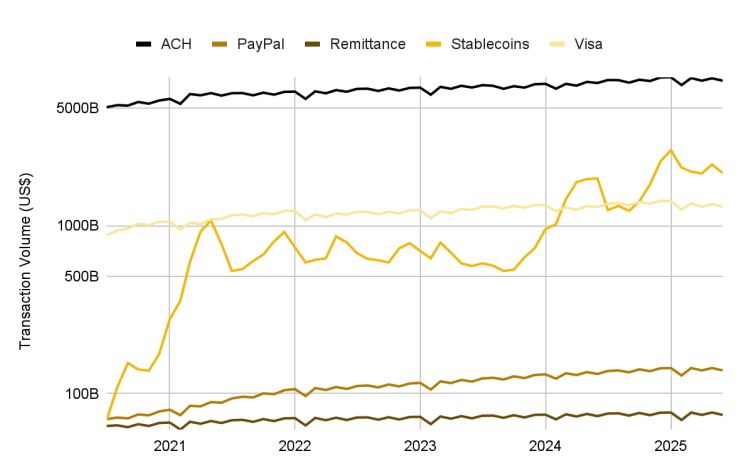
The new law gave institutional players a green light. JPMorgan expanded its JPM-D deposit token pilot, Citi moved forward on
tokenized cross-border settlements, and Visa reiterated plans to grow
stablecoin support, especially in emerging markets and high-value transfers.
Stablecoins gain as payment rails, Source: Binance
Decentralized finance also benefited from the bullish
tide. Total Value Locked (TVL) rose 23.6% in July, driven primarily by
Ethereum. Stablecoin activity expanded 5.1%, with USDT maintaining its lead
over USDC. Tron, long a hub for stablecoin transactions, recovered strongly
after a slow June.
Together, DeFi and stablecoins continued their
recovery from early 2025 doldrums, lifted by favorable legislative changes and
new institutional involvement.
Regulatory Risks Resurface
Despite July’s strong gains, late-month caution
returned. The Trump administration reimposed tariffs, and the Federal Reserve
maintained a wait-and-see stance on rate cuts. Meanwhile, analysts continue to
assess the implications of the July 30 White House crypto report.
Even so, July showcased the growing maturity and
institutional depth of the digital asset market. With Ethereum at the heart of
treasury adoption, stablecoins integrating with traditional finance, and
tokenized stocks gaining investor traction, blockchain finance appears to be
entering a new phase, one marked not just by speculation, but by real-world
utility.
Interest in tokenized stocks surged sharply in July, with TSLA and
SPY reaching $53.6 million in market cap – up 220% since June, Binance highlighted
in its latest report.
On-chain addresses linked to these assets grew from
just 1,600 to over 90,000 in one month. Trading activity on centralized
exchanges dwarfs on-chain platforms by over 70 times, suggesting pent-up
demand beyond what blockchain data reveals.
Tokenized stocks volumes experienced notable growth in July, Source: Binance
The market is still small but gaining momentum fast.
Just 1% tokenization of global equities could push the sector to $1.3 trillion,
more than eight times DeFi’s peak.
xStocks by Backed Finance emerged as a key player,
capitalizing on Europe’s permissive rules but now eyeing the U.S. as regulatory
clarity improves.
After months of Bitcoin dominance, the crypto market
flipped in July — with altcoins surging ahead, Ethereum in particular breaking
away from the pack. Fueled by regulatory clarity, new treasury allocations, and
explosive interest in tokenized assets, digital markets posted their strongest
month of 2025 yet.
Ethereum Outpaces the Market with 51% Jump
Ethereum stole the spotlight in July, rallying 51%, outpacing
every other major digital asset. The spike followed a wave of inflows into spot
ETH ETFs and unprecedented corporate treasury adoption. Over 24 companies reportedly added
ETH to their balance sheets, lifting corporate holdings by more than 127% to
over 2.7 million ETH.
The preference for direct ETH exposure over passive
ETF structures grew stronger, supported by Ethereum’s deflationary model and
staking yields. This institutional shift marked the most significant monthly
increase in ETH treasury demand ever recorded.
While Bitcoin reached a new all-time high of $123,000,
its dominance fell to 60.6%, down 5.2 percentage points. Altcoins gained nearly
10% in dominance, led by Ethereum’s rise but also supported by surging prices
in coins like SUI, ADA, and DOGE, each posting gains between 30% and 35%.
Landmark Stablecoin Law
A defining moment came mid-July when the GENIUS Act was signed into US law, creating the first federal framework for fully
reserved stablecoins. The legislation requires 1:1 fiat backing, monthly
disclosures, and confines issuance to regulated financial firms.
The new law gave institutional players a green light. JPMorgan expanded its JPM-D deposit token pilot, Citi moved forward on
tokenized cross-border settlements, and Visa reiterated plans to grow
stablecoin support, especially in emerging markets and high-value transfers.
Stablecoins gain as payment rails, Source: Binance
Decentralized finance also benefited from the bullish
tide. Total Value Locked (TVL) rose 23.6% in July, driven primarily by
Ethereum. Stablecoin activity expanded 5.1%, with USDT maintaining its lead
over USDC. Tron, long a hub for stablecoin transactions, recovered strongly
after a slow June.
Together, DeFi and stablecoins continued their
recovery from early 2025 doldrums, lifted by favorable legislative changes and
new institutional involvement.
Regulatory Risks Resurface
Despite July’s strong gains, late-month caution
returned. The Trump administration reimposed tariffs, and the Federal Reserve
maintained a wait-and-see stance on rate cuts. Meanwhile, analysts continue to
assess the implications of the July 30 White House crypto report.
Even so, July showcased the growing maturity and
institutional depth of the digital asset market. With Ethereum at the heart of
treasury adoption, stablecoins integrating with traditional finance, and
tokenized stocks gaining investor traction, blockchain finance appears to be
entering a new phase, one marked not just by speculation, but by real-world
utility.
Jared Kirui is an Editor at Finance Magnates with more than five years of experience in financial journalism. He covers online trading, fintech, payments, and crypto industries with a focus on companies, regulation and compliance, executive moves, trading technology, and market analysis.
His work has been featured in other media outlets, including Benzinga, ZyCrypto, The Distributed, and The Daily Hodl.
Education:
Bachelor of Commerce degree (Finance option), University of Nairobi
WhiteBIT secures brokerage license in Georgia to launch regulated crypto derivatives
FP Markets Winner Spotlight 🏆 | Global Broker of the Year 2025 #Trading #Broker #Innovation #Shorts
FP Markets Winner Spotlight 🏆 | Global Broker of the Year 2025 #Trading #Broker #Innovation #Shorts
FP Markets takes the spotlight as Global Broker of the Year 2025 at the Finance Magnates Awards.
Martin Stoilov, Head of Client Experience, shares that trust, innovation, and people played a key role in the company’s success, supported by a strong foundation of integrity and client-centricity.
Following this milestone, FP Markets continues to focus on growth, technology investment, and its core values of transparency and excellence.
👉 Be part of FM Awards 2026: https://awards.financemagnates.com/#nominate
FP Markets takes the spotlight as Global Broker of the Year 2025 at the Finance Magnates Awards.
Martin Stoilov, Head of Client Experience, shares that trust, innovation, and people played a key role in the company’s success, supported by a strong foundation of integrity and client-centricity.
Following this milestone, FP Markets continues to focus on growth, technology investment, and its core values of transparency and excellence.
👉 Be part of FM Awards 2026: https://awards.financemagnates.com/#nominate
In this video, we review @HolaPrimeMarketsOfficial, a multi-asset forex and CFDs broker offering different account types, trading platforms, and flexible trading conditions.
We cover the broker’s overall offering, including account options, trading environment, platforms like MT4 and MT5, and additional services such as managed accounts and fast withdrawals.
Watch the full video to see if Hola Prime Markets fits your trading needs.
📣 Stay up to date with the latest in finance and trading. Follow Finance Magnates for industry news, insights, and global event coverage.
Connect with us:
🔗 LinkedIn: /financemagnates
👍 Facebook: /financemagnates
📸 Instagram: https://www.instagram.com/financemagnates
🐦 X: https://x.com/financemagnates
🎥 TikTok: https://www.tiktok.com/tag/financemagnates
▶️ YouTube: /@financemagnates_official
#HolaPrime #ForexBroker #CFDTrading #FinanceMagnates #Trading #Forex #BrokerReview
In this video, we review @HolaPrimeMarketsOfficial, a multi-asset forex and CFDs broker offering different account types, trading platforms, and flexible trading conditions.
We cover the broker’s overall offering, including account options, trading environment, platforms like MT4 and MT5, and additional services such as managed accounts and fast withdrawals.
Watch the full video to see if Hola Prime Markets fits your trading needs.
📣 Stay up to date with the latest in finance and trading. Follow Finance Magnates for industry news, insights, and global event coverage.
Connect with us:
🔗 LinkedIn: /financemagnates
👍 Facebook: /financemagnates
📸 Instagram: https://www.instagram.com/financemagnates
🐦 X: https://x.com/financemagnates
🎥 TikTok: https://www.tiktok.com/tag/financemagnates
▶️ YouTube: /@financemagnates_official
#HolaPrime #ForexBroker #CFDTrading #FinanceMagnates #Trading #Forex #BrokerReview
Hola Prime Review: What You Need to Know | Full Breakdown by Finance Magnates
Hola Prime Review: What You Need to Know | Full Breakdown by Finance Magnates
In this video, we review @HolaPrime_Global, a proprietary trading firm offering evaluation programs and performance-based payouts in simulated market environments.
We cover how the challenge model works, including account types, profit splits (up to 95%), trading rules, and what it takes to reach a funded account. You’ll also learn about available platforms like MT4, MT5, cTrader, and more, along with insights into payouts, support, and trading conditions.
Watch the full video to see if Hola Prime fits your trading style.
📣 Stay up to date with the latest in finance and trading. Follow Finance Magnates for industry news, insights, and global event coverage.
Connect with us:
🔗 LinkedIn: /financemagnates
👍 Facebook: /financemagnates
📸 Instagram: https://www.instagram.com/financemagnates
🐦 X: https://x.com/financemagnates
🎥 TikTok: https://www.tiktok.com/tag/financemagnates
▶️ YouTube: /@financemagnates_official
#HolaPrime #PropFirm #Trading #FinanceMagnates #Forex #FuturesTrading #TradingReview #PropFirmReview
In this video, we review @HolaPrime_Global, a proprietary trading firm offering evaluation programs and performance-based payouts in simulated market environments.
We cover how the challenge model works, including account types, profit splits (up to 95%), trading rules, and what it takes to reach a funded account. You’ll also learn about available platforms like MT4, MT5, cTrader, and more, along with insights into payouts, support, and trading conditions.
Watch the full video to see if Hola Prime fits your trading style.
📣 Stay up to date with the latest in finance and trading. Follow Finance Magnates for industry news, insights, and global event coverage.
Connect with us:
🔗 LinkedIn: /financemagnates
👍 Facebook: /financemagnates
📸 Instagram: https://www.instagram.com/financemagnates
🐦 X: https://x.com/financemagnates
🎥 TikTok: https://www.tiktok.com/tag/financemagnates
▶️ YouTube: /@financemagnates_official
#HolaPrime #PropFirm #Trading #FinanceMagnates #Forex #FuturesTrading #TradingReview #PropFirmReview
Axi Winner Spotlight 🏆 | Global Most Innovative Broker 2025 #Innovation #Trading #Fintech #Broker
Axi Winner Spotlight 🏆 | Global Most Innovative Broker 2025 #Innovation #Trading #Fintech #Broker
Axi takes the spotlight at the Finance Magnates Awards, winning Global Most Innovative Broker 2025.
Olivia Xenofontos and Ivanna Openko share how the team will feel: proud, motivated, and ready to keep delivering.
They also describe the night as well-organized, focused, and enjoyable for all.
👉 Be part of FM Awards 2026.
Axi takes the spotlight at the Finance Magnates Awards, winning Global Most Innovative Broker 2025.
Olivia Xenofontos and Ivanna Openko share how the team will feel: proud, motivated, and ready to keep delivering.
They also describe the night as well-organized, focused, and enjoyable for all.
👉 Be part of FM Awards 2026.
Recognition that matters.
Built on transparency.
Driven by the industry.
The Finance Magnates Awards 2026.
Nominations are now open.
🔗 https://awards.financemagnates.com/?utm_source=SM&utm_medium=social&utm_campaign=recognition-matters
Recognition that matters.
Built on transparency.
Driven by the industry.
The Finance Magnates Awards 2026.
Nominations are now open.
🔗 https://awards.financemagnates.com/?utm_source=SM&utm_medium=social&utm_campaign=recognition-matters