Financial and Business News

Stablecoins Erase FX Spreads, Forcing Crypto Wallets past the Neobank Model

Wednesday, 25/02/2026 | 08:06 GMT by Alvin Kan
  • Stablecoins and interchange caps are squeezing crypto wallet margins to zero. Copying the neobank model is a dead end.
  • Payments are just the entry point. Wallets that monetise through on-chain yield, trading, and tokenised assets will win.
The stablecoin squeeze

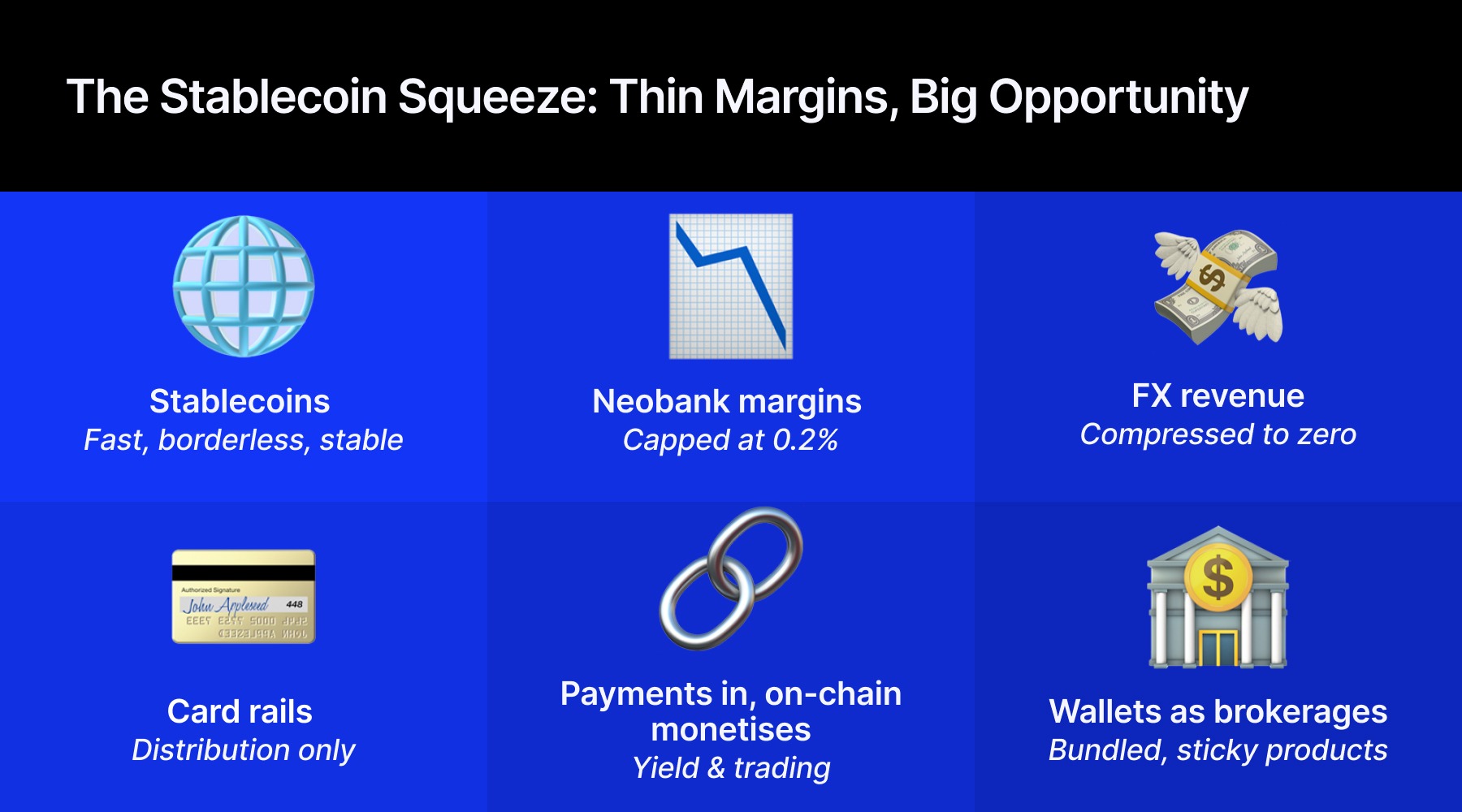
Stablecoins started as a workaround for crypto traders. They matured into a consumer money layer that moves across borders, settles quickly and keeps value stable in places where local currencies swing. Wallets now sit at the same crossroads neobanks faced a decade ago: payments promise scale, brand recognition and daily usage.

Crypto cannot copy the neobank model and expect durable margins. Interchange caps and razor-thin foreign exchange economics already squeezed neobanks into constant product expansion — and stablecoins compress spreads even further. Market pricing will reward wallets that treat payments as distribution and concentrate monetization in onchain finance, including trading, tokenized assets and structured yield.

Neobanks Hit a Ceiling Where Interchange Gets Capped

Neobanks built their growth stories by pairing sleek apps with card spend, and they relied on interchange and FX as recurring revenue. Europe’s regulatory caps made that ceiling explicit, limiting consumer debit fees to 0.2% and credit to 0.3%.

As scale increased, revenue still leaned heavily on card payments while profitability depended on building higher-margin lines, such as wealth products, subscriptions and lending. Revolut’s trajectory proves the point: card payments remained a major revenue driver even as wealth and interest income surged.

That pattern holds the lesson for crypto. Payments create daily relevance, and card rails offer reach, yet capped interchange rarely sustains an entire consumer finance stack on its own.

Stablecoins Tighten Margins Further by Compressing FX

Crypto “neobanks” face the same cap table with a sharper edge. Stablecoins turn cross-border value transfer into a commodity service, and the spread that once sat inside retail FX often disappears once a user holds a dollar-pegged asset. Institutions like the IMF increasingly frame stablecoins as a route to faster and cheaper payments, especially across borders.

Fintechs also move in that direction. Major buy-now-pay-later players have launched stablecoins to cut cross-border payment costs, a move that shows how quickly the economic centre of gravity shifts once stablecoin settlement becomes standard inside payment operations.

For wallet operators, this changes the unit economics. Stablecoin-led settlement pulls FX revenue toward zero and pushes competition into user experience, routing efficiency and risk controls. This dynamic compresses fees across the board.

Card Networks Keep Costs High While Margins Shrink

Card issuance delivers broad merchant acceptance, and consumers want familiar tap-to-pay experiences. Card coverage and local payment integration expand access for users who lack reliable banking, and stablecoin spending can plug into systems such as Brazil’s Pix while also using global card networks.

Those rails also carry fixed costs and compliance burdens. Network rules, chargebacks, fraud monitoring, program management and jurisdiction-by-jurisdiction licensing push operating costs upward even as interchange and FX compress downward. Artemis data shows the industry is already adapting: Visa now captures over 90% of on-chain card volume by partnering with full-stack issuers like Rain or Reap. By bypassing traditional sponsor banks, these players prove that surviving thin margins requires owning the entire stack, effectively replacing the "rented" neobank model with direct network integration.

The result resembles the neobank squeeze, with a harsher spread profile once stablecoins become the default “currency” inside the wallet.

The industry should stop treating card spend as a profit engine and start treating it as a distribution channel. It also asks wallet operators to accept thinner payment fees and build their business around higher-margin on-chain finance, leveraging DeFi protocols and investment products that banks rarely distribute directly at consumer scale.

Payments Work Best as a Gateway to Higher-Value Onchain Finance

The sustainable model positions transactions as the front door and earns revenue when users choose higher-value activities. Recent data validates this hierarchy, showing that payments and earning use cases are rising alongside trading. Bitget Wallet’s card spending volume grew more than 28-fold year on year, and stablecoin-focused earnings accelerated even as market activity cooled late in the year.

High-inflation environments provide the blueprint for this utility-first adoption. Users hold stablecoins to preserve purchasing power and then seek predictable returns through on-chain earning products. Due to the nature of how most of these products are marketed (headline yields, instant access to capital), transparency regarding the risks involved and the redemption terms of each product is critical.

Inevitably, the profits generated by scaling wallet payments will shift toward higher-margin on-chain financial products, including derivatives, RWAs and increasingly complex earning vaults, where platforms that package these services cleanly will take share.

Tokenised assets add a second layer of defensibility. Once users treat the wallet as a place to manage cash-like stablecoins and investable products in one interface, switching costs rise for reasons that resemble brokerage behaviour rather than card behaviour. Yield products also create stickier balances and reduce reliance on constant new user acquisition to maintain growth.

The Market Will Reward the Builders Who Accept Thin Payment Margins

Crypto wallets that copy the neobank revenue stack will face the same margin ceiling, with less room to manoeuvre once stablecoins erase spreads. The era of subsiding growth with interchange and FX spreads is over. The winners of the next cycle will use global payment networks to build daily usage and trust, while monetisation concentrates on higher-value on-chain activity.

Wallets get stuck when they try to recreate a full neobank. They do better when banking features feed into on-chain products that actually carry margin. This is why the breakout belongs to wallets that become an everyday on-chain finance platform, where payments bring users in, and markets keep them engaged. If the industry treats payments as the habit layer, the ceiling on crypto fintech rises sharply.

Stablecoins started as a workaround for crypto traders. They matured into a consumer money layer that moves across borders, settles quickly and keeps value stable in places where local currencies swing. Wallets now sit at the same crossroads neobanks faced a decade ago: payments promise scale, brand recognition and daily usage.

Crypto cannot copy the neobank model and expect durable margins. Interchange caps and razor-thin foreign exchange economics already squeezed neobanks into constant product expansion — and stablecoins compress spreads even further. Market pricing will reward wallets that treat payments as distribution and concentrate monetization in onchain finance, including trading, tokenized assets and structured yield.

Neobanks Hit a Ceiling Where Interchange Gets Capped

Neobanks built their growth stories by pairing sleek apps with card spend, and they relied on interchange and FX as recurring revenue. Europe’s regulatory caps made that ceiling explicit, limiting consumer debit fees to 0.2% and credit to 0.3%.

As scale increased, revenue still leaned heavily on card payments while profitability depended on building higher-margin lines, such as wealth products, subscriptions and lending. Revolut’s trajectory proves the point: card payments remained a major revenue driver even as wealth and interest income surged.

That pattern holds the lesson for crypto. Payments create daily relevance, and card rails offer reach, yet capped interchange rarely sustains an entire consumer finance stack on its own.

Stablecoins Tighten Margins Further by Compressing FX

Crypto “neobanks” face the same cap table with a sharper edge. Stablecoins turn cross-border value transfer into a commodity service, and the spread that once sat inside retail FX often disappears once a user holds a dollar-pegged asset. Institutions like the IMF increasingly frame stablecoins as a route to faster and cheaper payments, especially across borders.

Fintechs also move in that direction. Major buy-now-pay-later players have launched stablecoins to cut cross-border payment costs, a move that shows how quickly the economic centre of gravity shifts once stablecoin settlement becomes standard inside payment operations.

For wallet operators, this changes the unit economics. Stablecoin-led settlement pulls FX revenue toward zero and pushes competition into user experience, routing efficiency and risk controls. This dynamic compresses fees across the board.

Card Networks Keep Costs High While Margins Shrink

Card issuance delivers broad merchant acceptance, and consumers want familiar tap-to-pay experiences. Card coverage and local payment integration expand access for users who lack reliable banking, and stablecoin spending can plug into systems such as Brazil’s Pix while also using global card networks.

Those rails also carry fixed costs and compliance burdens. Network rules, chargebacks, fraud monitoring, program management and jurisdiction-by-jurisdiction licensing push operating costs upward even as interchange and FX compress downward. Artemis data shows the industry is already adapting: Visa now captures over 90% of on-chain card volume by partnering with full-stack issuers like Rain or Reap. By bypassing traditional sponsor banks, these players prove that surviving thin margins requires owning the entire stack, effectively replacing the "rented" neobank model with direct network integration.

The result resembles the neobank squeeze, with a harsher spread profile once stablecoins become the default “currency” inside the wallet.

The industry should stop treating card spend as a profit engine and start treating it as a distribution channel. It also asks wallet operators to accept thinner payment fees and build their business around higher-margin on-chain finance, leveraging DeFi protocols and investment products that banks rarely distribute directly at consumer scale.

Payments Work Best as a Gateway to Higher-Value Onchain Finance

The sustainable model positions transactions as the front door and earns revenue when users choose higher-value activities. Recent data validates this hierarchy, showing that payments and earning use cases are rising alongside trading. Bitget Wallet’s card spending volume grew more than 28-fold year on year, and stablecoin-focused earnings accelerated even as market activity cooled late in the year.

High-inflation environments provide the blueprint for this utility-first adoption. Users hold stablecoins to preserve purchasing power and then seek predictable returns through on-chain earning products. Due to the nature of how most of these products are marketed (headline yields, instant access to capital), transparency regarding the risks involved and the redemption terms of each product is critical.

Inevitably, the profits generated by scaling wallet payments will shift toward higher-margin on-chain financial products, including derivatives, RWAs and increasingly complex earning vaults, where platforms that package these services cleanly will take share.

Tokenised assets add a second layer of defensibility. Once users treat the wallet as a place to manage cash-like stablecoins and investable products in one interface, switching costs rise for reasons that resemble brokerage behaviour rather than card behaviour. Yield products also create stickier balances and reduce reliance on constant new user acquisition to maintain growth.

The Market Will Reward the Builders Who Accept Thin Payment Margins

Crypto wallets that copy the neobank revenue stack will face the same margin ceiling, with less room to manoeuvre once stablecoins erase spreads. The era of subsiding growth with interchange and FX spreads is over. The winners of the next cycle will use global payment networks to build daily usage and trust, while monetisation concentrates on higher-value on-chain activity.

Wallets get stuck when they try to recreate a full neobank. They do better when banking features feed into on-chain products that actually carry margin. This is why the breakout belongs to wallets that become an everyday on-chain finance platform, where payments bring users in, and markets keep them engaged. If the industry treats payments as the habit layer, the ceiling on crypto fintech rises sharply.

About the Author: Alvin Kan
Alvin Kan
  • 1 Article
Alvin Kan is the COO of Bitget Wallet, the world’s leading everyday finance app. He played a key leadership role in the company’s rebrand and global expansion strategy, helping scale the platform to over 90 million users. He previously led ecosystem growth at BNB Chain and Sei Labs and served as Head of Data Insights at LinkedIn. With extensive experience across Web3 and Web2, Alvin plays a pivotal role in shaping Bitget Wallet's strategic direction, driving innovation, growth, and the mass adoption of Web3.

CryptoCurrency