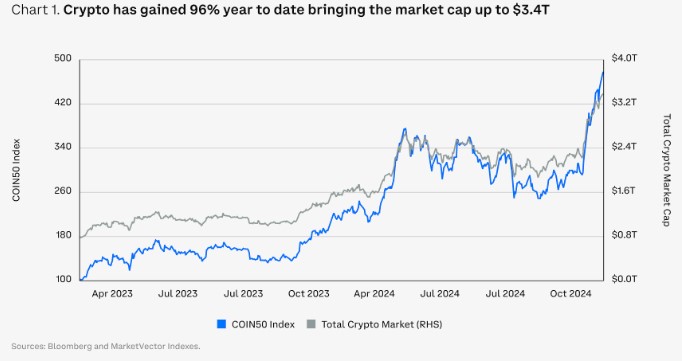
Coinbase's latest report showed that Bitcoin and Ether exchange-traded products attracted $30.7 billion into Bitcoin ETFs alone.
Stablecoins experienced rapid growth in 2024, with market capitalization reaching $193 billion due to their use in payments.
The past year has been a testament to crypto's
resilience, with markets adjusting to regulatory crackdowns and the economic
impact of interest rate hikes. Despite these challenges, the asset class has
emerged more robust, gaining substantial ground in institutional adoption.
Notably, in 2024, spot ETFs were approved in the US.
Bitcoin's market dominance surged significantly as ETFs attracted massive
institutional inflows, cementing crypto's place as a serious alternative asset
class, Coinbase's 2025 Crypto Market Outlook highlighted.
However, the journey to this point hasn't been without
its struggles. The push for regulation has been slow, but the US is finally
seeing a shift toward clarity.
Regulatory Acceptance
The upcoming legislative sessions are expected to make
crypto-friendly laws a reality. Potential developments include the Strategic
Bitcoin Reserve, which could see states like Pennsylvania allocating public
funds to crypto-based assets.
Source: Coinbase
According to the report, this wave of regulatory acceptance is not limited to
the US, and global markets are also poised to introduce frameworks that support
crypto, including the European Union's Markets in Crypto-Assets (MiCA)
regulation and similar efforts in the UK, UAE, and Asia.
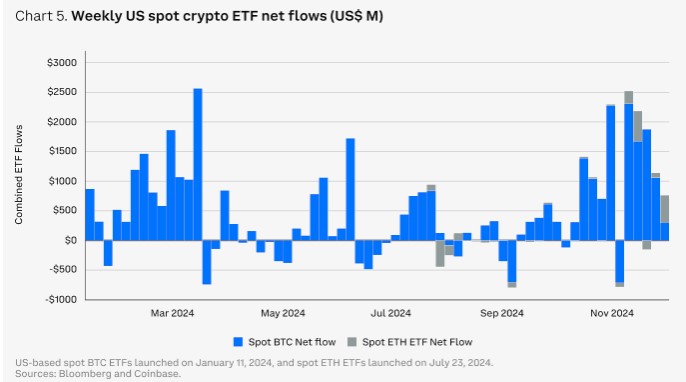
The introduction of Bitcoin and Ether exchange-traded
products (ETPs and ETFs) has reshaped the crypto landscape. These vehicles,
which allow easier access to crypto investments for institutional players, have
driven substantial capital inflows, $30.7 billion into bitcoin ETFs alone.
The growing role of ETFs in institutional portfolios
signals an ongoing shift from speculative narratives to a more
fundamentals-driven approach in crypto investing. The future of crypto will likely be marked by
continued innovations in decentralized finance (DeFi) and tokenization. These
technologies have the potential to disrupt traditional financial systems, from
asset issuance to payment processing.
As we move into 2025, all eyes will be on how
regulatory frameworks and technological advancements continue to shape the
crypto market. The rapid growth of stablecoins in 2024 has laid the
foundation for a transformative 2025 in the crypto space.
Source: Coinbase
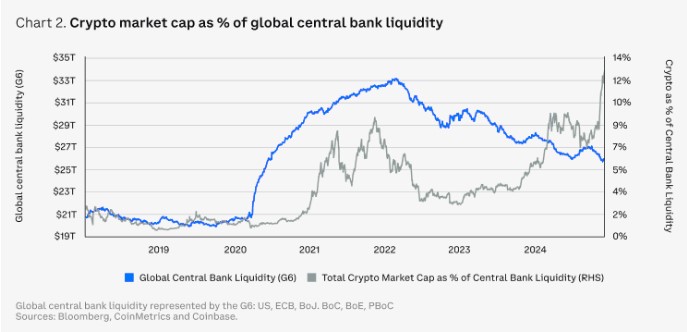
With stablecoin market capitalization reaching $193
billion by December 1 and projections of up to $3 trillion in the next five
years, the sector is reportedly dominating in capital flows and commerce.
Beyond financial applications, stablecoins are also
drawing political attention for their potential to address issues like the US
debt burden. In 2024, stablecoins experienced a surge in transaction volumes,
reaching $27.1 trillion by November, almost tripling the previous year's
numbers.
The tokenization of assets is expected to grow to $2
trillion to $30 trillion in the next five years, driven by institutional
players like BlackRock and Franklin Templeton embracing blockchain for
cross-border settlements and 24/7 trading.
Source: Coinbase
Decentralized finance (DeFi) is also poised for a
comeback in 2025, driven by a shift toward more sustainable financial
practices. After the unsustainable yields and risks of the previous cycle, DeFi
protocols are now incorporating real-world use cases and transparent
governance.
Beyond stablecoins and tokenization, Telegram trading
bots have reportedly emerged as a highly profitable sector within crypto in
2024. These bots, which allow users to trade tokens directly through chat-based
interfaces, have gained significant popularity, particularly for meme coins.
Artificial Intelligence
In 2024, Artificial intelligence (AI) has become a
major point of focus in both traditional and crypto markets. In the crypto
world, AI's potential applications range from improving blockchain security and
data veracity to enabling decentralized AI training networks.
Despite the uncertainty, AI has already started to
influence the market. From AI-driven content creation tools to autonomous AI
agents that manage crypto wallets and social media interactions, the technology
continues to evolve.
The past year has been a testament to crypto's
resilience, with markets adjusting to regulatory crackdowns and the economic
impact of interest rate hikes. Despite these challenges, the asset class has
emerged more robust, gaining substantial ground in institutional adoption.
Notably, in 2024, spot ETFs were approved in the US.
Bitcoin's market dominance surged significantly as ETFs attracted massive
institutional inflows, cementing crypto's place as a serious alternative asset
class, Coinbase's 2025 Crypto Market Outlook highlighted.
However, the journey to this point hasn't been without
its struggles. The push for regulation has been slow, but the US is finally
seeing a shift toward clarity.
Regulatory Acceptance
The upcoming legislative sessions are expected to make
crypto-friendly laws a reality. Potential developments include the Strategic
Bitcoin Reserve, which could see states like Pennsylvania allocating public
funds to crypto-based assets.
Source: Coinbase
According to the report, this wave of regulatory acceptance is not limited to
the US, and global markets are also poised to introduce frameworks that support
crypto, including the European Union's Markets in Crypto-Assets (MiCA)
regulation and similar efforts in the UK, UAE, and Asia.
The introduction of Bitcoin and Ether exchange-traded
products (ETPs and ETFs) has reshaped the crypto landscape. These vehicles,
which allow easier access to crypto investments for institutional players, have
driven substantial capital inflows, $30.7 billion into bitcoin ETFs alone.
The growing role of ETFs in institutional portfolios
signals an ongoing shift from speculative narratives to a more
fundamentals-driven approach in crypto investing. The future of crypto will likely be marked by
continued innovations in decentralized finance (DeFi) and tokenization. These
technologies have the potential to disrupt traditional financial systems, from
asset issuance to payment processing.
As we move into 2025, all eyes will be on how
regulatory frameworks and technological advancements continue to shape the
crypto market. The rapid growth of stablecoins in 2024 has laid the
foundation for a transformative 2025 in the crypto space.
Source: Coinbase
With stablecoin market capitalization reaching $193
billion by December 1 and projections of up to $3 trillion in the next five
years, the sector is reportedly dominating in capital flows and commerce.
Beyond financial applications, stablecoins are also
drawing political attention for their potential to address issues like the US
debt burden. In 2024, stablecoins experienced a surge in transaction volumes,
reaching $27.1 trillion by November, almost tripling the previous year's
numbers.
The tokenization of assets is expected to grow to $2
trillion to $30 trillion in the next five years, driven by institutional
players like BlackRock and Franklin Templeton embracing blockchain for
cross-border settlements and 24/7 trading.
Source: Coinbase
Decentralized finance (DeFi) is also poised for a
comeback in 2025, driven by a shift toward more sustainable financial
practices. After the unsustainable yields and risks of the previous cycle, DeFi
protocols are now incorporating real-world use cases and transparent
governance.
Beyond stablecoins and tokenization, Telegram trading
bots have reportedly emerged as a highly profitable sector within crypto in
2024. These bots, which allow users to trade tokens directly through chat-based
interfaces, have gained significant popularity, particularly for meme coins.
Artificial Intelligence
In 2024, Artificial intelligence (AI) has become a
major point of focus in both traditional and crypto markets. In the crypto
world, AI's potential applications range from improving blockchain security and
data veracity to enabling decentralized AI training networks.
Despite the uncertainty, AI has already started to
influence the market. From AI-driven content creation tools to autonomous AI
agents that manage crypto wallets and social media interactions, the technology
continues to evolve.
Coinbase Enters Prediction Markets as the Amazonification of Financial Platforms Gathers Pace
Featured Videos
Executive Interview | Charlotte Bullock | Chief Product Officer, Bank of London | FMLS:25
In this interview, we sat down with Charlotte Bullock, Head of Product at The Bank of London, previously at SAP and now shaping product at one of the sector’s most ambitious new banking players.
Charlotte reflects on the Summit so far and talks about the culture inside fintech banks today. We look at the pressures that come with scaling, and how firms can hold onto the nimble approach that made them stand out early on.
We also cover the state of payments ahead of her appearance on the payments roundtable: the blockages financial firms face, the areas that still need fixing, and what a realistic solution looks like in 2026.
In this interview, we sat down with Charlotte Bullock, Head of Product at The Bank of London, previously at SAP and now shaping product at one of the sector’s most ambitious new banking players.
Charlotte reflects on the Summit so far and talks about the culture inside fintech banks today. We look at the pressures that come with scaling, and how firms can hold onto the nimble approach that made them stand out early on.
We also cover the state of payments ahead of her appearance on the payments roundtable: the blockages financial firms face, the areas that still need fixing, and what a realistic solution looks like in 2026.
In this interview, we sat down with Charlotte Bullock, Head of Product at The Bank of London, previously at SAP and now shaping product at one of the sector’s most ambitious new banking players.
Charlotte reflects on the Summit so far and talks about the culture inside fintech banks today. We look at the pressures that come with scaling, and how firms can hold onto the nimble approach that made them stand out early on.
We also cover the state of payments ahead of her appearance on the payments roundtable: the blockages financial firms face, the areas that still need fixing, and what a realistic solution looks like in 2026.
In this interview, we sat down with Charlotte Bullock, Head of Product at The Bank of London, previously at SAP and now shaping product at one of the sector’s most ambitious new banking players.
Charlotte reflects on the Summit so far and talks about the culture inside fintech banks today. We look at the pressures that come with scaling, and how firms can hold onto the nimble approach that made them stand out early on.
We also cover the state of payments ahead of her appearance on the payments roundtable: the blockages financial firms face, the areas that still need fixing, and what a realistic solution looks like in 2026.
In this conversation, we sit down with Drew Niv, CSO at ATFX Connect and one of the most influential figures in modern FX.
We speak about market structure, the institutional view on liquidity, and the sharp rise of prop trading, a sector Drew has been commenting on in recent months. Drew explains why he once dismissed prop trading, why his view changed, and what he now thinks the model means for brokers, clients and risk managers.
We explore subscription-fee dependency, the high reneging rate, and the long-term challenge: how brokers can build a more stable and honest version of the model. Drew also talks about the traffic advantage standalone prop firms have built and why brokers may still win in the long run if they take the right approach.
In this conversation, we sit down with Drew Niv, CSO at ATFX Connect and one of the most influential figures in modern FX.
We speak about market structure, the institutional view on liquidity, and the sharp rise of prop trading, a sector Drew has been commenting on in recent months. Drew explains why he once dismissed prop trading, why his view changed, and what he now thinks the model means for brokers, clients and risk managers.
We explore subscription-fee dependency, the high reneging rate, and the long-term challenge: how brokers can build a more stable and honest version of the model. Drew also talks about the traffic advantage standalone prop firms have built and why brokers may still win in the long run if they take the right approach.
In this conversation, we sit down with Drew Niv, CSO at ATFX Connect and one of the most influential figures in modern FX.
We speak about market structure, the institutional view on liquidity, and the sharp rise of prop trading, a sector Drew has been commenting on in recent months. Drew explains why he once dismissed prop trading, why his view changed, and what he now thinks the model means for brokers, clients and risk managers.
We explore subscription-fee dependency, the high reneging rate, and the long-term challenge: how brokers can build a more stable and honest version of the model. Drew also talks about the traffic advantage standalone prop firms have built and why brokers may still win in the long run if they take the right approach.
In this conversation, we sit down with Drew Niv, CSO at ATFX Connect and one of the most influential figures in modern FX.
We speak about market structure, the institutional view on liquidity, and the sharp rise of prop trading, a sector Drew has been commenting on in recent months. Drew explains why he once dismissed prop trading, why his view changed, and what he now thinks the model means for brokers, clients and risk managers.
We explore subscription-fee dependency, the high reneging rate, and the long-term challenge: how brokers can build a more stable and honest version of the model. Drew also talks about the traffic advantage standalone prop firms have built and why brokers may still win in the long run if they take the right approach.
In this conversation, we sit down with Drew Niv, CSO at ATFX Connect and one of the most influential figures in modern FX.
We speak about market structure, the institutional view on liquidity, and the sharp rise of prop trading, a sector Drew has been commenting on in recent months. Drew explains why he once dismissed prop trading, why his view changed, and what he now thinks the model means for brokers, clients and risk managers.
We explore subscription-fee dependency, the high reneging rate, and the long-term challenge: how brokers can build a more stable and honest version of the model. Drew also talks about the traffic advantage standalone prop firms have built and why brokers may still win in the long run if they take the right approach.
In this conversation, we sit down with Drew Niv, CSO at ATFX Connect and one of the most influential figures in modern FX.
We speak about market structure, the institutional view on liquidity, and the sharp rise of prop trading, a sector Drew has been commenting on in recent months. Drew explains why he once dismissed prop trading, why his view changed, and what he now thinks the model means for brokers, clients and risk managers.
We explore subscription-fee dependency, the high reneging rate, and the long-term challenge: how brokers can build a more stable and honest version of the model. Drew also talks about the traffic advantage standalone prop firms have built and why brokers may still win in the long run if they take the right approach.
Executive Interview | Remonda Z. Kirketerp Møller| CEO & Founder Muinmos | FMLS:25
In this interview, Remonda Z. Kirketerp Møller, founder of Muinmos, breaks down the state of AI in regtech and what responsible adoption really looks like for brokers. We talk about rising fragmentation, the pressures around compliance accuracy, and why most firms are still in the early stages of AI maturity.
Ramanda also shares insights on regulator sandboxes, shifting expectations around accountability, and the current reality of MiCA licensing and passporting in Europe.
A concise look at where compliance, onboarding, and AI-driven processes are heading next.
In this interview, Remonda Z. Kirketerp Møller, founder of Muinmos, breaks down the state of AI in regtech and what responsible adoption really looks like for brokers. We talk about rising fragmentation, the pressures around compliance accuracy, and why most firms are still in the early stages of AI maturity.
Ramanda also shares insights on regulator sandboxes, shifting expectations around accountability, and the current reality of MiCA licensing and passporting in Europe.
A concise look at where compliance, onboarding, and AI-driven processes are heading next.
In this interview, Remonda Z. Kirketerp Møller, founder of Muinmos, breaks down the state of AI in regtech and what responsible adoption really looks like for brokers. We talk about rising fragmentation, the pressures around compliance accuracy, and why most firms are still in the early stages of AI maturity.
Ramanda also shares insights on regulator sandboxes, shifting expectations around accountability, and the current reality of MiCA licensing and passporting in Europe.
A concise look at where compliance, onboarding, and AI-driven processes are heading next.
In this interview, Remonda Z. Kirketerp Møller, founder of Muinmos, breaks down the state of AI in regtech and what responsible adoption really looks like for brokers. We talk about rising fragmentation, the pressures around compliance accuracy, and why most firms are still in the early stages of AI maturity.
Ramanda also shares insights on regulator sandboxes, shifting expectations around accountability, and the current reality of MiCA licensing and passporting in Europe.
A concise look at where compliance, onboarding, and AI-driven processes are heading next.
In this interview, Remonda Z. Kirketerp Møller, founder of Muinmos, breaks down the state of AI in regtech and what responsible adoption really looks like for brokers. We talk about rising fragmentation, the pressures around compliance accuracy, and why most firms are still in the early stages of AI maturity.
Ramanda also shares insights on regulator sandboxes, shifting expectations around accountability, and the current reality of MiCA licensing and passporting in Europe.
A concise look at where compliance, onboarding, and AI-driven processes are heading next.
In this interview, Remonda Z. Kirketerp Møller, founder of Muinmos, breaks down the state of AI in regtech and what responsible adoption really looks like for brokers. We talk about rising fragmentation, the pressures around compliance accuracy, and why most firms are still in the early stages of AI maturity.
Ramanda also shares insights on regulator sandboxes, shifting expectations around accountability, and the current reality of MiCA licensing and passporting in Europe.
A concise look at where compliance, onboarding, and AI-driven processes are heading next.
In this conversation, we speak with Aydin Bonabi, CEO and co-founder of Surveill, a firm focused on fraud detection and AI-driven compliance tools for financial institutions.
We start with Aydin’s view of the Summit and the challenges brokers face as fraud tactics grow more complex. He explains how firms can stay ahead through real-time signals, data patterns, and early-stage detection.
We also talk about AI training and why compliance teams often struggle to keep models accurate, fair, and aligned with regulatory expectations. Aydin breaks down what “good” AI training looks like inside a financial environment, including the importance of clean data, domain expertise, and human oversight.
He closes with a clear message: fraud is scaling, and so must the tools that stop it.
In this conversation, we speak with Aydin Bonabi, CEO and co-founder of Surveill, a firm focused on fraud detection and AI-driven compliance tools for financial institutions.
We start with Aydin’s view of the Summit and the challenges brokers face as fraud tactics grow more complex. He explains how firms can stay ahead through real-time signals, data patterns, and early-stage detection.
We also talk about AI training and why compliance teams often struggle to keep models accurate, fair, and aligned with regulatory expectations. Aydin breaks down what “good” AI training looks like inside a financial environment, including the importance of clean data, domain expertise, and human oversight.
He closes with a clear message: fraud is scaling, and so must the tools that stop it.
In this conversation, we speak with Aydin Bonabi, CEO and co-founder of Surveill, a firm focused on fraud detection and AI-driven compliance tools for financial institutions.
We start with Aydin’s view of the Summit and the challenges brokers face as fraud tactics grow more complex. He explains how firms can stay ahead through real-time signals, data patterns, and early-stage detection.
We also talk about AI training and why compliance teams often struggle to keep models accurate, fair, and aligned with regulatory expectations. Aydin breaks down what “good” AI training looks like inside a financial environment, including the importance of clean data, domain expertise, and human oversight.
He closes with a clear message: fraud is scaling, and so must the tools that stop it.
In this conversation, we speak with Aydin Bonabi, CEO and co-founder of Surveill, a firm focused on fraud detection and AI-driven compliance tools for financial institutions.
We start with Aydin’s view of the Summit and the challenges brokers face as fraud tactics grow more complex. He explains how firms can stay ahead through real-time signals, data patterns, and early-stage detection.
We also talk about AI training and why compliance teams often struggle to keep models accurate, fair, and aligned with regulatory expectations. Aydin breaks down what “good” AI training looks like inside a financial environment, including the importance of clean data, domain expertise, and human oversight.
He closes with a clear message: fraud is scaling, and so must the tools that stop it.
In this conversation, we speak with Aydin Bonabi, CEO and co-founder of Surveill, a firm focused on fraud detection and AI-driven compliance tools for financial institutions.
We start with Aydin’s view of the Summit and the challenges brokers face as fraud tactics grow more complex. He explains how firms can stay ahead through real-time signals, data patterns, and early-stage detection.
We also talk about AI training and why compliance teams often struggle to keep models accurate, fair, and aligned with regulatory expectations. Aydin breaks down what “good” AI training looks like inside a financial environment, including the importance of clean data, domain expertise, and human oversight.
He closes with a clear message: fraud is scaling, and so must the tools that stop it.
In this conversation, we speak with Aydin Bonabi, CEO and co-founder of Surveill, a firm focused on fraud detection and AI-driven compliance tools for financial institutions.
We start with Aydin’s view of the Summit and the challenges brokers face as fraud tactics grow more complex. He explains how firms can stay ahead through real-time signals, data patterns, and early-stage detection.
We also talk about AI training and why compliance teams often struggle to keep models accurate, fair, and aligned with regulatory expectations. Aydin breaks down what “good” AI training looks like inside a financial environment, including the importance of clean data, domain expertise, and human oversight.
He closes with a clear message: fraud is scaling, and so must the tools that stop it.
Exness expands its presence in Africa: Inside our interview with Paul Margarites in Cape Town
Finance Magnates met with Paul Margarites, Exness regional commercial director for Sub-Saharan Africa, during a visit to the firm’s office opening in Cape Town. In this talk, led by Andrea Badiola Mateos, Co-CEO at Finance Magnates, Paul shares views on the South African trading space, local user behavior, mobile trends, regulation, team growth, and how Exness plans to grow in more markets across the region. @Exness
Read the article at: https://www.financemagnates.com/thought-leadership/exness-expands-its-presence-in-africa-inside-our-interview-with-paul-margarites/
#exness #financemagnates #exnesstrading #CFDtrading #tradeonline #africanews #capetown
Finance Magnates met with Paul Margarites, Exness regional commercial director for Sub-Saharan Africa, during a visit to the firm’s office opening in Cape Town. In this talk, led by Andrea Badiola Mateos, Co-CEO at Finance Magnates, Paul shares views on the South African trading space, local user behavior, mobile trends, regulation, team growth, and how Exness plans to grow in more markets across the region. @Exness
Read the article at: https://www.financemagnates.com/thought-leadership/exness-expands-its-presence-in-africa-inside-our-interview-with-paul-margarites/
#exness #financemagnates #exnesstrading #CFDtrading #tradeonline #africanews #capetown
Finance Magnates met with Paul Margarites, Exness regional commercial director for Sub-Saharan Africa, during a visit to the firm’s office opening in Cape Town. In this talk, led by Andrea Badiola Mateos, Co-CEO at Finance Magnates, Paul shares views on the South African trading space, local user behavior, mobile trends, regulation, team growth, and how Exness plans to grow in more markets across the region. @Exness
Read the article at: https://www.financemagnates.com/thought-leadership/exness-expands-its-presence-in-africa-inside-our-interview-with-paul-margarites/
#exness #financemagnates #exnesstrading #CFDtrading #tradeonline #africanews #capetown
Finance Magnates met with Paul Margarites, Exness regional commercial director for Sub-Saharan Africa, during a visit to the firm’s office opening in Cape Town. In this talk, led by Andrea Badiola Mateos, Co-CEO at Finance Magnates, Paul shares views on the South African trading space, local user behavior, mobile trends, regulation, team growth, and how Exness plans to grow in more markets across the region. @Exness
Read the article at: https://www.financemagnates.com/thought-leadership/exness-expands-its-presence-in-africa-inside-our-interview-with-paul-margarites/
#exness #financemagnates #exnesstrading #CFDtrading #tradeonline #africanews #capetown
Finance Magnates met with Paul Margarites, Exness regional commercial director for Sub-Saharan Africa, during a visit to the firm’s office opening in Cape Town. In this talk, led by Andrea Badiola Mateos, Co-CEO at Finance Magnates, Paul shares views on the South African trading space, local user behavior, mobile trends, regulation, team growth, and how Exness plans to grow in more markets across the region. @Exness
Read the article at: https://www.financemagnates.com/thought-leadership/exness-expands-its-presence-in-africa-inside-our-interview-with-paul-margarites/
#exness #financemagnates #exnesstrading #CFDtrading #tradeonline #africanews #capetown
Finance Magnates met with Paul Margarites, Exness regional commercial director for Sub-Saharan Africa, during a visit to the firm’s office opening in Cape Town. In this talk, led by Andrea Badiola Mateos, Co-CEO at Finance Magnates, Paul shares views on the South African trading space, local user behavior, mobile trends, regulation, team growth, and how Exness plans to grow in more markets across the region. @Exness
Read the article at: https://www.financemagnates.com/thought-leadership/exness-expands-its-presence-in-africa-inside-our-interview-with-paul-margarites/
#exness #financemagnates #exnesstrading #CFDtrading #tradeonline #africanews #capetown