The fund recovery rate surged from 2% in 2022 to an impressive 10% in the latest figures.
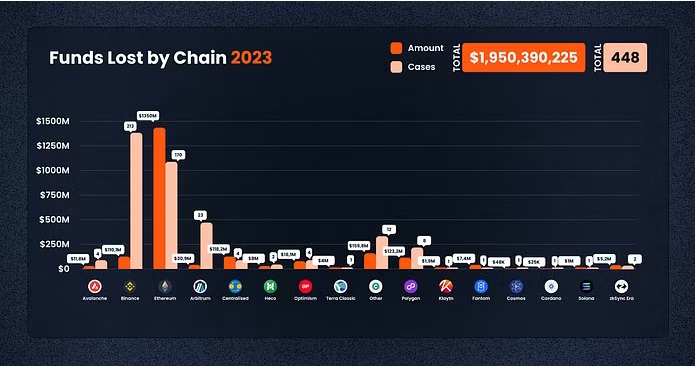
Ethereum faced substantial losses, losing about $1.35 billion in 170 incidents.
In a recent report released by security app De.Fi,
researchers revealed that cryptocurrency users lost nearly $2 billion to scams,
rug pulls, and hacks in 2023. Although this represented a significant reduction
from the previous year, it underscores the ongoing vulnerability of the
industry to security risks.
Market Decline and Improved Awareness Contribute to Lowered
Crypto Risks
The decrease in losses is largely attributed to the
implementation of enhanced security protocols, increased awareness within the
community, and an overall decline in market activity. Notably, this reduction
becomes even more substantial when factoring in the $40 billion lost to the
collapses of the stablecoin issuer Terraform Labs, the crypto lender Celsius, and the
FTX exchange.
This positive trend coincides with a bear market where
major alternative tokens experienced significant slumps before recovering in
recent months amid more bullish conditions. Additionally, the recovery rate of
funds saw a significant improvement, rising to around 10%, up from a mere 2% in
2022, according to De.Fi.
Breakdown by Chain 2023, Source: De.Fi
“This amount, though dispersed across various incidents,
underscores the persistent vulnerabilities and challenges within the DeFi
ecosystem,” De.Fi wrote in its report, which the firm shared with TechCrunch.
“2023 stood as a testament to both the ongoing vulnerabilities and the strides
made in addressing them, even as interest in the space was relatively muted by
the ongoing bear market in the first half of the year.”
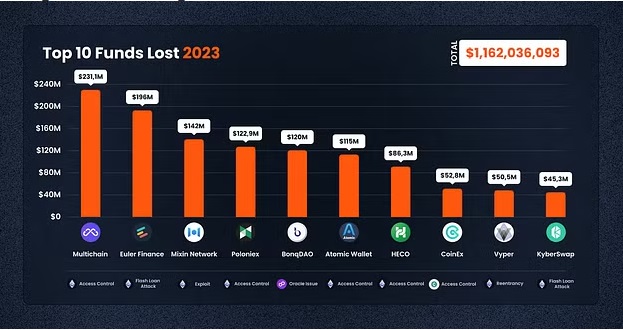
Top 10 Funds Lost, Source: De.Fi
Ethereum, the largest blockchain by active users and value
locked, bore the highest losses, with approximately $1.35 billion erased in an
estimated 170 incidents. This highlights Ethereum's attractiveness to malicious
actors due to its extensive ecosystem and high-profile projects, with the most
substantial exploit being the $230 million attack on the cross-chain platform
Multichain in July.
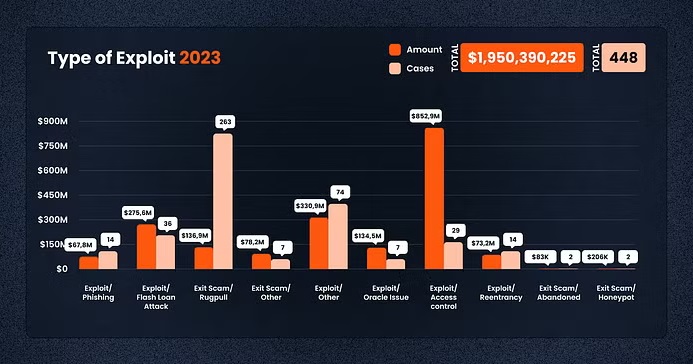
Type of Exploit 2023, Source: De.Fi
BNB Chain also emerged as a target, witnessing a loss of
$110.12 million across 213 incidents. The zkSync Era network lost $5.2 million
in two incidents, while Solana experienced a loss of $1 million in a single
attack.
Losses on centralized platforms, including exchanges and
trading platforms, totaled around $256 million across seven cases. The largest
of these incidents occurred in November when an attack on Poloniex resulted in
a net loss of $122 million.
Access control exploits proved to be the most damaging, with
attackers exploiting weaknesses in how permissions and access rights are
managed within smart contracts or platforms. Such exploits, totaling more than
$852 million in losses from 29 instances, often grant unauthorized access to
funds or critical functionalities.
While the cryptocurrency
industry has made strides in bolstering security measures, the report
highlights the persistent challenges and underscores the importance of ongoing
vigilance and innovation to safeguard users and their assets.
Vulnerabilities Exposed: Implications for Traditional Cold
Wallet Security
Ledger confirmed that hackers inserted malicious code into
the GitHub library for Connect Kit, a widely used javascript library enabling
decentralized finance (DeFi) protocols to connect with hardware wallets. This
has put several DeFi platforms, including Sushi, Lido, Metamask, and Coinbase,
at risk.
While Ledger swiftly removed the malicious code, users
remain at risk. All protocols using Connect Kit must manually update their
versions to address the security threat. Ledger's CEO emphasized the need for
continuous security improvement, acknowledging the incident as a reminder of
the dynamic nature of security.
The attack questions the previously perceived safety of cold
wallets, typically considered secure due to their offline nature. Ledger is
actively cooperating with authorities, vowing to support affected users and aid
in the investigation to apprehend the hacker and recover stolen assets.
In a recent report released by security app De.Fi,
researchers revealed that cryptocurrency users lost nearly $2 billion to scams,
rug pulls, and hacks in 2023. Although this represented a significant reduction
from the previous year, it underscores the ongoing vulnerability of the
industry to security risks.
Market Decline and Improved Awareness Contribute to Lowered
Crypto Risks
The decrease in losses is largely attributed to the
implementation of enhanced security protocols, increased awareness within the
community, and an overall decline in market activity. Notably, this reduction
becomes even more substantial when factoring in the $40 billion lost to the
collapses of the stablecoin issuer Terraform Labs, the crypto lender Celsius, and the
FTX exchange.
This positive trend coincides with a bear market where
major alternative tokens experienced significant slumps before recovering in
recent months amid more bullish conditions. Additionally, the recovery rate of
funds saw a significant improvement, rising to around 10%, up from a mere 2% in
2022, according to De.Fi.
Breakdown by Chain 2023, Source: De.Fi
“This amount, though dispersed across various incidents,
underscores the persistent vulnerabilities and challenges within the DeFi
ecosystem,” De.Fi wrote in its report, which the firm shared with TechCrunch.
“2023 stood as a testament to both the ongoing vulnerabilities and the strides
made in addressing them, even as interest in the space was relatively muted by
the ongoing bear market in the first half of the year.”
Top 10 Funds Lost, Source: De.Fi
Ethereum, the largest blockchain by active users and value
locked, bore the highest losses, with approximately $1.35 billion erased in an
estimated 170 incidents. This highlights Ethereum's attractiveness to malicious
actors due to its extensive ecosystem and high-profile projects, with the most
substantial exploit being the $230 million attack on the cross-chain platform
Multichain in July.
Type of Exploit 2023, Source: De.Fi
BNB Chain also emerged as a target, witnessing a loss of
$110.12 million across 213 incidents. The zkSync Era network lost $5.2 million
in two incidents, while Solana experienced a loss of $1 million in a single
attack.
Losses on centralized platforms, including exchanges and
trading platforms, totaled around $256 million across seven cases. The largest
of these incidents occurred in November when an attack on Poloniex resulted in
a net loss of $122 million.
Access control exploits proved to be the most damaging, with
attackers exploiting weaknesses in how permissions and access rights are
managed within smart contracts or platforms. Such exploits, totaling more than
$852 million in losses from 29 instances, often grant unauthorized access to
funds or critical functionalities.
While the cryptocurrency
industry has made strides in bolstering security measures, the report
highlights the persistent challenges and underscores the importance of ongoing
vigilance and innovation to safeguard users and their assets.
Vulnerabilities Exposed: Implications for Traditional Cold
Wallet Security
Ledger confirmed that hackers inserted malicious code into
the GitHub library for Connect Kit, a widely used javascript library enabling
decentralized finance (DeFi) protocols to connect with hardware wallets. This
has put several DeFi platforms, including Sushi, Lido, Metamask, and Coinbase,
at risk.
While Ledger swiftly removed the malicious code, users
remain at risk. All protocols using Connect Kit must manually update their
versions to address the security threat. Ledger's CEO emphasized the need for
continuous security improvement, acknowledging the incident as a reminder of
the dynamic nature of security.
The attack questions the previously perceived safety of cold
wallets, typically considered secure due to their offline nature. Ledger is
actively cooperating with authorities, vowing to support affected users and aid
in the investigation to apprehend the hacker and recover stolen assets.
Tareq is a financial writer with 15 years of experience covering global markets. His work spans technical analysis, forex broker reviews, and market sentiment, with a focus on topics relevant to retail traders. He joined Finance Magnates in 2023.
At Finance Magnates, he serves as News Editor, covering retail forex and CFD brokers, cryptocurrency exchanges, fintech firms, and regulatory developments shaping the trading industry. He holds an Honours degree in Information Technology from Anfell College, London.
Education:
Honours degree Information Technology, Anfell College, London
WhiteBIT secures brokerage license in Georgia to launch regulated crypto derivatives
FP Markets Winner Spotlight 🏆 | Global Broker of the Year 2025 #Trading #Broker #Innovation #Shorts
FP Markets Winner Spotlight 🏆 | Global Broker of the Year 2025 #Trading #Broker #Innovation #Shorts
FP Markets takes the spotlight as Global Broker of the Year 2025 at the Finance Magnates Awards.
Martin Stoilov, Head of Client Experience, shares that trust, innovation, and people played a key role in the company’s success, supported by a strong foundation of integrity and client-centricity.
Following this milestone, FP Markets continues to focus on growth, technology investment, and its core values of transparency and excellence.
👉 Be part of FM Awards 2026: https://awards.financemagnates.com/#nominate
FP Markets takes the spotlight as Global Broker of the Year 2025 at the Finance Magnates Awards.
Martin Stoilov, Head of Client Experience, shares that trust, innovation, and people played a key role in the company’s success, supported by a strong foundation of integrity and client-centricity.
Following this milestone, FP Markets continues to focus on growth, technology investment, and its core values of transparency and excellence.
👉 Be part of FM Awards 2026: https://awards.financemagnates.com/#nominate
In this video, we review @HolaPrimeMarketsOfficial, a multi-asset forex and CFDs broker offering different account types, trading platforms, and flexible trading conditions.
We cover the broker’s overall offering, including account options, trading environment, platforms like MT4 and MT5, and additional services such as managed accounts and fast withdrawals.
Watch the full video to see if Hola Prime Markets fits your trading needs.
📣 Stay up to date with the latest in finance and trading. Follow Finance Magnates for industry news, insights, and global event coverage.
Connect with us:
🔗 LinkedIn: /financemagnates
👍 Facebook: /financemagnates
📸 Instagram: https://www.instagram.com/financemagnates
🐦 X: https://x.com/financemagnates
🎥 TikTok: https://www.tiktok.com/tag/financemagnates
▶️ YouTube: /@financemagnates_official
#HolaPrime #ForexBroker #CFDTrading #FinanceMagnates #Trading #Forex #BrokerReview
In this video, we review @HolaPrimeMarketsOfficial, a multi-asset forex and CFDs broker offering different account types, trading platforms, and flexible trading conditions.
We cover the broker’s overall offering, including account options, trading environment, platforms like MT4 and MT5, and additional services such as managed accounts and fast withdrawals.
Watch the full video to see if Hola Prime Markets fits your trading needs.
📣 Stay up to date with the latest in finance and trading. Follow Finance Magnates for industry news, insights, and global event coverage.
Connect with us:
🔗 LinkedIn: /financemagnates
👍 Facebook: /financemagnates
📸 Instagram: https://www.instagram.com/financemagnates
🐦 X: https://x.com/financemagnates
🎥 TikTok: https://www.tiktok.com/tag/financemagnates
▶️ YouTube: /@financemagnates_official
#HolaPrime #ForexBroker #CFDTrading #FinanceMagnates #Trading #Forex #BrokerReview
Hola Prime Review: What You Need to Know | Full Breakdown by Finance Magnates
Hola Prime Review: What You Need to Know | Full Breakdown by Finance Magnates
In this video, we review @HolaPrime_Global, a proprietary trading firm offering evaluation programs and performance-based payouts in simulated market environments.
We cover how the challenge model works, including account types, profit splits (up to 95%), trading rules, and what it takes to reach a funded account. You’ll also learn about available platforms like MT4, MT5, cTrader, and more, along with insights into payouts, support, and trading conditions.
Watch the full video to see if Hola Prime fits your trading style.
📣 Stay up to date with the latest in finance and trading. Follow Finance Magnates for industry news, insights, and global event coverage.
Connect with us:
🔗 LinkedIn: /financemagnates
👍 Facebook: /financemagnates
📸 Instagram: https://www.instagram.com/financemagnates
🐦 X: https://x.com/financemagnates
🎥 TikTok: https://www.tiktok.com/tag/financemagnates
▶️ YouTube: /@financemagnates_official
#HolaPrime #PropFirm #Trading #FinanceMagnates #Forex #FuturesTrading #TradingReview #PropFirmReview
In this video, we review @HolaPrime_Global, a proprietary trading firm offering evaluation programs and performance-based payouts in simulated market environments.
We cover how the challenge model works, including account types, profit splits (up to 95%), trading rules, and what it takes to reach a funded account. You’ll also learn about available platforms like MT4, MT5, cTrader, and more, along with insights into payouts, support, and trading conditions.
Watch the full video to see if Hola Prime fits your trading style.
📣 Stay up to date with the latest in finance and trading. Follow Finance Magnates for industry news, insights, and global event coverage.
Connect with us:
🔗 LinkedIn: /financemagnates
👍 Facebook: /financemagnates
📸 Instagram: https://www.instagram.com/financemagnates
🐦 X: https://x.com/financemagnates
🎥 TikTok: https://www.tiktok.com/tag/financemagnates
▶️ YouTube: /@financemagnates_official
#HolaPrime #PropFirm #Trading #FinanceMagnates #Forex #FuturesTrading #TradingReview #PropFirmReview
Axi Winner Spotlight 🏆 | Global Most Innovative Broker 2025 #Innovation #Trading #Fintech #Broker
Axi Winner Spotlight 🏆 | Global Most Innovative Broker 2025 #Innovation #Trading #Fintech #Broker
Axi takes the spotlight at the Finance Magnates Awards, winning Global Most Innovative Broker 2025.
Olivia Xenofontos and Ivanna Openko share how the team will feel: proud, motivated, and ready to keep delivering.
They also describe the night as well-organized, focused, and enjoyable for all.
👉 Be part of FM Awards 2026.
Axi takes the spotlight at the Finance Magnates Awards, winning Global Most Innovative Broker 2025.
Olivia Xenofontos and Ivanna Openko share how the team will feel: proud, motivated, and ready to keep delivering.
They also describe the night as well-organized, focused, and enjoyable for all.
👉 Be part of FM Awards 2026.
Recognition that matters.
Built on transparency.
Driven by the industry.
The Finance Magnates Awards 2026.
Nominations are now open.
🔗 https://awards.financemagnates.com/?utm_source=SM&utm_medium=social&utm_campaign=recognition-matters
Recognition that matters.
Built on transparency.
Driven by the industry.
The Finance Magnates Awards 2026.
Nominations are now open.
🔗 https://awards.financemagnates.com/?utm_source=SM&utm_medium=social&utm_campaign=recognition-matters