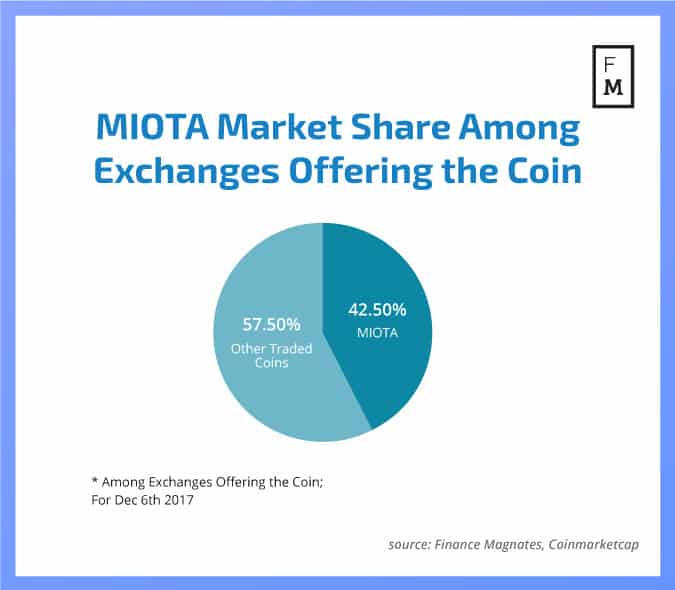
The bullish run began on December 3rd, when a single IOTA token (officially called a “MIOTA”) doubled its valuation from roughly $1.40 to $2.80. MIOTA tokens briefly peaked on December 6th around $5.45 before facing a correction. While the price of MIOTA tokens is still in flux, it has managed to stay at least 6x what it was just six weeks ago. In mid-October, MIOTA was trading around $0.40.
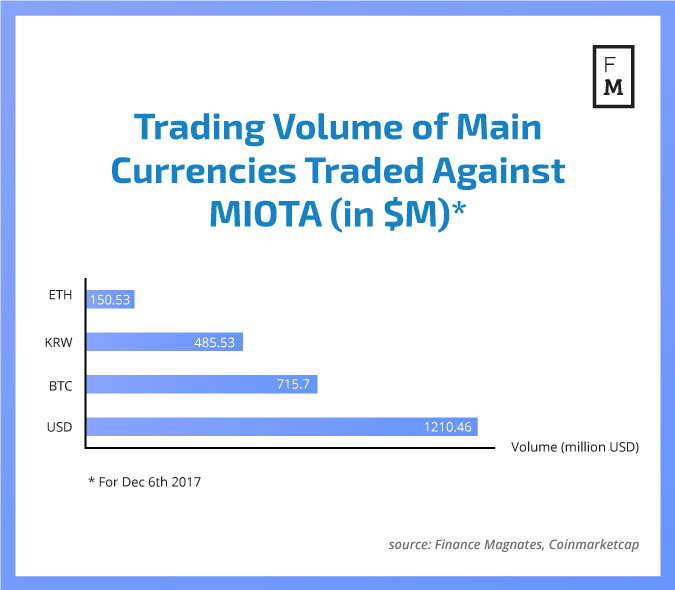
At the time of press, IOTA’s 24-hour trading volume was roughly $1.38 billion, around $130 million higher than that of Bitcoin Cash, the world's third-largest cryptocurrency.
The sudden high demand for MIOTA tokens comes in the wake of IOTA’s announcement in late November that the IOTA Foundation (founded in 2015) has joined with 20 other companies, including Microsoft and Fujitsu, to create a decentralized data marketplace. The marketplace will be integrated along with the IOTA network into Internet-of-Things devices manufactured by other companies in the partnership, and will collect and sell data produced by the usage of said devices.
Unlike the Bitcoin blockchain, however, the Tangle does not rely on miners to confirm transactions. Instead, new blocks are created automatically with every transaction and verified within small groups
of other transactions, rather than needing approval from the entire blockchain in order to be confirmed; for this reason, the Tangle network actually becomes faster and more efficient as more people use it.
Blocks are added in a non-linear, non-chronological fashion to the Tangle; this allows transactions to take place offline (they are added later). Because the entire Tangle does not need to be present on a device to confirm transactions, the network is also “lightweight” and can be supported by a variety of devices, from computers to mobile phones to IoT-connected toasters.
In fact, the design of the Tangle network was created such that it could easily be integrated into the Internet of Things. Its free transactions and “infinite scalability” theoretically make the cryptocurrency ideal for machine-to-machine communication and transactions.
Decentralizing Everything
By allowing automatic, instantaneous payments, the IOTA network hopes to decentralize the ownership of physical objects. For example, the IOTA network could be hooked up to a smartphone and used to automatically calculate the cost pay for the use of a self-driving taxi (with no “middleman”.) Theoretically, the IOTA platform would make the ownership of a car less necessary--all cars could be shared, and used by people who needed them when they need them, rather than sitting in a garage or driveway for most of the day.
The Internet-of-Things industry, while rapidly expanding, has really just barely begun to become a part of the everyday lives of the world’s wealthiest and most technologically advanced societies. According to the IOTA website, “the distributed ledger revolution has only barely begun, the vast majority of use-cases has not even been thought of yet, and with the next generation ledger that IOTA created developers will be able to invent even more solutions.”
The IOTA network also supports a fully-encrypted messaging platform called the MAM (“Masked Authenticated Messaging”) that allows devices connected to the IOTA network to securely exchange data with one another. The platform allows data to be shared with multiple entities at once, similar to a radio broadcast that anyone with permission can tune in and listen to.
IOTA: Fostering a Strong Community of Investors, Developers, and Business Partners
The IOTA Foundation is responsible for starting “The Big Deal,” a community funding project that was created to attract developers and corporate entities to the IOTA network. Participation in The Big Deal is incentivized with the promise of IOTA tokens in exchange for access to knowledge, as well as other resources, such as developers, marketers, and media coverage. The Big Deal may be at least partially responsible for the recent announcement of IOTA’s high-profile partnerships.
The recent buzz has attracted lots of individuals in the crypto community as well. According to a report from CryptoCoinsNews, the /r/IOTA was the sixth-fastest growing subreddit page on Monday of this week. At the time of writing, the subreddit had over 53,000 followers; Ripple had just over 45,000.
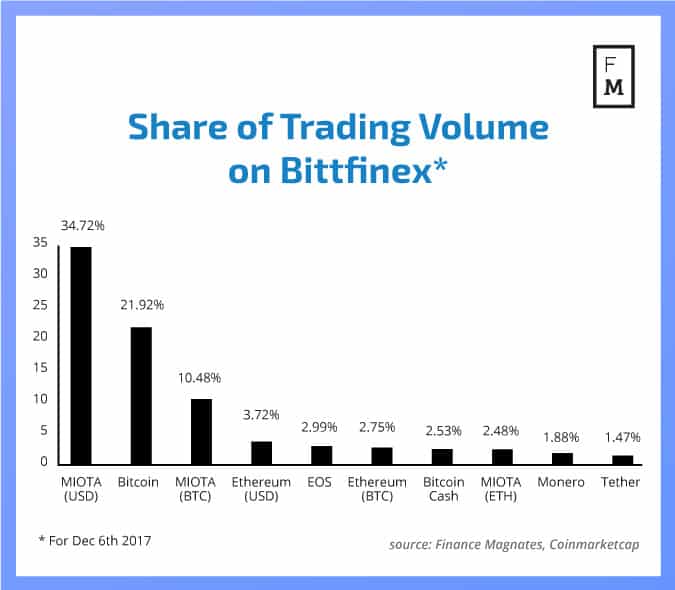
Despite its surging popularity, IOTA is only available for trading on thirteen exchanges. At the time of writing, Bitfinex was responsible approximately 60% of IOTA’s trading volume, while Binance and CoinOne held approximately 15% apiece. The remaining 10% was scattered across less well-known exchanges.
While the IOTA network will undoubtedly face its own set of challenges as it continues its journey into IoT integration, it is a force to be reckoned with. The cryptocurrency has positioned itself extremely well to become the first ever to really be adopted for practical, “real-world” use. If everything goes as IOTA has planned, the latest partnerships (and the resulting boost in token value) are just the beginning.
The bullish run began on December 3rd, when a single IOTA token (officially called a “MIOTA”) doubled its valuation from roughly $1.40 to $2.80. MIOTA tokens briefly peaked on December 6th around $5.45 before facing a correction. While the price of MIOTA tokens is still in flux, it has managed to stay at least 6x what it was just six weeks ago. In mid-October, MIOTA was trading around $0.40.
At the time of press, IOTA’s 24-hour trading volume was roughly $1.38 billion, around $130 million higher than that of Bitcoin Cash, the world's third-largest cryptocurrency.
The sudden high demand for MIOTA tokens comes in the wake of IOTA’s announcement in late November that the IOTA Foundation (founded in 2015) has joined with 20 other companies, including Microsoft and Fujitsu, to create a decentralized data marketplace. The marketplace will be integrated along with the IOTA network into Internet-of-Things devices manufactured by other companies in the partnership, and will collect and sell data produced by the usage of said devices.
Unlike the Bitcoin blockchain, however, the Tangle does not rely on miners to confirm transactions. Instead, new blocks are created automatically with every transaction and verified within small groups
of other transactions, rather than needing approval from the entire blockchain in order to be confirmed; for this reason, the Tangle network actually becomes faster and more efficient as more people use it.
Blocks are added in a non-linear, non-chronological fashion to the Tangle; this allows transactions to take place offline (they are added later). Because the entire Tangle does not need to be present on a device to confirm transactions, the network is also “lightweight” and can be supported by a variety of devices, from computers to mobile phones to IoT-connected toasters.
In fact, the design of the Tangle network was created such that it could easily be integrated into the Internet of Things. Its free transactions and “infinite scalability” theoretically make the cryptocurrency ideal for machine-to-machine communication and transactions.
Decentralizing Everything
By allowing automatic, instantaneous payments, the IOTA network hopes to decentralize the ownership of physical objects. For example, the IOTA network could be hooked up to a smartphone and used to automatically calculate the cost pay for the use of a self-driving taxi (with no “middleman”.) Theoretically, the IOTA platform would make the ownership of a car less necessary--all cars could be shared, and used by people who needed them when they need them, rather than sitting in a garage or driveway for most of the day.
The Internet-of-Things industry, while rapidly expanding, has really just barely begun to become a part of the everyday lives of the world’s wealthiest and most technologically advanced societies. According to the IOTA website, “the distributed ledger revolution has only barely begun, the vast majority of use-cases has not even been thought of yet, and with the next generation ledger that IOTA created developers will be able to invent even more solutions.”
The IOTA network also supports a fully-encrypted messaging platform called the MAM (“Masked Authenticated Messaging”) that allows devices connected to the IOTA network to securely exchange data with one another. The platform allows data to be shared with multiple entities at once, similar to a radio broadcast that anyone with permission can tune in and listen to.
IOTA: Fostering a Strong Community of Investors, Developers, and Business Partners
The IOTA Foundation is responsible for starting “The Big Deal,” a community funding project that was created to attract developers and corporate entities to the IOTA network. Participation in The Big Deal is incentivized with the promise of IOTA tokens in exchange for access to knowledge, as well as other resources, such as developers, marketers, and media coverage. The Big Deal may be at least partially responsible for the recent announcement of IOTA’s high-profile partnerships.
The recent buzz has attracted lots of individuals in the crypto community as well. According to a report from CryptoCoinsNews, the /r/IOTA was the sixth-fastest growing subreddit page on Monday of this week. At the time of writing, the subreddit had over 53,000 followers; Ripple had just over 45,000.
Despite its surging popularity, IOTA is only available for trading on thirteen exchanges. At the time of writing, Bitfinex was responsible approximately 60% of IOTA’s trading volume, while Binance and CoinOne held approximately 15% apiece. The remaining 10% was scattered across less well-known exchanges.
While the IOTA network will undoubtedly face its own set of challenges as it continues its journey into IoT integration, it is a force to be reckoned with. The cryptocurrency has positioned itself extremely well to become the first ever to really be adopted for practical, “real-world” use. If everything goes as IOTA has planned, the latest partnerships (and the resulting boost in token value) are just the beginning.
Rachel is a self-taught crypto geek and a passionate writer. She believes in the power that the written word has to educate, connect and empower individuals to make positive and powerful financial choices. She is the Podcast Host and a Cryptocurrency Editor at Finance Magnates.
Kraken Steps Up Speed Race with New Equinix Colocation Service for Crypto Traders
Featured Videos
FP Markets Winner Spotlight 🏆 | Global Broker of the Year 2025 #Trading #Broker #Innovation #Shorts
FP Markets Winner Spotlight 🏆 | Global Broker of the Year 2025 #Trading #Broker #Innovation #Shorts
FP Markets Winner Spotlight 🏆 | Global Broker of the Year 2025 #Trading #Broker #Innovation #Shorts
FP Markets Winner Spotlight 🏆 | Global Broker of the Year 2025 #Trading #Broker #Innovation #Shorts
FP Markets takes the spotlight as Global Broker of the Year 2025 at the Finance Magnates Awards.
Martin Stoilov, Head of Client Experience, shares that trust, innovation, and people played a key role in the company’s success, supported by a strong foundation of integrity and client-centricity.
Following this milestone, FP Markets continues to focus on growth, technology investment, and its core values of transparency and excellence.
👉 Be part of FM Awards 2026: https://awards.financemagnates.com/#nominate
FP Markets takes the spotlight as Global Broker of the Year 2025 at the Finance Magnates Awards.
Martin Stoilov, Head of Client Experience, shares that trust, innovation, and people played a key role in the company’s success, supported by a strong foundation of integrity and client-centricity.
Following this milestone, FP Markets continues to focus on growth, technology investment, and its core values of transparency and excellence.
👉 Be part of FM Awards 2026: https://awards.financemagnates.com/#nominate
FP Markets takes the spotlight as Global Broker of the Year 2025 at the Finance Magnates Awards.
Martin Stoilov, Head of Client Experience, shares that trust, innovation, and people played a key role in the company’s success, supported by a strong foundation of integrity and client-centricity.
Following this milestone, FP Markets continues to focus on growth, technology investment, and its core values of transparency and excellence.
👉 Be part of FM Awards 2026: https://awards.financemagnates.com/#nominate
FP Markets takes the spotlight as Global Broker of the Year 2025 at the Finance Magnates Awards.
Martin Stoilov, Head of Client Experience, shares that trust, innovation, and people played a key role in the company’s success, supported by a strong foundation of integrity and client-centricity.
Following this milestone, FP Markets continues to focus on growth, technology investment, and its core values of transparency and excellence.
👉 Be part of FM Awards 2026: https://awards.financemagnates.com/#nominate
In this video, we review @HolaPrimeMarketsOfficial, a multi-asset forex and CFDs broker offering different account types, trading platforms, and flexible trading conditions.
We cover the broker’s overall offering, including account options, trading environment, platforms like MT4 and MT5, and additional services such as managed accounts and fast withdrawals.
Watch the full video to see if Hola Prime Markets fits your trading needs.
📣 Stay up to date with the latest in finance and trading. Follow Finance Magnates for industry news, insights, and global event coverage.
Connect with us:
🔗 LinkedIn: /financemagnates
👍 Facebook: /financemagnates
📸 Instagram: https://www.instagram.com/financemagnates
🐦 X: https://x.com/financemagnates
🎥 TikTok: https://www.tiktok.com/tag/financemagnates
▶️ YouTube: /@financemagnates_official
#HolaPrime #ForexBroker #CFDTrading #FinanceMagnates #Trading #Forex #BrokerReview
In this video, we review @HolaPrimeMarketsOfficial, a multi-asset forex and CFDs broker offering different account types, trading platforms, and flexible trading conditions.
We cover the broker’s overall offering, including account options, trading environment, platforms like MT4 and MT5, and additional services such as managed accounts and fast withdrawals.
Watch the full video to see if Hola Prime Markets fits your trading needs.
📣 Stay up to date with the latest in finance and trading. Follow Finance Magnates for industry news, insights, and global event coverage.
Connect with us:
🔗 LinkedIn: /financemagnates
👍 Facebook: /financemagnates
📸 Instagram: https://www.instagram.com/financemagnates
🐦 X: https://x.com/financemagnates
🎥 TikTok: https://www.tiktok.com/tag/financemagnates
▶️ YouTube: /@financemagnates_official
#HolaPrime #ForexBroker #CFDTrading #FinanceMagnates #Trading #Forex #BrokerReview
In this video, we review @HolaPrimeMarketsOfficial, a multi-asset forex and CFDs broker offering different account types, trading platforms, and flexible trading conditions.
We cover the broker’s overall offering, including account options, trading environment, platforms like MT4 and MT5, and additional services such as managed accounts and fast withdrawals.
Watch the full video to see if Hola Prime Markets fits your trading needs.
📣 Stay up to date with the latest in finance and trading. Follow Finance Magnates for industry news, insights, and global event coverage.
Connect with us:
🔗 LinkedIn: /financemagnates
👍 Facebook: /financemagnates
📸 Instagram: https://www.instagram.com/financemagnates
🐦 X: https://x.com/financemagnates
🎥 TikTok: https://www.tiktok.com/tag/financemagnates
▶️ YouTube: /@financemagnates_official
#HolaPrime #ForexBroker #CFDTrading #FinanceMagnates #Trading #Forex #BrokerReview
In this video, we review @HolaPrimeMarketsOfficial, a multi-asset forex and CFDs broker offering different account types, trading platforms, and flexible trading conditions.
We cover the broker’s overall offering, including account options, trading environment, platforms like MT4 and MT5, and additional services such as managed accounts and fast withdrawals.
Watch the full video to see if Hola Prime Markets fits your trading needs.
📣 Stay up to date with the latest in finance and trading. Follow Finance Magnates for industry news, insights, and global event coverage.
Connect with us:
🔗 LinkedIn: /financemagnates
👍 Facebook: /financemagnates
📸 Instagram: https://www.instagram.com/financemagnates
🐦 X: https://x.com/financemagnates
🎥 TikTok: https://www.tiktok.com/tag/financemagnates
▶️ YouTube: /@financemagnates_official
#HolaPrime #ForexBroker #CFDTrading #FinanceMagnates #Trading #Forex #BrokerReview
In this video, we review @HolaPrimeMarketsOfficial, a multi-asset forex and CFDs broker offering different account types, trading platforms, and flexible trading conditions.
We cover the broker’s overall offering, including account options, trading environment, platforms like MT4 and MT5, and additional services such as managed accounts and fast withdrawals.
Watch the full video to see if Hola Prime Markets fits your trading needs.
📣 Stay up to date with the latest in finance and trading. Follow Finance Magnates for industry news, insights, and global event coverage.
Connect with us:
🔗 LinkedIn: /financemagnates
👍 Facebook: /financemagnates
📸 Instagram: https://www.instagram.com/financemagnates
🐦 X: https://x.com/financemagnates
🎥 TikTok: https://www.tiktok.com/tag/financemagnates
▶️ YouTube: /@financemagnates_official
#HolaPrime #ForexBroker #CFDTrading #FinanceMagnates #Trading #Forex #BrokerReview
In this video, we review @HolaPrimeMarketsOfficial, a multi-asset forex and CFDs broker offering different account types, trading platforms, and flexible trading conditions.
We cover the broker’s overall offering, including account options, trading environment, platforms like MT4 and MT5, and additional services such as managed accounts and fast withdrawals.
Watch the full video to see if Hola Prime Markets fits your trading needs.
📣 Stay up to date with the latest in finance and trading. Follow Finance Magnates for industry news, insights, and global event coverage.
Connect with us:
🔗 LinkedIn: /financemagnates
👍 Facebook: /financemagnates
📸 Instagram: https://www.instagram.com/financemagnates
🐦 X: https://x.com/financemagnates
🎥 TikTok: https://www.tiktok.com/tag/financemagnates
▶️ YouTube: /@financemagnates_official
#HolaPrime #ForexBroker #CFDTrading #FinanceMagnates #Trading #Forex #BrokerReview
Hola Prime Review: What You Need to Know | Full Breakdown by Finance Magnates
Hola Prime Review: What You Need to Know | Full Breakdown by Finance Magnates
Hola Prime Review: What You Need to Know | Full Breakdown by Finance Magnates
Hola Prime Review: What You Need to Know | Full Breakdown by Finance Magnates
Hola Prime Review: What You Need to Know | Full Breakdown by Finance Magnates
Hola Prime Review: What You Need to Know | Full Breakdown by Finance Magnates
In this video, we review @HolaPrime_Global, a proprietary trading firm offering evaluation programs and performance-based payouts in simulated market environments.
We cover how the challenge model works, including account types, profit splits (up to 95%), trading rules, and what it takes to reach a funded account. You’ll also learn about available platforms like MT4, MT5, cTrader, and more, along with insights into payouts, support, and trading conditions.
Watch the full video to see if Hola Prime fits your trading style.
📣 Stay up to date with the latest in finance and trading. Follow Finance Magnates for industry news, insights, and global event coverage.
Connect with us:
🔗 LinkedIn: /financemagnates
👍 Facebook: /financemagnates
📸 Instagram: https://www.instagram.com/financemagnates
🐦 X: https://x.com/financemagnates
🎥 TikTok: https://www.tiktok.com/tag/financemagnates
▶️ YouTube: /@financemagnates_official
#HolaPrime #PropFirm #Trading #FinanceMagnates #Forex #FuturesTrading #TradingReview #PropFirmReview
In this video, we review @HolaPrime_Global, a proprietary trading firm offering evaluation programs and performance-based payouts in simulated market environments.
We cover how the challenge model works, including account types, profit splits (up to 95%), trading rules, and what it takes to reach a funded account. You’ll also learn about available platforms like MT4, MT5, cTrader, and more, along with insights into payouts, support, and trading conditions.
Watch the full video to see if Hola Prime fits your trading style.
📣 Stay up to date with the latest in finance and trading. Follow Finance Magnates for industry news, insights, and global event coverage.
Connect with us:
🔗 LinkedIn: /financemagnates
👍 Facebook: /financemagnates
📸 Instagram: https://www.instagram.com/financemagnates
🐦 X: https://x.com/financemagnates
🎥 TikTok: https://www.tiktok.com/tag/financemagnates
▶️ YouTube: /@financemagnates_official
#HolaPrime #PropFirm #Trading #FinanceMagnates #Forex #FuturesTrading #TradingReview #PropFirmReview
In this video, we review @HolaPrime_Global, a proprietary trading firm offering evaluation programs and performance-based payouts in simulated market environments.
We cover how the challenge model works, including account types, profit splits (up to 95%), trading rules, and what it takes to reach a funded account. You’ll also learn about available platforms like MT4, MT5, cTrader, and more, along with insights into payouts, support, and trading conditions.
Watch the full video to see if Hola Prime fits your trading style.
📣 Stay up to date with the latest in finance and trading. Follow Finance Magnates for industry news, insights, and global event coverage.
Connect with us:
🔗 LinkedIn: /financemagnates
👍 Facebook: /financemagnates
📸 Instagram: https://www.instagram.com/financemagnates
🐦 X: https://x.com/financemagnates
🎥 TikTok: https://www.tiktok.com/tag/financemagnates
▶️ YouTube: /@financemagnates_official
#HolaPrime #PropFirm #Trading #FinanceMagnates #Forex #FuturesTrading #TradingReview #PropFirmReview
In this video, we review @HolaPrime_Global, a proprietary trading firm offering evaluation programs and performance-based payouts in simulated market environments.
We cover how the challenge model works, including account types, profit splits (up to 95%), trading rules, and what it takes to reach a funded account. You’ll also learn about available platforms like MT4, MT5, cTrader, and more, along with insights into payouts, support, and trading conditions.
Watch the full video to see if Hola Prime fits your trading style.
📣 Stay up to date with the latest in finance and trading. Follow Finance Magnates for industry news, insights, and global event coverage.
Connect with us:
🔗 LinkedIn: /financemagnates
👍 Facebook: /financemagnates
📸 Instagram: https://www.instagram.com/financemagnates
🐦 X: https://x.com/financemagnates
🎥 TikTok: https://www.tiktok.com/tag/financemagnates
▶️ YouTube: /@financemagnates_official
#HolaPrime #PropFirm #Trading #FinanceMagnates #Forex #FuturesTrading #TradingReview #PropFirmReview
In this video, we review @HolaPrime_Global, a proprietary trading firm offering evaluation programs and performance-based payouts in simulated market environments.
We cover how the challenge model works, including account types, profit splits (up to 95%), trading rules, and what it takes to reach a funded account. You’ll also learn about available platforms like MT4, MT5, cTrader, and more, along with insights into payouts, support, and trading conditions.
Watch the full video to see if Hola Prime fits your trading style.
📣 Stay up to date with the latest in finance and trading. Follow Finance Magnates for industry news, insights, and global event coverage.
Connect with us:
🔗 LinkedIn: /financemagnates
👍 Facebook: /financemagnates
📸 Instagram: https://www.instagram.com/financemagnates
🐦 X: https://x.com/financemagnates
🎥 TikTok: https://www.tiktok.com/tag/financemagnates
▶️ YouTube: /@financemagnates_official
#HolaPrime #PropFirm #Trading #FinanceMagnates #Forex #FuturesTrading #TradingReview #PropFirmReview
In this video, we review @HolaPrime_Global, a proprietary trading firm offering evaluation programs and performance-based payouts in simulated market environments.
We cover how the challenge model works, including account types, profit splits (up to 95%), trading rules, and what it takes to reach a funded account. You’ll also learn about available platforms like MT4, MT5, cTrader, and more, along with insights into payouts, support, and trading conditions.
Watch the full video to see if Hola Prime fits your trading style.
📣 Stay up to date with the latest in finance and trading. Follow Finance Magnates for industry news, insights, and global event coverage.
Connect with us:
🔗 LinkedIn: /financemagnates
👍 Facebook: /financemagnates
📸 Instagram: https://www.instagram.com/financemagnates
🐦 X: https://x.com/financemagnates
🎥 TikTok: https://www.tiktok.com/tag/financemagnates
▶️ YouTube: /@financemagnates_official
#HolaPrime #PropFirm #Trading #FinanceMagnates #Forex #FuturesTrading #TradingReview #PropFirmReview
Axi Winner Spotlight 🏆 | Global Most Innovative Broker 2025 #Innovation #Trading #Fintech #Broker
Axi Winner Spotlight 🏆 | Global Most Innovative Broker 2025 #Innovation #Trading #Fintech #Broker
Axi Winner Spotlight 🏆 | Global Most Innovative Broker 2025 #Innovation #Trading #Fintech #Broker
Axi Winner Spotlight 🏆 | Global Most Innovative Broker 2025 #Innovation #Trading #Fintech #Broker
Axi Winner Spotlight 🏆 | Global Most Innovative Broker 2025 #Innovation #Trading #Fintech #Broker
Axi Winner Spotlight 🏆 | Global Most Innovative Broker 2025 #Innovation #Trading #Fintech #Broker
Axi takes the spotlight at the Finance Magnates Awards, winning Global Most Innovative Broker 2025.
Olivia Xenofontos and Ivanna Openko share how the team will feel: proud, motivated, and ready to keep delivering.
They also describe the night as well-organized, focused, and enjoyable for all.
👉 Be part of FM Awards 2026.
Axi takes the spotlight at the Finance Magnates Awards, winning Global Most Innovative Broker 2025.
Olivia Xenofontos and Ivanna Openko share how the team will feel: proud, motivated, and ready to keep delivering.
They also describe the night as well-organized, focused, and enjoyable for all.
👉 Be part of FM Awards 2026.
Axi takes the spotlight at the Finance Magnates Awards, winning Global Most Innovative Broker 2025.
Olivia Xenofontos and Ivanna Openko share how the team will feel: proud, motivated, and ready to keep delivering.
They also describe the night as well-organized, focused, and enjoyable for all.
👉 Be part of FM Awards 2026.
Axi takes the spotlight at the Finance Magnates Awards, winning Global Most Innovative Broker 2025.
Olivia Xenofontos and Ivanna Openko share how the team will feel: proud, motivated, and ready to keep delivering.
They also describe the night as well-organized, focused, and enjoyable for all.
👉 Be part of FM Awards 2026.
Axi takes the spotlight at the Finance Magnates Awards, winning Global Most Innovative Broker 2025.
Olivia Xenofontos and Ivanna Openko share how the team will feel: proud, motivated, and ready to keep delivering.
They also describe the night as well-organized, focused, and enjoyable for all.
👉 Be part of FM Awards 2026.
Axi takes the spotlight at the Finance Magnates Awards, winning Global Most Innovative Broker 2025.
Olivia Xenofontos and Ivanna Openko share how the team will feel: proud, motivated, and ready to keep delivering.
They also describe the night as well-organized, focused, and enjoyable for all.
👉 Be part of FM Awards 2026.
Recognition that matters.
Built on transparency.
Driven by the industry.
The Finance Magnates Awards 2026.
Nominations are now open.
🔗 https://awards.financemagnates.com/?utm_source=SM&utm_medium=social&utm_campaign=recognition-matters
Recognition that matters.
Built on transparency.
Driven by the industry.
The Finance Magnates Awards 2026.
Nominations are now open.
🔗 https://awards.financemagnates.com/?utm_source=SM&utm_medium=social&utm_campaign=recognition-matters
Recognition that matters.
Built on transparency.
Driven by the industry.
The Finance Magnates Awards 2026.
Nominations are now open.
🔗 https://awards.financemagnates.com/?utm_source=SM&utm_medium=social&utm_campaign=recognition-matters
Recognition that matters.
Built on transparency.
Driven by the industry.
The Finance Magnates Awards 2026.
Nominations are now open.
🔗 https://awards.financemagnates.com/?utm_source=SM&utm_medium=social&utm_campaign=recognition-matters
Recognition that matters.
Built on transparency.
Driven by the industry.
The Finance Magnates Awards 2026.
Nominations are now open.
🔗 https://awards.financemagnates.com/?utm_source=SM&utm_medium=social&utm_campaign=recognition-matters
Recognition that matters.
Built on transparency.
Driven by the industry.
The Finance Magnates Awards 2026.
Nominations are now open.
🔗 https://awards.financemagnates.com/?utm_source=SM&utm_medium=social&utm_campaign=recognition-matters