
Rumors of the attack originally began circulating on January 6.
FM
UPDATE 14.1.2019: Gate.io published a more extensive report on the hack claiming that 54,200 ETC in total (worth $271,500 when the hack occured) had been transferred out of the exchange. In a separate statement on Jan. 8, Coinbase claimed that a total of more than $1.1 million in crypto had been affected during the 51% attack.
---------------------------------------
A 51% attack was confirmed to have hit the Ethereum Classic (ETC) network on January 7, by Bitfly, the operator of the Ethereum block explorer, the Ethernodes node explorers, and an Ethereum Classic mining pool.
We can confirm that there was a successful 51% attack on the Ethereum Classic (#ETC) network with multiple 100+ block reorganization. We recommend all services to closely monitored the chain and significantly increase required confirmations.
Rumors of 51% Attack on ETC Originally Appeared January 6
Reports that ETC may have been experiencing a 51% attack originally appeared on January 6 in CoinNess, a Chinese-based coin journal. The publication wrote that transaction rollbacks had triggered an alert for Chinese blockchain security firm SlowMist.
However, the ETC team changed its tune less than eight hours later with another tweet imploring “all exchanges and mining pools” to “please allow a significantly higher confirmation time on withdrawals and deposits (+400).”
To all exchanges and mining pools please allow a significantly higher confirmation time on withdrawals and deposits (+400)
Then, without expressly confirming that the attack had taken place, the ETC team then retweeted the original CoinNess article.
At the time of writing, the attack appeared to have subsided--ETHNews reported that the ETC address that is suspected to be associated with the attack has been “silent” since it mined block #7,256,171 nearly twenty-four hours ago.
However, some controversy arose around the attack when US-based crypto exchange Coinbase came forward and said that it noticed a “deep chain reorganization of the Ethereum Classic blockchain that included a double spend” on Saturday, January 5th, a full day before the CoinNess report.
Ethereum Classic responded to the report with a tweet saying that “unfortunately [Coinbase] did not connect with ETC personnel regarding the attack.”
Regarding @coinbase account of recent events: they allegedly detected double spends but unfortunately did not connect with ETC personnel regarding the attack.
This is still very much an ongoing process. https://t.co/in1OGdV8T9
Coinbase’s report on the 51% attack was posted on the company’s Medium blog on January 7. Coinbase Security Engineer Mark Nesbitt, who authored the post, wrote that Coinbase detected "a deep chain reorganization of the Ethereum Classic blockchain that included a double spend" on January 5. The post claims that since then, there have been at least eight more chain reorganizations worth around $460,000.
Exchanges React to Attack
A number of exchanges and other platforms that interact with ETC have taken precautionary steps to ensure that their users and the ETC community isn’t negatively affected by the attack. Among them, Bitfly has reportedly increased block confirmations on its mining pool.
US-based crypto exchange Kraken wrote in a post that “as the 51% attack appears to be ongoing, we have temporarily halted ETC deposits and withdrawals,” adding that “[we] will bring ETC funding back online only once we believe it is safe to do so.” Originally, the exchange increased the level of transaction confirmations necessary for ETC transactions from 120 to 500 to prevent false transactions.
Crypto exchange Gate.io posted on its website that although “Gate.io's censor successfully blocked attacker's transactions at the beginning and submitted them to the manual exam,” the censor did pass some false transactions, causing about $40,000 in losses.
“Gate.io will take all the loss for the users,” the post said. Finance Magnates interviewed Gate.io’s Vice President of International Affairs Virgilio Lizardo late in 2018. During the interview, Lizardo said that “Gate sets itself apart by prioritising security and [user] experience.”
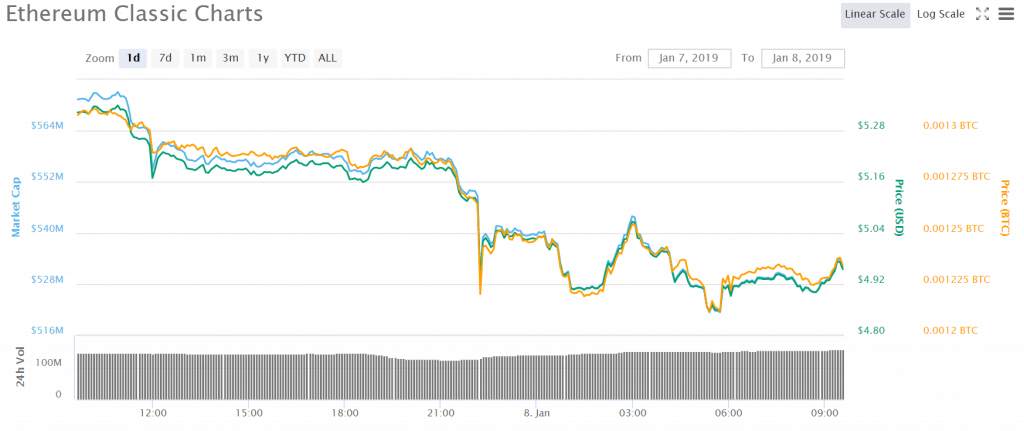
At the time of writing, ETC's valuation had sunk roughly seven percent within the last 24 hours to $4.96, according to data from CoinMarketCap.
UPDATE 14.1.2019: Gate.io published a more extensive report on the hack claiming that 54,200 ETC in total (worth $271,500 when the hack occured) had been transferred out of the exchange. In a separate statement on Jan. 8, Coinbase claimed that a total of more than $1.1 million in crypto had been affected during the 51% attack.
---------------------------------------
A 51% attack was confirmed to have hit the Ethereum Classic (ETC) network on January 7, by Bitfly, the operator of the Ethereum block explorer, the Ethernodes node explorers, and an Ethereum Classic mining pool.
We can confirm that there was a successful 51% attack on the Ethereum Classic (#ETC) network with multiple 100+ block reorganization. We recommend all services to closely monitored the chain and significantly increase required confirmations.
Rumors of 51% Attack on ETC Originally Appeared January 6
Reports that ETC may have been experiencing a 51% attack originally appeared on January 6 in CoinNess, a Chinese-based coin journal. The publication wrote that transaction rollbacks had triggered an alert for Chinese blockchain security firm SlowMist.
However, the ETC team changed its tune less than eight hours later with another tweet imploring “all exchanges and mining pools” to “please allow a significantly higher confirmation time on withdrawals and deposits (+400).”
To all exchanges and mining pools please allow a significantly higher confirmation time on withdrawals and deposits (+400)
Then, without expressly confirming that the attack had taken place, the ETC team then retweeted the original CoinNess article.
At the time of writing, the attack appeared to have subsided--ETHNews reported that the ETC address that is suspected to be associated with the attack has been “silent” since it mined block #7,256,171 nearly twenty-four hours ago.
However, some controversy arose around the attack when US-based crypto exchange Coinbase came forward and said that it noticed a “deep chain reorganization of the Ethereum Classic blockchain that included a double spend” on Saturday, January 5th, a full day before the CoinNess report.
Ethereum Classic responded to the report with a tweet saying that “unfortunately [Coinbase] did not connect with ETC personnel regarding the attack.”
Regarding @coinbase account of recent events: they allegedly detected double spends but unfortunately did not connect with ETC personnel regarding the attack.
This is still very much an ongoing process. https://t.co/in1OGdV8T9
Coinbase’s report on the 51% attack was posted on the company’s Medium blog on January 7. Coinbase Security Engineer Mark Nesbitt, who authored the post, wrote that Coinbase detected "a deep chain reorganization of the Ethereum Classic blockchain that included a double spend" on January 5. The post claims that since then, there have been at least eight more chain reorganizations worth around $460,000.
Exchanges React to Attack
A number of exchanges and other platforms that interact with ETC have taken precautionary steps to ensure that their users and the ETC community isn’t negatively affected by the attack. Among them, Bitfly has reportedly increased block confirmations on its mining pool.
US-based crypto exchange Kraken wrote in a post that “as the 51% attack appears to be ongoing, we have temporarily halted ETC deposits and withdrawals,” adding that “[we] will bring ETC funding back online only once we believe it is safe to do so.” Originally, the exchange increased the level of transaction confirmations necessary for ETC transactions from 120 to 500 to prevent false transactions.
Crypto exchange Gate.io posted on its website that although “Gate.io's censor successfully blocked attacker's transactions at the beginning and submitted them to the manual exam,” the censor did pass some false transactions, causing about $40,000 in losses.
“Gate.io will take all the loss for the users,” the post said. Finance Magnates interviewed Gate.io’s Vice President of International Affairs Virgilio Lizardo late in 2018. During the interview, Lizardo said that “Gate sets itself apart by prioritising security and [user] experience.”
At the time of writing, ETC's valuation had sunk roughly seven percent within the last 24 hours to $4.96, according to data from CoinMarketCap.
Rachel is a self-taught crypto geek and a passionate writer. She believes in the power that the written word has to educate, connect and empower individuals to make positive and powerful financial choices. She is the Podcast Host and a Cryptocurrency Editor at Finance Magnates.
Crypto Industry in 2025: Five Defining Trends – And One Prediction for 2026
Featured Videos
Executive Interview | Charlotte Bullock | Chief Product Officer, Bank of London | FMLS:25
In this interview, we sat down with Charlotte Bullock, Head of Product at The Bank of London, previously at SAP and now shaping product at one of the sector’s most ambitious new banking players.
Charlotte reflects on the Summit so far and talks about the culture inside fintech banks today. We look at the pressures that come with scaling, and how firms can hold onto the nimble approach that made them stand out early on.
We also cover the state of payments ahead of her appearance on the payments roundtable: the blockages financial firms face, the areas that still need fixing, and what a realistic solution looks like in 2026.
In this interview, we sat down with Charlotte Bullock, Head of Product at The Bank of London, previously at SAP and now shaping product at one of the sector’s most ambitious new banking players.
Charlotte reflects on the Summit so far and talks about the culture inside fintech banks today. We look at the pressures that come with scaling, and how firms can hold onto the nimble approach that made them stand out early on.
We also cover the state of payments ahead of her appearance on the payments roundtable: the blockages financial firms face, the areas that still need fixing, and what a realistic solution looks like in 2026.
In this interview, we sat down with Charlotte Bullock, Head of Product at The Bank of London, previously at SAP and now shaping product at one of the sector’s most ambitious new banking players.
Charlotte reflects on the Summit so far and talks about the culture inside fintech banks today. We look at the pressures that come with scaling, and how firms can hold onto the nimble approach that made them stand out early on.
We also cover the state of payments ahead of her appearance on the payments roundtable: the blockages financial firms face, the areas that still need fixing, and what a realistic solution looks like in 2026.
In this interview, we sat down with Charlotte Bullock, Head of Product at The Bank of London, previously at SAP and now shaping product at one of the sector’s most ambitious new banking players.
Charlotte reflects on the Summit so far and talks about the culture inside fintech banks today. We look at the pressures that come with scaling, and how firms can hold onto the nimble approach that made them stand out early on.
We also cover the state of payments ahead of her appearance on the payments roundtable: the blockages financial firms face, the areas that still need fixing, and what a realistic solution looks like in 2026.
In this conversation, we sit down with Drew Niv, CSO at ATFX Connect and one of the most influential figures in modern FX.
We speak about market structure, the institutional view on liquidity, and the sharp rise of prop trading, a sector Drew has been commenting on in recent months. Drew explains why he once dismissed prop trading, why his view changed, and what he now thinks the model means for brokers, clients and risk managers.
We explore subscription-fee dependency, the high reneging rate, and the long-term challenge: how brokers can build a more stable and honest version of the model. Drew also talks about the traffic advantage standalone prop firms have built and why brokers may still win in the long run if they take the right approach.
In this conversation, we sit down with Drew Niv, CSO at ATFX Connect and one of the most influential figures in modern FX.
We speak about market structure, the institutional view on liquidity, and the sharp rise of prop trading, a sector Drew has been commenting on in recent months. Drew explains why he once dismissed prop trading, why his view changed, and what he now thinks the model means for brokers, clients and risk managers.
We explore subscription-fee dependency, the high reneging rate, and the long-term challenge: how brokers can build a more stable and honest version of the model. Drew also talks about the traffic advantage standalone prop firms have built and why brokers may still win in the long run if they take the right approach.
In this conversation, we sit down with Drew Niv, CSO at ATFX Connect and one of the most influential figures in modern FX.
We speak about market structure, the institutional view on liquidity, and the sharp rise of prop trading, a sector Drew has been commenting on in recent months. Drew explains why he once dismissed prop trading, why his view changed, and what he now thinks the model means for brokers, clients and risk managers.
We explore subscription-fee dependency, the high reneging rate, and the long-term challenge: how brokers can build a more stable and honest version of the model. Drew also talks about the traffic advantage standalone prop firms have built and why brokers may still win in the long run if they take the right approach.
In this conversation, we sit down with Drew Niv, CSO at ATFX Connect and one of the most influential figures in modern FX.
We speak about market structure, the institutional view on liquidity, and the sharp rise of prop trading, a sector Drew has been commenting on in recent months. Drew explains why he once dismissed prop trading, why his view changed, and what he now thinks the model means for brokers, clients and risk managers.
We explore subscription-fee dependency, the high reneging rate, and the long-term challenge: how brokers can build a more stable and honest version of the model. Drew also talks about the traffic advantage standalone prop firms have built and why brokers may still win in the long run if they take the right approach.
In this conversation, we sit down with Drew Niv, CSO at ATFX Connect and one of the most influential figures in modern FX.
We speak about market structure, the institutional view on liquidity, and the sharp rise of prop trading, a sector Drew has been commenting on in recent months. Drew explains why he once dismissed prop trading, why his view changed, and what he now thinks the model means for brokers, clients and risk managers.
We explore subscription-fee dependency, the high reneging rate, and the long-term challenge: how brokers can build a more stable and honest version of the model. Drew also talks about the traffic advantage standalone prop firms have built and why brokers may still win in the long run if they take the right approach.
In this conversation, we sit down with Drew Niv, CSO at ATFX Connect and one of the most influential figures in modern FX.
We speak about market structure, the institutional view on liquidity, and the sharp rise of prop trading, a sector Drew has been commenting on in recent months. Drew explains why he once dismissed prop trading, why his view changed, and what he now thinks the model means for brokers, clients and risk managers.
We explore subscription-fee dependency, the high reneging rate, and the long-term challenge: how brokers can build a more stable and honest version of the model. Drew also talks about the traffic advantage standalone prop firms have built and why brokers may still win in the long run if they take the right approach.
Executive Interview | Remonda Z. Kirketerp Møller| CEO & Founder Muinmos | FMLS:25
In this interview, Remonda Z. Kirketerp Møller, founder of Muinmos, breaks down the state of AI in regtech and what responsible adoption really looks like for brokers. We talk about rising fragmentation, the pressures around compliance accuracy, and why most firms are still in the early stages of AI maturity.
Ramanda also shares insights on regulator sandboxes, shifting expectations around accountability, and the current reality of MiCA licensing and passporting in Europe.
A concise look at where compliance, onboarding, and AI-driven processes are heading next.
In this interview, Remonda Z. Kirketerp Møller, founder of Muinmos, breaks down the state of AI in regtech and what responsible adoption really looks like for brokers. We talk about rising fragmentation, the pressures around compliance accuracy, and why most firms are still in the early stages of AI maturity.
Ramanda also shares insights on regulator sandboxes, shifting expectations around accountability, and the current reality of MiCA licensing and passporting in Europe.
A concise look at where compliance, onboarding, and AI-driven processes are heading next.
In this interview, Remonda Z. Kirketerp Møller, founder of Muinmos, breaks down the state of AI in regtech and what responsible adoption really looks like for brokers. We talk about rising fragmentation, the pressures around compliance accuracy, and why most firms are still in the early stages of AI maturity.
Ramanda also shares insights on regulator sandboxes, shifting expectations around accountability, and the current reality of MiCA licensing and passporting in Europe.
A concise look at where compliance, onboarding, and AI-driven processes are heading next.
In this interview, Remonda Z. Kirketerp Møller, founder of Muinmos, breaks down the state of AI in regtech and what responsible adoption really looks like for brokers. We talk about rising fragmentation, the pressures around compliance accuracy, and why most firms are still in the early stages of AI maturity.
Ramanda also shares insights on regulator sandboxes, shifting expectations around accountability, and the current reality of MiCA licensing and passporting in Europe.
A concise look at where compliance, onboarding, and AI-driven processes are heading next.
In this interview, Remonda Z. Kirketerp Møller, founder of Muinmos, breaks down the state of AI in regtech and what responsible adoption really looks like for brokers. We talk about rising fragmentation, the pressures around compliance accuracy, and why most firms are still in the early stages of AI maturity.
Ramanda also shares insights on regulator sandboxes, shifting expectations around accountability, and the current reality of MiCA licensing and passporting in Europe.
A concise look at where compliance, onboarding, and AI-driven processes are heading next.
In this interview, Remonda Z. Kirketerp Møller, founder of Muinmos, breaks down the state of AI in regtech and what responsible adoption really looks like for brokers. We talk about rising fragmentation, the pressures around compliance accuracy, and why most firms are still in the early stages of AI maturity.
Ramanda also shares insights on regulator sandboxes, shifting expectations around accountability, and the current reality of MiCA licensing and passporting in Europe.
A concise look at where compliance, onboarding, and AI-driven processes are heading next.
In this conversation, we speak with Aydin Bonabi, CEO and co-founder of Surveill, a firm focused on fraud detection and AI-driven compliance tools for financial institutions.
We start with Aydin’s view of the Summit and the challenges brokers face as fraud tactics grow more complex. He explains how firms can stay ahead through real-time signals, data patterns, and early-stage detection.
We also talk about AI training and why compliance teams often struggle to keep models accurate, fair, and aligned with regulatory expectations. Aydin breaks down what “good” AI training looks like inside a financial environment, including the importance of clean data, domain expertise, and human oversight.
He closes with a clear message: fraud is scaling, and so must the tools that stop it.
In this conversation, we speak with Aydin Bonabi, CEO and co-founder of Surveill, a firm focused on fraud detection and AI-driven compliance tools for financial institutions.
We start with Aydin’s view of the Summit and the challenges brokers face as fraud tactics grow more complex. He explains how firms can stay ahead through real-time signals, data patterns, and early-stage detection.
We also talk about AI training and why compliance teams often struggle to keep models accurate, fair, and aligned with regulatory expectations. Aydin breaks down what “good” AI training looks like inside a financial environment, including the importance of clean data, domain expertise, and human oversight.
He closes with a clear message: fraud is scaling, and so must the tools that stop it.
In this conversation, we speak with Aydin Bonabi, CEO and co-founder of Surveill, a firm focused on fraud detection and AI-driven compliance tools for financial institutions.
We start with Aydin’s view of the Summit and the challenges brokers face as fraud tactics grow more complex. He explains how firms can stay ahead through real-time signals, data patterns, and early-stage detection.
We also talk about AI training and why compliance teams often struggle to keep models accurate, fair, and aligned with regulatory expectations. Aydin breaks down what “good” AI training looks like inside a financial environment, including the importance of clean data, domain expertise, and human oversight.
He closes with a clear message: fraud is scaling, and so must the tools that stop it.
In this conversation, we speak with Aydin Bonabi, CEO and co-founder of Surveill, a firm focused on fraud detection and AI-driven compliance tools for financial institutions.
We start with Aydin’s view of the Summit and the challenges brokers face as fraud tactics grow more complex. He explains how firms can stay ahead through real-time signals, data patterns, and early-stage detection.
We also talk about AI training and why compliance teams often struggle to keep models accurate, fair, and aligned with regulatory expectations. Aydin breaks down what “good” AI training looks like inside a financial environment, including the importance of clean data, domain expertise, and human oversight.
He closes with a clear message: fraud is scaling, and so must the tools that stop it.
In this conversation, we speak with Aydin Bonabi, CEO and co-founder of Surveill, a firm focused on fraud detection and AI-driven compliance tools for financial institutions.
We start with Aydin’s view of the Summit and the challenges brokers face as fraud tactics grow more complex. He explains how firms can stay ahead through real-time signals, data patterns, and early-stage detection.
We also talk about AI training and why compliance teams often struggle to keep models accurate, fair, and aligned with regulatory expectations. Aydin breaks down what “good” AI training looks like inside a financial environment, including the importance of clean data, domain expertise, and human oversight.
He closes with a clear message: fraud is scaling, and so must the tools that stop it.
In this conversation, we speak with Aydin Bonabi, CEO and co-founder of Surveill, a firm focused on fraud detection and AI-driven compliance tools for financial institutions.
We start with Aydin’s view of the Summit and the challenges brokers face as fraud tactics grow more complex. He explains how firms can stay ahead through real-time signals, data patterns, and early-stage detection.
We also talk about AI training and why compliance teams often struggle to keep models accurate, fair, and aligned with regulatory expectations. Aydin breaks down what “good” AI training looks like inside a financial environment, including the importance of clean data, domain expertise, and human oversight.
He closes with a clear message: fraud is scaling, and so must the tools that stop it.
Exness expands its presence in Africa: Inside our interview with Paul Margarites in Cape Town
Finance Magnates met with Paul Margarites, Exness regional commercial director for Sub-Saharan Africa, during a visit to the firm’s office opening in Cape Town. In this talk, led by Andrea Badiola Mateos, Co-CEO at Finance Magnates, Paul shares views on the South African trading space, local user behavior, mobile trends, regulation, team growth, and how Exness plans to grow in more markets across the region. @Exness
Read the article at: https://www.financemagnates.com/thought-leadership/exness-expands-its-presence-in-africa-inside-our-interview-with-paul-margarites/
#exness #financemagnates #exnesstrading #CFDtrading #tradeonline #africanews #capetown
Finance Magnates met with Paul Margarites, Exness regional commercial director for Sub-Saharan Africa, during a visit to the firm’s office opening in Cape Town. In this talk, led by Andrea Badiola Mateos, Co-CEO at Finance Magnates, Paul shares views on the South African trading space, local user behavior, mobile trends, regulation, team growth, and how Exness plans to grow in more markets across the region. @Exness
Read the article at: https://www.financemagnates.com/thought-leadership/exness-expands-its-presence-in-africa-inside-our-interview-with-paul-margarites/
#exness #financemagnates #exnesstrading #CFDtrading #tradeonline #africanews #capetown
Finance Magnates met with Paul Margarites, Exness regional commercial director for Sub-Saharan Africa, during a visit to the firm’s office opening in Cape Town. In this talk, led by Andrea Badiola Mateos, Co-CEO at Finance Magnates, Paul shares views on the South African trading space, local user behavior, mobile trends, regulation, team growth, and how Exness plans to grow in more markets across the region. @Exness
Read the article at: https://www.financemagnates.com/thought-leadership/exness-expands-its-presence-in-africa-inside-our-interview-with-paul-margarites/
#exness #financemagnates #exnesstrading #CFDtrading #tradeonline #africanews #capetown
Finance Magnates met with Paul Margarites, Exness regional commercial director for Sub-Saharan Africa, during a visit to the firm’s office opening in Cape Town. In this talk, led by Andrea Badiola Mateos, Co-CEO at Finance Magnates, Paul shares views on the South African trading space, local user behavior, mobile trends, regulation, team growth, and how Exness plans to grow in more markets across the region. @Exness
Read the article at: https://www.financemagnates.com/thought-leadership/exness-expands-its-presence-in-africa-inside-our-interview-with-paul-margarites/
#exness #financemagnates #exnesstrading #CFDtrading #tradeonline #africanews #capetown
Finance Magnates met with Paul Margarites, Exness regional commercial director for Sub-Saharan Africa, during a visit to the firm’s office opening in Cape Town. In this talk, led by Andrea Badiola Mateos, Co-CEO at Finance Magnates, Paul shares views on the South African trading space, local user behavior, mobile trends, regulation, team growth, and how Exness plans to grow in more markets across the region. @Exness
Read the article at: https://www.financemagnates.com/thought-leadership/exness-expands-its-presence-in-africa-inside-our-interview-with-paul-margarites/
#exness #financemagnates #exnesstrading #CFDtrading #tradeonline #africanews #capetown
Finance Magnates met with Paul Margarites, Exness regional commercial director for Sub-Saharan Africa, during a visit to the firm’s office opening in Cape Town. In this talk, led by Andrea Badiola Mateos, Co-CEO at Finance Magnates, Paul shares views on the South African trading space, local user behavior, mobile trends, regulation, team growth, and how Exness plans to grow in more markets across the region. @Exness
Read the article at: https://www.financemagnates.com/thought-leadership/exness-expands-its-presence-in-africa-inside-our-interview-with-paul-margarites/
#exness #financemagnates #exnesstrading #CFDtrading #tradeonline #africanews #capetown