Figuring out how to pay taxes on crypto is a daunting task--but it must be done.
FM
A number of the more libertarian voices within the crypto community (looking at you, John McAfee) have argued that storing savings in Bitcoin and other cryptocurrencies is a great way to avoid paying taxes.
While it is true that it can be difficult for the government to detect exactly how much money you’ve made if you haven’t converted any of your cryptocurrency into fiat currency, it is now harder than ever before to sweep that sweet, sweet Bitcoin money under the rug and out of the government’s view.
And it’s only going to get harder. While 2018 didn’t bring much regulatory change in a legislative sense for the cryptocurrency world, the government has more understanding of how the system works than ever before--and it is keener than ever to collect its share of what the market has to offer (although there were some quite heavy losses across the board.)
IRS Criminal Chief Don Fort: Increasing focus on cryptocurrency tax compliance. IRS is "way out ahead of other law enforcement agencies" in terms of expertise, investigative ability. pic.twitter.com/PsW1lyCe3Q
The point is to be aware: big brother is watching, and he wants to know about all of your gains and losses. This is particularly true if your cryptocurrency has (at any point throughout the year) been on a cryptocurrency exchange, especially an exchange within the United States. There is more pressure on exchanges now than ever before when it comes to complying with regulators’ wishes--and if the IRS wants to see an extensive record of an exchange’s accounts, then so be it.
Some Investors May Have Failed to Report Out of Ignorance, Not Negligence
The IRS’ apparently increased drive to collect on crypto gains is likely due to the fact that the organization missed out on tons and tons of revenue last April. Despite the fact that there were plenty of people who had made plenty of money during the massive cryptocurrency boom of late 2017, tax reporting figures were pitifully low--last April, tax preparation software company Credit Karma reported that of the 250,000 tax returns that had been filed through its reporting service, less than 100 mentioned gains or losses in cryptocurrency.
Per the IRS guidelines, we are to use a “reasonable manner that is consistently applied” to calculate the cost and sale values of our cryptocurrencies, when trying to determine our gains and losses
However, it’s important to keep in mind that the lack of reporting can be at least partially attributed to a lack of knowledge about cryptocurrency in general. Many cryptocurrency investors have little or no experience with reporting income earned on any type of investment; some may not even know that this kind of reporting is necessary.
And what about money earned through other cryptocurrency-related things, like mining, hard forks, and airdrops? The fact is that the organization simply hasn’t provided very much guidance on exactly what needs to be reported--and with a group of investors that may already feel bewildered by the simple W2 forms that have to be reported each year, it’s unlikely that widespread accurate filings on cryptocurrency gains will take place anytime soon.
If you have lost coins due to hacking, sketchy ICOs, forgotten passwords, inaccessible wallets, stolen coins, etc., you might be able to deduct these as losses. These various types of losses are all treated differently though, so consult with a tax professional first!
Little Information on Correct Reporting Has Been Provided Since 2014
“The IRS has provided little more information than their six-page Q&A from 2014,” Some people in Congress have requested more guidance from the IRS but it hasn’t occurred yet,” said Logan, although this may change in the near future: “as audits are performed and cases appear before tax court, the IRS will likely be pushed to provide more regulations.”
Paul Banker, general manager of tax reporting at Sovos, told Finance Magnates that the lack of clarity could lead to the spread of misinformation from exchanges to their users: “There has been a lack of clarity from the IRS regarding the specific ‘form’ exchanges should be providing to their customers for the various transactions in this space,” he said.
Paul Banker.
Banker continued to say that in most cases, cryptocurrency traders should plan to use information on the 1099-B form to report their crypto gains and losses on transactions of securities, and the 1099-K to report gross proceeds that have been paid via electronic methods. Cryptocurrency exchanges were told to provide 1099-K forms to their users in the 2014 directive, but few of them actually began to comply with this mandate until 2018.
Additionally, “there is no threshold for the 1099-B, so the reporting differences for the exchanges are significant, and this is why the industry is closely watching the regulatory environment for guidance.” This means that in most places in the United States, cryptocurrency gains and losses that do not exceed a total of $20,000 need not be reported.
Still, there are variances state-by-state, and one should never assume that just because they only made a small amount of money that they are in the clear. Banker says that in some states (ie Massachusetts and Vermont), reporting thresholds for the 1099-K can be as low as $600.
”The Timing of Any New Information is Still Uncertain”, And It Probably Won’t Be This Year
Indeed, “The question is how those regulations will continue to take shape,” Banker said. “The IRS promises to offer clarity, but the timing of any new information is still uncertain.”
And according to the 2018-2019 Priority Guidance Plan, published by the Department of the Treasury and the IRS, it won’t be anytime this year--cryptocurrencies are not mentioned at all throughout the entire document.
But until more clarity is achieved, IRS Commissioner Charles Rettig said that the cryptocurrency industry should, “pay attention to informal guidance as though it’s formal guidance,” and that “the IRS will have more information about [crypto] than you could ever imagine.”
In other words, the IRS does not see its own lack of clarity as an excuse for failing to report cryptocurrency gains and losses.
While we have not seen any widespread subpoenas of exchanges happen so far this year, we must not forget that in late 2016, the IRS demanded that Coinbase hand over roughly 500,000 customer records. Although Coinbase took the summons to court and managed to lower the number of records it handed over to just 13,000, the tax agency meant business--and though this was the first time that something like this happened, it certainly will not be the last.
Better Safe Than Sorry
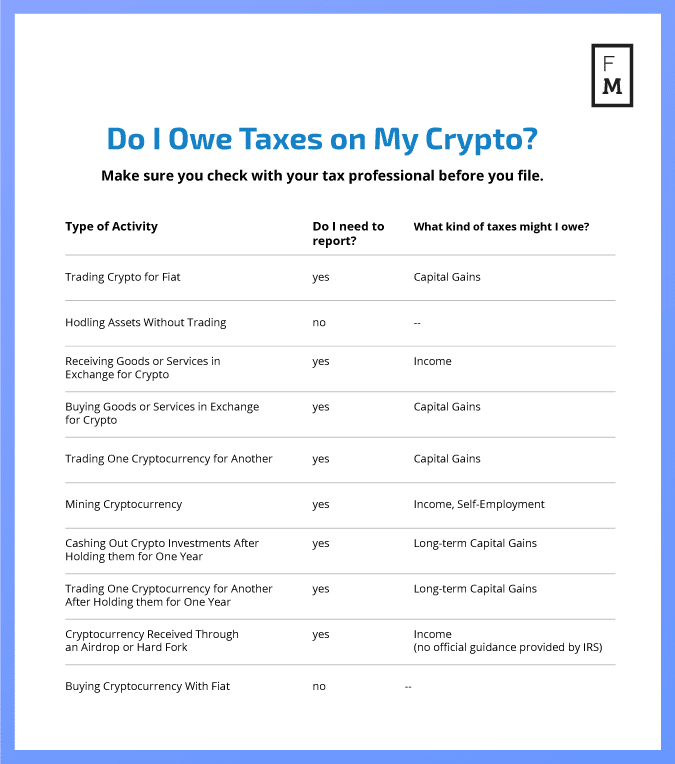
So, investors who have traded in cryptocurrency at any time throughout 2018 need to do their best to correctly report their gains in order to avoid trouble. According to many tax experts, this is inclusive of not only crypto-to-fiat exchanges, but crypto-to-crypto exchanges, which (although there has been no official ruling) are not generally considered to be like-kind exchanges, which would make them tax exempt. Buying or selling goods or services with cryptocurrency is also considered to be a taxable event.
Buying crypto isn’t a taxable event.
Selling crypto for fiat (e.g., USD) is a taxable event.
Trading one coin for another is a taxable event.
Using crypto to purchase goods or services is a taxable event.
— Crypto Tax Girl (@CryptoTaxGirl) July 11, 2018
Indeed, the IRS’ general view on cryptocurrency is that they are legally taxed as property rather than currency, and as such, crypto earnings should be reported as capital gains. For federal reporting, this means that cryptocurrency investors must fill in and file two separate forms: Schedule D, which is where investors report gains and losses and form 8949, which is where investors must provide records of their trades.
Logan says that “for most investors, holding the cryptocurrency for over one year will allow the gains to be taxed as long-term capital gains which are lower than ordinary tax rates,” Logan said.
If you have just realized that you are one of the individuals that may need to report your cryptocurrency earnings this April, don’t panic--you’ve still got time. But remember, failing to report could cost you in more ways that one.
A number of the more libertarian voices within the crypto community (looking at you, John McAfee) have argued that storing savings in Bitcoin and other cryptocurrencies is a great way to avoid paying taxes.
While it is true that it can be difficult for the government to detect exactly how much money you’ve made if you haven’t converted any of your cryptocurrency into fiat currency, it is now harder than ever before to sweep that sweet, sweet Bitcoin money under the rug and out of the government’s view.
And it’s only going to get harder. While 2018 didn’t bring much regulatory change in a legislative sense for the cryptocurrency world, the government has more understanding of how the system works than ever before--and it is keener than ever to collect its share of what the market has to offer (although there were some quite heavy losses across the board.)
IRS Criminal Chief Don Fort: Increasing focus on cryptocurrency tax compliance. IRS is "way out ahead of other law enforcement agencies" in terms of expertise, investigative ability. pic.twitter.com/PsW1lyCe3Q
The point is to be aware: big brother is watching, and he wants to know about all of your gains and losses. This is particularly true if your cryptocurrency has (at any point throughout the year) been on a cryptocurrency exchange, especially an exchange within the United States. There is more pressure on exchanges now than ever before when it comes to complying with regulators’ wishes--and if the IRS wants to see an extensive record of an exchange’s accounts, then so be it.
Some Investors May Have Failed to Report Out of Ignorance, Not Negligence
The IRS’ apparently increased drive to collect on crypto gains is likely due to the fact that the organization missed out on tons and tons of revenue last April. Despite the fact that there were plenty of people who had made plenty of money during the massive cryptocurrency boom of late 2017, tax reporting figures were pitifully low--last April, tax preparation software company Credit Karma reported that of the 250,000 tax returns that had been filed through its reporting service, less than 100 mentioned gains or losses in cryptocurrency.
Per the IRS guidelines, we are to use a “reasonable manner that is consistently applied” to calculate the cost and sale values of our cryptocurrencies, when trying to determine our gains and losses
However, it’s important to keep in mind that the lack of reporting can be at least partially attributed to a lack of knowledge about cryptocurrency in general. Many cryptocurrency investors have little or no experience with reporting income earned on any type of investment; some may not even know that this kind of reporting is necessary.
And what about money earned through other cryptocurrency-related things, like mining, hard forks, and airdrops? The fact is that the organization simply hasn’t provided very much guidance on exactly what needs to be reported--and with a group of investors that may already feel bewildered by the simple W2 forms that have to be reported each year, it’s unlikely that widespread accurate filings on cryptocurrency gains will take place anytime soon.
If you have lost coins due to hacking, sketchy ICOs, forgotten passwords, inaccessible wallets, stolen coins, etc., you might be able to deduct these as losses. These various types of losses are all treated differently though, so consult with a tax professional first!
Little Information on Correct Reporting Has Been Provided Since 2014
“The IRS has provided little more information than their six-page Q&A from 2014,” Some people in Congress have requested more guidance from the IRS but it hasn’t occurred yet,” said Logan, although this may change in the near future: “as audits are performed and cases appear before tax court, the IRS will likely be pushed to provide more regulations.”
Paul Banker, general manager of tax reporting at Sovos, told Finance Magnates that the lack of clarity could lead to the spread of misinformation from exchanges to their users: “There has been a lack of clarity from the IRS regarding the specific ‘form’ exchanges should be providing to their customers for the various transactions in this space,” he said.
Paul Banker.
Banker continued to say that in most cases, cryptocurrency traders should plan to use information on the 1099-B form to report their crypto gains and losses on transactions of securities, and the 1099-K to report gross proceeds that have been paid via electronic methods. Cryptocurrency exchanges were told to provide 1099-K forms to their users in the 2014 directive, but few of them actually began to comply with this mandate until 2018.
Additionally, “there is no threshold for the 1099-B, so the reporting differences for the exchanges are significant, and this is why the industry is closely watching the regulatory environment for guidance.” This means that in most places in the United States, cryptocurrency gains and losses that do not exceed a total of $20,000 need not be reported.
Still, there are variances state-by-state, and one should never assume that just because they only made a small amount of money that they are in the clear. Banker says that in some states (ie Massachusetts and Vermont), reporting thresholds for the 1099-K can be as low as $600.
”The Timing of Any New Information is Still Uncertain”, And It Probably Won’t Be This Year
Indeed, “The question is how those regulations will continue to take shape,” Banker said. “The IRS promises to offer clarity, but the timing of any new information is still uncertain.”
And according to the 2018-2019 Priority Guidance Plan, published by the Department of the Treasury and the IRS, it won’t be anytime this year--cryptocurrencies are not mentioned at all throughout the entire document.
But until more clarity is achieved, IRS Commissioner Charles Rettig said that the cryptocurrency industry should, “pay attention to informal guidance as though it’s formal guidance,” and that “the IRS will have more information about [crypto] than you could ever imagine.”
In other words, the IRS does not see its own lack of clarity as an excuse for failing to report cryptocurrency gains and losses.
While we have not seen any widespread subpoenas of exchanges happen so far this year, we must not forget that in late 2016, the IRS demanded that Coinbase hand over roughly 500,000 customer records. Although Coinbase took the summons to court and managed to lower the number of records it handed over to just 13,000, the tax agency meant business--and though this was the first time that something like this happened, it certainly will not be the last.
Better Safe Than Sorry
So, investors who have traded in cryptocurrency at any time throughout 2018 need to do their best to correctly report their gains in order to avoid trouble. According to many tax experts, this is inclusive of not only crypto-to-fiat exchanges, but crypto-to-crypto exchanges, which (although there has been no official ruling) are not generally considered to be like-kind exchanges, which would make them tax exempt. Buying or selling goods or services with cryptocurrency is also considered to be a taxable event.
Buying crypto isn’t a taxable event.
Selling crypto for fiat (e.g., USD) is a taxable event.
Trading one coin for another is a taxable event.
Using crypto to purchase goods or services is a taxable event.
— Crypto Tax Girl (@CryptoTaxGirl) July 11, 2018
Indeed, the IRS’ general view on cryptocurrency is that they are legally taxed as property rather than currency, and as such, crypto earnings should be reported as capital gains. For federal reporting, this means that cryptocurrency investors must fill in and file two separate forms: Schedule D, which is where investors report gains and losses and form 8949, which is where investors must provide records of their trades.
Logan says that “for most investors, holding the cryptocurrency for over one year will allow the gains to be taxed as long-term capital gains which are lower than ordinary tax rates,” Logan said.
If you have just realized that you are one of the individuals that may need to report your cryptocurrency earnings this April, don’t panic--you’ve still got time. But remember, failing to report could cost you in more ways that one.
Rachel is a self-taught crypto geek and a passionate writer. She believes in the power that the written word has to educate, connect and empower individuals to make positive and powerful financial choices. She is the Podcast Host and a Cryptocurrency Editor at Finance Magnates.
Crypto Built More Rails, but the Next Battle Is Over How Much Work a Dollar Can Do
Featured Videos
FP Markets Winner Spotlight 🏆 | Global Broker of the Year 2025 #Trading #Broker #Innovation #Shorts
FP Markets Winner Spotlight 🏆 | Global Broker of the Year 2025 #Trading #Broker #Innovation #Shorts
FP Markets Winner Spotlight 🏆 | Global Broker of the Year 2025 #Trading #Broker #Innovation #Shorts
FP Markets Winner Spotlight 🏆 | Global Broker of the Year 2025 #Trading #Broker #Innovation #Shorts
FP Markets takes the spotlight as Global Broker of the Year 2025 at the Finance Magnates Awards.
Martin Stoilov, Head of Client Experience, shares that trust, innovation, and people played a key role in the company’s success, supported by a strong foundation of integrity and client-centricity.
Following this milestone, FP Markets continues to focus on growth, technology investment, and its core values of transparency and excellence.
👉 Be part of FM Awards 2026: https://awards.financemagnates.com/#nominate
FP Markets takes the spotlight as Global Broker of the Year 2025 at the Finance Magnates Awards.
Martin Stoilov, Head of Client Experience, shares that trust, innovation, and people played a key role in the company’s success, supported by a strong foundation of integrity and client-centricity.
Following this milestone, FP Markets continues to focus on growth, technology investment, and its core values of transparency and excellence.
👉 Be part of FM Awards 2026: https://awards.financemagnates.com/#nominate
FP Markets takes the spotlight as Global Broker of the Year 2025 at the Finance Magnates Awards.
Martin Stoilov, Head of Client Experience, shares that trust, innovation, and people played a key role in the company’s success, supported by a strong foundation of integrity and client-centricity.
Following this milestone, FP Markets continues to focus on growth, technology investment, and its core values of transparency and excellence.
👉 Be part of FM Awards 2026: https://awards.financemagnates.com/#nominate
FP Markets takes the spotlight as Global Broker of the Year 2025 at the Finance Magnates Awards.
Martin Stoilov, Head of Client Experience, shares that trust, innovation, and people played a key role in the company’s success, supported by a strong foundation of integrity and client-centricity.
Following this milestone, FP Markets continues to focus on growth, technology investment, and its core values of transparency and excellence.
👉 Be part of FM Awards 2026: https://awards.financemagnates.com/#nominate
In this video, we review @HolaPrimeMarketsOfficial, a multi-asset forex and CFDs broker offering different account types, trading platforms, and flexible trading conditions.
We cover the broker’s overall offering, including account options, trading environment, platforms like MT4 and MT5, and additional services such as managed accounts and fast withdrawals.
Watch the full video to see if Hola Prime Markets fits your trading needs.
📣 Stay up to date with the latest in finance and trading. Follow Finance Magnates for industry news, insights, and global event coverage.
Connect with us:
🔗 LinkedIn: /financemagnates
👍 Facebook: /financemagnates
📸 Instagram: https://www.instagram.com/financemagnates
🐦 X: https://x.com/financemagnates
🎥 TikTok: https://www.tiktok.com/tag/financemagnates
▶️ YouTube: /@financemagnates_official
#HolaPrime #ForexBroker #CFDTrading #FinanceMagnates #Trading #Forex #BrokerReview
In this video, we review @HolaPrimeMarketsOfficial, a multi-asset forex and CFDs broker offering different account types, trading platforms, and flexible trading conditions.
We cover the broker’s overall offering, including account options, trading environment, platforms like MT4 and MT5, and additional services such as managed accounts and fast withdrawals.
Watch the full video to see if Hola Prime Markets fits your trading needs.
📣 Stay up to date with the latest in finance and trading. Follow Finance Magnates for industry news, insights, and global event coverage.
Connect with us:
🔗 LinkedIn: /financemagnates
👍 Facebook: /financemagnates
📸 Instagram: https://www.instagram.com/financemagnates
🐦 X: https://x.com/financemagnates
🎥 TikTok: https://www.tiktok.com/tag/financemagnates
▶️ YouTube: /@financemagnates_official
#HolaPrime #ForexBroker #CFDTrading #FinanceMagnates #Trading #Forex #BrokerReview
In this video, we review @HolaPrimeMarketsOfficial, a multi-asset forex and CFDs broker offering different account types, trading platforms, and flexible trading conditions.
We cover the broker’s overall offering, including account options, trading environment, platforms like MT4 and MT5, and additional services such as managed accounts and fast withdrawals.
Watch the full video to see if Hola Prime Markets fits your trading needs.
📣 Stay up to date with the latest in finance and trading. Follow Finance Magnates for industry news, insights, and global event coverage.
Connect with us:
🔗 LinkedIn: /financemagnates
👍 Facebook: /financemagnates
📸 Instagram: https://www.instagram.com/financemagnates
🐦 X: https://x.com/financemagnates
🎥 TikTok: https://www.tiktok.com/tag/financemagnates
▶️ YouTube: /@financemagnates_official
#HolaPrime #ForexBroker #CFDTrading #FinanceMagnates #Trading #Forex #BrokerReview
In this video, we review @HolaPrimeMarketsOfficial, a multi-asset forex and CFDs broker offering different account types, trading platforms, and flexible trading conditions.
We cover the broker’s overall offering, including account options, trading environment, platforms like MT4 and MT5, and additional services such as managed accounts and fast withdrawals.
Watch the full video to see if Hola Prime Markets fits your trading needs.
📣 Stay up to date with the latest in finance and trading. Follow Finance Magnates for industry news, insights, and global event coverage.
Connect with us:
🔗 LinkedIn: /financemagnates
👍 Facebook: /financemagnates
📸 Instagram: https://www.instagram.com/financemagnates
🐦 X: https://x.com/financemagnates
🎥 TikTok: https://www.tiktok.com/tag/financemagnates
▶️ YouTube: /@financemagnates_official
#HolaPrime #ForexBroker #CFDTrading #FinanceMagnates #Trading #Forex #BrokerReview
In this video, we review @HolaPrimeMarketsOfficial, a multi-asset forex and CFDs broker offering different account types, trading platforms, and flexible trading conditions.
We cover the broker’s overall offering, including account options, trading environment, platforms like MT4 and MT5, and additional services such as managed accounts and fast withdrawals.
Watch the full video to see if Hola Prime Markets fits your trading needs.
📣 Stay up to date with the latest in finance and trading. Follow Finance Magnates for industry news, insights, and global event coverage.
Connect with us:
🔗 LinkedIn: /financemagnates
👍 Facebook: /financemagnates
📸 Instagram: https://www.instagram.com/financemagnates
🐦 X: https://x.com/financemagnates
🎥 TikTok: https://www.tiktok.com/tag/financemagnates
▶️ YouTube: /@financemagnates_official
#HolaPrime #ForexBroker #CFDTrading #FinanceMagnates #Trading #Forex #BrokerReview
In this video, we review @HolaPrimeMarketsOfficial, a multi-asset forex and CFDs broker offering different account types, trading platforms, and flexible trading conditions.
We cover the broker’s overall offering, including account options, trading environment, platforms like MT4 and MT5, and additional services such as managed accounts and fast withdrawals.
Watch the full video to see if Hola Prime Markets fits your trading needs.
📣 Stay up to date with the latest in finance and trading. Follow Finance Magnates for industry news, insights, and global event coverage.
Connect with us:
🔗 LinkedIn: /financemagnates
👍 Facebook: /financemagnates
📸 Instagram: https://www.instagram.com/financemagnates
🐦 X: https://x.com/financemagnates
🎥 TikTok: https://www.tiktok.com/tag/financemagnates
▶️ YouTube: /@financemagnates_official
#HolaPrime #ForexBroker #CFDTrading #FinanceMagnates #Trading #Forex #BrokerReview
Hola Prime Review: What You Need to Know | Full Breakdown by Finance Magnates
Hola Prime Review: What You Need to Know | Full Breakdown by Finance Magnates
Hola Prime Review: What You Need to Know | Full Breakdown by Finance Magnates
Hola Prime Review: What You Need to Know | Full Breakdown by Finance Magnates
Hola Prime Review: What You Need to Know | Full Breakdown by Finance Magnates
Hola Prime Review: What You Need to Know | Full Breakdown by Finance Magnates
In this video, we review @HolaPrime_Global, a proprietary trading firm offering evaluation programs and performance-based payouts in simulated market environments.
We cover how the challenge model works, including account types, profit splits (up to 95%), trading rules, and what it takes to reach a funded account. You’ll also learn about available platforms like MT4, MT5, cTrader, and more, along with insights into payouts, support, and trading conditions.
Watch the full video to see if Hola Prime fits your trading style.
📣 Stay up to date with the latest in finance and trading. Follow Finance Magnates for industry news, insights, and global event coverage.
Connect with us:
🔗 LinkedIn: /financemagnates
👍 Facebook: /financemagnates
📸 Instagram: https://www.instagram.com/financemagnates
🐦 X: https://x.com/financemagnates
🎥 TikTok: https://www.tiktok.com/tag/financemagnates
▶️ YouTube: /@financemagnates_official
#HolaPrime #PropFirm #Trading #FinanceMagnates #Forex #FuturesTrading #TradingReview #PropFirmReview
In this video, we review @HolaPrime_Global, a proprietary trading firm offering evaluation programs and performance-based payouts in simulated market environments.
We cover how the challenge model works, including account types, profit splits (up to 95%), trading rules, and what it takes to reach a funded account. You’ll also learn about available platforms like MT4, MT5, cTrader, and more, along with insights into payouts, support, and trading conditions.
Watch the full video to see if Hola Prime fits your trading style.
📣 Stay up to date with the latest in finance and trading. Follow Finance Magnates for industry news, insights, and global event coverage.
Connect with us:
🔗 LinkedIn: /financemagnates
👍 Facebook: /financemagnates
📸 Instagram: https://www.instagram.com/financemagnates
🐦 X: https://x.com/financemagnates
🎥 TikTok: https://www.tiktok.com/tag/financemagnates
▶️ YouTube: /@financemagnates_official
#HolaPrime #PropFirm #Trading #FinanceMagnates #Forex #FuturesTrading #TradingReview #PropFirmReview
In this video, we review @HolaPrime_Global, a proprietary trading firm offering evaluation programs and performance-based payouts in simulated market environments.
We cover how the challenge model works, including account types, profit splits (up to 95%), trading rules, and what it takes to reach a funded account. You’ll also learn about available platforms like MT4, MT5, cTrader, and more, along with insights into payouts, support, and trading conditions.
Watch the full video to see if Hola Prime fits your trading style.
📣 Stay up to date with the latest in finance and trading. Follow Finance Magnates for industry news, insights, and global event coverage.
Connect with us:
🔗 LinkedIn: /financemagnates
👍 Facebook: /financemagnates
📸 Instagram: https://www.instagram.com/financemagnates
🐦 X: https://x.com/financemagnates
🎥 TikTok: https://www.tiktok.com/tag/financemagnates
▶️ YouTube: /@financemagnates_official
#HolaPrime #PropFirm #Trading #FinanceMagnates #Forex #FuturesTrading #TradingReview #PropFirmReview
In this video, we review @HolaPrime_Global, a proprietary trading firm offering evaluation programs and performance-based payouts in simulated market environments.
We cover how the challenge model works, including account types, profit splits (up to 95%), trading rules, and what it takes to reach a funded account. You’ll also learn about available platforms like MT4, MT5, cTrader, and more, along with insights into payouts, support, and trading conditions.
Watch the full video to see if Hola Prime fits your trading style.
📣 Stay up to date with the latest in finance and trading. Follow Finance Magnates for industry news, insights, and global event coverage.
Connect with us:
🔗 LinkedIn: /financemagnates
👍 Facebook: /financemagnates
📸 Instagram: https://www.instagram.com/financemagnates
🐦 X: https://x.com/financemagnates
🎥 TikTok: https://www.tiktok.com/tag/financemagnates
▶️ YouTube: /@financemagnates_official
#HolaPrime #PropFirm #Trading #FinanceMagnates #Forex #FuturesTrading #TradingReview #PropFirmReview
In this video, we review @HolaPrime_Global, a proprietary trading firm offering evaluation programs and performance-based payouts in simulated market environments.
We cover how the challenge model works, including account types, profit splits (up to 95%), trading rules, and what it takes to reach a funded account. You’ll also learn about available platforms like MT4, MT5, cTrader, and more, along with insights into payouts, support, and trading conditions.
Watch the full video to see if Hola Prime fits your trading style.
📣 Stay up to date with the latest in finance and trading. Follow Finance Magnates for industry news, insights, and global event coverage.
Connect with us:
🔗 LinkedIn: /financemagnates
👍 Facebook: /financemagnates
📸 Instagram: https://www.instagram.com/financemagnates
🐦 X: https://x.com/financemagnates
🎥 TikTok: https://www.tiktok.com/tag/financemagnates
▶️ YouTube: /@financemagnates_official
#HolaPrime #PropFirm #Trading #FinanceMagnates #Forex #FuturesTrading #TradingReview #PropFirmReview
In this video, we review @HolaPrime_Global, a proprietary trading firm offering evaluation programs and performance-based payouts in simulated market environments.
We cover how the challenge model works, including account types, profit splits (up to 95%), trading rules, and what it takes to reach a funded account. You’ll also learn about available platforms like MT4, MT5, cTrader, and more, along with insights into payouts, support, and trading conditions.
Watch the full video to see if Hola Prime fits your trading style.
📣 Stay up to date with the latest in finance and trading. Follow Finance Magnates for industry news, insights, and global event coverage.
Connect with us:
🔗 LinkedIn: /financemagnates
👍 Facebook: /financemagnates
📸 Instagram: https://www.instagram.com/financemagnates
🐦 X: https://x.com/financemagnates
🎥 TikTok: https://www.tiktok.com/tag/financemagnates
▶️ YouTube: /@financemagnates_official
#HolaPrime #PropFirm #Trading #FinanceMagnates #Forex #FuturesTrading #TradingReview #PropFirmReview
Axi Winner Spotlight 🏆 | Global Most Innovative Broker 2025 #Innovation #Trading #Fintech #Broker
Axi Winner Spotlight 🏆 | Global Most Innovative Broker 2025 #Innovation #Trading #Fintech #Broker
Axi Winner Spotlight 🏆 | Global Most Innovative Broker 2025 #Innovation #Trading #Fintech #Broker
Axi Winner Spotlight 🏆 | Global Most Innovative Broker 2025 #Innovation #Trading #Fintech #Broker
Axi Winner Spotlight 🏆 | Global Most Innovative Broker 2025 #Innovation #Trading #Fintech #Broker
Axi Winner Spotlight 🏆 | Global Most Innovative Broker 2025 #Innovation #Trading #Fintech #Broker
Axi takes the spotlight at the Finance Magnates Awards, winning Global Most Innovative Broker 2025.
Olivia Xenofontos and Ivanna Openko share how the team will feel: proud, motivated, and ready to keep delivering.
They also describe the night as well-organized, focused, and enjoyable for all.
👉 Be part of FM Awards 2026.
Axi takes the spotlight at the Finance Magnates Awards, winning Global Most Innovative Broker 2025.
Olivia Xenofontos and Ivanna Openko share how the team will feel: proud, motivated, and ready to keep delivering.
They also describe the night as well-organized, focused, and enjoyable for all.
👉 Be part of FM Awards 2026.
Axi takes the spotlight at the Finance Magnates Awards, winning Global Most Innovative Broker 2025.
Olivia Xenofontos and Ivanna Openko share how the team will feel: proud, motivated, and ready to keep delivering.
They also describe the night as well-organized, focused, and enjoyable for all.
👉 Be part of FM Awards 2026.
Axi takes the spotlight at the Finance Magnates Awards, winning Global Most Innovative Broker 2025.
Olivia Xenofontos and Ivanna Openko share how the team will feel: proud, motivated, and ready to keep delivering.
They also describe the night as well-organized, focused, and enjoyable for all.
👉 Be part of FM Awards 2026.
Axi takes the spotlight at the Finance Magnates Awards, winning Global Most Innovative Broker 2025.
Olivia Xenofontos and Ivanna Openko share how the team will feel: proud, motivated, and ready to keep delivering.
They also describe the night as well-organized, focused, and enjoyable for all.
👉 Be part of FM Awards 2026.
Axi takes the spotlight at the Finance Magnates Awards, winning Global Most Innovative Broker 2025.
Olivia Xenofontos and Ivanna Openko share how the team will feel: proud, motivated, and ready to keep delivering.
They also describe the night as well-organized, focused, and enjoyable for all.
👉 Be part of FM Awards 2026.
Recognition that matters.
Built on transparency.
Driven by the industry.
The Finance Magnates Awards 2026.
Nominations are now open.
🔗 https://awards.financemagnates.com/?utm_source=SM&utm_medium=social&utm_campaign=recognition-matters
Recognition that matters.
Built on transparency.
Driven by the industry.
The Finance Magnates Awards 2026.
Nominations are now open.
🔗 https://awards.financemagnates.com/?utm_source=SM&utm_medium=social&utm_campaign=recognition-matters
Recognition that matters.
Built on transparency.
Driven by the industry.
The Finance Magnates Awards 2026.
Nominations are now open.
🔗 https://awards.financemagnates.com/?utm_source=SM&utm_medium=social&utm_campaign=recognition-matters
Recognition that matters.
Built on transparency.
Driven by the industry.
The Finance Magnates Awards 2026.
Nominations are now open.
🔗 https://awards.financemagnates.com/?utm_source=SM&utm_medium=social&utm_campaign=recognition-matters
Recognition that matters.
Built on transparency.
Driven by the industry.
The Finance Magnates Awards 2026.
Nominations are now open.
🔗 https://awards.financemagnates.com/?utm_source=SM&utm_medium=social&utm_campaign=recognition-matters
Recognition that matters.
Built on transparency.
Driven by the industry.
The Finance Magnates Awards 2026.
Nominations are now open.
🔗 https://awards.financemagnates.com/?utm_source=SM&utm_medium=social&utm_campaign=recognition-matters