Bitcoin has been struggling to climb over $12k for weeks. Could an increased hash rate indicate a higher price?
Reuters
The price of Bitcoin has been struggling to mount the $12,000 resistance level for roughly three weeks since it surpassed $10,000 on July 27th. However, as pressure below the $12,000 level has continued to build, its seven-day average Hash Rate has reached a new all-time high.
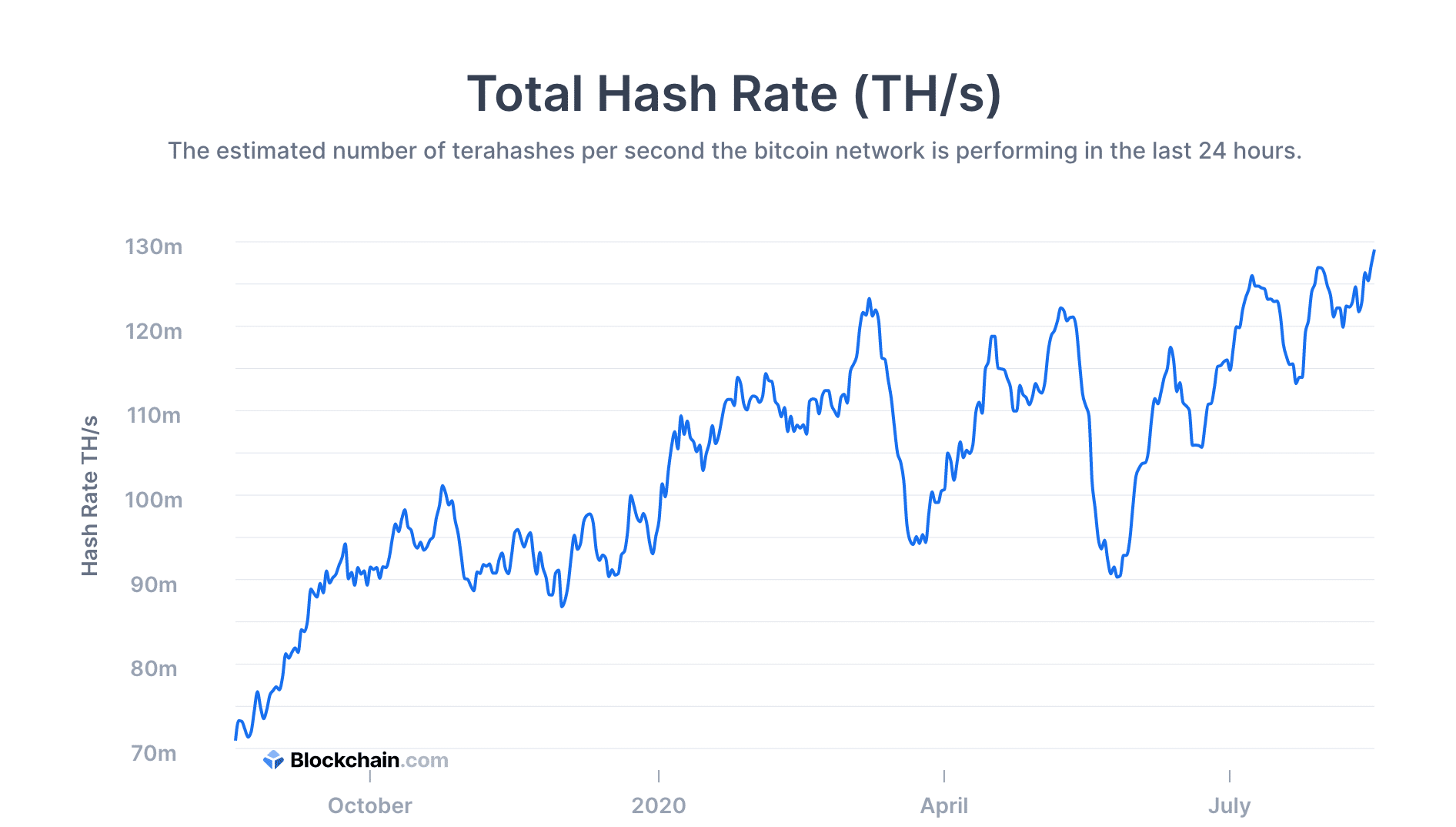
Indeed, citing data from Blockchian.com, CoinTelegraph reported that as of August 15th, Bitcoin’s seven-day average hash rate hit 129.075 TeraHash/second (TH/s). The previous all-time high of 126.91 TH/s was reached on July 29th.
A Rising Hash Rate Could Indicate a Coming Rise in the Price of BTC
Hash rate is a measurement of how much computing power is being used on a Blockchain at any given time. While there isn’t a direct correlation between a network’s hash rate and the price of its cryptocurrency, some analysts believe that a rising hash rate is indicative of a rising price to come.
This is because an increase in hash rate may signify an influx of new miners, or at least, more mining equipment onto the Bitcoin network, presumably because miners believe that they can make a profit.
A higher hash rate could also suggest that existing miners have more faith in an asset’s profitability. In other words, the entities that are spending money and resources to put the hash power into the network believe that their endeavors will be profitable, and therefore, they will continue to spend.
For example, earlier this year, Jeremy Britton, the chief financial officer at Boston Trading Co., explained to Finance Magnates that increased mining costs on the Bitcoin network mean that miners will hold onto their coins until higher price levels are reached, increasing the Bitcoin price 'floor'.
Jeremy Britton, chief financial officer at Boston Trading Co.
“As with mining any scarce resource (e.g. silver or gold), if mining becomes more difficult or more expensive, the price of the underlying asset will increase,” he said.
Before May’s halving, Britton explained that it costs roughly $3,000 “just in electricity to mine a single bitcoin (notwithstanding the cost of hardware, and internet access). This is why, when BTC ‘crashed’ earlier in 2019, the price did not go below $3,000; miners did not wish to sell for a loss.”
Now that the halving has taken place, however, “the price to mine a single bitcoin [has increased] to a minimum of $6,000. Whatever the new ceiling is, the floor will be $6,000, as miners will refuse to sell for a loss.”
The price of Bitcoin has been struggling to mount the $12,000 resistance level for roughly three weeks since it surpassed $10,000 on July 27th. However, as pressure below the $12,000 level has continued to build, its seven-day average Hash Rate has reached a new all-time high.
Indeed, citing data from Blockchian.com, CoinTelegraph reported that as of August 15th, Bitcoin’s seven-day average hash rate hit 129.075 TeraHash/second (TH/s). The previous all-time high of 126.91 TH/s was reached on July 29th.
A Rising Hash Rate Could Indicate a Coming Rise in the Price of BTC
Hash rate is a measurement of how much computing power is being used on a Blockchain at any given time. While there isn’t a direct correlation between a network’s hash rate and the price of its cryptocurrency, some analysts believe that a rising hash rate is indicative of a rising price to come.
This is because an increase in hash rate may signify an influx of new miners, or at least, more mining equipment onto the Bitcoin network, presumably because miners believe that they can make a profit.
A higher hash rate could also suggest that existing miners have more faith in an asset’s profitability. In other words, the entities that are spending money and resources to put the hash power into the network believe that their endeavors will be profitable, and therefore, they will continue to spend.
For example, earlier this year, Jeremy Britton, the chief financial officer at Boston Trading Co., explained to Finance Magnates that increased mining costs on the Bitcoin network mean that miners will hold onto their coins until higher price levels are reached, increasing the Bitcoin price 'floor'.
Jeremy Britton, chief financial officer at Boston Trading Co.
“As with mining any scarce resource (e.g. silver or gold), if mining becomes more difficult or more expensive, the price of the underlying asset will increase,” he said.
Before May’s halving, Britton explained that it costs roughly $3,000 “just in electricity to mine a single bitcoin (notwithstanding the cost of hardware, and internet access). This is why, when BTC ‘crashed’ earlier in 2019, the price did not go below $3,000; miners did not wish to sell for a loss.”
Now that the halving has taken place, however, “the price to mine a single bitcoin [has increased] to a minimum of $6,000. Whatever the new ceiling is, the floor will be $6,000, as miners will refuse to sell for a loss.”
Rachel is a self-taught crypto geek and a passionate writer. She believes in the power that the written word has to educate, connect and empower individuals to make positive and powerful financial choices. She is the Podcast Host and a Cryptocurrency Editor at Finance Magnates.
Crypto Built More Rails, but the Next Battle Is Over How Much Work a Dollar Can Do
FP Markets Winner Spotlight 🏆 | Global Broker of the Year 2025 #Trading #Broker #Innovation #Shorts
FP Markets Winner Spotlight 🏆 | Global Broker of the Year 2025 #Trading #Broker #Innovation #Shorts
FP Markets takes the spotlight as Global Broker of the Year 2025 at the Finance Magnates Awards.
Martin Stoilov, Head of Client Experience, shares that trust, innovation, and people played a key role in the company’s success, supported by a strong foundation of integrity and client-centricity.
Following this milestone, FP Markets continues to focus on growth, technology investment, and its core values of transparency and excellence.
👉 Be part of FM Awards 2026: https://awards.financemagnates.com/#nominate
FP Markets takes the spotlight as Global Broker of the Year 2025 at the Finance Magnates Awards.
Martin Stoilov, Head of Client Experience, shares that trust, innovation, and people played a key role in the company’s success, supported by a strong foundation of integrity and client-centricity.
Following this milestone, FP Markets continues to focus on growth, technology investment, and its core values of transparency and excellence.
👉 Be part of FM Awards 2026: https://awards.financemagnates.com/#nominate
In this video, we review @HolaPrimeMarketsOfficial, a multi-asset forex and CFDs broker offering different account types, trading platforms, and flexible trading conditions.
We cover the broker’s overall offering, including account options, trading environment, platforms like MT4 and MT5, and additional services such as managed accounts and fast withdrawals.
Watch the full video to see if Hola Prime Markets fits your trading needs.
📣 Stay up to date with the latest in finance and trading. Follow Finance Magnates for industry news, insights, and global event coverage.
Connect with us:
🔗 LinkedIn: /financemagnates
👍 Facebook: /financemagnates
📸 Instagram: https://www.instagram.com/financemagnates
🐦 X: https://x.com/financemagnates
🎥 TikTok: https://www.tiktok.com/tag/financemagnates
▶️ YouTube: /@financemagnates_official
#HolaPrime #ForexBroker #CFDTrading #FinanceMagnates #Trading #Forex #BrokerReview
In this video, we review @HolaPrimeMarketsOfficial, a multi-asset forex and CFDs broker offering different account types, trading platforms, and flexible trading conditions.
We cover the broker’s overall offering, including account options, trading environment, platforms like MT4 and MT5, and additional services such as managed accounts and fast withdrawals.
Watch the full video to see if Hola Prime Markets fits your trading needs.
📣 Stay up to date with the latest in finance and trading. Follow Finance Magnates for industry news, insights, and global event coverage.
Connect with us:
🔗 LinkedIn: /financemagnates
👍 Facebook: /financemagnates
📸 Instagram: https://www.instagram.com/financemagnates
🐦 X: https://x.com/financemagnates
🎥 TikTok: https://www.tiktok.com/tag/financemagnates
▶️ YouTube: /@financemagnates_official
#HolaPrime #ForexBroker #CFDTrading #FinanceMagnates #Trading #Forex #BrokerReview
Hola Prime Review: What You Need to Know | Full Breakdown by Finance Magnates
Hola Prime Review: What You Need to Know | Full Breakdown by Finance Magnates
In this video, we review @HolaPrime_Global, a proprietary trading firm offering evaluation programs and performance-based payouts in simulated market environments.
We cover how the challenge model works, including account types, profit splits (up to 95%), trading rules, and what it takes to reach a funded account. You’ll also learn about available platforms like MT4, MT5, cTrader, and more, along with insights into payouts, support, and trading conditions.
Watch the full video to see if Hola Prime fits your trading style.
📣 Stay up to date with the latest in finance and trading. Follow Finance Magnates for industry news, insights, and global event coverage.
Connect with us:
🔗 LinkedIn: /financemagnates
👍 Facebook: /financemagnates
📸 Instagram: https://www.instagram.com/financemagnates
🐦 X: https://x.com/financemagnates
🎥 TikTok: https://www.tiktok.com/tag/financemagnates
▶️ YouTube: /@financemagnates_official
#HolaPrime #PropFirm #Trading #FinanceMagnates #Forex #FuturesTrading #TradingReview #PropFirmReview
In this video, we review @HolaPrime_Global, a proprietary trading firm offering evaluation programs and performance-based payouts in simulated market environments.
We cover how the challenge model works, including account types, profit splits (up to 95%), trading rules, and what it takes to reach a funded account. You’ll also learn about available platforms like MT4, MT5, cTrader, and more, along with insights into payouts, support, and trading conditions.
Watch the full video to see if Hola Prime fits your trading style.
📣 Stay up to date with the latest in finance and trading. Follow Finance Magnates for industry news, insights, and global event coverage.
Connect with us:
🔗 LinkedIn: /financemagnates
👍 Facebook: /financemagnates
📸 Instagram: https://www.instagram.com/financemagnates
🐦 X: https://x.com/financemagnates
🎥 TikTok: https://www.tiktok.com/tag/financemagnates
▶️ YouTube: /@financemagnates_official
#HolaPrime #PropFirm #Trading #FinanceMagnates #Forex #FuturesTrading #TradingReview #PropFirmReview
Axi Winner Spotlight 🏆 | Global Most Innovative Broker 2025 #Innovation #Trading #Fintech #Broker
Axi Winner Spotlight 🏆 | Global Most Innovative Broker 2025 #Innovation #Trading #Fintech #Broker
Axi takes the spotlight at the Finance Magnates Awards, winning Global Most Innovative Broker 2025.
Olivia Xenofontos and Ivanna Openko share how the team will feel: proud, motivated, and ready to keep delivering.
They also describe the night as well-organized, focused, and enjoyable for all.
👉 Be part of FM Awards 2026.
Axi takes the spotlight at the Finance Magnates Awards, winning Global Most Innovative Broker 2025.
Olivia Xenofontos and Ivanna Openko share how the team will feel: proud, motivated, and ready to keep delivering.
They also describe the night as well-organized, focused, and enjoyable for all.
👉 Be part of FM Awards 2026.
Recognition that matters.
Built on transparency.
Driven by the industry.
The Finance Magnates Awards 2026.
Nominations are now open.
🔗 https://awards.financemagnates.com/?utm_source=SM&utm_medium=social&utm_campaign=recognition-matters
Recognition that matters.
Built on transparency.
Driven by the industry.
The Finance Magnates Awards 2026.
Nominations are now open.
🔗 https://awards.financemagnates.com/?utm_source=SM&utm_medium=social&utm_campaign=recognition-matters