I was looking at the charts and the setup I am currently seeing flashed back to a classic bubble chart that I showed my friends a couple of weeks ago. I was explaining them my theory on why they should be extremely cautious with their BTC holdings. They just told me that “this time it's different”, and reaffirmed my belief in this classic bubble theory. But let’s get back to Wall Street.
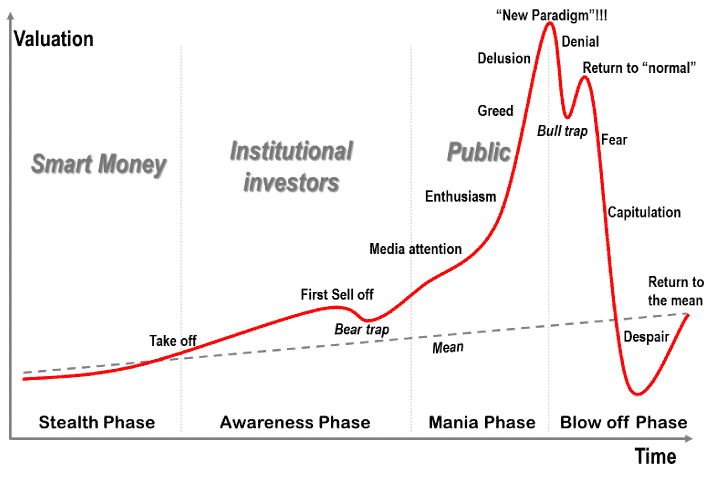
Classic Bubble Price Action. Source: Dr. Jean-Paul Rodrigue Dept. of Global Studies and Geography, Hofstra University
What is ‘Buy the Rumour, Sell the Fact’?
Experienced traders have an age-old adage in their minds - when you start hearing rumors about something big happening in a given market, start taking action based on those. The assumption here is that more frequently than not, the rumor mill knows something that you don't.
So after seeing the classic bubble chart, I thought, hey this looks quite familiar, and I don’t think my friends trading Bitcoin have seen something like it in their careers yet. (While it probably happened at least once in 2013-2014 already, they most likely weren't aware of Bitcoin at the time.)
The classic bubble scenario is to play the market so that you get the best possible entry price and the best possible exit price. If there are people in this world that know how to do this, they are either physically roaming the streets of New York, and Chicago, or nowadays are just digitally present all over the globe.
Wall Street Plays This Game Best
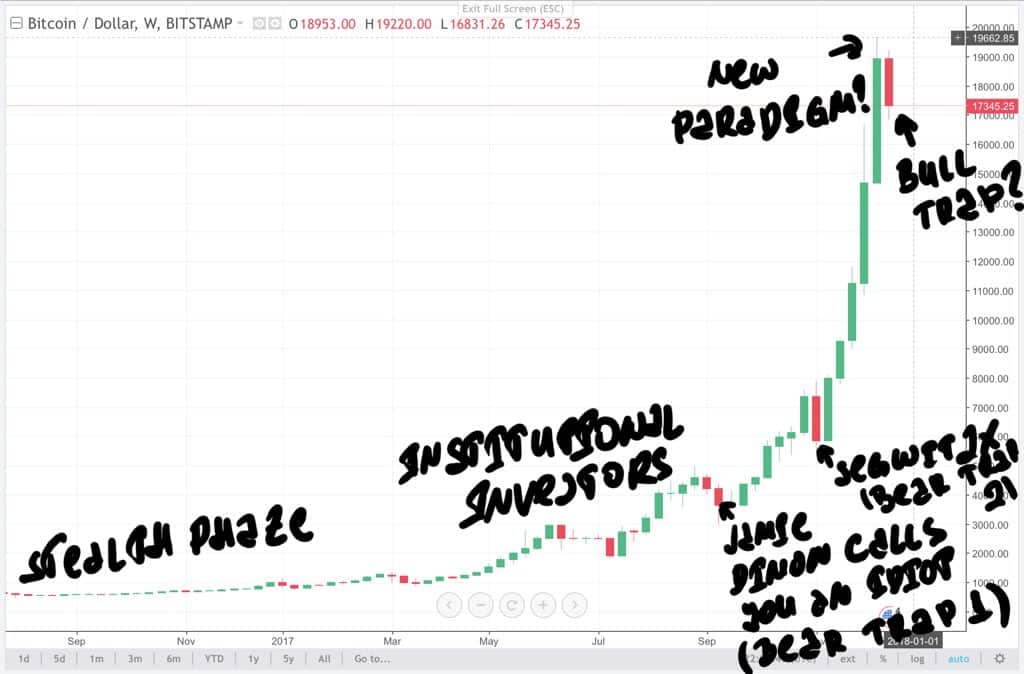
So how do you manage to enter at the right time and exit at the right time? Let’s see how it might be happening with Bitcoin. Suppose that the price of an asset class has doubled in three months. This is something that happened to Bitcoin at the start of the year, as confidence levels in digital currencies started briskly rising. Welcome to the ‘stealth phase’, the time when the so-called ‘smart money’ got into the market.
Roll forward another three months, and you start hearing some more noise. August comes, Bitcoin is getting forked, there is now another Bitcoin, you feel confused - what is going on? The fork passes, the price keeps rising, and adventurous institutional investors are starting to get interested. So they devise a plan (or it's all just coincidence): “It would be great if we had futures to trade this asset class,” they tell their favorite exchanges.
The exchanges start thinking about the commissions they could make if such a volatile asset class was offered for trading. Rumours that futures contracts become imminent.. but let’s pause for a bit. Here comes Jamie Dimon who point blank tells the nerds: “You are idiots if you think you can make money on Bitcoin.” And you get angry: “How dare you, Jamie Dimon, you evil CEO of a major Wall Street bank!”
So you start buying more.. and the price continues rising. By now many institutional investors have realized that futures contracts are imminent and the media noise is playing to their advantage as more and more small players are getting interested in divesting their savings.
Bitcoin weekly chart since August 2016. Source: Tradingview
A Brief Pause for a Breath of Fresh Air
Come November institutional investors have loaded up on Bitcoin. BTC millionaires are left and right on TV, shouting that BTC is undervalued at $10,000...
The financial media plays the game and keeps paying more and more attention to a once-obscure asset class. Before you know it, more than half of the shows on financial TV are giving Bitcoin 90% of their airtime.
But let’s roll back again: it’s the beginning of November, and the SegWit2x fork is upon us. We’ve been here before, not a big deal - we saw how it happened in August. But wait, there is a massive dip that lasts 24-36 hours. Bitcoin Cash is king.. for a day! That was close; Bitcoin survived it, this is it, it's time to buy again.
Here we are in December. Everybody knows that two Chicago-based exchanges are going to start offering Bitcoin. And both contracts begin trading at a premium. There are way more buyers of cash-settled index contracts than sellers. But this doesn’t matter to the price of Bitcoin which is set on crypto exchanges.
While the deals on those are affecting the price on the CBOT and the CME, no amount of money changing hands in these contracts will influence the price on Coinbase, Bitstamp or Kraken. That's because the owners of the futures contracts are never forced to do any business on the crypto exchange and settle their debt by paying a Bitcoin. They simply pay the difference in cash.
There is one significant and new aspect of the market though. You can now short Bitcoin. After months of one-sided moves, no sane person would do that, right? Except if you are an institutional investor that has been buying physical Bitcoin and is now willing to hedge the position to manage some of the risks… or all of them. What happens to the futures market if those institutional investors start unloading BTC on crypto exchanges? You guessed it right; they could make double the profits by taking a roundtrip on the roller coaster train.
And here we are today again. Bitcoin tanked 10 percent for a brief period and here come the Asian buyers to save the day. Will they manage to prop it up to $20,000 again? I don’t know. I just wanted to share my thoughts with you about the recent price action and hear your opinion if the above makes any sense to you.
I was looking at the charts and the setup I am currently seeing flashed back to a classic bubble chart that I showed my friends a couple of weeks ago. I was explaining them my theory on why they should be extremely cautious with their BTC holdings. They just told me that “this time it's different”, and reaffirmed my belief in this classic bubble theory. But let’s get back to Wall Street.
Classic Bubble Price Action. Source: Dr. Jean-Paul Rodrigue Dept. of Global Studies and Geography, Hofstra University
What is ‘Buy the Rumour, Sell the Fact’?
Experienced traders have an age-old adage in their minds - when you start hearing rumors about something big happening in a given market, start taking action based on those. The assumption here is that more frequently than not, the rumor mill knows something that you don't.
So after seeing the classic bubble chart, I thought, hey this looks quite familiar, and I don’t think my friends trading Bitcoin have seen something like it in their careers yet. (While it probably happened at least once in 2013-2014 already, they most likely weren't aware of Bitcoin at the time.)
The classic bubble scenario is to play the market so that you get the best possible entry price and the best possible exit price. If there are people in this world that know how to do this, they are either physically roaming the streets of New York, and Chicago, or nowadays are just digitally present all over the globe.
Wall Street Plays This Game Best
So how do you manage to enter at the right time and exit at the right time? Let’s see how it might be happening with Bitcoin. Suppose that the price of an asset class has doubled in three months. This is something that happened to Bitcoin at the start of the year, as confidence levels in digital currencies started briskly rising. Welcome to the ‘stealth phase’, the time when the so-called ‘smart money’ got into the market.
Roll forward another three months, and you start hearing some more noise. August comes, Bitcoin is getting forked, there is now another Bitcoin, you feel confused - what is going on? The fork passes, the price keeps rising, and adventurous institutional investors are starting to get interested. So they devise a plan (or it's all just coincidence): “It would be great if we had futures to trade this asset class,” they tell their favorite exchanges.
The exchanges start thinking about the commissions they could make if such a volatile asset class was offered for trading. Rumours that futures contracts become imminent.. but let’s pause for a bit. Here comes Jamie Dimon who point blank tells the nerds: “You are idiots if you think you can make money on Bitcoin.” And you get angry: “How dare you, Jamie Dimon, you evil CEO of a major Wall Street bank!”
So you start buying more.. and the price continues rising. By now many institutional investors have realized that futures contracts are imminent and the media noise is playing to their advantage as more and more small players are getting interested in divesting their savings.
Bitcoin weekly chart since August 2016. Source: Tradingview
A Brief Pause for a Breath of Fresh Air
Come November institutional investors have loaded up on Bitcoin. BTC millionaires are left and right on TV, shouting that BTC is undervalued at $10,000...
The financial media plays the game and keeps paying more and more attention to a once-obscure asset class. Before you know it, more than half of the shows on financial TV are giving Bitcoin 90% of their airtime.
But let’s roll back again: it’s the beginning of November, and the SegWit2x fork is upon us. We’ve been here before, not a big deal - we saw how it happened in August. But wait, there is a massive dip that lasts 24-36 hours. Bitcoin Cash is king.. for a day! That was close; Bitcoin survived it, this is it, it's time to buy again.
Here we are in December. Everybody knows that two Chicago-based exchanges are going to start offering Bitcoin. And both contracts begin trading at a premium. There are way more buyers of cash-settled index contracts than sellers. But this doesn’t matter to the price of Bitcoin which is set on crypto exchanges.
While the deals on those are affecting the price on the CBOT and the CME, no amount of money changing hands in these contracts will influence the price on Coinbase, Bitstamp or Kraken. That's because the owners of the futures contracts are never forced to do any business on the crypto exchange and settle their debt by paying a Bitcoin. They simply pay the difference in cash.
There is one significant and new aspect of the market though. You can now short Bitcoin. After months of one-sided moves, no sane person would do that, right? Except if you are an institutional investor that has been buying physical Bitcoin and is now willing to hedge the position to manage some of the risks… or all of them. What happens to the futures market if those institutional investors start unloading BTC on crypto exchanges? You guessed it right; they could make double the profits by taking a roundtrip on the roller coaster train.
And here we are today again. Bitcoin tanked 10 percent for a brief period and here come the Asian buyers to save the day. Will they manage to prop it up to $20,000 again? I don’t know. I just wanted to share my thoughts with you about the recent price action and hear your opinion if the above makes any sense to you.
Moomoo Adds Crossover’s Crypto Execution Network for US Retail Traders
Featured Videos
AvaTrade to Acquire Most of FXCM; NAGA Raises $8M
AvaTrade to Acquire Most of FXCM; NAGA Raises $8M
AvaTrade to Acquire Most of FXCM; NAGA Raises $8M
AvaTrade to Acquire Most of FXCM; NAGA Raises $8M
Today’s financial news recap covers AvaTrade agrees to acquire most of FXCM, NAGA secures eight million dollars in new financing, and Wise seeks a tax settlement in the UK.
Finance Magnates Daily Recap brings you the latest news from forex and CFD brokers, fintech, payments, cryptocurrency, digital assets, trading platforms, financial regulation and global markets.
Get the key company news, executive moves, deals, regulatory updates and market developments of the day, in just a few minutes. New episodes published every weekday.
Read more: https://www.financemagnates.com
#FinanceMagnates #ForexNews #FintechNews
Today’s financial news recap covers AvaTrade agrees to acquire most of FXCM, NAGA secures eight million dollars in new financing, and Wise seeks a tax settlement in the UK.
Finance Magnates Daily Recap brings you the latest news from forex and CFD brokers, fintech, payments, cryptocurrency, digital assets, trading platforms, financial regulation and global markets.
Get the key company news, executive moves, deals, regulatory updates and market developments of the day, in just a few minutes. New episodes published every weekday.
Read more: https://www.financemagnates.com
#FinanceMagnates #ForexNews #FintechNews
Today’s financial news recap covers AvaTrade agrees to acquire most of FXCM, NAGA secures eight million dollars in new financing, and Wise seeks a tax settlement in the UK.
Finance Magnates Daily Recap brings you the latest news from forex and CFD brokers, fintech, payments, cryptocurrency, digital assets, trading platforms, financial regulation and global markets.
Get the key company news, executive moves, deals, regulatory updates and market developments of the day, in just a few minutes. New episodes published every weekday.
Read more: https://www.financemagnates.com
#FinanceMagnates #ForexNews #FintechNews
Today’s financial news recap covers AvaTrade agrees to acquire most of FXCM, NAGA secures eight million dollars in new financing, and Wise seeks a tax settlement in the UK.
Finance Magnates Daily Recap brings you the latest news from forex and CFD brokers, fintech, payments, cryptocurrency, digital assets, trading platforms, financial regulation and global markets.
Get the key company news, executive moves, deals, regulatory updates and market developments of the day, in just a few minutes. New episodes published every weekday.
Read more: https://www.financemagnates.com
#FinanceMagnates #ForexNews #FintechNews
XTB Adds Overnight US Stock Trading; Nasdaq Ventures Invests in One Trading
XTB Adds Overnight US Stock Trading; Nasdaq Ventures Invests in One Trading
XTB Adds Overnight US Stock Trading; Nasdaq Ventures Invests in One Trading
XTB Adds Overnight US Stock Trading; Nasdaq Ventures Invests in One Trading
XTB Adds Overnight US Stock Trading; Nasdaq Ventures Invests in One Trading
XTB Adds Overnight US Stock Trading; Nasdaq Ventures Invests in One Trading
Today’s financial news recap covers XTB expands overnight US stock trading, Fortrade reports higher revenue, Nasdaq backs One Trading, and Vest Labs raises 13 million dollars.
Finance Magnates Daily Recap brings you the latest news from forex and CFD brokers, fintech, payments, cryptocurrency, digital assets, trading platforms, financial regulation and global markets.
Get the key company news, executive moves, deals, regulatory updates and market developments of the day, in just a few minutes. New episodes published every weekday.
Read more: https://www.financemagnates.com
#FinanceMagnates #ForexNews #FintechNews
Today’s financial news recap covers XTB expands overnight US stock trading, Fortrade reports higher revenue, Nasdaq backs One Trading, and Vest Labs raises 13 million dollars.
Finance Magnates Daily Recap brings you the latest news from forex and CFD brokers, fintech, payments, cryptocurrency, digital assets, trading platforms, financial regulation and global markets.
Get the key company news, executive moves, deals, regulatory updates and market developments of the day, in just a few minutes. New episodes published every weekday.
Read more: https://www.financemagnates.com
#FinanceMagnates #ForexNews #FintechNews
Today’s financial news recap covers XTB expands overnight US stock trading, Fortrade reports higher revenue, Nasdaq backs One Trading, and Vest Labs raises 13 million dollars.
Finance Magnates Daily Recap brings you the latest news from forex and CFD brokers, fintech, payments, cryptocurrency, digital assets, trading platforms, financial regulation and global markets.
Get the key company news, executive moves, deals, regulatory updates and market developments of the day, in just a few minutes. New episodes published every weekday.
Read more: https://www.financemagnates.com
#FinanceMagnates #ForexNews #FintechNews
Today’s financial news recap covers XTB expands overnight US stock trading, Fortrade reports higher revenue, Nasdaq backs One Trading, and Vest Labs raises 13 million dollars.
Finance Magnates Daily Recap brings you the latest news from forex and CFD brokers, fintech, payments, cryptocurrency, digital assets, trading platforms, financial regulation and global markets.
Get the key company news, executive moves, deals, regulatory updates and market developments of the day, in just a few minutes. New episodes published every weekday.
Read more: https://www.financemagnates.com
#FinanceMagnates #ForexNews #FintechNews
Today’s financial news recap covers XTB expands overnight US stock trading, Fortrade reports higher revenue, Nasdaq backs One Trading, and Vest Labs raises 13 million dollars.
Finance Magnates Daily Recap brings you the latest news from forex and CFD brokers, fintech, payments, cryptocurrency, digital assets, trading platforms, financial regulation and global markets.
Get the key company news, executive moves, deals, regulatory updates and market developments of the day, in just a few minutes. New episodes published every weekday.
Read more: https://www.financemagnates.com
#FinanceMagnates #ForexNews #FintechNews
Today’s financial news recap covers XTB expands overnight US stock trading, Fortrade reports higher revenue, Nasdaq backs One Trading, and Vest Labs raises 13 million dollars.
Finance Magnates Daily Recap brings you the latest news from forex and CFD brokers, fintech, payments, cryptocurrency, digital assets, trading platforms, financial regulation and global markets.
Get the key company news, executive moves, deals, regulatory updates and market developments of the day, in just a few minutes. New episodes published every weekday.
Read more: https://www.financemagnates.com
#FinanceMagnates #ForexNews #FintechNews
CMC Founder Downplays Volatility Hit; Devexperts Names CEO
CMC Founder Downplays Volatility Hit; Devexperts Names CEO
CMC Founder Downplays Volatility Hit; Devexperts Names CEO
CMC Founder Downplays Volatility Hit; Devexperts Names CEO
CMC Founder Downplays Volatility Hit; Devexperts Names CEO
CMC Founder Downplays Volatility Hit; Devexperts Names CEO
Today’s financial news recap covers low volatility pressures brokers, Devexperts names a new CEO, Saxo cuts onboarding time, and OKX reaches a 25 billion dollar valuation.
Finance Magnates Daily Recap brings you the latest news from forex and CFD brokers, fintech, payments, cryptocurrency, digital assets, trading platforms, financial regulation and global markets.
Get the key company news, executive moves, deals, regulatory updates and market developments of the day, in just a few minutes. New episodes published every weekday.
Read more: https://www.financemagnates.com
#FinanceMagnates #ForexNews #FintechNews
Today’s financial news recap covers low volatility pressures brokers, Devexperts names a new CEO, Saxo cuts onboarding time, and OKX reaches a 25 billion dollar valuation.
Finance Magnates Daily Recap brings you the latest news from forex and CFD brokers, fintech, payments, cryptocurrency, digital assets, trading platforms, financial regulation and global markets.
Get the key company news, executive moves, deals, regulatory updates and market developments of the day, in just a few minutes. New episodes published every weekday.
Read more: https://www.financemagnates.com
#FinanceMagnates #ForexNews #FintechNews
Today’s financial news recap covers low volatility pressures brokers, Devexperts names a new CEO, Saxo cuts onboarding time, and OKX reaches a 25 billion dollar valuation.
Finance Magnates Daily Recap brings you the latest news from forex and CFD brokers, fintech, payments, cryptocurrency, digital assets, trading platforms, financial regulation and global markets.
Get the key company news, executive moves, deals, regulatory updates and market developments of the day, in just a few minutes. New episodes published every weekday.
Read more: https://www.financemagnates.com
#FinanceMagnates #ForexNews #FintechNews
Today’s financial news recap covers low volatility pressures brokers, Devexperts names a new CEO, Saxo cuts onboarding time, and OKX reaches a 25 billion dollar valuation.
Finance Magnates Daily Recap brings you the latest news from forex and CFD brokers, fintech, payments, cryptocurrency, digital assets, trading platforms, financial regulation and global markets.
Get the key company news, executive moves, deals, regulatory updates and market developments of the day, in just a few minutes. New episodes published every weekday.
Read more: https://www.financemagnates.com
#FinanceMagnates #ForexNews #FintechNews
Today’s financial news recap covers low volatility pressures brokers, Devexperts names a new CEO, Saxo cuts onboarding time, and OKX reaches a 25 billion dollar valuation.
Finance Magnates Daily Recap brings you the latest news from forex and CFD brokers, fintech, payments, cryptocurrency, digital assets, trading platforms, financial regulation and global markets.
Get the key company news, executive moves, deals, regulatory updates and market developments of the day, in just a few minutes. New episodes published every weekday.
Read more: https://www.financemagnates.com
#FinanceMagnates #ForexNews #FintechNews
Today’s financial news recap covers low volatility pressures brokers, Devexperts names a new CEO, Saxo cuts onboarding time, and OKX reaches a 25 billion dollar valuation.
Finance Magnates Daily Recap brings you the latest news from forex and CFD brokers, fintech, payments, cryptocurrency, digital assets, trading platforms, financial regulation and global markets.
Get the key company news, executive moves, deals, regulatory updates and market developments of the day, in just a few minutes. New episodes published every weekday.
Read more: https://www.financemagnates.com
#FinanceMagnates #ForexNews #FintechNews
Today’s financial news recap covers Trade Nation buys FXCM's UK client book, Trading 212 reports higher revenue, the CFTC's move to allow perpetual index futures.
Finance Magnates Daily Recap brings you the latest news from forex and CFD brokers, fintech, payments, cryptocurrency, digital assets, trading platforms, financial regulation and global markets.
Get the key company news, executive moves, deals, regulatory updates and market developments of the day, in just a few minutes. New episodes published every weekday.
Read more: https://www.financemagnates.com
#FinanceMagnates #ForexNews #FintechNews
Today’s financial news recap covers Trade Nation buys FXCM's UK client book, Trading 212 reports higher revenue, the CFTC's move to allow perpetual index futures.
Finance Magnates Daily Recap brings you the latest news from forex and CFD brokers, fintech, payments, cryptocurrency, digital assets, trading platforms, financial regulation and global markets.
Get the key company news, executive moves, deals, regulatory updates and market developments of the day, in just a few minutes. New episodes published every weekday.
Read more: https://www.financemagnates.com
#FinanceMagnates #ForexNews #FintechNews
Today’s financial news recap covers Trade Nation buys FXCM's UK client book, Trading 212 reports higher revenue, the CFTC's move to allow perpetual index futures.
Finance Magnates Daily Recap brings you the latest news from forex and CFD brokers, fintech, payments, cryptocurrency, digital assets, trading platforms, financial regulation and global markets.
Get the key company news, executive moves, deals, regulatory updates and market developments of the day, in just a few minutes. New episodes published every weekday.
Read more: https://www.financemagnates.com
#FinanceMagnates #ForexNews #FintechNews
Today’s financial news recap covers Trade Nation buys FXCM's UK client book, Trading 212 reports higher revenue, the CFTC's move to allow perpetual index futures.
Finance Magnates Daily Recap brings you the latest news from forex and CFD brokers, fintech, payments, cryptocurrency, digital assets, trading platforms, financial regulation and global markets.
Get the key company news, executive moves, deals, regulatory updates and market developments of the day, in just a few minutes. New episodes published every weekday.
Read more: https://www.financemagnates.com
#FinanceMagnates #ForexNews #FintechNews
Today’s financial news recap covers Trade Nation buys FXCM's UK client book, Trading 212 reports higher revenue, the CFTC's move to allow perpetual index futures.
Finance Magnates Daily Recap brings you the latest news from forex and CFD brokers, fintech, payments, cryptocurrency, digital assets, trading platforms, financial regulation and global markets.
Get the key company news, executive moves, deals, regulatory updates and market developments of the day, in just a few minutes. New episodes published every weekday.
Read more: https://www.financemagnates.com
#FinanceMagnates #ForexNews #FintechNews
Today’s financial news recap covers Trade Nation buys FXCM's UK client book, Trading 212 reports higher revenue, the CFTC's move to allow perpetual index futures.
Finance Magnates Daily Recap brings you the latest news from forex and CFD brokers, fintech, payments, cryptocurrency, digital assets, trading platforms, financial regulation and global markets.
Get the key company news, executive moves, deals, regulatory updates and market developments of the day, in just a few minutes. New episodes published every weekday.
Read more: https://www.financemagnates.com
#FinanceMagnates #ForexNews #FintechNews
Your career isn’t a linear path.
Your career isn’t a linear path.
Your career isn’t a linear path.
Your career isn’t a linear path.
Your career isn’t a linear path.
Your career isn’t a linear path.
Roles change. Career goals change. Sometimes you want a completely new challenge.
But the skills and knowledge you build along the way can stay with you and give you something to build on.
For Jeff Patterson, that continued growth is key to long-term career development.
You bring the skills. FM Academy helps you build the knowledge.
#FMAcademy #FinanceMagnates #FinanceCareers #ProfessionalDevelopment #Fintech
Roles change. Career goals change. Sometimes you want a completely new challenge.
But the skills and knowledge you build along the way can stay with you and give you something to build on.
For Jeff Patterson, that continued growth is key to long-term career development.
You bring the skills. FM Academy helps you build the knowledge.
#FMAcademy #FinanceMagnates #FinanceCareers #ProfessionalDevelopment #Fintech
Roles change. Career goals change. Sometimes you want a completely new challenge.
But the skills and knowledge you build along the way can stay with you and give you something to build on.
For Jeff Patterson, that continued growth is key to long-term career development.
You bring the skills. FM Academy helps you build the knowledge.
#FMAcademy #FinanceMagnates #FinanceCareers #ProfessionalDevelopment #Fintech
Roles change. Career goals change. Sometimes you want a completely new challenge.
But the skills and knowledge you build along the way can stay with you and give you something to build on.
For Jeff Patterson, that continued growth is key to long-term career development.
You bring the skills. FM Academy helps you build the knowledge.
#FMAcademy #FinanceMagnates #FinanceCareers #ProfessionalDevelopment #Fintech
Roles change. Career goals change. Sometimes you want a completely new challenge.
But the skills and knowledge you build along the way can stay with you and give you something to build on.
For Jeff Patterson, that continued growth is key to long-term career development.
You bring the skills. FM Academy helps you build the knowledge.
#FMAcademy #FinanceMagnates #FinanceCareers #ProfessionalDevelopment #Fintech
Roles change. Career goals change. Sometimes you want a completely new challenge.
But the skills and knowledge you build along the way can stay with you and give you something to build on.
For Jeff Patterson, that continued growth is key to long-term career development.
You bring the skills. FM Academy helps you build the knowledge.
#FMAcademy #FinanceMagnates #FinanceCareers #ProfessionalDevelopment #Fintech