CeFi entities have experienced a nearly 1,000% increase in hacking incidents, including a $305 million breach at DMM Bitcoin, according to Cyvers.
WazirX sought a six-month moratorium after a $234 million hack in July affecting 45% of customer funds.
The year 2024 has recorded unprecedented losses in the
cybersecurity landscape. By the end of Q3, they reached $2.11 billion in total,
surpassing all the losses from 2023, Cyvers' report shows.
The year has witnessed a sharp increase in hacking
incidents. This highlights a growing threat landscape that necessitates immediate
attention, as shown by the significant breach of WazirX and DMM Bitcoin
exchange.
Cybersecurity Losses Surge
In the first three quarters of 2024, losses have already
exceeded the total for 2023. Key statistics illustrate this trend: from
January to September 2023, losses amounted to $1.23 billion, while the total
for January to December 2023 was $1.69 billion.
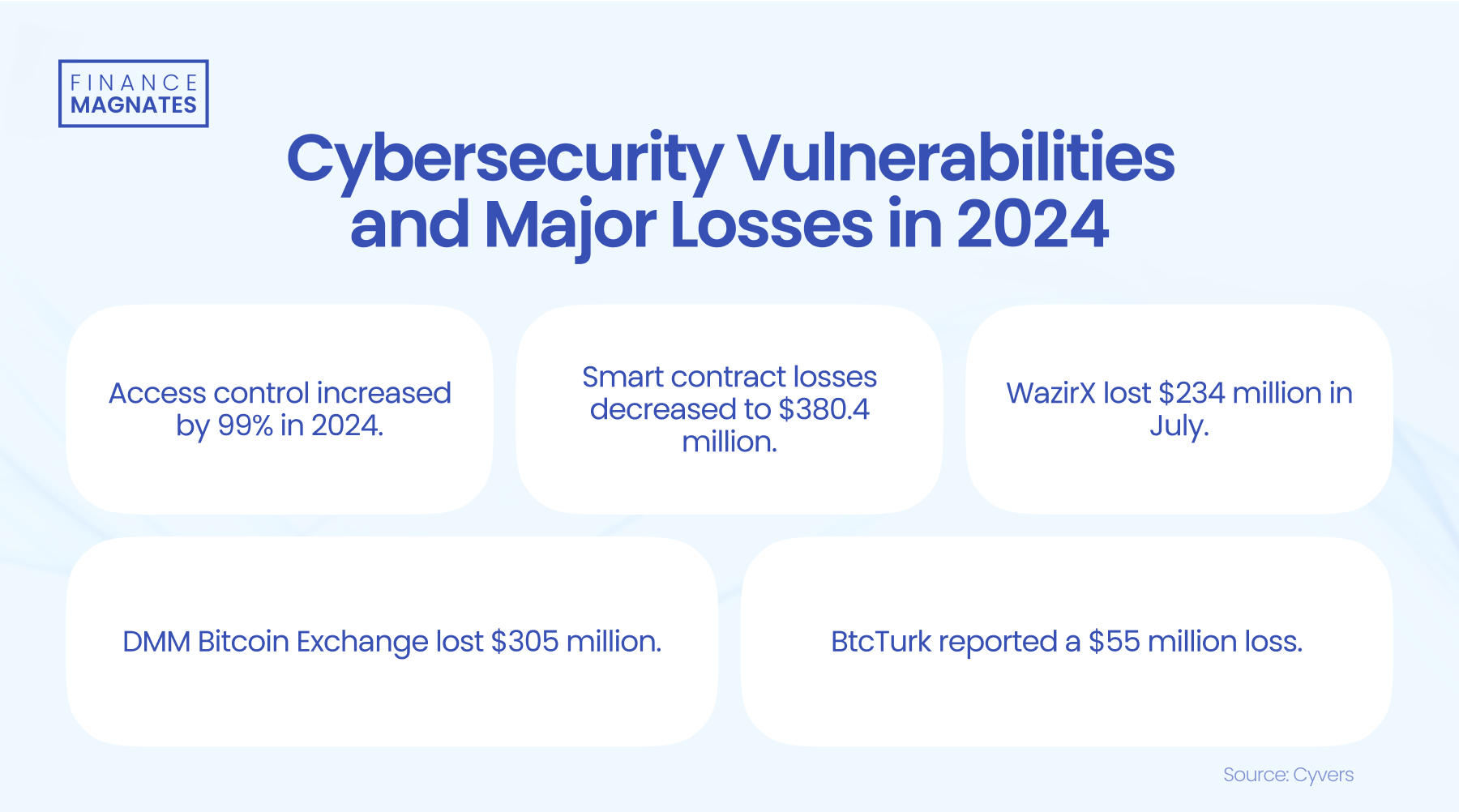
The losses from January to September 2024 represent an
approximately 72% increase compared to the same period in the previous year.
Additionally, hacking incidents in centralized finance (CeFi) entities have
surged by nearly 1,000%. Losses from wallet and custodian breaches have
almost doubled. Conversely, losses from decentralized finance (DeFi) platform
hacks have decreased by 25%.
CeFi Vulnerabilities: WazirX and DMM
CeFi platforms have experienced a dramatic rise in hacking
incidents. The year has seen a 984% year-on-year increase in hacks, driven
primarily by several high-profile attacks. In Q2 2024, centralized exchanges
reported losses of approximately $401 million due to five significant attacks.
The DMM Bitcoin exchange breach accounted for $305 million
of this total, marking it as one of the largest centralized exchange
breaches of the year. Other affected platforms included BtcTurk, Lykke, Rain
Exchange, and FixedFloat. This increase in vulnerabilities underscores the need
for improved access controls and regulatory oversight.
WazirX, which suffered a loss of $234 million in a July hack
affecting 45% of customer funds, initially sought a six-month moratorium. The
judge noted that WazirX acted in good faith by requesting the moratorium and
suggested that the exchange consider disclosing assets beyond its held tokens.
In contrast, DeFi platforms have shown a 25% reduction in
losses compared to Q2 2023, yet they continue to face substantial challenges.
During Q2 2024, they experienced losses of $171.3 million across 62
incidents.
The complexity of smart contracts and decentralized protocols leaves
these platforms vulnerable. Ethereum and BNB Chain remain the primary targets
for DeFi exploits, reflecting their extensive ecosystems.
The report highlights critical vulnerabilities affecting the
sector. Access control vulnerabilities from January to September 2023 totaled
$742.6 million, while for the same period in 2024, they reached $1.62 billion,
indicating a 99% increase.
The overall number of incidents also demonstrates concerning
trends. From January to September 2024, a total of 131 incidents were reported,
including 79 smart contract exploits and 51 access control violations. In
comparison, the same period in 2023 recorded 44 incidents, reflecting a 197%
surge in 2024. Specifically, smart contract exploits increased by 182%, and
access control violations rose by 218%.
To address these issues, the report outlines several
recommendations. There is a critical need to enhance cross-chain security
protocols, adopt real-time threat detection technologies, and evolve regulatory
frameworks to address emerging risks, including AI-driven attacks and quantum
computing vulnerabilities.
Furthermore, global regulatory bodies, such as
IOSCO, should prioritize real-time monitoring and incident response strategies to effectively combat the evolving nature of crypto-related crimes.
Improving Web3 Security Measures
The first three quarters of 2024 have seen a significant
rise in incidents across both centralized and decentralized platforms. CeFi
platforms in particular have been vulnerable, experiencing a notable increase
in high-profile attacks. While DeFi platforms have shown some resilience, they
still face ongoing threats.
Market participants opine that it is essential for
the industry to adopt proactive security measures and strengthen regulatory
oversight to mitigate future risks and foster a secure Web3 ecosystem.
The year 2024 has recorded unprecedented losses in the
cybersecurity landscape. By the end of Q3, they reached $2.11 billion in total,
surpassing all the losses from 2023, Cyvers' report shows.
The year has witnessed a sharp increase in hacking
incidents. This highlights a growing threat landscape that necessitates immediate
attention, as shown by the significant breach of WazirX and DMM Bitcoin
exchange.
Cybersecurity Losses Surge
In the first three quarters of 2024, losses have already
exceeded the total for 2023. Key statistics illustrate this trend: from
January to September 2023, losses amounted to $1.23 billion, while the total
for January to December 2023 was $1.69 billion.
The losses from January to September 2024 represent an
approximately 72% increase compared to the same period in the previous year.
Additionally, hacking incidents in centralized finance (CeFi) entities have
surged by nearly 1,000%. Losses from wallet and custodian breaches have
almost doubled. Conversely, losses from decentralized finance (DeFi) platform
hacks have decreased by 25%.
CeFi Vulnerabilities: WazirX and DMM
CeFi platforms have experienced a dramatic rise in hacking
incidents. The year has seen a 984% year-on-year increase in hacks, driven
primarily by several high-profile attacks. In Q2 2024, centralized exchanges
reported losses of approximately $401 million due to five significant attacks.
The DMM Bitcoin exchange breach accounted for $305 million
of this total, marking it as one of the largest centralized exchange
breaches of the year. Other affected platforms included BtcTurk, Lykke, Rain
Exchange, and FixedFloat. This increase in vulnerabilities underscores the need
for improved access controls and regulatory oversight.
WazirX, which suffered a loss of $234 million in a July hack
affecting 45% of customer funds, initially sought a six-month moratorium. The
judge noted that WazirX acted in good faith by requesting the moratorium and
suggested that the exchange consider disclosing assets beyond its held tokens.
In contrast, DeFi platforms have shown a 25% reduction in
losses compared to Q2 2023, yet they continue to face substantial challenges.
During Q2 2024, they experienced losses of $171.3 million across 62
incidents.
The complexity of smart contracts and decentralized protocols leaves
these platforms vulnerable. Ethereum and BNB Chain remain the primary targets
for DeFi exploits, reflecting their extensive ecosystems.
The report highlights critical vulnerabilities affecting the
sector. Access control vulnerabilities from January to September 2023 totaled
$742.6 million, while for the same period in 2024, they reached $1.62 billion,
indicating a 99% increase.
The overall number of incidents also demonstrates concerning
trends. From January to September 2024, a total of 131 incidents were reported,
including 79 smart contract exploits and 51 access control violations. In
comparison, the same period in 2023 recorded 44 incidents, reflecting a 197%
surge in 2024. Specifically, smart contract exploits increased by 182%, and
access control violations rose by 218%.
To address these issues, the report outlines several
recommendations. There is a critical need to enhance cross-chain security
protocols, adopt real-time threat detection technologies, and evolve regulatory
frameworks to address emerging risks, including AI-driven attacks and quantum
computing vulnerabilities.
Furthermore, global regulatory bodies, such as
IOSCO, should prioritize real-time monitoring and incident response strategies to effectively combat the evolving nature of crypto-related crimes.
Improving Web3 Security Measures
The first three quarters of 2024 have seen a significant
rise in incidents across both centralized and decentralized platforms. CeFi
platforms in particular have been vulnerable, experiencing a notable increase
in high-profile attacks. While DeFi platforms have shown some resilience, they
still face ongoing threats.
Market participants opine that it is essential for
the industry to adopt proactive security measures and strengthen regulatory
oversight to mitigate future risks and foster a secure Web3 ecosystem.
Coinbase Enters Prediction Markets as the Amazonification of Financial Platforms Gathers Pace
Featured Videos
Executive Interview | Charlotte Bullock | Chief Product Officer, Bank of London | FMLS:25
In this interview, we sat down with Charlotte Bullock, Head of Product at The Bank of London, previously at SAP and now shaping product at one of the sector’s most ambitious new banking players.
Charlotte reflects on the Summit so far and talks about the culture inside fintech banks today. We look at the pressures that come with scaling, and how firms can hold onto the nimble approach that made them stand out early on.
We also cover the state of payments ahead of her appearance on the payments roundtable: the blockages financial firms face, the areas that still need fixing, and what a realistic solution looks like in 2026.
In this interview, we sat down with Charlotte Bullock, Head of Product at The Bank of London, previously at SAP and now shaping product at one of the sector’s most ambitious new banking players.
Charlotte reflects on the Summit so far and talks about the culture inside fintech banks today. We look at the pressures that come with scaling, and how firms can hold onto the nimble approach that made them stand out early on.
We also cover the state of payments ahead of her appearance on the payments roundtable: the blockages financial firms face, the areas that still need fixing, and what a realistic solution looks like in 2026.
In this interview, we sat down with Charlotte Bullock, Head of Product at The Bank of London, previously at SAP and now shaping product at one of the sector’s most ambitious new banking players.
Charlotte reflects on the Summit so far and talks about the culture inside fintech banks today. We look at the pressures that come with scaling, and how firms can hold onto the nimble approach that made them stand out early on.
We also cover the state of payments ahead of her appearance on the payments roundtable: the blockages financial firms face, the areas that still need fixing, and what a realistic solution looks like in 2026.
In this interview, we sat down with Charlotte Bullock, Head of Product at The Bank of London, previously at SAP and now shaping product at one of the sector’s most ambitious new banking players.
Charlotte reflects on the Summit so far and talks about the culture inside fintech banks today. We look at the pressures that come with scaling, and how firms can hold onto the nimble approach that made them stand out early on.
We also cover the state of payments ahead of her appearance on the payments roundtable: the blockages financial firms face, the areas that still need fixing, and what a realistic solution looks like in 2026.
In this conversation, we sit down with Drew Niv, CSO at ATFX Connect and one of the most influential figures in modern FX.
We speak about market structure, the institutional view on liquidity, and the sharp rise of prop trading, a sector Drew has been commenting on in recent months. Drew explains why he once dismissed prop trading, why his view changed, and what he now thinks the model means for brokers, clients and risk managers.
We explore subscription-fee dependency, the high reneging rate, and the long-term challenge: how brokers can build a more stable and honest version of the model. Drew also talks about the traffic advantage standalone prop firms have built and why brokers may still win in the long run if they take the right approach.
In this conversation, we sit down with Drew Niv, CSO at ATFX Connect and one of the most influential figures in modern FX.
We speak about market structure, the institutional view on liquidity, and the sharp rise of prop trading, a sector Drew has been commenting on in recent months. Drew explains why he once dismissed prop trading, why his view changed, and what he now thinks the model means for brokers, clients and risk managers.
We explore subscription-fee dependency, the high reneging rate, and the long-term challenge: how brokers can build a more stable and honest version of the model. Drew also talks about the traffic advantage standalone prop firms have built and why brokers may still win in the long run if they take the right approach.
In this conversation, we sit down with Drew Niv, CSO at ATFX Connect and one of the most influential figures in modern FX.
We speak about market structure, the institutional view on liquidity, and the sharp rise of prop trading, a sector Drew has been commenting on in recent months. Drew explains why he once dismissed prop trading, why his view changed, and what he now thinks the model means for brokers, clients and risk managers.
We explore subscription-fee dependency, the high reneging rate, and the long-term challenge: how brokers can build a more stable and honest version of the model. Drew also talks about the traffic advantage standalone prop firms have built and why brokers may still win in the long run if they take the right approach.
In this conversation, we sit down with Drew Niv, CSO at ATFX Connect and one of the most influential figures in modern FX.
We speak about market structure, the institutional view on liquidity, and the sharp rise of prop trading, a sector Drew has been commenting on in recent months. Drew explains why he once dismissed prop trading, why his view changed, and what he now thinks the model means for brokers, clients and risk managers.
We explore subscription-fee dependency, the high reneging rate, and the long-term challenge: how brokers can build a more stable and honest version of the model. Drew also talks about the traffic advantage standalone prop firms have built and why brokers may still win in the long run if they take the right approach.
In this conversation, we sit down with Drew Niv, CSO at ATFX Connect and one of the most influential figures in modern FX.
We speak about market structure, the institutional view on liquidity, and the sharp rise of prop trading, a sector Drew has been commenting on in recent months. Drew explains why he once dismissed prop trading, why his view changed, and what he now thinks the model means for brokers, clients and risk managers.
We explore subscription-fee dependency, the high reneging rate, and the long-term challenge: how brokers can build a more stable and honest version of the model. Drew also talks about the traffic advantage standalone prop firms have built and why brokers may still win in the long run if they take the right approach.
In this conversation, we sit down with Drew Niv, CSO at ATFX Connect and one of the most influential figures in modern FX.
We speak about market structure, the institutional view on liquidity, and the sharp rise of prop trading, a sector Drew has been commenting on in recent months. Drew explains why he once dismissed prop trading, why his view changed, and what he now thinks the model means for brokers, clients and risk managers.
We explore subscription-fee dependency, the high reneging rate, and the long-term challenge: how brokers can build a more stable and honest version of the model. Drew also talks about the traffic advantage standalone prop firms have built and why brokers may still win in the long run if they take the right approach.
Executive Interview | Remonda Z. Kirketerp Møller| CEO & Founder Muinmos | FMLS:25
In this interview, Remonda Z. Kirketerp Møller, founder of Muinmos, breaks down the state of AI in regtech and what responsible adoption really looks like for brokers. We talk about rising fragmentation, the pressures around compliance accuracy, and why most firms are still in the early stages of AI maturity.
Ramanda also shares insights on regulator sandboxes, shifting expectations around accountability, and the current reality of MiCA licensing and passporting in Europe.
A concise look at where compliance, onboarding, and AI-driven processes are heading next.
In this interview, Remonda Z. Kirketerp Møller, founder of Muinmos, breaks down the state of AI in regtech and what responsible adoption really looks like for brokers. We talk about rising fragmentation, the pressures around compliance accuracy, and why most firms are still in the early stages of AI maturity.
Ramanda also shares insights on regulator sandboxes, shifting expectations around accountability, and the current reality of MiCA licensing and passporting in Europe.
A concise look at where compliance, onboarding, and AI-driven processes are heading next.
In this interview, Remonda Z. Kirketerp Møller, founder of Muinmos, breaks down the state of AI in regtech and what responsible adoption really looks like for brokers. We talk about rising fragmentation, the pressures around compliance accuracy, and why most firms are still in the early stages of AI maturity.
Ramanda also shares insights on regulator sandboxes, shifting expectations around accountability, and the current reality of MiCA licensing and passporting in Europe.
A concise look at where compliance, onboarding, and AI-driven processes are heading next.
In this interview, Remonda Z. Kirketerp Møller, founder of Muinmos, breaks down the state of AI in regtech and what responsible adoption really looks like for brokers. We talk about rising fragmentation, the pressures around compliance accuracy, and why most firms are still in the early stages of AI maturity.
Ramanda also shares insights on regulator sandboxes, shifting expectations around accountability, and the current reality of MiCA licensing and passporting in Europe.
A concise look at where compliance, onboarding, and AI-driven processes are heading next.
In this interview, Remonda Z. Kirketerp Møller, founder of Muinmos, breaks down the state of AI in regtech and what responsible adoption really looks like for brokers. We talk about rising fragmentation, the pressures around compliance accuracy, and why most firms are still in the early stages of AI maturity.
Ramanda also shares insights on regulator sandboxes, shifting expectations around accountability, and the current reality of MiCA licensing and passporting in Europe.
A concise look at where compliance, onboarding, and AI-driven processes are heading next.
In this interview, Remonda Z. Kirketerp Møller, founder of Muinmos, breaks down the state of AI in regtech and what responsible adoption really looks like for brokers. We talk about rising fragmentation, the pressures around compliance accuracy, and why most firms are still in the early stages of AI maturity.
Ramanda also shares insights on regulator sandboxes, shifting expectations around accountability, and the current reality of MiCA licensing and passporting in Europe.
A concise look at where compliance, onboarding, and AI-driven processes are heading next.
In this conversation, we speak with Aydin Bonabi, CEO and co-founder of Surveill, a firm focused on fraud detection and AI-driven compliance tools for financial institutions.
We start with Aydin’s view of the Summit and the challenges brokers face as fraud tactics grow more complex. He explains how firms can stay ahead through real-time signals, data patterns, and early-stage detection.
We also talk about AI training and why compliance teams often struggle to keep models accurate, fair, and aligned with regulatory expectations. Aydin breaks down what “good” AI training looks like inside a financial environment, including the importance of clean data, domain expertise, and human oversight.
He closes with a clear message: fraud is scaling, and so must the tools that stop it.
In this conversation, we speak with Aydin Bonabi, CEO and co-founder of Surveill, a firm focused on fraud detection and AI-driven compliance tools for financial institutions.
We start with Aydin’s view of the Summit and the challenges brokers face as fraud tactics grow more complex. He explains how firms can stay ahead through real-time signals, data patterns, and early-stage detection.
We also talk about AI training and why compliance teams often struggle to keep models accurate, fair, and aligned with regulatory expectations. Aydin breaks down what “good” AI training looks like inside a financial environment, including the importance of clean data, domain expertise, and human oversight.
He closes with a clear message: fraud is scaling, and so must the tools that stop it.
In this conversation, we speak with Aydin Bonabi, CEO and co-founder of Surveill, a firm focused on fraud detection and AI-driven compliance tools for financial institutions.
We start with Aydin’s view of the Summit and the challenges brokers face as fraud tactics grow more complex. He explains how firms can stay ahead through real-time signals, data patterns, and early-stage detection.
We also talk about AI training and why compliance teams often struggle to keep models accurate, fair, and aligned with regulatory expectations. Aydin breaks down what “good” AI training looks like inside a financial environment, including the importance of clean data, domain expertise, and human oversight.
He closes with a clear message: fraud is scaling, and so must the tools that stop it.
In this conversation, we speak with Aydin Bonabi, CEO and co-founder of Surveill, a firm focused on fraud detection and AI-driven compliance tools for financial institutions.
We start with Aydin’s view of the Summit and the challenges brokers face as fraud tactics grow more complex. He explains how firms can stay ahead through real-time signals, data patterns, and early-stage detection.
We also talk about AI training and why compliance teams often struggle to keep models accurate, fair, and aligned with regulatory expectations. Aydin breaks down what “good” AI training looks like inside a financial environment, including the importance of clean data, domain expertise, and human oversight.
He closes with a clear message: fraud is scaling, and so must the tools that stop it.
In this conversation, we speak with Aydin Bonabi, CEO and co-founder of Surveill, a firm focused on fraud detection and AI-driven compliance tools for financial institutions.
We start with Aydin’s view of the Summit and the challenges brokers face as fraud tactics grow more complex. He explains how firms can stay ahead through real-time signals, data patterns, and early-stage detection.
We also talk about AI training and why compliance teams often struggle to keep models accurate, fair, and aligned with regulatory expectations. Aydin breaks down what “good” AI training looks like inside a financial environment, including the importance of clean data, domain expertise, and human oversight.
He closes with a clear message: fraud is scaling, and so must the tools that stop it.
In this conversation, we speak with Aydin Bonabi, CEO and co-founder of Surveill, a firm focused on fraud detection and AI-driven compliance tools for financial institutions.
We start with Aydin’s view of the Summit and the challenges brokers face as fraud tactics grow more complex. He explains how firms can stay ahead through real-time signals, data patterns, and early-stage detection.
We also talk about AI training and why compliance teams often struggle to keep models accurate, fair, and aligned with regulatory expectations. Aydin breaks down what “good” AI training looks like inside a financial environment, including the importance of clean data, domain expertise, and human oversight.
He closes with a clear message: fraud is scaling, and so must the tools that stop it.
Exness expands its presence in Africa: Inside our interview with Paul Margarites in Cape Town
Finance Magnates met with Paul Margarites, Exness regional commercial director for Sub-Saharan Africa, during a visit to the firm’s office opening in Cape Town. In this talk, led by Andrea Badiola Mateos, Co-CEO at Finance Magnates, Paul shares views on the South African trading space, local user behavior, mobile trends, regulation, team growth, and how Exness plans to grow in more markets across the region. @Exness
Read the article at: https://www.financemagnates.com/thought-leadership/exness-expands-its-presence-in-africa-inside-our-interview-with-paul-margarites/
#exness #financemagnates #exnesstrading #CFDtrading #tradeonline #africanews #capetown
Finance Magnates met with Paul Margarites, Exness regional commercial director for Sub-Saharan Africa, during a visit to the firm’s office opening in Cape Town. In this talk, led by Andrea Badiola Mateos, Co-CEO at Finance Magnates, Paul shares views on the South African trading space, local user behavior, mobile trends, regulation, team growth, and how Exness plans to grow in more markets across the region. @Exness
Read the article at: https://www.financemagnates.com/thought-leadership/exness-expands-its-presence-in-africa-inside-our-interview-with-paul-margarites/
#exness #financemagnates #exnesstrading #CFDtrading #tradeonline #africanews #capetown
Finance Magnates met with Paul Margarites, Exness regional commercial director for Sub-Saharan Africa, during a visit to the firm’s office opening in Cape Town. In this talk, led by Andrea Badiola Mateos, Co-CEO at Finance Magnates, Paul shares views on the South African trading space, local user behavior, mobile trends, regulation, team growth, and how Exness plans to grow in more markets across the region. @Exness
Read the article at: https://www.financemagnates.com/thought-leadership/exness-expands-its-presence-in-africa-inside-our-interview-with-paul-margarites/
#exness #financemagnates #exnesstrading #CFDtrading #tradeonline #africanews #capetown
Finance Magnates met with Paul Margarites, Exness regional commercial director for Sub-Saharan Africa, during a visit to the firm’s office opening in Cape Town. In this talk, led by Andrea Badiola Mateos, Co-CEO at Finance Magnates, Paul shares views on the South African trading space, local user behavior, mobile trends, regulation, team growth, and how Exness plans to grow in more markets across the region. @Exness
Read the article at: https://www.financemagnates.com/thought-leadership/exness-expands-its-presence-in-africa-inside-our-interview-with-paul-margarites/
#exness #financemagnates #exnesstrading #CFDtrading #tradeonline #africanews #capetown
Finance Magnates met with Paul Margarites, Exness regional commercial director for Sub-Saharan Africa, during a visit to the firm’s office opening in Cape Town. In this talk, led by Andrea Badiola Mateos, Co-CEO at Finance Magnates, Paul shares views on the South African trading space, local user behavior, mobile trends, regulation, team growth, and how Exness plans to grow in more markets across the region. @Exness
Read the article at: https://www.financemagnates.com/thought-leadership/exness-expands-its-presence-in-africa-inside-our-interview-with-paul-margarites/
#exness #financemagnates #exnesstrading #CFDtrading #tradeonline #africanews #capetown
Finance Magnates met with Paul Margarites, Exness regional commercial director for Sub-Saharan Africa, during a visit to the firm’s office opening in Cape Town. In this talk, led by Andrea Badiola Mateos, Co-CEO at Finance Magnates, Paul shares views on the South African trading space, local user behavior, mobile trends, regulation, team growth, and how Exness plans to grow in more markets across the region. @Exness
Read the article at: https://www.financemagnates.com/thought-leadership/exness-expands-its-presence-in-africa-inside-our-interview-with-paul-margarites/
#exness #financemagnates #exnesstrading #CFDtrading #tradeonline #africanews #capetown