The exchange updated its IPO offer with 15.18 million shares at $28 each.
Gemini shares are expected to debut on Nasdaq on Friday.
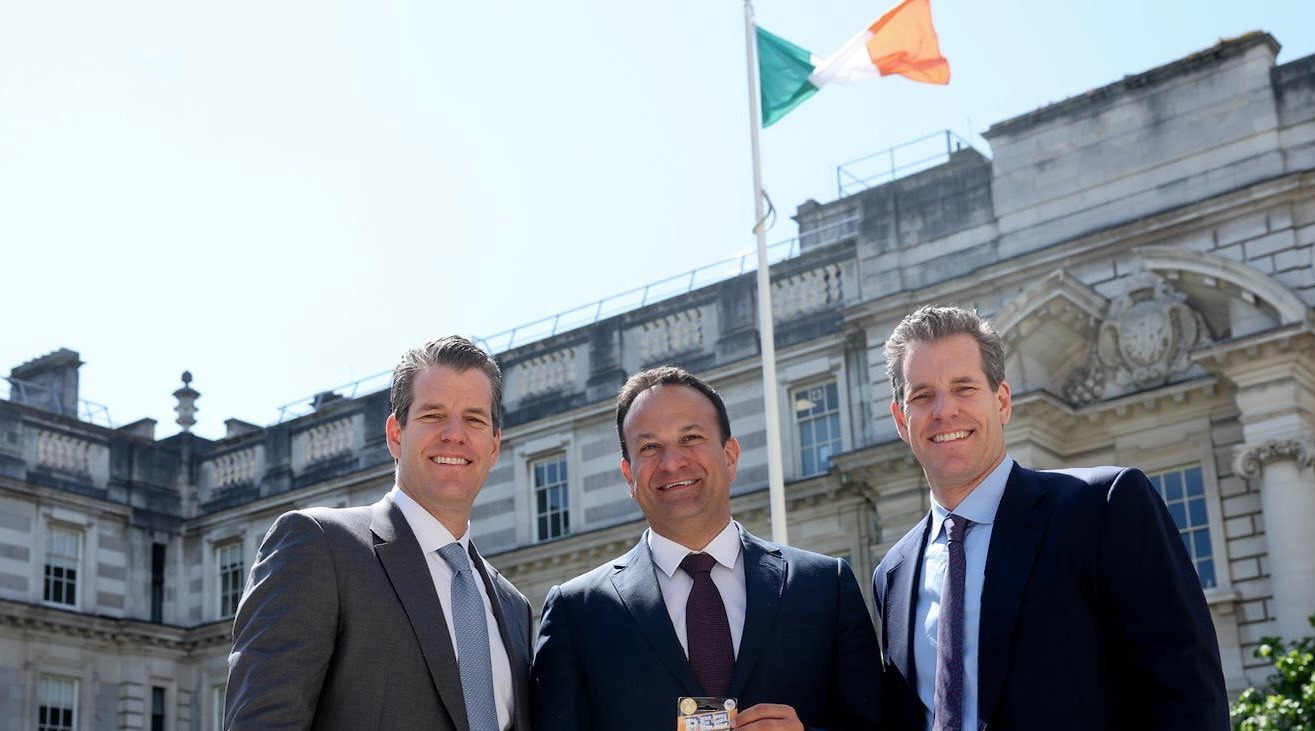
Winklevoss Brothers and Irish Prime Minister. Source: Gemini
The initial public offering (IPO) of Gemini, the crypto exchange founded by the Winklevoss twins, has been oversubscribed 20 times, Reuters reported. Further, the exchange and its bankers decided to cap the IPO proceeds at $425 million, which is unusual.
IPO Offer Revised
Gemini initially planned to raise $317 million at a valuation of about $2.22 billion. The company first planned to offer 16.67 million shares priced between $17 and $19 each, but then received an offer price between $24 and $26 each.
Following high demand, the company again increased its IPO offer price yesterday (Thursday) to $28 per share, but lowered the number of offered shares to 15.18 million. This also explains reported the IPO cap the company has put in place.
At the top end of the offering, the company would have a market cap of over $3 billion. Its shares will likely start trading on Nasdaq from Friday’s session.
According to a Securities and Exchange Commission (SEC) filing, Gemini would have raised as much as $433 million in the first share sale without the cap. However, that figure excluded the $50 million the crypto exchange received from Nasdaq in a private placement.
Riding the IPO Wave
Gemini is going public when sentiment towards crypto-related IPOs is at its peak. Stablecoin issuer Circle and brokerage firm eToro, which generates substantial income from crypto trading, also had bumper IPOs earlier this year.
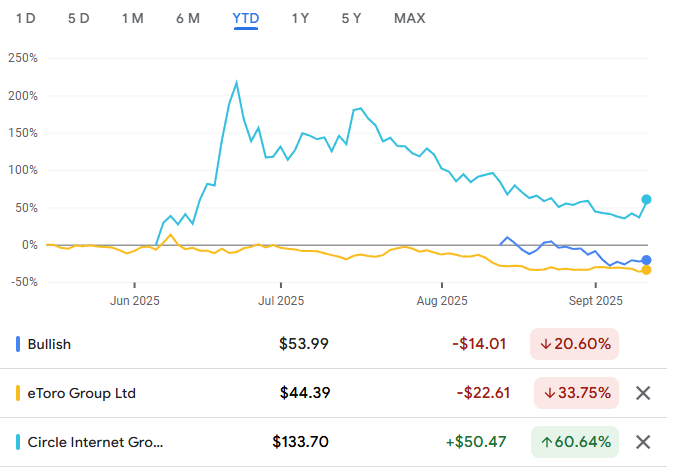
Although Circle shares are trading well above the debut price, they have almost halved from the peak reached within weeks of the listing. eToro, on the other hand, has lost a third of its debut value.
Bullish is another crypto exchange that went public in August. It also had a bumper IPO, but its shares are now trading 20 per cent lower than the debut value.
Bullish, eToro and Circle stocks since IPO (Source: Google Finance)
Founded in 2014 by Cameron and Tyler Winklevoss, Gemini has positioned itself as a regulated exchange for U.S. investors. However, the company has faced challenges, including a dispute with bankrupt lender Genesis that drew regulatory scrutiny, but continues to pursue growth in a competitive market.
Earlier this year, the U.S. Securities and Exchange Commission closed its investigation into the company. The exchange also settled a $5 million lawsuit with the Commodity Futures Trading Commission, clearing significant obstacles to its market debut.
The initial public offering (IPO) of Gemini, the crypto exchange founded by the Winklevoss twins, has been oversubscribed 20 times, Reuters reported. Further, the exchange and its bankers decided to cap the IPO proceeds at $425 million, which is unusual.
IPO Offer Revised
Gemini initially planned to raise $317 million at a valuation of about $2.22 billion. The company first planned to offer 16.67 million shares priced between $17 and $19 each, but then received an offer price between $24 and $26 each.
Following high demand, the company again increased its IPO offer price yesterday (Thursday) to $28 per share, but lowered the number of offered shares to 15.18 million. This also explains reported the IPO cap the company has put in place.
At the top end of the offering, the company would have a market cap of over $3 billion. Its shares will likely start trading on Nasdaq from Friday’s session.
According to a Securities and Exchange Commission (SEC) filing, Gemini would have raised as much as $433 million in the first share sale without the cap. However, that figure excluded the $50 million the crypto exchange received from Nasdaq in a private placement.
Riding the IPO Wave
Gemini is going public when sentiment towards crypto-related IPOs is at its peak. Stablecoin issuer Circle and brokerage firm eToro, which generates substantial income from crypto trading, also had bumper IPOs earlier this year.
Although Circle shares are trading well above the debut price, they have almost halved from the peak reached within weeks of the listing. eToro, on the other hand, has lost a third of its debut value.
Bullish is another crypto exchange that went public in August. It also had a bumper IPO, but its shares are now trading 20 per cent lower than the debut value.
Bullish, eToro and Circle stocks since IPO (Source: Google Finance)
Founded in 2014 by Cameron and Tyler Winklevoss, Gemini has positioned itself as a regulated exchange for U.S. investors. However, the company has faced challenges, including a dispute with bankrupt lender Genesis that drew regulatory scrutiny, but continues to pursue growth in a competitive market.
Earlier this year, the U.S. Securities and Exchange Commission closed its investigation into the company. The exchange also settled a $5 million lawsuit with the Commodity Futures Trading Commission, clearing significant obstacles to its market debut.
Arnab Shome is an electronics engineer-turned-financial editor. He holds a Bachelor of Technology from the National Institute of Technology, Agartala. He entered the retail trading industry about a decade ago, covering the cryptocurrency market for Finance Magnates, and later expanded his coverage to include forex and CFDs as well.
His work at Finance Magnates includes C-level interviews, data-driven analysis, opinion pieces, and scoops of industry exclusives. He also contributes to Finance Magnates’ quarterly industry report.
Area of coverage:
1. CFD broker-related news
2. Industry-related Regulatory updates and developments
3. New retail trading trends
4. Prop trading industry updates
5. Executive interviews
Education:
Bachelor of Technology - National Institute of Technology, Agartala (India)
WhiteBIT secures brokerage license in Georgia to launch regulated crypto derivatives
FP Markets Winner Spotlight 🏆 | Global Broker of the Year 2025 #Trading #Broker #Innovation #Shorts
FP Markets Winner Spotlight 🏆 | Global Broker of the Year 2025 #Trading #Broker #Innovation #Shorts
FP Markets takes the spotlight as Global Broker of the Year 2025 at the Finance Magnates Awards.
Martin Stoilov, Head of Client Experience, shares that trust, innovation, and people played a key role in the company’s success, supported by a strong foundation of integrity and client-centricity.
Following this milestone, FP Markets continues to focus on growth, technology investment, and its core values of transparency and excellence.
👉 Be part of FM Awards 2026: https://awards.financemagnates.com/#nominate
FP Markets takes the spotlight as Global Broker of the Year 2025 at the Finance Magnates Awards.
Martin Stoilov, Head of Client Experience, shares that trust, innovation, and people played a key role in the company’s success, supported by a strong foundation of integrity and client-centricity.
Following this milestone, FP Markets continues to focus on growth, technology investment, and its core values of transparency and excellence.
👉 Be part of FM Awards 2026: https://awards.financemagnates.com/#nominate
In this video, we review @HolaPrimeMarketsOfficial, a multi-asset forex and CFDs broker offering different account types, trading platforms, and flexible trading conditions.
We cover the broker’s overall offering, including account options, trading environment, platforms like MT4 and MT5, and additional services such as managed accounts and fast withdrawals.
Watch the full video to see if Hola Prime Markets fits your trading needs.
📣 Stay up to date with the latest in finance and trading. Follow Finance Magnates for industry news, insights, and global event coverage.
Connect with us:
🔗 LinkedIn: /financemagnates
👍 Facebook: /financemagnates
📸 Instagram: https://www.instagram.com/financemagnates
🐦 X: https://x.com/financemagnates
🎥 TikTok: https://www.tiktok.com/tag/financemagnates
▶️ YouTube: /@financemagnates_official
#HolaPrime #ForexBroker #CFDTrading #FinanceMagnates #Trading #Forex #BrokerReview
In this video, we review @HolaPrimeMarketsOfficial, a multi-asset forex and CFDs broker offering different account types, trading platforms, and flexible trading conditions.
We cover the broker’s overall offering, including account options, trading environment, platforms like MT4 and MT5, and additional services such as managed accounts and fast withdrawals.
Watch the full video to see if Hola Prime Markets fits your trading needs.
📣 Stay up to date with the latest in finance and trading. Follow Finance Magnates for industry news, insights, and global event coverage.
Connect with us:
🔗 LinkedIn: /financemagnates
👍 Facebook: /financemagnates
📸 Instagram: https://www.instagram.com/financemagnates
🐦 X: https://x.com/financemagnates
🎥 TikTok: https://www.tiktok.com/tag/financemagnates
▶️ YouTube: /@financemagnates_official
#HolaPrime #ForexBroker #CFDTrading #FinanceMagnates #Trading #Forex #BrokerReview
Hola Prime Review: What You Need to Know | Full Breakdown by Finance Magnates
Hola Prime Review: What You Need to Know | Full Breakdown by Finance Magnates
In this video, we review @HolaPrime_Global, a proprietary trading firm offering evaluation programs and performance-based payouts in simulated market environments.
We cover how the challenge model works, including account types, profit splits (up to 95%), trading rules, and what it takes to reach a funded account. You’ll also learn about available platforms like MT4, MT5, cTrader, and more, along with insights into payouts, support, and trading conditions.
Watch the full video to see if Hola Prime fits your trading style.
📣 Stay up to date with the latest in finance and trading. Follow Finance Magnates for industry news, insights, and global event coverage.
Connect with us:
🔗 LinkedIn: /financemagnates
👍 Facebook: /financemagnates
📸 Instagram: https://www.instagram.com/financemagnates
🐦 X: https://x.com/financemagnates
🎥 TikTok: https://www.tiktok.com/tag/financemagnates
▶️ YouTube: /@financemagnates_official
#HolaPrime #PropFirm #Trading #FinanceMagnates #Forex #FuturesTrading #TradingReview #PropFirmReview
In this video, we review @HolaPrime_Global, a proprietary trading firm offering evaluation programs and performance-based payouts in simulated market environments.
We cover how the challenge model works, including account types, profit splits (up to 95%), trading rules, and what it takes to reach a funded account. You’ll also learn about available platforms like MT4, MT5, cTrader, and more, along with insights into payouts, support, and trading conditions.
Watch the full video to see if Hola Prime fits your trading style.
📣 Stay up to date with the latest in finance and trading. Follow Finance Magnates for industry news, insights, and global event coverage.
Connect with us:
🔗 LinkedIn: /financemagnates
👍 Facebook: /financemagnates
📸 Instagram: https://www.instagram.com/financemagnates
🐦 X: https://x.com/financemagnates
🎥 TikTok: https://www.tiktok.com/tag/financemagnates
▶️ YouTube: /@financemagnates_official
#HolaPrime #PropFirm #Trading #FinanceMagnates #Forex #FuturesTrading #TradingReview #PropFirmReview
Axi Winner Spotlight 🏆 | Global Most Innovative Broker 2025 #Innovation #Trading #Fintech #Broker
Axi Winner Spotlight 🏆 | Global Most Innovative Broker 2025 #Innovation #Trading #Fintech #Broker
Axi takes the spotlight at the Finance Magnates Awards, winning Global Most Innovative Broker 2025.
Olivia Xenofontos and Ivanna Openko share how the team will feel: proud, motivated, and ready to keep delivering.
They also describe the night as well-organized, focused, and enjoyable for all.
👉 Be part of FM Awards 2026.
Axi takes the spotlight at the Finance Magnates Awards, winning Global Most Innovative Broker 2025.
Olivia Xenofontos and Ivanna Openko share how the team will feel: proud, motivated, and ready to keep delivering.
They also describe the night as well-organized, focused, and enjoyable for all.
👉 Be part of FM Awards 2026.
Recognition that matters.
Built on transparency.
Driven by the industry.
The Finance Magnates Awards 2026.
Nominations are now open.
🔗 https://awards.financemagnates.com/?utm_source=SM&utm_medium=social&utm_campaign=recognition-matters
Recognition that matters.
Built on transparency.
Driven by the industry.
The Finance Magnates Awards 2026.
Nominations are now open.
🔗 https://awards.financemagnates.com/?utm_source=SM&utm_medium=social&utm_campaign=recognition-matters