Analyst forecasts the company will report 7th declining quarter in a row.
Trading
volumes on Coinbase (NASDAQ: COIN) have fallen so sharply in the past quarter that they are now
below the levels seen in April 2021, when the exchange debuted on Nasdaq.
According to CCData, trader activity was valued at $76 billion, a decrease of 52% compared to the previous year's third quarter.
For Coinbase, Trading
Volume Is a Significant Revenue Driver
The
exchange itself admits that transaction revenue accounts for more than half of
its total income. When investors remain inactive and trading volumes decline,
the platform's profits also shrink considerably.
Although
Coinbase remains one of the larger exchanges in terms of reported volumes, it
has seen a significant drop in this key metric over the past year. This trend
also affects other platforms and is a result of lower cryptocurrency prices,
scandals, and high-profile exchange collapses.
Coinbase
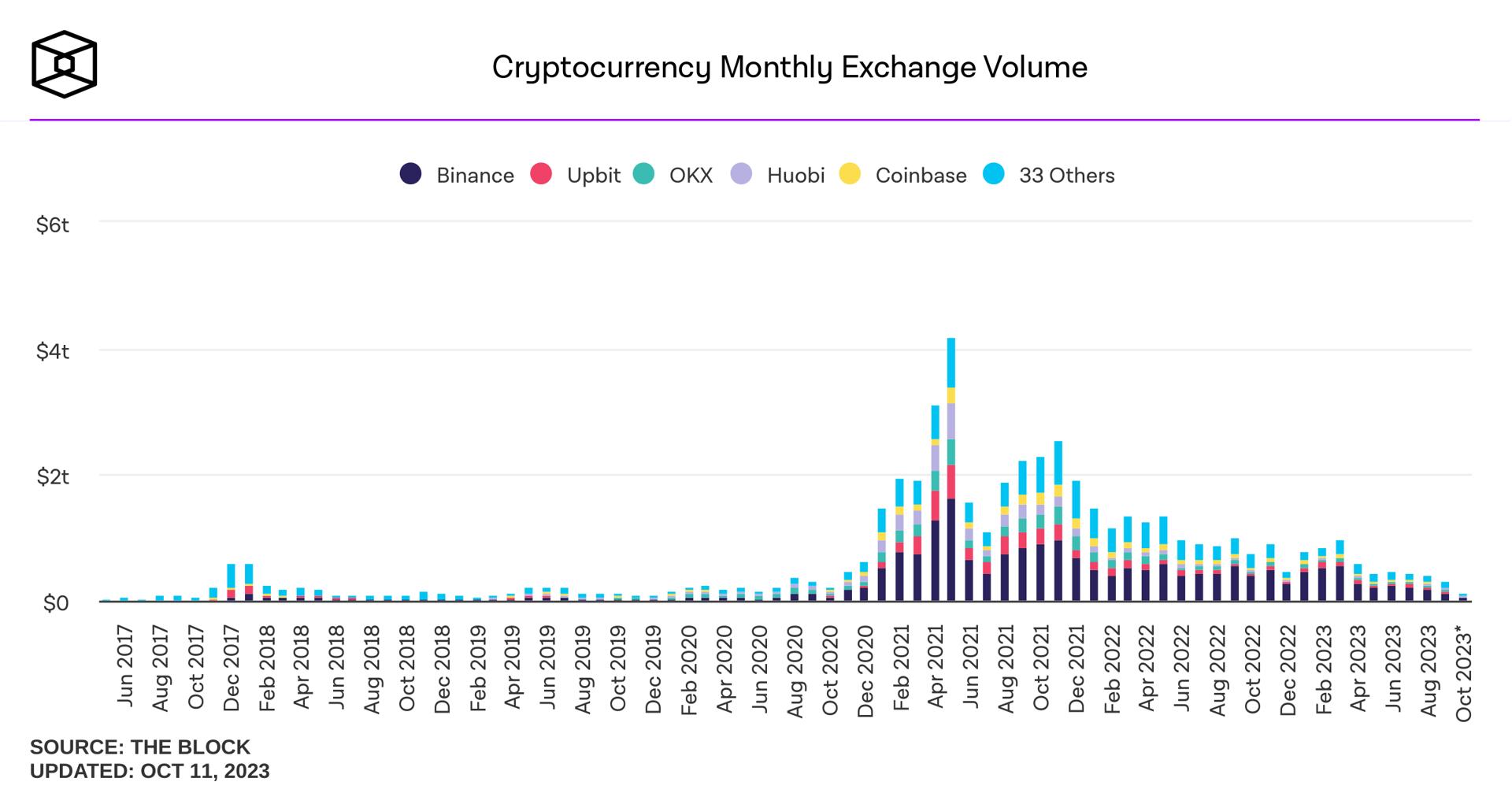
achieved record volumes in May 2021 when cryptocurrency prices soared to
historic highs. In that single month, turnover reached $259 billion. However, it
was more than ten times lower in September, at $20
billion.
Coinbase volumes going down. Source: The Block
Analysts
are already more than certain that the company will report its seventh
consecutive declining quarter when it releases its report next month. For
example, Mizuho Securities believes that Q3 2023 revenue will be 10% lower than
official forecasts.
Despite
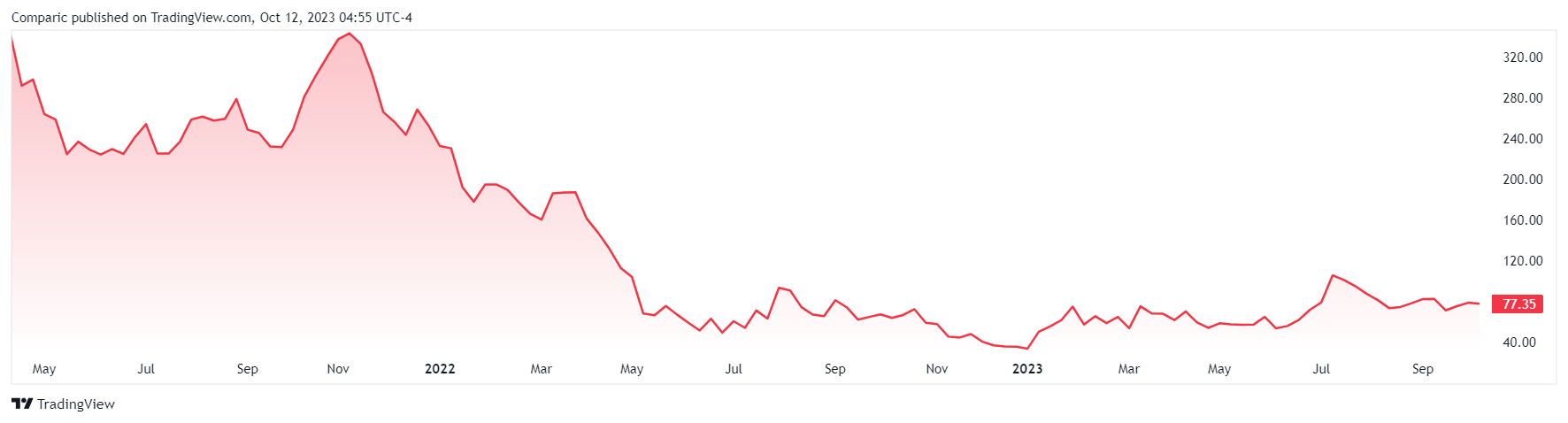
this, Coinbase's stock has risen by nearly 120% this year. Some might say that the
shares have nowhere to fall, as they have lost over 80% of their value since
their debut in 2021. However, the chart shows that since May 2022, they have been
consolidating in the same volatility range and currently cost just under $80.
COIN shares consolidates. Source: Tradingview.com
Singapore and Bermuda, but
Not Europe
The San
Francisco-based cryptocurrency exchange has been strategically expanding its
global footprint. After a year of provisional approval, the company recently
secured a Major Payment Institution license from Singapore's Monetary
Authority. This follows Coinbase abandoning its earlier plan to enter the
Singaporean market by acquiring the now-defunct Zipmex exchange in 2022.
In addition
to its Singaporean venture, Coinbase has received regulatory approval from
Bermuda's financial authority, allowing it to offer perpetual futures trading
to qualified non-US customers. This new offering will be available on the
Coinbase Advanced platform in the near future.
However,
the company has put its European expansion on hold, specifically its plans to
acquire FTX Europe. Initially aimed at breaking into the European derivatives
market, the acquisition was suspended due to regulatory hurdles in the US. FTX
Europe, known for its significant share in the European trading volumes, was a
key target for Coinbase, as it holds nearly 75% of the global crypto
derivatives trading volume.
Trading
volumes on Coinbase (NASDAQ: COIN) have fallen so sharply in the past quarter that they are now
below the levels seen in April 2021, when the exchange debuted on Nasdaq.
According to CCData, trader activity was valued at $76 billion, a decrease of 52% compared to the previous year's third quarter.
For Coinbase, Trading
Volume Is a Significant Revenue Driver
The
exchange itself admits that transaction revenue accounts for more than half of
its total income. When investors remain inactive and trading volumes decline,
the platform's profits also shrink considerably.
Although
Coinbase remains one of the larger exchanges in terms of reported volumes, it
has seen a significant drop in this key metric over the past year. This trend
also affects other platforms and is a result of lower cryptocurrency prices,
scandals, and high-profile exchange collapses.
Coinbase
achieved record volumes in May 2021 when cryptocurrency prices soared to
historic highs. In that single month, turnover reached $259 billion. However, it
was more than ten times lower in September, at $20
billion.
Coinbase volumes going down. Source: The Block
Analysts
are already more than certain that the company will report its seventh
consecutive declining quarter when it releases its report next month. For
example, Mizuho Securities believes that Q3 2023 revenue will be 10% lower than
official forecasts.
Despite
this, Coinbase's stock has risen by nearly 120% this year. Some might say that the
shares have nowhere to fall, as they have lost over 80% of their value since
their debut in 2021. However, the chart shows that since May 2022, they have been
consolidating in the same volatility range and currently cost just under $80.
COIN shares consolidates. Source: Tradingview.com
Singapore and Bermuda, but
Not Europe
The San
Francisco-based cryptocurrency exchange has been strategically expanding its
global footprint. After a year of provisional approval, the company recently
secured a Major Payment Institution license from Singapore's Monetary
Authority. This follows Coinbase abandoning its earlier plan to enter the
Singaporean market by acquiring the now-defunct Zipmex exchange in 2022.
In addition
to its Singaporean venture, Coinbase has received regulatory approval from
Bermuda's financial authority, allowing it to offer perpetual futures trading
to qualified non-US customers. This new offering will be available on the
Coinbase Advanced platform in the near future.
However,
the company has put its European expansion on hold, specifically its plans to
acquire FTX Europe. Initially aimed at breaking into the European derivatives
market, the acquisition was suspended due to regulatory hurdles in the US. FTX
Europe, known for its significant share in the European trading volumes, was a
key target for Coinbase, as it holds nearly 75% of the global crypto
derivatives trading volume.
Damian Chmiel is a Senior Analyst & Editor at Finance Magnates with more than 15 years of experience in the CFD and online trading industry. Active as both a trader and journalist since 2010, he focuses on broker coverage, fintech innovation, and regulatory developments across Europe, the Middle East, and Asia.
His work includes interviews with C-level leaders at major brokerages and fintech platforms, as well as co-authoring Finance Magnates’ quarterly industry benchmarking reports. Damian’s reporting is data-driven, market-aware, and grounded in direct industry engagement. His analysis and commentary have also been cited by external media outlets, including Investing.com, Binance, The Asset, Stockhead, and Dispatch.
Education:
MA in Finance and Accounting, Cracow University of Economics
Kraken Steps Up Speed Race with New Equinix Colocation Service for Crypto Traders
FP Markets Winner Spotlight 🏆 | Global Broker of the Year 2025 #Trading #Broker #Innovation #Shorts
FP Markets Winner Spotlight 🏆 | Global Broker of the Year 2025 #Trading #Broker #Innovation #Shorts
FP Markets takes the spotlight as Global Broker of the Year 2025 at the Finance Magnates Awards.
Martin Stoilov, Head of Client Experience, shares that trust, innovation, and people played a key role in the company’s success, supported by a strong foundation of integrity and client-centricity.
Following this milestone, FP Markets continues to focus on growth, technology investment, and its core values of transparency and excellence.
👉 Be part of FM Awards 2026: https://awards.financemagnates.com/#nominate
FP Markets takes the spotlight as Global Broker of the Year 2025 at the Finance Magnates Awards.
Martin Stoilov, Head of Client Experience, shares that trust, innovation, and people played a key role in the company’s success, supported by a strong foundation of integrity and client-centricity.
Following this milestone, FP Markets continues to focus on growth, technology investment, and its core values of transparency and excellence.
👉 Be part of FM Awards 2026: https://awards.financemagnates.com/#nominate
In this video, we review @HolaPrimeMarketsOfficial, a multi-asset forex and CFDs broker offering different account types, trading platforms, and flexible trading conditions.
We cover the broker’s overall offering, including account options, trading environment, platforms like MT4 and MT5, and additional services such as managed accounts and fast withdrawals.
Watch the full video to see if Hola Prime Markets fits your trading needs.
📣 Stay up to date with the latest in finance and trading. Follow Finance Magnates for industry news, insights, and global event coverage.
Connect with us:
🔗 LinkedIn: /financemagnates
👍 Facebook: /financemagnates
📸 Instagram: https://www.instagram.com/financemagnates
🐦 X: https://x.com/financemagnates
🎥 TikTok: https://www.tiktok.com/tag/financemagnates
▶️ YouTube: /@financemagnates_official
#HolaPrime #ForexBroker #CFDTrading #FinanceMagnates #Trading #Forex #BrokerReview
In this video, we review @HolaPrimeMarketsOfficial, a multi-asset forex and CFDs broker offering different account types, trading platforms, and flexible trading conditions.
We cover the broker’s overall offering, including account options, trading environment, platforms like MT4 and MT5, and additional services such as managed accounts and fast withdrawals.
Watch the full video to see if Hola Prime Markets fits your trading needs.
📣 Stay up to date with the latest in finance and trading. Follow Finance Magnates for industry news, insights, and global event coverage.
Connect with us:
🔗 LinkedIn: /financemagnates
👍 Facebook: /financemagnates
📸 Instagram: https://www.instagram.com/financemagnates
🐦 X: https://x.com/financemagnates
🎥 TikTok: https://www.tiktok.com/tag/financemagnates
▶️ YouTube: /@financemagnates_official
#HolaPrime #ForexBroker #CFDTrading #FinanceMagnates #Trading #Forex #BrokerReview
Hola Prime Review: What You Need to Know | Full Breakdown by Finance Magnates
Hola Prime Review: What You Need to Know | Full Breakdown by Finance Magnates
In this video, we review @HolaPrime_Global, a proprietary trading firm offering evaluation programs and performance-based payouts in simulated market environments.
We cover how the challenge model works, including account types, profit splits (up to 95%), trading rules, and what it takes to reach a funded account. You’ll also learn about available platforms like MT4, MT5, cTrader, and more, along with insights into payouts, support, and trading conditions.
Watch the full video to see if Hola Prime fits your trading style.
📣 Stay up to date with the latest in finance and trading. Follow Finance Magnates for industry news, insights, and global event coverage.
Connect with us:
🔗 LinkedIn: /financemagnates
👍 Facebook: /financemagnates
📸 Instagram: https://www.instagram.com/financemagnates
🐦 X: https://x.com/financemagnates
🎥 TikTok: https://www.tiktok.com/tag/financemagnates
▶️ YouTube: /@financemagnates_official
#HolaPrime #PropFirm #Trading #FinanceMagnates #Forex #FuturesTrading #TradingReview #PropFirmReview
In this video, we review @HolaPrime_Global, a proprietary trading firm offering evaluation programs and performance-based payouts in simulated market environments.
We cover how the challenge model works, including account types, profit splits (up to 95%), trading rules, and what it takes to reach a funded account. You’ll also learn about available platforms like MT4, MT5, cTrader, and more, along with insights into payouts, support, and trading conditions.
Watch the full video to see if Hola Prime fits your trading style.
📣 Stay up to date with the latest in finance and trading. Follow Finance Magnates for industry news, insights, and global event coverage.
Connect with us:
🔗 LinkedIn: /financemagnates
👍 Facebook: /financemagnates
📸 Instagram: https://www.instagram.com/financemagnates
🐦 X: https://x.com/financemagnates
🎥 TikTok: https://www.tiktok.com/tag/financemagnates
▶️ YouTube: /@financemagnates_official
#HolaPrime #PropFirm #Trading #FinanceMagnates #Forex #FuturesTrading #TradingReview #PropFirmReview
Axi Winner Spotlight 🏆 | Global Most Innovative Broker 2025 #Innovation #Trading #Fintech #Broker
Axi Winner Spotlight 🏆 | Global Most Innovative Broker 2025 #Innovation #Trading #Fintech #Broker
Axi takes the spotlight at the Finance Magnates Awards, winning Global Most Innovative Broker 2025.
Olivia Xenofontos and Ivanna Openko share how the team will feel: proud, motivated, and ready to keep delivering.
They also describe the night as well-organized, focused, and enjoyable for all.
👉 Be part of FM Awards 2026.
Axi takes the spotlight at the Finance Magnates Awards, winning Global Most Innovative Broker 2025.
Olivia Xenofontos and Ivanna Openko share how the team will feel: proud, motivated, and ready to keep delivering.
They also describe the night as well-organized, focused, and enjoyable for all.
👉 Be part of FM Awards 2026.
Recognition that matters.
Built on transparency.
Driven by the industry.
The Finance Magnates Awards 2026.
Nominations are now open.
🔗 https://awards.financemagnates.com/?utm_source=SM&utm_medium=social&utm_campaign=recognition-matters
Recognition that matters.
Built on transparency.
Driven by the industry.
The Finance Magnates Awards 2026.
Nominations are now open.
🔗 https://awards.financemagnates.com/?utm_source=SM&utm_medium=social&utm_campaign=recognition-matters