The island nation is the gearing up to bring crypto regulations.
The symposium marketed the presence of regulators and industry leaders.
(Left to right) Loretta Joseph, Rick McDonell, John Dahmasing Salong, and Martin St-Hilaire
A who’s who of Vanuatu’s financial industry and its regulators converged at Port Vila’s Warwick Le Lagon resort on June 27 to discuss the new licence for virtual asset service providers (VASP) and to review the jurisdiction’s best strategies to avoid global regulatory watch lists.
This was the second Symposium organized by the Vanuatu Financial Services Commission, this time under the theme “Shaping tomorrow: Exploring the role of the financial dealers licence and virtual assets in national development.” The event was attended by the Honourable John Dahmasing Salong, Minister of Finance and Economic Management and by MP Andrew Solomon Napuat.
VFSC's Commissioner, Branan Karae, opened the day by reviewing the past year’s progress. The biggest step was the VASP Bill, now ready to become law in the next parliamentary session, probably in September.
Karae underlined his team's efforts to streamline the application process for Financial Dealer Licences (FDL). They are now processing at least two to three every month, for a total of about 75 since the new regulatory regime was introduced in 2022. And the numbers continue to grow. The VFSC also held a mini-symposium in Sydney in May to beef up its marketing efforts and applied for membership in the International Organization of Securities Commissions (IOSCO) to enhance its reputation.
The Commissioner proudly introduced the newest Ni-Vanuatu woman in fintech, Jossiana Peter, a graduate in banking and finance from Macquarie University in Sydney, who will be the Virtual Assets Supervisor in his office.
A New Licence for Virtual Asset Service Providers
The requirements for the upcoming VASP licence were detailed in a joint presentation by Joshua Tarinako, Managing Supervisor at VFSC, and Loretta Joseph, an Australian consultant for the VFSC who has been instrumental in drafting the new Bill.
She noted that Vanuatu was “one of a few jurisdictions that have done something about virtual assets” in line with the requirements of the Financial Action Task Force (FATF), the global regulatory body for financial services.
“This ensures that the innovation due to new technology, like decentralized finance and cryptocurrencies, will be shaped within legal boundaries in a way that fosters trust and stability in the digital economy. We tried to devise clear, logical legislation that doesn’t stifle innovation and specifies what operators can and cannot do,” said Loretta Joseph.
Joshua Tarinako walked the audience through the requirements for the VASP licence, which is classified as Category D in the FDL program. The requirements share similarities with A, B and C licences, such as physical presence, management experience, quarterly reports and more.
The Category D licence is divided into four subcategories, depending on the type of service provided: D1 for exchanges, D2 for custodians, D3 for virtual asset managers and D4 for banks. There’s also a time-limited 12-month “Fintech sandbox utility” status for VASP start-ups currently in testing their products.
A process has been drafted for Initial Token Offerings, which Joseph described as “digital crowdfunding.” Proponents must submit a White Paper detailing their business plan, such as funding, product roadmap and conditions attached to their token. There will be a Purchaser Right with a 10-day “cooling-off period” to allow participants to change their minds.
Once the law passes Parliament, the VFSC will provide more guidance on a range of topics to be defined, such as initial capital requirements for VASPs.
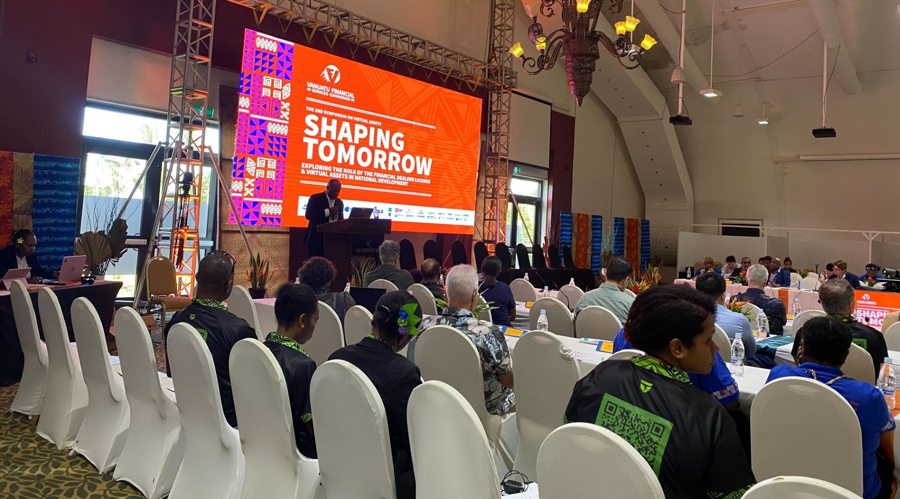
From the floor of the symposium at Port Vila’s Warwick Le Lagon resort
Developing a “Culture of Compliance”
A panel was held on international standard requirements from the FATF, the Asia-Pacific Group (APG) and the European Union (EU). These bodies keep watchlists of non-compliant jurisdictions with dire consequences for those targeted. Vanuatu has long been delisted by the FATF and APG but remains on two EU lists: one pertaining to money laundering controls and the other to tax practices.
Rick McDonell, the former Executive Secretary of the FATF and APG, shared some pro tips on global compliance.
He warned against upcoming re-assessments by these bodies, especially the FATF’s Recommendation 16. Known as the “travel rule,” it requires VASPs to verify the identities of originators and beneficiaries for any transaction over 1000 USD or EUR and to report any suspicious activity.
“Many countries aren’t implementing the rules properly, while others are just doing a bad job, especially investigating and confiscating the proceeds of crime,” he added.
“When the assessors come next time, they will look at how well you apply their standards. It’s a very intrusive process so your government and private sector will need to defend themselves against any lack of understanding (…) Make sure you have the statistics to show that you’re being compliant and to make a persuasive case, both in your submissions and when you meet face to face.”
The next on-site visit will be in October 2026, but he recommended starting early with a “holistic effort” involving industry and government.
When it comes to EU watchlists, McDonell pinpointed a “lack of coordination” and “miscommunication,” both of which could be solved through discussions at a high level.
The Honourable Andrew Solomon Napuat, MP and chairperson of the FDL task force, detailed how he and five fellow MPs have been “knocking down doors” in the past year to push government agencies to work together on addressing EU listings.
“This is not a single-agency issue. It’s a sovereign issue affecting all of us. Everyone must come together and gather all the technical knowledge we need to support our leaders at the political level,” he added.
Panagiotis Nikolaou, advisor for the Cyprus SEC, shared his own experience in the matter. “We’ve seen countries rushing to complete requirements but we found that just ticking the boxes is not enough. It’s about developing a culture of compliance, not only to delist from EU lists but to make sure you don’t get on any watchlist anywhere ever again,” he emphasized.
Vanuatu is on the right path according to McDonell, who led the first APG meeting many years ago. “The level of understanding is incredible. It’s an impressive improvement. Countries trying to build their financial sector need regulatory certainty and a good reputation, and those are on the rise in Vanuatu.”
Our regulator (VFSC) announced the drafting of a new legislation on #DigitalAssets.
The #fintech industry offers a path toward growth and prosperity for everyone in our country. So stay tuned for more good news! pic.twitter.com/xT2p19K9dS
Another panel addressed the difficulties foreign investors encounter when they start FDL businesses in Vanuatu.
For Martin St-Hilaire, managing director at Titan FX, the biggest priorities are investing in education and relaxing immigration rules for foreign skilled workers – and the two are usually intertwined.
“Knowledge industries, such as fintech, are our best chance to grow our economy. All it takes is an internet connection and an education. Unfortunately, Vanuatu has a schooling average of just 6.8 years and only 5% of our youth advance to post-secondary studies, so we can’t even fill all the currently open positions,” St-Hilaire explained.
“Importing foreign skilled workers would not only fill the skill gap, it would provide mentors for the next generation of local knowledge workers. Foreigners are bringing both their skills and teaching capacity.”
St-Hilaire pleaded for a “change of mindset” in which Vanuatus opens its borders to foreign workers, instead of scaring them away with cumbersome visa rules.
In his view, the FDL program perfectly demonstrates his theory: “Each new FDL can pair a local with a foreign worker, who trains them, so we grow into two plus two, three plus three, and so on. Our sector already employs about 110 people, who, in turn, support their families and spend their earnings in the community. These jobs didn’t exist five years ago, so foreign workers didn’t take them away from anyone. We created a whole new industry from scratch by importing the skills we needed.”
He stressed that the current immigration rules are “not protecting anything,” they’re only “damaging future opportunities for local kids.”
St-Hilaire was joined by Howard Aru, the former CEO of the Vanuatu Foreign Investment Promotion Agency and current GM at the Vanuatu Chamber of Commerce, who seconded St-Hilaire’s call for “a change in thinking.”
“I’ve been singing this song for 20 years. Hopefully more industries will follow fintech’s lead,” Aru stated.
A who’s who of Vanuatu’s financial industry and its regulators converged at Port Vila’s Warwick Le Lagon resort on June 27 to discuss the new licence for virtual asset service providers (VASP) and to review the jurisdiction’s best strategies to avoid global regulatory watch lists.
This was the second Symposium organized by the Vanuatu Financial Services Commission, this time under the theme “Shaping tomorrow: Exploring the role of the financial dealers licence and virtual assets in national development.” The event was attended by the Honourable John Dahmasing Salong, Minister of Finance and Economic Management and by MP Andrew Solomon Napuat.
VFSC's Commissioner, Branan Karae, opened the day by reviewing the past year’s progress. The biggest step was the VASP Bill, now ready to become law in the next parliamentary session, probably in September.
Karae underlined his team's efforts to streamline the application process for Financial Dealer Licences (FDL). They are now processing at least two to three every month, for a total of about 75 since the new regulatory regime was introduced in 2022. And the numbers continue to grow. The VFSC also held a mini-symposium in Sydney in May to beef up its marketing efforts and applied for membership in the International Organization of Securities Commissions (IOSCO) to enhance its reputation.
The Commissioner proudly introduced the newest Ni-Vanuatu woman in fintech, Jossiana Peter, a graduate in banking and finance from Macquarie University in Sydney, who will be the Virtual Assets Supervisor in his office.
A New Licence for Virtual Asset Service Providers
The requirements for the upcoming VASP licence were detailed in a joint presentation by Joshua Tarinako, Managing Supervisor at VFSC, and Loretta Joseph, an Australian consultant for the VFSC who has been instrumental in drafting the new Bill.
She noted that Vanuatu was “one of a few jurisdictions that have done something about virtual assets” in line with the requirements of the Financial Action Task Force (FATF), the global regulatory body for financial services.
“This ensures that the innovation due to new technology, like decentralized finance and cryptocurrencies, will be shaped within legal boundaries in a way that fosters trust and stability in the digital economy. We tried to devise clear, logical legislation that doesn’t stifle innovation and specifies what operators can and cannot do,” said Loretta Joseph.
Joshua Tarinako walked the audience through the requirements for the VASP licence, which is classified as Category D in the FDL program. The requirements share similarities with A, B and C licences, such as physical presence, management experience, quarterly reports and more.
The Category D licence is divided into four subcategories, depending on the type of service provided: D1 for exchanges, D2 for custodians, D3 for virtual asset managers and D4 for banks. There’s also a time-limited 12-month “Fintech sandbox utility” status for VASP start-ups currently in testing their products.
A process has been drafted for Initial Token Offerings, which Joseph described as “digital crowdfunding.” Proponents must submit a White Paper detailing their business plan, such as funding, product roadmap and conditions attached to their token. There will be a Purchaser Right with a 10-day “cooling-off period” to allow participants to change their minds.
Once the law passes Parliament, the VFSC will provide more guidance on a range of topics to be defined, such as initial capital requirements for VASPs.
From the floor of the symposium at Port Vila’s Warwick Le Lagon resort
Developing a “Culture of Compliance”
A panel was held on international standard requirements from the FATF, the Asia-Pacific Group (APG) and the European Union (EU). These bodies keep watchlists of non-compliant jurisdictions with dire consequences for those targeted. Vanuatu has long been delisted by the FATF and APG but remains on two EU lists: one pertaining to money laundering controls and the other to tax practices.
Rick McDonell, the former Executive Secretary of the FATF and APG, shared some pro tips on global compliance.
He warned against upcoming re-assessments by these bodies, especially the FATF’s Recommendation 16. Known as the “travel rule,” it requires VASPs to verify the identities of originators and beneficiaries for any transaction over 1000 USD or EUR and to report any suspicious activity.
“Many countries aren’t implementing the rules properly, while others are just doing a bad job, especially investigating and confiscating the proceeds of crime,” he added.
“When the assessors come next time, they will look at how well you apply their standards. It’s a very intrusive process so your government and private sector will need to defend themselves against any lack of understanding (…) Make sure you have the statistics to show that you’re being compliant and to make a persuasive case, both in your submissions and when you meet face to face.”
The next on-site visit will be in October 2026, but he recommended starting early with a “holistic effort” involving industry and government.
When it comes to EU watchlists, McDonell pinpointed a “lack of coordination” and “miscommunication,” both of which could be solved through discussions at a high level.
The Honourable Andrew Solomon Napuat, MP and chairperson of the FDL task force, detailed how he and five fellow MPs have been “knocking down doors” in the past year to push government agencies to work together on addressing EU listings.
“This is not a single-agency issue. It’s a sovereign issue affecting all of us. Everyone must come together and gather all the technical knowledge we need to support our leaders at the political level,” he added.
Panagiotis Nikolaou, advisor for the Cyprus SEC, shared his own experience in the matter. “We’ve seen countries rushing to complete requirements but we found that just ticking the boxes is not enough. It’s about developing a culture of compliance, not only to delist from EU lists but to make sure you don’t get on any watchlist anywhere ever again,” he emphasized.
Vanuatu is on the right path according to McDonell, who led the first APG meeting many years ago. “The level of understanding is incredible. It’s an impressive improvement. Countries trying to build their financial sector need regulatory certainty and a good reputation, and those are on the rise in Vanuatu.”
Our regulator (VFSC) announced the drafting of a new legislation on #DigitalAssets.
The #fintech industry offers a path toward growth and prosperity for everyone in our country. So stay tuned for more good news! pic.twitter.com/xT2p19K9dS
Another panel addressed the difficulties foreign investors encounter when they start FDL businesses in Vanuatu.
For Martin St-Hilaire, managing director at Titan FX, the biggest priorities are investing in education and relaxing immigration rules for foreign skilled workers – and the two are usually intertwined.
“Knowledge industries, such as fintech, are our best chance to grow our economy. All it takes is an internet connection and an education. Unfortunately, Vanuatu has a schooling average of just 6.8 years and only 5% of our youth advance to post-secondary studies, so we can’t even fill all the currently open positions,” St-Hilaire explained.
“Importing foreign skilled workers would not only fill the skill gap, it would provide mentors for the next generation of local knowledge workers. Foreigners are bringing both their skills and teaching capacity.”
St-Hilaire pleaded for a “change of mindset” in which Vanuatus opens its borders to foreign workers, instead of scaring them away with cumbersome visa rules.
In his view, the FDL program perfectly demonstrates his theory: “Each new FDL can pair a local with a foreign worker, who trains them, so we grow into two plus two, three plus three, and so on. Our sector already employs about 110 people, who, in turn, support their families and spend their earnings in the community. These jobs didn’t exist five years ago, so foreign workers didn’t take them away from anyone. We created a whole new industry from scratch by importing the skills we needed.”
He stressed that the current immigration rules are “not protecting anything,” they’re only “damaging future opportunities for local kids.”
St-Hilaire was joined by Howard Aru, the former CEO of the Vanuatu Foreign Investment Promotion Agency and current GM at the Vanuatu Chamber of Commerce, who seconded St-Hilaire’s call for “a change in thinking.”
“I’ve been singing this song for 20 years. Hopefully more industries will follow fintech’s lead,” Aru stated.
CFTC Seeks Public Input on Proposed Retail Crypto Regulatory Framework
Featured Videos
AvaTrade to Acquire Most of FXCM; NAGA Raises $8M
AvaTrade to Acquire Most of FXCM; NAGA Raises $8M
AvaTrade to Acquire Most of FXCM; NAGA Raises $8M
AvaTrade to Acquire Most of FXCM; NAGA Raises $8M
Today’s financial news recap covers AvaTrade agrees to acquire most of FXCM, NAGA secures eight million dollars in new financing, and Wise seeks a tax settlement in the UK.
Finance Magnates Daily Recap brings you the latest news from forex and CFD brokers, fintech, payments, cryptocurrency, digital assets, trading platforms, financial regulation and global markets.
Get the key company news, executive moves, deals, regulatory updates and market developments of the day, in just a few minutes. New episodes published every weekday.
Read more: https://www.financemagnates.com
#FinanceMagnates #ForexNews #FintechNews
Today’s financial news recap covers AvaTrade agrees to acquire most of FXCM, NAGA secures eight million dollars in new financing, and Wise seeks a tax settlement in the UK.
Finance Magnates Daily Recap brings you the latest news from forex and CFD brokers, fintech, payments, cryptocurrency, digital assets, trading platforms, financial regulation and global markets.
Get the key company news, executive moves, deals, regulatory updates and market developments of the day, in just a few minutes. New episodes published every weekday.
Read more: https://www.financemagnates.com
#FinanceMagnates #ForexNews #FintechNews
Today’s financial news recap covers AvaTrade agrees to acquire most of FXCM, NAGA secures eight million dollars in new financing, and Wise seeks a tax settlement in the UK.
Finance Magnates Daily Recap brings you the latest news from forex and CFD brokers, fintech, payments, cryptocurrency, digital assets, trading platforms, financial regulation and global markets.
Get the key company news, executive moves, deals, regulatory updates and market developments of the day, in just a few minutes. New episodes published every weekday.
Read more: https://www.financemagnates.com
#FinanceMagnates #ForexNews #FintechNews
Today’s financial news recap covers AvaTrade agrees to acquire most of FXCM, NAGA secures eight million dollars in new financing, and Wise seeks a tax settlement in the UK.
Finance Magnates Daily Recap brings you the latest news from forex and CFD brokers, fintech, payments, cryptocurrency, digital assets, trading platforms, financial regulation and global markets.
Get the key company news, executive moves, deals, regulatory updates and market developments of the day, in just a few minutes. New episodes published every weekday.
Read more: https://www.financemagnates.com
#FinanceMagnates #ForexNews #FintechNews
XTB Adds Overnight US Stock Trading; Nasdaq Ventures Invests in One Trading
XTB Adds Overnight US Stock Trading; Nasdaq Ventures Invests in One Trading
XTB Adds Overnight US Stock Trading; Nasdaq Ventures Invests in One Trading
XTB Adds Overnight US Stock Trading; Nasdaq Ventures Invests in One Trading
XTB Adds Overnight US Stock Trading; Nasdaq Ventures Invests in One Trading
XTB Adds Overnight US Stock Trading; Nasdaq Ventures Invests in One Trading
Today’s financial news recap covers XTB expands overnight US stock trading, Fortrade reports higher revenue, Nasdaq backs One Trading, and Vest Labs raises 13 million dollars.
Finance Magnates Daily Recap brings you the latest news from forex and CFD brokers, fintech, payments, cryptocurrency, digital assets, trading platforms, financial regulation and global markets.
Get the key company news, executive moves, deals, regulatory updates and market developments of the day, in just a few minutes. New episodes published every weekday.
Read more: https://www.financemagnates.com
#FinanceMagnates #ForexNews #FintechNews
Today’s financial news recap covers XTB expands overnight US stock trading, Fortrade reports higher revenue, Nasdaq backs One Trading, and Vest Labs raises 13 million dollars.
Finance Magnates Daily Recap brings you the latest news from forex and CFD brokers, fintech, payments, cryptocurrency, digital assets, trading platforms, financial regulation and global markets.
Get the key company news, executive moves, deals, regulatory updates and market developments of the day, in just a few minutes. New episodes published every weekday.
Read more: https://www.financemagnates.com
#FinanceMagnates #ForexNews #FintechNews
Today’s financial news recap covers XTB expands overnight US stock trading, Fortrade reports higher revenue, Nasdaq backs One Trading, and Vest Labs raises 13 million dollars.
Finance Magnates Daily Recap brings you the latest news from forex and CFD brokers, fintech, payments, cryptocurrency, digital assets, trading platforms, financial regulation and global markets.
Get the key company news, executive moves, deals, regulatory updates and market developments of the day, in just a few minutes. New episodes published every weekday.
Read more: https://www.financemagnates.com
#FinanceMagnates #ForexNews #FintechNews
Today’s financial news recap covers XTB expands overnight US stock trading, Fortrade reports higher revenue, Nasdaq backs One Trading, and Vest Labs raises 13 million dollars.
Finance Magnates Daily Recap brings you the latest news from forex and CFD brokers, fintech, payments, cryptocurrency, digital assets, trading platforms, financial regulation and global markets.
Get the key company news, executive moves, deals, regulatory updates and market developments of the day, in just a few minutes. New episodes published every weekday.
Read more: https://www.financemagnates.com
#FinanceMagnates #ForexNews #FintechNews
Today’s financial news recap covers XTB expands overnight US stock trading, Fortrade reports higher revenue, Nasdaq backs One Trading, and Vest Labs raises 13 million dollars.
Finance Magnates Daily Recap brings you the latest news from forex and CFD brokers, fintech, payments, cryptocurrency, digital assets, trading platforms, financial regulation and global markets.
Get the key company news, executive moves, deals, regulatory updates and market developments of the day, in just a few minutes. New episodes published every weekday.
Read more: https://www.financemagnates.com
#FinanceMagnates #ForexNews #FintechNews
Today’s financial news recap covers XTB expands overnight US stock trading, Fortrade reports higher revenue, Nasdaq backs One Trading, and Vest Labs raises 13 million dollars.
Finance Magnates Daily Recap brings you the latest news from forex and CFD brokers, fintech, payments, cryptocurrency, digital assets, trading platforms, financial regulation and global markets.
Get the key company news, executive moves, deals, regulatory updates and market developments of the day, in just a few minutes. New episodes published every weekday.
Read more: https://www.financemagnates.com
#FinanceMagnates #ForexNews #FintechNews
CMC Founder Downplays Volatility Hit; Devexperts Names CEO
CMC Founder Downplays Volatility Hit; Devexperts Names CEO
CMC Founder Downplays Volatility Hit; Devexperts Names CEO
CMC Founder Downplays Volatility Hit; Devexperts Names CEO
CMC Founder Downplays Volatility Hit; Devexperts Names CEO
CMC Founder Downplays Volatility Hit; Devexperts Names CEO
Today’s financial news recap covers low volatility pressures brokers, Devexperts names a new CEO, Saxo cuts onboarding time, and OKX reaches a 25 billion dollar valuation.
Finance Magnates Daily Recap brings you the latest news from forex and CFD brokers, fintech, payments, cryptocurrency, digital assets, trading platforms, financial regulation and global markets.
Get the key company news, executive moves, deals, regulatory updates and market developments of the day, in just a few minutes. New episodes published every weekday.
Read more: https://www.financemagnates.com
#FinanceMagnates #ForexNews #FintechNews
Today’s financial news recap covers low volatility pressures brokers, Devexperts names a new CEO, Saxo cuts onboarding time, and OKX reaches a 25 billion dollar valuation.
Finance Magnates Daily Recap brings you the latest news from forex and CFD brokers, fintech, payments, cryptocurrency, digital assets, trading platforms, financial regulation and global markets.
Get the key company news, executive moves, deals, regulatory updates and market developments of the day, in just a few minutes. New episodes published every weekday.
Read more: https://www.financemagnates.com
#FinanceMagnates #ForexNews #FintechNews
Today’s financial news recap covers low volatility pressures brokers, Devexperts names a new CEO, Saxo cuts onboarding time, and OKX reaches a 25 billion dollar valuation.
Finance Magnates Daily Recap brings you the latest news from forex and CFD brokers, fintech, payments, cryptocurrency, digital assets, trading platforms, financial regulation and global markets.
Get the key company news, executive moves, deals, regulatory updates and market developments of the day, in just a few minutes. New episodes published every weekday.
Read more: https://www.financemagnates.com
#FinanceMagnates #ForexNews #FintechNews
Today’s financial news recap covers low volatility pressures brokers, Devexperts names a new CEO, Saxo cuts onboarding time, and OKX reaches a 25 billion dollar valuation.
Finance Magnates Daily Recap brings you the latest news from forex and CFD brokers, fintech, payments, cryptocurrency, digital assets, trading platforms, financial regulation and global markets.
Get the key company news, executive moves, deals, regulatory updates and market developments of the day, in just a few minutes. New episodes published every weekday.
Read more: https://www.financemagnates.com
#FinanceMagnates #ForexNews #FintechNews
Today’s financial news recap covers low volatility pressures brokers, Devexperts names a new CEO, Saxo cuts onboarding time, and OKX reaches a 25 billion dollar valuation.
Finance Magnates Daily Recap brings you the latest news from forex and CFD brokers, fintech, payments, cryptocurrency, digital assets, trading platforms, financial regulation and global markets.
Get the key company news, executive moves, deals, regulatory updates and market developments of the day, in just a few minutes. New episodes published every weekday.
Read more: https://www.financemagnates.com
#FinanceMagnates #ForexNews #FintechNews
Today’s financial news recap covers low volatility pressures brokers, Devexperts names a new CEO, Saxo cuts onboarding time, and OKX reaches a 25 billion dollar valuation.
Finance Magnates Daily Recap brings you the latest news from forex and CFD brokers, fintech, payments, cryptocurrency, digital assets, trading platforms, financial regulation and global markets.
Get the key company news, executive moves, deals, regulatory updates and market developments of the day, in just a few minutes. New episodes published every weekday.
Read more: https://www.financemagnates.com
#FinanceMagnates #ForexNews #FintechNews
Today’s financial news recap covers Trade Nation buys FXCM's UK client book, Trading 212 reports higher revenue, the CFTC's move to allow perpetual index futures.
Finance Magnates Daily Recap brings you the latest news from forex and CFD brokers, fintech, payments, cryptocurrency, digital assets, trading platforms, financial regulation and global markets.
Get the key company news, executive moves, deals, regulatory updates and market developments of the day, in just a few minutes. New episodes published every weekday.
Read more: https://www.financemagnates.com
#FinanceMagnates #ForexNews #FintechNews
Today’s financial news recap covers Trade Nation buys FXCM's UK client book, Trading 212 reports higher revenue, the CFTC's move to allow perpetual index futures.
Finance Magnates Daily Recap brings you the latest news from forex and CFD brokers, fintech, payments, cryptocurrency, digital assets, trading platforms, financial regulation and global markets.
Get the key company news, executive moves, deals, regulatory updates and market developments of the day, in just a few minutes. New episodes published every weekday.
Read more: https://www.financemagnates.com
#FinanceMagnates #ForexNews #FintechNews
Today’s financial news recap covers Trade Nation buys FXCM's UK client book, Trading 212 reports higher revenue, the CFTC's move to allow perpetual index futures.
Finance Magnates Daily Recap brings you the latest news from forex and CFD brokers, fintech, payments, cryptocurrency, digital assets, trading platforms, financial regulation and global markets.
Get the key company news, executive moves, deals, regulatory updates and market developments of the day, in just a few minutes. New episodes published every weekday.
Read more: https://www.financemagnates.com
#FinanceMagnates #ForexNews #FintechNews
Today’s financial news recap covers Trade Nation buys FXCM's UK client book, Trading 212 reports higher revenue, the CFTC's move to allow perpetual index futures.
Finance Magnates Daily Recap brings you the latest news from forex and CFD brokers, fintech, payments, cryptocurrency, digital assets, trading platforms, financial regulation and global markets.
Get the key company news, executive moves, deals, regulatory updates and market developments of the day, in just a few minutes. New episodes published every weekday.
Read more: https://www.financemagnates.com
#FinanceMagnates #ForexNews #FintechNews
Today’s financial news recap covers Trade Nation buys FXCM's UK client book, Trading 212 reports higher revenue, the CFTC's move to allow perpetual index futures.
Finance Magnates Daily Recap brings you the latest news from forex and CFD brokers, fintech, payments, cryptocurrency, digital assets, trading platforms, financial regulation and global markets.
Get the key company news, executive moves, deals, regulatory updates and market developments of the day, in just a few minutes. New episodes published every weekday.
Read more: https://www.financemagnates.com
#FinanceMagnates #ForexNews #FintechNews
Today’s financial news recap covers Trade Nation buys FXCM's UK client book, Trading 212 reports higher revenue, the CFTC's move to allow perpetual index futures.
Finance Magnates Daily Recap brings you the latest news from forex and CFD brokers, fintech, payments, cryptocurrency, digital assets, trading platforms, financial regulation and global markets.
Get the key company news, executive moves, deals, regulatory updates and market developments of the day, in just a few minutes. New episodes published every weekday.
Read more: https://www.financemagnates.com
#FinanceMagnates #ForexNews #FintechNews
Your career isn’t a linear path.
Your career isn’t a linear path.
Your career isn’t a linear path.
Your career isn’t a linear path.
Your career isn’t a linear path.
Your career isn’t a linear path.
Roles change. Career goals change. Sometimes you want a completely new challenge.
But the skills and knowledge you build along the way can stay with you and give you something to build on.
For Jeff Patterson, that continued growth is key to long-term career development.
You bring the skills. FM Academy helps you build the knowledge.
#FMAcademy #FinanceMagnates #FinanceCareers #ProfessionalDevelopment #Fintech
Roles change. Career goals change. Sometimes you want a completely new challenge.
But the skills and knowledge you build along the way can stay with you and give you something to build on.
For Jeff Patterson, that continued growth is key to long-term career development.
You bring the skills. FM Academy helps you build the knowledge.
#FMAcademy #FinanceMagnates #FinanceCareers #ProfessionalDevelopment #Fintech
Roles change. Career goals change. Sometimes you want a completely new challenge.
But the skills and knowledge you build along the way can stay with you and give you something to build on.
For Jeff Patterson, that continued growth is key to long-term career development.
You bring the skills. FM Academy helps you build the knowledge.
#FMAcademy #FinanceMagnates #FinanceCareers #ProfessionalDevelopment #Fintech
Roles change. Career goals change. Sometimes you want a completely new challenge.
But the skills and knowledge you build along the way can stay with you and give you something to build on.
For Jeff Patterson, that continued growth is key to long-term career development.
You bring the skills. FM Academy helps you build the knowledge.
#FMAcademy #FinanceMagnates #FinanceCareers #ProfessionalDevelopment #Fintech
Roles change. Career goals change. Sometimes you want a completely new challenge.
But the skills and knowledge you build along the way can stay with you and give you something to build on.
For Jeff Patterson, that continued growth is key to long-term career development.
You bring the skills. FM Academy helps you build the knowledge.
#FMAcademy #FinanceMagnates #FinanceCareers #ProfessionalDevelopment #Fintech
Roles change. Career goals change. Sometimes you want a completely new challenge.
But the skills and knowledge you build along the way can stay with you and give you something to build on.
For Jeff Patterson, that continued growth is key to long-term career development.
You bring the skills. FM Academy helps you build the knowledge.
#FMAcademy #FinanceMagnates #FinanceCareers #ProfessionalDevelopment #Fintech