
Neither wrongdoing nor regulation seems to put off the buy side from dark trading.
Immediately after the New York Attorney General announced it was going after Barclays LX, the dark pool's market share saw a big drop – from 1.6% to 0.5%.
Since then, there’s been a bit of a recovery, but nowhere near prior to the June 2014 announcement. Credit Suisse, meanwhile, has remained at some 2% market share. The jury’s still out on whether the latest round of fines, totalling $154.3 million, for dark pool violations to be paid out by Barclays ($70 million) and Credit Suisse ($84.3 million) will impact volumes further.
The bigger impact to Barclays’ volumes in the aftermath might have something to do with the more acrimonious, highly public back and forth arguments after the New York Attorney General announced its investigation. Credit Suisse on the other hand maintained a lower profile, and also played a good game of expectations management, according to some sources.
TABB Group Analyst, Valerie Bogard, who collects information on dark pool liquidity for the consultancy, said that this latest action is just another step in a trend for more disclosure in the dark with US regulators FINRA (Financial Industry Regulatory Authority) and the SEC (Securities and Exchange Commission).

Valerie Bogard, Analyst, TABB Group
Over the last couple of years, US dark pool volumes - defined as dark ATSs (alternative trading systems) and single dealer platforms - have remained flat, with single dealer platforms comprising some 3%, and dark ATSs comprising about 14% of the industry as of 2015, according to TABB research.
The constant stream of dark pool wrongdoing continues to grow, however – Barclays and Credit Suisse are only the latest in a string of fines for ITG ($20 million), UBS ($14 million), and, going back a bit further to 2011, Pipeline ($1 million).
Doesn’t it make the buy side a little bit wary of using dark venues?
“People still find a value in going to the dark, they are there for a reason, so to a certain extent people will continue to find pools that they find worthy of liquidity,” said Bogard.
“Certainly investors have seen the actions of the SEC and have seen that they have shown that they are interested in shining more light on ATSs. So that functions as a means to alleviate some of (investors’) worries,” she added.
Regulatory Coordination and Captive Clients
The bulk of the order against Credit Suisse pertained to preferential relationships, optimizing between affiliated businesses, and lapses of disclosure, said Haim Bodek. Considering the size of the fine, more egregious behaviour might have been expected - something like ITG's secret proprietary trading desk.
You are probably going to see more lawsuits coming from investors...
One interesting note is that Light Pool, an ECN (electronic communication network), was included in the order against Credit Suisse. Specifically, that the bank misrepresented that it would identify ‘opportunistic’ traders and kick them out of the ECN, even though the relevant technology was not used for the first year that Light Pool was operational. Moreover ‘opportunistic’ traders were able to continue activities undeterred.
Bodek says that this is indicative of a "coordinated trading venue sweep by the SEC across lit exchanges, ECNs and dark pools".
Both Barclays and Credit Suisse expressed relief that the action is behind them and that they can move on.
Barclays said it’s “pleased to have reached agreement with both the SEC and the New York Attorney General to conclude their investigations concerning our US equities ATS practices and Market Access controls. The agreement will enable us to focus all of our efforts on serving our clients”.
Haim Bodek, Managing Principal, Decimus Capital Markets
While Credit Suisse said: “We are pleased to have resolved these matters with the SEC and the New York Attorney General”.
In a 2015 statement, ITG's Board Chair, Maureen O'Hara too expressed intentions to "put this regrettable legacy matter behind us and (work) to rebuild our clients’ trust".
Bodek is cautious on whether this regulatory action represents closure. For one thing, class action lawsuits may get new wind in their sails though proving damages has traditionally been a difficult task. One emerging exception is the share price hit borne by investors after wrong-doing announcements.
“You are probably going to see more lawsuits coming from investors in the firms, that are the result of enforcement actions to the degree that they negatively impact share price,” he said. “Those (lawsuits) are much more likely to result in getting through the early procedural hurdles such as motions to dismiss.”
If these had been minor venues, he added, the volumes would have completely collapsed from the first whiff of trouble. But banks have a captive multi-product relationship that includes commissions bundled with research, which leads to dependency in the customer base of the major banks and makes clients resistant to moving.
European v US Dark Pools
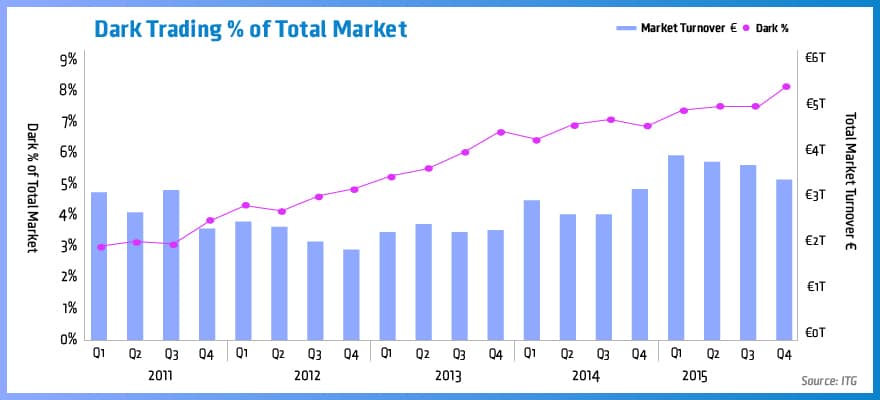
Dark pool trading has never been as popular in Europe as it has been in the US, but that’s been changing. According to ITG research, from December 2014 to December 2015, value traded in dark MTFs (Multilateral Trading Facilities) increased by 45%, while the volume of shares traded increased by just 25%.
Increasing demand among institutional investors suggests that new regulatory thresholds are too restrictive...
If regulators in the US have been focused on transparency and reporting as the way forward, European regulations under MiFID II have taken a very different tack indeed.
MiFID II's technical standards, which will likely come into force in early 2018, a years’ delay from the original timetable, include the ‘double volume cap’: hard caps of 4% for individual dark pools and 8% across all venues in Europe, subject to some exceptions for block-sized trades.
What that means is that if dark trading in a particular stock exceeds 4% of total volume of trading for the previous 12 months on a single venue, the stock will not be permitted to trade on that venue for six months, while all dark trading in a particular stock will be halted across Europe if aggregate dark trading in the stock exceeds 8% of total volume of trading for the previous 12 months, explained ITG in a statement.
European Trading in Dark Venues: ITG POSIT, UBS MTF, Turquoise Dark, Chi-X Dark, BATS Dark, Instinet Blockmatch, Liquidnet, Sigma X MTF, Smartpool, Blink MTF and Nordic@MID
Rob Boardman, EMEA CEO of ITG, said in a statement: “Increasing demand among institutional investors suggests that new regulatory thresholds are too restrictive, particularly for large-cap stocks.”
One source, from a group representing buy side interests, said that, despite the revelations of wrongdoing exposed in the US regulatory actions, dark pools provide protection from predatory traders, in other words, proprietary trading firms hitting large trades, information leakage, as well as avoiding the kind of market impact associated with filling a large order all at once.
What European regulators fail to understand, the source added, is that some of the small sized child orders in the dark are part of a larger parent order being filled in a price optimal way. For example, buying 150 shares in the dark (child order) is part of a larger 3,000 share fill (parent order).
Most of the issues that we have seen are in the US rather than in Europe
“Regulators, in my view anyway, still seem to miss that when it comes to smaller orders that are executed in the dark, these are child orders going back to larger parents and one of the reasons we have to do that is because we are unable to find a counterparty that is able to deal in the same depth and size of execution that we as traditional asset managers want to execute,” the source said.
In addition, the source believes that, in Europe, there are adequate protections from previous regulations in the form of waivers - reference price and large-in-scale.
“Most of the issues that we have seen are in the US rather than in Europe, and one of the reasons for that is that the rules in Europe around the operation of dark pools provide for sufficient protections for asset managers that operate in Europe,” the source said. “So there is that rather important distinction to be made between the issues that are coming out of the US operated dark pools, vis-à-vis their European counterparts.”
About 100% of FTSE100 companies will breach the cap on day one
Behavioural Changes
Although MiFID II does come with a review, and as a result the regulation could be tweaked, the source said it’s best to think of the double volume cap is being set in stone. And that regulation is going to have detrimental impacts on the market, the source added.
“No platform, no dark pool operator is ever going to want to be the venue that is switched off for breaching the 4% volume cap. What (those operators) have said is: if on our platform we are reaching 3.75% 3.8% at that point in time we will start cancelling orders because we do not want to be the ones switched off."
In other words, market practice could potentially develop an ‘on venue cap’ of 3.75 or 3.8% rather than 4%. “This sort of hard cap is not helpful”.
And then there’s the shares themselves: upwards of 20% of Royal Mail, some 25% of Pearson and WPP, for example, are traded in the dark.
No platform, no dark pool operator is ever going to want to be the venue that is switched off for breaching the 4% volume cap.
“About 100% of FTSE100 companies will breach the cap on day one. If you look at the FTSE250 or the (CAC40) in France or the shares listed on the DAX in Frankfurt, roughly almost 100% of all those companies will breach the cap on day one,
“That will drive behavioural change…it could defer investment decisions that asset managers are making, particularly for shares that are illiquid in nature. It could in fact have an impact on the value and holdings of our client’s assets, which is why we have always said having a hard cap in place could have a detrimental impact on the value of the assets of our clients if we have to defer investment opportunities because we are unable to find the right counterparty, or our transaction is in an illiquid share.”
Immediately after the New York Attorney General announced it was going after Barclays LX, the dark pool's market share saw a big drop – from 1.6% to 0.5%.
Since then, there’s been a bit of a recovery, but nowhere near prior to the June 2014 announcement. Credit Suisse, meanwhile, has remained at some 2% market share. The jury’s still out on whether the latest round of fines, totalling $154.3 million, for dark pool violations to be paid out by Barclays ($70 million) and Credit Suisse ($84.3 million) will impact volumes further.
The bigger impact to Barclays’ volumes in the aftermath might have something to do with the more acrimonious, highly public back and forth arguments after the New York Attorney General announced its investigation. Credit Suisse on the other hand maintained a lower profile, and also played a good game of expectations management, according to some sources.
TABB Group Analyst, Valerie Bogard, who collects information on dark pool liquidity for the consultancy, said that this latest action is just another step in a trend for more disclosure in the dark with US regulators FINRA (Financial Industry Regulatory Authority) and the SEC (Securities and Exchange Commission).
Valerie Bogard, Analyst, TABB Group
Over the last couple of years, US dark pool volumes - defined as dark ATSs (alternative trading systems) and single dealer platforms - have remained flat, with single dealer platforms comprising some 3%, and dark ATSs comprising about 14% of the industry as of 2015, according to TABB research.
The constant stream of dark pool wrongdoing continues to grow, however – Barclays and Credit Suisse are only the latest in a string of fines for ITG ($20 million), UBS ($14 million), and, going back a bit further to 2011, Pipeline ($1 million).
Doesn’t it make the buy side a little bit wary of using dark venues?
“People still find a value in going to the dark, they are there for a reason, so to a certain extent people will continue to find pools that they find worthy of liquidity,” said Bogard.
“Certainly investors have seen the actions of the SEC and have seen that they have shown that they are interested in shining more light on ATSs. So that functions as a means to alleviate some of (investors’) worries,” she added.
Regulatory Coordination and Captive Clients
The bulk of the order against Credit Suisse pertained to preferential relationships, optimizing between affiliated businesses, and lapses of disclosure, said Haim Bodek. Considering the size of the fine, more egregious behaviour might have been expected - something like ITG's secret proprietary trading desk.
You are probably going to see more lawsuits coming from investors...
One interesting note is that Light Pool, an ECN (electronic communication network), was included in the order against Credit Suisse. Specifically, that the bank misrepresented that it would identify ‘opportunistic’ traders and kick them out of the ECN, even though the relevant technology was not used for the first year that Light Pool was operational. Moreover ‘opportunistic’ traders were able to continue activities undeterred.
Bodek says that this is indicative of a "coordinated trading venue sweep by the SEC across lit exchanges, ECNs and dark pools".
Both Barclays and Credit Suisse expressed relief that the action is behind them and that they can move on.
Barclays said it’s “pleased to have reached agreement with both the SEC and the New York Attorney General to conclude their investigations concerning our US equities ATS practices and Market Access controls. The agreement will enable us to focus all of our efforts on serving our clients”.
Haim Bodek, Managing Principal, Decimus Capital Markets
While Credit Suisse said: “We are pleased to have resolved these matters with the SEC and the New York Attorney General”.
In a 2015 statement, ITG's Board Chair, Maureen O'Hara too expressed intentions to "put this regrettable legacy matter behind us and (work) to rebuild our clients’ trust".
Bodek is cautious on whether this regulatory action represents closure. For one thing, class action lawsuits may get new wind in their sails though proving damages has traditionally been a difficult task. One emerging exception is the share price hit borne by investors after wrong-doing announcements.
“You are probably going to see more lawsuits coming from investors in the firms, that are the result of enforcement actions to the degree that they negatively impact share price,” he said. “Those (lawsuits) are much more likely to result in getting through the early procedural hurdles such as motions to dismiss.”
If these had been minor venues, he added, the volumes would have completely collapsed from the first whiff of trouble. But banks have a captive multi-product relationship that includes commissions bundled with research, which leads to dependency in the customer base of the major banks and makes clients resistant to moving.
European v US Dark Pools
Dark pool trading has never been as popular in Europe as it has been in the US, but that’s been changing. According to ITG research, from December 2014 to December 2015, value traded in dark MTFs (Multilateral Trading Facilities) increased by 45%, while the volume of shares traded increased by just 25%.
Increasing demand among institutional investors suggests that new regulatory thresholds are too restrictive...
If regulators in the US have been focused on transparency and reporting as the way forward, European regulations under MiFID II have taken a very different tack indeed.
MiFID II's technical standards, which will likely come into force in early 2018, a years’ delay from the original timetable, include the ‘double volume cap’: hard caps of 4% for individual dark pools and 8% across all venues in Europe, subject to some exceptions for block-sized trades.
What that means is that if dark trading in a particular stock exceeds 4% of total volume of trading for the previous 12 months on a single venue, the stock will not be permitted to trade on that venue for six months, while all dark trading in a particular stock will be halted across Europe if aggregate dark trading in the stock exceeds 8% of total volume of trading for the previous 12 months, explained ITG in a statement.
European Trading in Dark Venues: ITG POSIT, UBS MTF, Turquoise Dark, Chi-X Dark, BATS Dark, Instinet Blockmatch, Liquidnet, Sigma X MTF, Smartpool, Blink MTF and Nordic@MID
Rob Boardman, EMEA CEO of ITG, said in a statement: “Increasing demand among institutional investors suggests that new regulatory thresholds are too restrictive, particularly for large-cap stocks.”
One source, from a group representing buy side interests, said that, despite the revelations of wrongdoing exposed in the US regulatory actions, dark pools provide protection from predatory traders, in other words, proprietary trading firms hitting large trades, information leakage, as well as avoiding the kind of market impact associated with filling a large order all at once.
What European regulators fail to understand, the source added, is that some of the small sized child orders in the dark are part of a larger parent order being filled in a price optimal way. For example, buying 150 shares in the dark (child order) is part of a larger 3,000 share fill (parent order).
Most of the issues that we have seen are in the US rather than in Europe
“Regulators, in my view anyway, still seem to miss that when it comes to smaller orders that are executed in the dark, these are child orders going back to larger parents and one of the reasons we have to do that is because we are unable to find a counterparty that is able to deal in the same depth and size of execution that we as traditional asset managers want to execute,” the source said.
In addition, the source believes that, in Europe, there are adequate protections from previous regulations in the form of waivers - reference price and large-in-scale.
“Most of the issues that we have seen are in the US rather than in Europe, and one of the reasons for that is that the rules in Europe around the operation of dark pools provide for sufficient protections for asset managers that operate in Europe,” the source said. “So there is that rather important distinction to be made between the issues that are coming out of the US operated dark pools, vis-à-vis their European counterparts.”
About 100% of FTSE100 companies will breach the cap on day one
Behavioural Changes
Although MiFID II does come with a review, and as a result the regulation could be tweaked, the source said it’s best to think of the double volume cap is being set in stone. And that regulation is going to have detrimental impacts on the market, the source added.
“No platform, no dark pool operator is ever going to want to be the venue that is switched off for breaching the 4% volume cap. What (those operators) have said is: if on our platform we are reaching 3.75% 3.8% at that point in time we will start cancelling orders because we do not want to be the ones switched off."
In other words, market practice could potentially develop an ‘on venue cap’ of 3.75 or 3.8% rather than 4%. “This sort of hard cap is not helpful”.
And then there’s the shares themselves: upwards of 20% of Royal Mail, some 25% of Pearson and WPP, for example, are traded in the dark.
No platform, no dark pool operator is ever going to want to be the venue that is switched off for breaching the 4% volume cap.
“About 100% of FTSE100 companies will breach the cap on day one. If you look at the FTSE250 or the (CAC40) in France or the shares listed on the DAX in Frankfurt, roughly almost 100% of all those companies will breach the cap on day one,
“That will drive behavioural change…it could defer investment decisions that asset managers are making, particularly for shares that are illiquid in nature. It could in fact have an impact on the value and holdings of our client’s assets, which is why we have always said having a hard cap in place could have a detrimental impact on the value of the assets of our clients if we have to defer investment opportunities because we are unable to find the right counterparty, or our transaction is in an illiquid share.”
In this video, we review @AxiOfficialChannel , a multi-asset broker offering access to forex and CFD markets through MetaTrader 4, MetaTrader 5, the Axi Trading App, and copy trading solutions.
We examine the broker’s regulatory framework, platform offering, market coverage, and customer support structure. We also explore key features such as available trading instruments, swap-free account options, funding considerations, and multilingual support.
Watch the full video for a clear, fact-based overview of Axi’s products, trading tools, and overall broker offering.
#Axi #ForexBroker #CFDTrading #FinanceMagnates #Trading #BrokerReview #OnlineTrading
In this video, we review @AxiOfficialChannel , a multi-asset broker offering access to forex and CFD markets through MetaTrader 4, MetaTrader 5, the Axi Trading App, and copy trading solutions.
We examine the broker’s regulatory framework, platform offering, market coverage, and customer support structure. We also explore key features such as available trading instruments, swap-free account options, funding considerations, and multilingual support.
Watch the full video for a clear, fact-based overview of Axi’s products, trading tools, and overall broker offering.
#Axi #ForexBroker #CFDTrading #FinanceMagnates #Trading #BrokerReview #OnlineTrading
In this video, we review @AxiOfficialChannel , a multi-asset broker offering access to forex and CFD markets through MetaTrader 4, MetaTrader 5, the Axi Trading App, and copy trading solutions.
We examine the broker’s regulatory framework, platform offering, market coverage, and customer support structure. We also explore key features such as available trading instruments, swap-free account options, funding considerations, and multilingual support.
Watch the full video for a clear, fact-based overview of Axi’s products, trading tools, and overall broker offering.
#Axi #ForexBroker #CFDTrading #FinanceMagnates #Trading #BrokerReview #OnlineTrading
In this video, we review @AxiOfficialChannel , a multi-asset broker offering access to forex and CFD markets through MetaTrader 4, MetaTrader 5, the Axi Trading App, and copy trading solutions.
We examine the broker’s regulatory framework, platform offering, market coverage, and customer support structure. We also explore key features such as available trading instruments, swap-free account options, funding considerations, and multilingual support.
Watch the full video for a clear, fact-based overview of Axi’s products, trading tools, and overall broker offering.
#Axi #ForexBroker #CFDTrading #FinanceMagnates #Trading #BrokerReview #OnlineTrading
In this video, we review @AxiOfficialChannel , a multi-asset broker offering access to forex and CFD markets through MetaTrader 4, MetaTrader 5, the Axi Trading App, and copy trading solutions.
We examine the broker’s regulatory framework, platform offering, market coverage, and customer support structure. We also explore key features such as available trading instruments, swap-free account options, funding considerations, and multilingual support.
Watch the full video for a clear, fact-based overview of Axi’s products, trading tools, and overall broker offering.
#Axi #ForexBroker #CFDTrading #FinanceMagnates #Trading #BrokerReview #OnlineTrading
In this video, we review @AxiOfficialChannel , a multi-asset broker offering access to forex and CFD markets through MetaTrader 4, MetaTrader 5, the Axi Trading App, and copy trading solutions.
We examine the broker’s regulatory framework, platform offering, market coverage, and customer support structure. We also explore key features such as available trading instruments, swap-free account options, funding considerations, and multilingual support.
Watch the full video for a clear, fact-based overview of Axi’s products, trading tools, and overall broker offering.
#Axi #ForexBroker #CFDTrading #FinanceMagnates #Trading #BrokerReview #OnlineTrading
Multi-Asset or Die: The New Brokerage Playbook
This panel will explore how firms are moving beyond CFDs into crypto, perpetuals, equities, and multi‑asset offerings, and the challenges they face across regulation, technology, liquidity, and risk management. It examines what is driving the shift, what it takes to execute it successfully, and how brokers can position themselves for the next phase of growth.
Beyond Reach? Retail Investor Acquisition Across APAC
APAC accounts for two-thirds of global retail trading traffic, but with differences of language, regulation, and trader profile, the region's growth is ag great as complexity.
This session gathers CMOs, heads of acquisition, and IB relationship managers to examine what actually works, channel by channel, market by market.
Attendees will walk away with:
A clear view of which channels deliver funded, retained traders across Singapore, Japan, and Southeast Asia
Understanding of how to structure IB partnerships for LTV, not first deposit
Insight into what localization actually costs beyond the translation budget
Perspective on how ad restrictions, crypto promotion limits, and bundling rules differ across APAC jurisdictions
A read on whether the super-app model changes acquisition economics for retail investing platforms
APAC accounts for two-thirds of global retail trading traffic, but with differences of language, regulation, and trader profile, the region's growth is ag great as complexity.
This session gathers CMOs, heads of acquisition, and IB relationship managers to examine what actually works, channel by channel, market by market.
Attendees will walk away with:
A clear view of which channels deliver funded, retained traders across Singapore, Japan, and Southeast Asia
Understanding of how to structure IB partnerships for LTV, not first deposit
Insight into what localization actually costs beyond the translation budget
Perspective on how ad restrictions, crypto promotion limits, and bundling rules differ across APAC jurisdictions
A read on whether the super-app model changes acquisition economics for retail investing platforms
APAC accounts for two-thirds of global retail trading traffic, but with differences of language, regulation, and trader profile, the region's growth is ag great as complexity.
This session gathers CMOs, heads of acquisition, and IB relationship managers to examine what actually works, channel by channel, market by market.
Attendees will walk away with:
A clear view of which channels deliver funded, retained traders across Singapore, Japan, and Southeast Asia
Understanding of how to structure IB partnerships for LTV, not first deposit
Insight into what localization actually costs beyond the translation budget
Perspective on how ad restrictions, crypto promotion limits, and bundling rules differ across APAC jurisdictions
A read on whether the super-app model changes acquisition economics for retail investing platforms
APAC accounts for two-thirds of global retail trading traffic, but with differences of language, regulation, and trader profile, the region's growth is ag great as complexity.
This session gathers CMOs, heads of acquisition, and IB relationship managers to examine what actually works, channel by channel, market by market.
Attendees will walk away with:
A clear view of which channels deliver funded, retained traders across Singapore, Japan, and Southeast Asia
Understanding of how to structure IB partnerships for LTV, not first deposit
Insight into what localization actually costs beyond the translation budget
Perspective on how ad restrictions, crypto promotion limits, and bundling rules differ across APAC jurisdictions
A read on whether the super-app model changes acquisition economics for retail investing platforms
APAC accounts for two-thirds of global retail trading traffic, but with differences of language, regulation, and trader profile, the region's growth is ag great as complexity.
This session gathers CMOs, heads of acquisition, and IB relationship managers to examine what actually works, channel by channel, market by market.
Attendees will walk away with:
A clear view of which channels deliver funded, retained traders across Singapore, Japan, and Southeast Asia
Understanding of how to structure IB partnerships for LTV, not first deposit
Insight into what localization actually costs beyond the translation budget
Perspective on how ad restrictions, crypto promotion limits, and bundling rules differ across APAC jurisdictions
A read on whether the super-app model changes acquisition economics for retail investing platforms
APAC accounts for two-thirds of global retail trading traffic, but with differences of language, regulation, and trader profile, the region's growth is ag great as complexity.
This session gathers CMOs, heads of acquisition, and IB relationship managers to examine what actually works, channel by channel, market by market.
Attendees will walk away with:
A clear view of which channels deliver funded, retained traders across Singapore, Japan, and Southeast Asia
Understanding of how to structure IB partnerships for LTV, not first deposit
Insight into what localization actually costs beyond the translation budget
Perspective on how ad restrictions, crypto promotion limits, and bundling rules differ across APAC jurisdictions
A read on whether the super-app model changes acquisition economics for retail investing platforms
Buy, Build or Both? Trading Tech for Brokers, Banks & Beyond
For every feature and product, someone has to decide: build it in-house or buy from a vendor. In Singapore and across APAC, local banks and global players face the same question with very different constraints.
This session gathers heads of technology and e-trading to compare how client demand and cost structures shape their choices, and how long it actually takes to ship in each.
Attendees will walk away with:
First-hand view of how client feedback informs decision-making across different market participants.
Understanding pain points and benefits of working with 3rd party integrations at scale.
Insight into products and innovation banks’ retail and trading heads will look for in 2026.
For every feature and product, someone has to decide: build it in-house or buy from a vendor. In Singapore and across APAC, local banks and global players face the same question with very different constraints.
This session gathers heads of technology and e-trading to compare how client demand and cost structures shape their choices, and how long it actually takes to ship in each.
Attendees will walk away with:
First-hand view of how client feedback informs decision-making across different market participants.
Understanding pain points and benefits of working with 3rd party integrations at scale.
Insight into products and innovation banks’ retail and trading heads will look for in 2026.
For every feature and product, someone has to decide: build it in-house or buy from a vendor. In Singapore and across APAC, local banks and global players face the same question with very different constraints.
This session gathers heads of technology and e-trading to compare how client demand and cost structures shape their choices, and how long it actually takes to ship in each.
Attendees will walk away with:
First-hand view of how client feedback informs decision-making across different market participants.
Understanding pain points and benefits of working with 3rd party integrations at scale.
Insight into products and innovation banks’ retail and trading heads will look for in 2026.
For every feature and product, someone has to decide: build it in-house or buy from a vendor. In Singapore and across APAC, local banks and global players face the same question with very different constraints.
This session gathers heads of technology and e-trading to compare how client demand and cost structures shape their choices, and how long it actually takes to ship in each.
Attendees will walk away with:
First-hand view of how client feedback informs decision-making across different market participants.
Understanding pain points and benefits of working with 3rd party integrations at scale.
Insight into products and innovation banks’ retail and trading heads will look for in 2026.
For every feature and product, someone has to decide: build it in-house or buy from a vendor. In Singapore and across APAC, local banks and global players face the same question with very different constraints.
This session gathers heads of technology and e-trading to compare how client demand and cost structures shape their choices, and how long it actually takes to ship in each.
Attendees will walk away with:
First-hand view of how client feedback informs decision-making across different market participants.
Understanding pain points and benefits of working with 3rd party integrations at scale.
Insight into products and innovation banks’ retail and trading heads will look for in 2026.
For every feature and product, someone has to decide: build it in-house or buy from a vendor. In Singapore and across APAC, local banks and global players face the same question with very different constraints.
This session gathers heads of technology and e-trading to compare how client demand and cost structures shape their choices, and how long it actually takes to ship in each.
Attendees will walk away with:
First-hand view of how client feedback informs decision-making across different market participants.
Understanding pain points and benefits of working with 3rd party integrations at scale.
Insight into products and innovation banks’ retail and trading heads will look for in 2026.