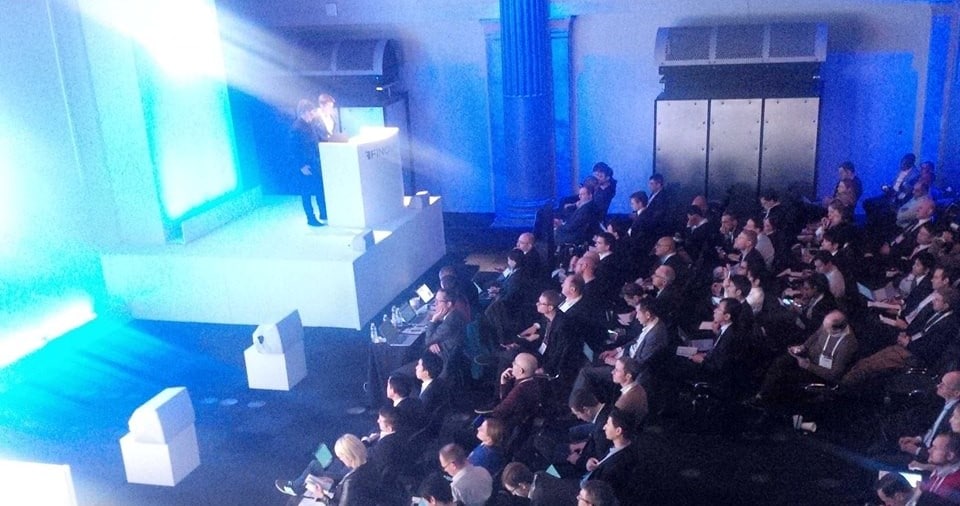
Fintech’s relationship with institutions is branching out - whether that’s as disruptive threat to the established order or seeking funding and a client base from those same powerful backers.
Finovate Europe ran February 9-10 in London, UK.
When Scalable Capital started its presentation at Finovate this week in London, Co-Founder and Managing Director Adam French asked a question on many people’s minds: “Does the world need another robo?”
The newly minted investment firm obviously thinks so.
Instead of asset class allocations based on a risk category, clients are allocated ‘risk units’ that get used for a trading strategy, and portfolios change as market risk does. In other words, just because market risk changes, doesn’t mean that the client’s tolerance for risk needs to.
Speaking to Finance Magnates, Erik Podzuweit, Co-Founder and CEO at Scalable, said the firm's competition is banking advisory but there's a big opportunity with people who are doing nothing with their money at all.

In Germany, there’s some €2 trillion languishing in bank accounts not earning interest, said Ella Rabener, Co-Founder and Chief Marketing Officer at Scalable: “People don’t know what to do with their money, they are afraid to do it on their own in the capital markets because they know there is quite a bit of risk involved.”
Average initial investment is between €40,000 and €50,000, and tends to come from higher earning professionals. Scalable has no plans to sell into institutions, however. “We don’t want to become a software provider.” said Podzuweit.
Rabener added: “There is no white labelling of any form. We really want to become a brand.”
On the other end of the spectrum is Capitali.se, which has created a kind of virtual assistant to take your words and convert them to trades. Just type in what you want to buy and under what circumstance you want to exit - either in trader or common language - and the machine works for you. It can also tell you how to do it better.
The way we envision it, you will manage a portfolio of your ideas.
“Today, when you trade, you manage a portfolio of a lot of single trading positions. The way we envision it, you will manage a portfolio of your ideas,” said CEO of Capitali.se, Shahar Rabin. Interest has come from banks and brokers, with equities and FX being favoured asset classes.
Unlike Scalable, however, there are no designs to be its own shop. “When we offer it to banks and brokers, we integrate into them and give them a white label solution and they can offer it to their clients.”
For market data provider Xignite, about 40% of clients are developers for technology companies selling software to institutional or retail customers. Another 40% are banks, brokers, asset managers and hedge funds. The remaining are corporate businesses, with a big portion consuming FX data.

In the last couple of years, the fastest growing client base had been Fintech though there is now a shift into banks feeling the competitive pressure, said Xignite’s CEO Stephane Dubois. Xignite recently completed a $20.5 million round of funding led by QUICK Corporation, part of the Nikkei Group and the largest financial information provider in Japan.
“A lot of large banks became our client because they bought some Fintech company that was our client…Some of them are buying those firms and incorporating them into their model,” he said.
Banks’ cost structures were restrictive in terms of what kind of customers they could afford to serve. Fintech companies came in and automated it all. “They removed all this friction that you had in the market and essentially lowered the profitability points and lowered the cost it takes to service customers,” said Dubois.
It’s not like the Fintech companies will kill the banks.
But is it really competition between Fintech and the banks? Or is there a lot of cooperation going on? After all, some of the major investors in Fintech companies are institutional.
There has been a shift, he noted. At previous Finovate conferences, there were quite a few companies wanting to become the retail player offering it all: the trading, the advice, the payment service, etc. Now, it’s more about selling software that a firm could build a robo-advisor with, for example.
Jehan de Castet, CEO of Fluo, a robo-advisory service provider for the insurance industry, said part of the push is that customer processing needs to be cheap, and that means automation. "With the new robo-advisor in particular, you are able to treat even lower profit consumers in the right way rather than shutting down this market." Fluo works with firms such as Allianz, AIG, Generali, and Axa, said de Castet.
Trouble- or Peace-Makers?
There are two ways to see Fintech's role: disruptor or collaborator, said Amaury de la Lance, CEO at Aston iTrade Finance. "The disruption way is to build a business where you fight with the bank and the financial institution, which is a great idea and it can work especially on the B2C market."
Aston decided to go towards collaboration by helping corporates with their invoices. De la Lance explained that businesses are looking for short-term funding, and Aston gets cash to corporates using several strategies: reducing payment delay; connecting corporates to an insurer covering non-payment; and considering cash-raising options in the form of invoice securitization via fund managers. But the platform remains proprietary to Aston, he added.
"We are purely on B2B and collaboration, which is one of the part of the Fintech market."
The extent to which working with traditional banks becomes a popular rallying cry remains to be seen, since in its own tradition Fintech has made waves by threatening to cause upheaval in the established order.
Still, looking back on Finovate's two days, Xignite's Dubois said that the word used most was 'white label': “It’s not like the Fintech companies will kill the banks. The banks will evolve."
When Scalable Capital started its presentation at Finovate this week in London, Co-Founder and Managing Director Adam French asked a question on many people’s minds: “Does the world need another robo?”
The newly minted investment firm obviously thinks so.
Instead of asset class allocations based on a risk category, clients are allocated ‘risk units’ that get used for a trading strategy, and portfolios change as market risk does. In other words, just because market risk changes, doesn’t mean that the client’s tolerance for risk needs to.
Speaking to Finance Magnates, Erik Podzuweit, Co-Founder and CEO at Scalable, said the firm's competition is banking advisory but there's a big opportunity with people who are doing nothing with their money at all.
In Germany, there’s some €2 trillion languishing in bank accounts not earning interest, said Ella Rabener, Co-Founder and Chief Marketing Officer at Scalable: “People don’t know what to do with their money, they are afraid to do it on their own in the capital markets because they know there is quite a bit of risk involved.”
Average initial investment is between €40,000 and €50,000, and tends to come from higher earning professionals. Scalable has no plans to sell into institutions, however. “We don’t want to become a software provider.” said Podzuweit.
Rabener added: “There is no white labelling of any form. We really want to become a brand.”
On the other end of the spectrum is Capitali.se, which has created a kind of virtual assistant to take your words and convert them to trades. Just type in what you want to buy and under what circumstance you want to exit - either in trader or common language - and the machine works for you. It can also tell you how to do it better.
The way we envision it, you will manage a portfolio of your ideas.
“Today, when you trade, you manage a portfolio of a lot of single trading positions. The way we envision it, you will manage a portfolio of your ideas,” said CEO of Capitali.se, Shahar Rabin. Interest has come from banks and brokers, with equities and FX being favoured asset classes.
Unlike Scalable, however, there are no designs to be its own shop. “When we offer it to banks and brokers, we integrate into them and give them a white label solution and they can offer it to their clients.”
For market data provider Xignite, about 40% of clients are developers for technology companies selling software to institutional or retail customers. Another 40% are banks, brokers, asset managers and hedge funds. The remaining are corporate businesses, with a big portion consuming FX data.
In the last couple of years, the fastest growing client base had been Fintech though there is now a shift into banks feeling the competitive pressure, said Xignite’s CEO Stephane Dubois. Xignite recently completed a $20.5 million round of funding led by QUICK Corporation, part of the Nikkei Group and the largest financial information provider in Japan.
“A lot of large banks became our client because they bought some Fintech company that was our client…Some of them are buying those firms and incorporating them into their model,” he said.
Banks’ cost structures were restrictive in terms of what kind of customers they could afford to serve. Fintech companies came in and automated it all. “They removed all this friction that you had in the market and essentially lowered the profitability points and lowered the cost it takes to service customers,” said Dubois.
It’s not like the Fintech companies will kill the banks.
But is it really competition between Fintech and the banks? Or is there a lot of cooperation going on? After all, some of the major investors in Fintech companies are institutional.
There has been a shift, he noted. At previous Finovate conferences, there were quite a few companies wanting to become the retail player offering it all: the trading, the advice, the payment service, etc. Now, it’s more about selling software that a firm could build a robo-advisor with, for example.
Jehan de Castet, CEO of Fluo, a robo-advisory service provider for the insurance industry, said part of the push is that customer processing needs to be cheap, and that means automation. "With the new robo-advisor in particular, you are able to treat even lower profit consumers in the right way rather than shutting down this market." Fluo works with firms such as Allianz, AIG, Generali, and Axa, said de Castet.
Trouble- or Peace-Makers?
There are two ways to see Fintech's role: disruptor or collaborator, said Amaury de la Lance, CEO at Aston iTrade Finance. "The disruption way is to build a business where you fight with the bank and the financial institution, which is a great idea and it can work especially on the B2C market."
Aston decided to go towards collaboration by helping corporates with their invoices. De la Lance explained that businesses are looking for short-term funding, and Aston gets cash to corporates using several strategies: reducing payment delay; connecting corporates to an insurer covering non-payment; and considering cash-raising options in the form of invoice securitization via fund managers. But the platform remains proprietary to Aston, he added.
"We are purely on B2B and collaboration, which is one of the part of the Fintech market."
The extent to which working with traditional banks becomes a popular rallying cry remains to be seen, since in its own tradition Fintech has made waves by threatening to cause upheaval in the established order.
Still, looking back on Finovate's two days, Xignite's Dubois said that the word used most was 'white label': “It’s not like the Fintech companies will kill the banks. The banks will evolve."
GCEX Secures MiCA Licence in Denmark as EU Crypto Regulation Takes Shape
Featured Videos
OnePrime’s Jerry Khargi on Infrastructure, Liquidity & Trust | Executive Interview
Recorded live at FMLS:25 London, this exclusive executive interview features Jerry Khargi, Executive Director at OnePrime, in conversation with Andrea Badiola Mateos from Finance Magnates.
In this in-depth discussion, Jerry shares:
- OnePrime’s journey from a retail-focused business to a global institutional liquidity provider
- What truly sets award-winning trading infrastructure apart
- Key trends shaping institutional trading, including technology and AI
- The importance of transparency, ethics, and reputation in long-term success
- OnePrime’s vision for growth over the next 12–24 months
Fresh from winning Finance Magnates’ Best Trading Infrastructure Broker, Jerry explains how experience, mentorship, and real-world problem solving form the “special sauce” behind OnePrime’s institutional offering.
🏆 Award Highlight: Best Trading Infrastructure Broker
👉 Subscribe to Finance Magnates for more executive interviews, market insights, and exclusive coverage from the world’s leading financial events.
#FMLS25 #FinanceMagnates #OnePrime #InstitutionalTrading #Liquidity #TradingInfrastructure #ExecutiveInterview
Recorded live at FMLS:25 London, this exclusive executive interview features Jerry Khargi, Executive Director at OnePrime, in conversation with Andrea Badiola Mateos from Finance Magnates.
In this in-depth discussion, Jerry shares:
- OnePrime’s journey from a retail-focused business to a global institutional liquidity provider
- What truly sets award-winning trading infrastructure apart
- Key trends shaping institutional trading, including technology and AI
- The importance of transparency, ethics, and reputation in long-term success
- OnePrime’s vision for growth over the next 12–24 months
Fresh from winning Finance Magnates’ Best Trading Infrastructure Broker, Jerry explains how experience, mentorship, and real-world problem solving form the “special sauce” behind OnePrime’s institutional offering.
🏆 Award Highlight: Best Trading Infrastructure Broker
👉 Subscribe to Finance Magnates for more executive interviews, market insights, and exclusive coverage from the world’s leading financial events.
#FMLS25 #FinanceMagnates #OnePrime #InstitutionalTrading #Liquidity #TradingInfrastructure #ExecutiveInterview
Recorded live at FMLS:25 London, this exclusive executive interview features Jerry Khargi, Executive Director at OnePrime, in conversation with Andrea Badiola Mateos from Finance Magnates.
In this in-depth discussion, Jerry shares:
- OnePrime’s journey from a retail-focused business to a global institutional liquidity provider
- What truly sets award-winning trading infrastructure apart
- Key trends shaping institutional trading, including technology and AI
- The importance of transparency, ethics, and reputation in long-term success
- OnePrime’s vision for growth over the next 12–24 months
Fresh from winning Finance Magnates’ Best Trading Infrastructure Broker, Jerry explains how experience, mentorship, and real-world problem solving form the “special sauce” behind OnePrime’s institutional offering.
🏆 Award Highlight: Best Trading Infrastructure Broker
👉 Subscribe to Finance Magnates for more executive interviews, market insights, and exclusive coverage from the world’s leading financial events.
#FMLS25 #FinanceMagnates #OnePrime #InstitutionalTrading #Liquidity #TradingInfrastructure #ExecutiveInterview
Recorded live at FMLS:25 London, this exclusive executive interview features Jerry Khargi, Executive Director at OnePrime, in conversation with Andrea Badiola Mateos from Finance Magnates.
In this in-depth discussion, Jerry shares:
- OnePrime’s journey from a retail-focused business to a global institutional liquidity provider
- What truly sets award-winning trading infrastructure apart
- Key trends shaping institutional trading, including technology and AI
- The importance of transparency, ethics, and reputation in long-term success
- OnePrime’s vision for growth over the next 12–24 months
Fresh from winning Finance Magnates’ Best Trading Infrastructure Broker, Jerry explains how experience, mentorship, and real-world problem solving form the “special sauce” behind OnePrime’s institutional offering.
🏆 Award Highlight: Best Trading Infrastructure Broker
👉 Subscribe to Finance Magnates for more executive interviews, market insights, and exclusive coverage from the world’s leading financial events.
#FMLS25 #FinanceMagnates #OnePrime #InstitutionalTrading #Liquidity #TradingInfrastructure #ExecutiveInterview
How does the Finance Magnates newsroom decide which updates are worth covering? #financenews
What makes an update worth covering in financial media?
According to Yam Yehoshua, Editor-in-Chief at Finance Magnates, editorial focus starts with relevance: stories that serve the industry, support brokers and technology providers, and help decision-makers navigate their businesses.
A reminder that strong financial journalism is built on value, not volume.
What makes an update worth covering in financial media?
According to Yam Yehoshua, Editor-in-Chief at Finance Magnates, editorial focus starts with relevance: stories that serve the industry, support brokers and technology providers, and help decision-makers navigate their businesses.
A reminder that strong financial journalism is built on value, not volume.
What makes an update worth covering in financial media?
According to Yam Yehoshua, Editor-in-Chief at Finance Magnates, editorial focus starts with relevance: stories that serve the industry, support brokers and technology providers, and help decision-makers navigate their businesses.
A reminder that strong financial journalism is built on value, not volume.
What makes an update worth covering in financial media?
According to Yam Yehoshua, Editor-in-Chief at Finance Magnates, editorial focus starts with relevance: stories that serve the industry, support brokers and technology providers, and help decision-makers navigate their businesses.
A reminder that strong financial journalism is built on value, not volume.
What makes an update worth covering in financial media?
According to Yam Yehoshua, Editor-in-Chief at Finance Magnates, editorial focus starts with relevance: stories that serve the industry, support brokers and technology providers, and help decision-makers navigate their businesses.
A reminder that strong financial journalism is built on value, not volume.
What makes an update worth covering in financial media?
According to Yam Yehoshua, Editor-in-Chief at Finance Magnates, editorial focus starts with relevance: stories that serve the industry, support brokers and technology providers, and help decision-makers navigate their businesses.
A reminder that strong financial journalism is built on value, not volume.
Liquidity as a Business: How Brokers Can Earn More
This webinar will focuses on how brokers can create new revenue streams by launching or enhancing their liquidity business.
John Murillo, Chief Dealing Officer of the B2BROKER group, covers how:
- Retail brokers can launch their own B2B arm to distribute liquidity and boost profitability.
- Institutional brokers can upgrade their liquidity offering and strengthen their market position.
- New entrants can start from scratch and become liquidity providers through a ready-made turnkey solution.
Hosted by B2BROKER, a global fintech provider of liquidity and technology solutions, the session will reveal how to monetize liquidity, accelerate business growth, and increase profitability using the Liquidity Provider Turnkey solution.
📣 Stay updated with the latest in finance and trading! Follow Finance Magnates across our social media platforms for news, insights, and event updates.
Connect with us today:
🔗 LinkedIn: / https://www.linkedin.com/company/financemagnates/
👍 Facebook: / https://www.facebook.com/financemagnates/
📸 Instagram: / https://www.instagram.com/financemagnates_official/?hl=en
🐦 X: https://x.com/financemagnates?
🎥 TikTok: https://www.tiktok.com/tag/financemag...
▶️ YouTube: / @financemagnates_official
This webinar will focuses on how brokers can create new revenue streams by launching or enhancing their liquidity business.
John Murillo, Chief Dealing Officer of the B2BROKER group, covers how:
- Retail brokers can launch their own B2B arm to distribute liquidity and boost profitability.
- Institutional brokers can upgrade their liquidity offering and strengthen their market position.
- New entrants can start from scratch and become liquidity providers through a ready-made turnkey solution.
Hosted by B2BROKER, a global fintech provider of liquidity and technology solutions, the session will reveal how to monetize liquidity, accelerate business growth, and increase profitability using the Liquidity Provider Turnkey solution.
📣 Stay updated with the latest in finance and trading! Follow Finance Magnates across our social media platforms for news, insights, and event updates.
Connect with us today:
🔗 LinkedIn: / https://www.linkedin.com/company/financemagnates/
👍 Facebook: / https://www.facebook.com/financemagnates/
📸 Instagram: / https://www.instagram.com/financemagnates_official/?hl=en
🐦 X: https://x.com/financemagnates?
🎥 TikTok: https://www.tiktok.com/tag/financemag...
▶️ YouTube: / @financemagnates_official
This webinar will focuses on how brokers can create new revenue streams by launching or enhancing their liquidity business.
John Murillo, Chief Dealing Officer of the B2BROKER group, covers how:
- Retail brokers can launch their own B2B arm to distribute liquidity and boost profitability.
- Institutional brokers can upgrade their liquidity offering and strengthen their market position.
- New entrants can start from scratch and become liquidity providers through a ready-made turnkey solution.
Hosted by B2BROKER, a global fintech provider of liquidity and technology solutions, the session will reveal how to monetize liquidity, accelerate business growth, and increase profitability using the Liquidity Provider Turnkey solution.
📣 Stay updated with the latest in finance and trading! Follow Finance Magnates across our social media platforms for news, insights, and event updates.
Connect with us today:
🔗 LinkedIn: / https://www.linkedin.com/company/financemagnates/
👍 Facebook: / https://www.facebook.com/financemagnates/
📸 Instagram: / https://www.instagram.com/financemagnates_official/?hl=en
🐦 X: https://x.com/financemagnates?
🎥 TikTok: https://www.tiktok.com/tag/financemag...
▶️ YouTube: / @financemagnates_official
This webinar will focuses on how brokers can create new revenue streams by launching or enhancing their liquidity business.
John Murillo, Chief Dealing Officer of the B2BROKER group, covers how:
- Retail brokers can launch their own B2B arm to distribute liquidity and boost profitability.
- Institutional brokers can upgrade their liquidity offering and strengthen their market position.
- New entrants can start from scratch and become liquidity providers through a ready-made turnkey solution.
Hosted by B2BROKER, a global fintech provider of liquidity and technology solutions, the session will reveal how to monetize liquidity, accelerate business growth, and increase profitability using the Liquidity Provider Turnkey solution.
📣 Stay updated with the latest in finance and trading! Follow Finance Magnates across our social media platforms for news, insights, and event updates.
Connect with us today:
🔗 LinkedIn: / https://www.linkedin.com/company/financemagnates/
👍 Facebook: / https://www.facebook.com/financemagnates/
📸 Instagram: / https://www.instagram.com/financemagnates_official/?hl=en
🐦 X: https://x.com/financemagnates?
🎥 TikTok: https://www.tiktok.com/tag/financemag...
▶️ YouTube: / @financemagnates_official
This webinar will focuses on how brokers can create new revenue streams by launching or enhancing their liquidity business.
John Murillo, Chief Dealing Officer of the B2BROKER group, covers how:
- Retail brokers can launch their own B2B arm to distribute liquidity and boost profitability.
- Institutional brokers can upgrade their liquidity offering and strengthen their market position.
- New entrants can start from scratch and become liquidity providers through a ready-made turnkey solution.
Hosted by B2BROKER, a global fintech provider of liquidity and technology solutions, the session will reveal how to monetize liquidity, accelerate business growth, and increase profitability using the Liquidity Provider Turnkey solution.
📣 Stay updated with the latest in finance and trading! Follow Finance Magnates across our social media platforms for news, insights, and event updates.
Connect with us today:
🔗 LinkedIn: / https://www.linkedin.com/company/financemagnates/
👍 Facebook: / https://www.facebook.com/financemagnates/
📸 Instagram: / https://www.instagram.com/financemagnates_official/?hl=en
🐦 X: https://x.com/financemagnates?
🎥 TikTok: https://www.tiktok.com/tag/financemag...
▶️ YouTube: / @financemagnates_official
This webinar will focuses on how brokers can create new revenue streams by launching or enhancing their liquidity business.
John Murillo, Chief Dealing Officer of the B2BROKER group, covers how:
- Retail brokers can launch their own B2B arm to distribute liquidity and boost profitability.
- Institutional brokers can upgrade their liquidity offering and strengthen their market position.
- New entrants can start from scratch and become liquidity providers through a ready-made turnkey solution.
Hosted by B2BROKER, a global fintech provider of liquidity and technology solutions, the session will reveal how to monetize liquidity, accelerate business growth, and increase profitability using the Liquidity Provider Turnkey solution.
📣 Stay updated with the latest in finance and trading! Follow Finance Magnates across our social media platforms for news, insights, and event updates.
Connect with us today:
🔗 LinkedIn: / https://www.linkedin.com/company/financemagnates/
👍 Facebook: / https://www.facebook.com/financemagnates/
📸 Instagram: / https://www.instagram.com/financemagnates_official/?hl=en
🐦 X: https://x.com/financemagnates?
🎥 TikTok: https://www.tiktok.com/tag/financemag...
▶️ YouTube: / @financemagnates_official
How FYNXT is Transforming Brokerages with Modular Tech | Executive Interview with Stephen Miles
Join us for an exclusive interview with Stephen Miles, Chief Revenue Officer at FYNXT, recorded live at FMLS:25. In this conversation, Stephen breaks down how modular brokerage technology is driving growth, retention, and efficiency across the brokerage industry.
Learn how FYNXT's unified yet modular platform is giving brokers a competitive edge—powering faster onboarding, increased trading volumes, and dramatically improved IB performance.
🔑 What You'll Learn in This Video:
- The biggest challenges brokerages face going into 2026
- Why FYNXT’s modular platform is outperforming in-house builds
- How automation is transforming IB channels
- The real ROI: 11x LTV increases and reduced acquisition costs
👉 Don’t forget to like, comment, and subscribe.
#FYNXT #StephenMiles #FMLS2025 #BrokerageTechnology #ModularTech #FintechInterview #DigitalTransformation #FinancialMarkets #CROInterview #FintechInnovation #TradingTechnology #IndependentBrokers #FinanceLeaders
Join us for an exclusive interview with Stephen Miles, Chief Revenue Officer at FYNXT, recorded live at FMLS:25. In this conversation, Stephen breaks down how modular brokerage technology is driving growth, retention, and efficiency across the brokerage industry.
Learn how FYNXT's unified yet modular platform is giving brokers a competitive edge—powering faster onboarding, increased trading volumes, and dramatically improved IB performance.
🔑 What You'll Learn in This Video:
- The biggest challenges brokerages face going into 2026
- Why FYNXT’s modular platform is outperforming in-house builds
- How automation is transforming IB channels
- The real ROI: 11x LTV increases and reduced acquisition costs
👉 Don’t forget to like, comment, and subscribe.
#FYNXT #StephenMiles #FMLS2025 #BrokerageTechnology #ModularTech #FintechInterview #DigitalTransformation #FinancialMarkets #CROInterview #FintechInnovation #TradingTechnology #IndependentBrokers #FinanceLeaders
Join us for an exclusive interview with Stephen Miles, Chief Revenue Officer at FYNXT, recorded live at FMLS:25. In this conversation, Stephen breaks down how modular brokerage technology is driving growth, retention, and efficiency across the brokerage industry.
Learn how FYNXT's unified yet modular platform is giving brokers a competitive edge—powering faster onboarding, increased trading volumes, and dramatically improved IB performance.
🔑 What You'll Learn in This Video:
- The biggest challenges brokerages face going into 2026
- Why FYNXT’s modular platform is outperforming in-house builds
- How automation is transforming IB channels
- The real ROI: 11x LTV increases and reduced acquisition costs
👉 Don’t forget to like, comment, and subscribe.
#FYNXT #StephenMiles #FMLS2025 #BrokerageTechnology #ModularTech #FintechInterview #DigitalTransformation #FinancialMarkets #CROInterview #FintechInnovation #TradingTechnology #IndependentBrokers #FinanceLeaders
Join us for an exclusive interview with Stephen Miles, Chief Revenue Officer at FYNXT, recorded live at FMLS:25. In this conversation, Stephen breaks down how modular brokerage technology is driving growth, retention, and efficiency across the brokerage industry.
Learn how FYNXT's unified yet modular platform is giving brokers a competitive edge—powering faster onboarding, increased trading volumes, and dramatically improved IB performance.
🔑 What You'll Learn in This Video:
- The biggest challenges brokerages face going into 2026
- Why FYNXT’s modular platform is outperforming in-house builds
- How automation is transforming IB channels
- The real ROI: 11x LTV increases and reduced acquisition costs
👉 Don’t forget to like, comment, and subscribe.
#FYNXT #StephenMiles #FMLS2025 #BrokerageTechnology #ModularTech #FintechInterview #DigitalTransformation #FinancialMarkets #CROInterview #FintechInnovation #TradingTechnology #IndependentBrokers #FinanceLeaders
Join us for an exclusive interview with Stephen Miles, Chief Revenue Officer at FYNXT, recorded live at FMLS:25. In this conversation, Stephen breaks down how modular brokerage technology is driving growth, retention, and efficiency across the brokerage industry.
Learn how FYNXT's unified yet modular platform is giving brokers a competitive edge—powering faster onboarding, increased trading volumes, and dramatically improved IB performance.
🔑 What You'll Learn in This Video:
- The biggest challenges brokerages face going into 2026
- Why FYNXT’s modular platform is outperforming in-house builds
- How automation is transforming IB channels
- The real ROI: 11x LTV increases and reduced acquisition costs
👉 Don’t forget to like, comment, and subscribe.
#FYNXT #StephenMiles #FMLS2025 #BrokerageTechnology #ModularTech #FintechInterview #DigitalTransformation #FinancialMarkets #CROInterview #FintechInnovation #TradingTechnology #IndependentBrokers #FinanceLeaders
Join us for an exclusive interview with Stephen Miles, Chief Revenue Officer at FYNXT, recorded live at FMLS:25. In this conversation, Stephen breaks down how modular brokerage technology is driving growth, retention, and efficiency across the brokerage industry.
Learn how FYNXT's unified yet modular platform is giving brokers a competitive edge—powering faster onboarding, increased trading volumes, and dramatically improved IB performance.
🔑 What You'll Learn in This Video:
- The biggest challenges brokerages face going into 2026
- Why FYNXT’s modular platform is outperforming in-house builds
- How automation is transforming IB channels
- The real ROI: 11x LTV increases and reduced acquisition costs
👉 Don’t forget to like, comment, and subscribe.
#FYNXT #StephenMiles #FMLS2025 #BrokerageTechnology #ModularTech #FintechInterview #DigitalTransformation #FinancialMarkets #CROInterview #FintechInnovation #TradingTechnology #IndependentBrokers #FinanceLeaders
Executive Interview | Charlotte Bullock | Chief Product Officer, Bank of London | FMLS:25
In this interview, we sat down with Charlotte Bullock, Head of Product at The Bank of London, previously at SAP and now shaping product at one of the sector’s most ambitious new banking players.
Charlotte reflects on the Summit so far and talks about the culture inside fintech banks today. We look at the pressures that come with scaling, and how firms can hold onto the nimble approach that made them stand out early on.
We also cover the state of payments ahead of her appearance on the payments roundtable: the blockages financial firms face, the areas that still need fixing, and what a realistic solution looks like in 2026.
In this interview, we sat down with Charlotte Bullock, Head of Product at The Bank of London, previously at SAP and now shaping product at one of the sector’s most ambitious new banking players.
Charlotte reflects on the Summit so far and talks about the culture inside fintech banks today. We look at the pressures that come with scaling, and how firms can hold onto the nimble approach that made them stand out early on.
We also cover the state of payments ahead of her appearance on the payments roundtable: the blockages financial firms face, the areas that still need fixing, and what a realistic solution looks like in 2026.
In this interview, we sat down with Charlotte Bullock, Head of Product at The Bank of London, previously at SAP and now shaping product at one of the sector’s most ambitious new banking players.
Charlotte reflects on the Summit so far and talks about the culture inside fintech banks today. We look at the pressures that come with scaling, and how firms can hold onto the nimble approach that made them stand out early on.
We also cover the state of payments ahead of her appearance on the payments roundtable: the blockages financial firms face, the areas that still need fixing, and what a realistic solution looks like in 2026.
In this interview, we sat down with Charlotte Bullock, Head of Product at The Bank of London, previously at SAP and now shaping product at one of the sector’s most ambitious new banking players.
Charlotte reflects on the Summit so far and talks about the culture inside fintech banks today. We look at the pressures that come with scaling, and how firms can hold onto the nimble approach that made them stand out early on.
We also cover the state of payments ahead of her appearance on the payments roundtable: the blockages financial firms face, the areas that still need fixing, and what a realistic solution looks like in 2026.
In this interview, we sat down with Charlotte Bullock, Head of Product at The Bank of London, previously at SAP and now shaping product at one of the sector’s most ambitious new banking players.
Charlotte reflects on the Summit so far and talks about the culture inside fintech banks today. We look at the pressures that come with scaling, and how firms can hold onto the nimble approach that made them stand out early on.
We also cover the state of payments ahead of her appearance on the payments roundtable: the blockages financial firms face, the areas that still need fixing, and what a realistic solution looks like in 2026.
In this interview, we sat down with Charlotte Bullock, Head of Product at The Bank of London, previously at SAP and now shaping product at one of the sector’s most ambitious new banking players.
Charlotte reflects on the Summit so far and talks about the culture inside fintech banks today. We look at the pressures that come with scaling, and how firms can hold onto the nimble approach that made them stand out early on.
We also cover the state of payments ahead of her appearance on the payments roundtable: the blockages financial firms face, the areas that still need fixing, and what a realistic solution looks like in 2026.