Ripple's token has repeatedly failed to break resistance at $2.17, reinforcing a bearish descending channel pattern that remains unresolved.
A legal setback further pressured sentiment, as a judge rejected a proposed settlement between Ripple and the SEC, renewing regulatory uncertainty.
FM
XRP’s price has come under intense pressure despite a
series of major wallet transfers and a brief period of geopolitical calm. The
token dropped 3% over the last 24 hours, falling to $2.08 even as whales
moved nearly half a billion dollars worth of XRP. The latest slump has shifted focus to the
$2.08 support zone closely, and the risks of a deeper breakdown are building.
The decline came despite broader market relief
following news of a ceasefire between Iran and Israel, reportedly brokered with
the help of U.S. President Donald Trump.
While that helped stabilize global sentiment, XRP
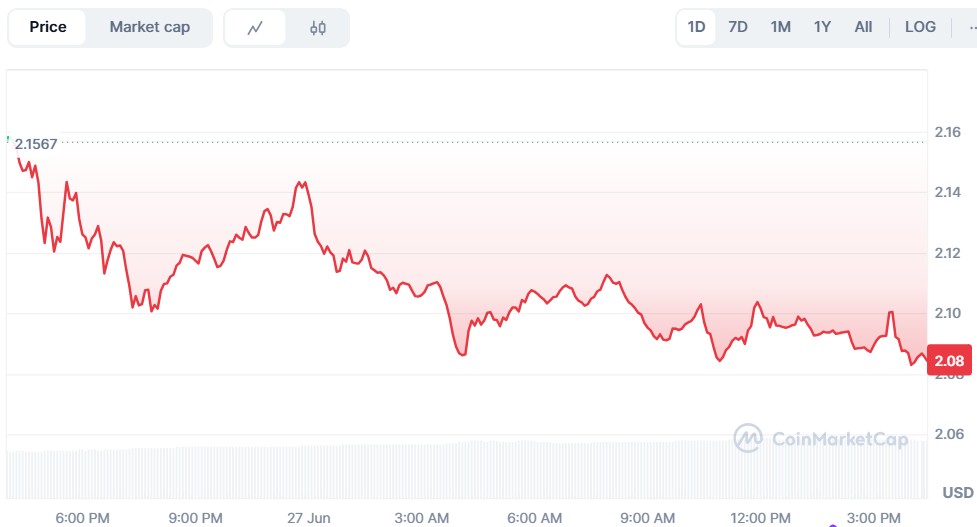
remained an outlier in weakness. The token dropped from a session high of $2.15 to $2.08, then bounced slightly to $2.14. This trajectory marked its steepest
intraday fall since mid-June.
XRP's daily chart shows a significant price decline
XRP Price Analysis
Adding to the selling pressure was a large-scale XRP
transfer by Ripple itself. The company moved $439 million worth of tokens to an
unknown wallet, prompting speculation about possible distribution to exchanges.
Meanwhile, other whale wallets moved another $58
million in XRP to centralized trading platforms, fueling fears
of a broader selloff or internal asset reshuffling, Coindesk reported.
XRP Extends Losses
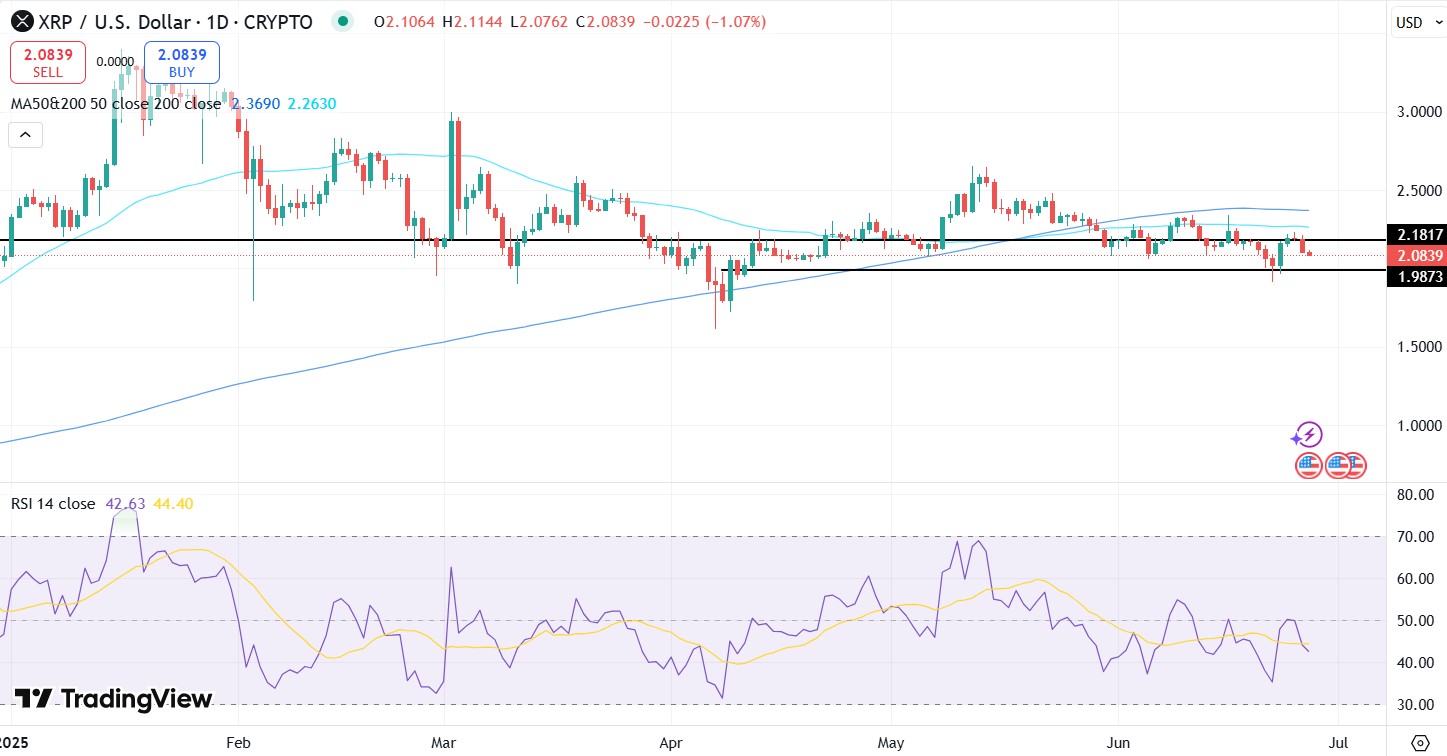
Technically, XRP failed to hold above key levels.
Resistance solidified around $2.18 after multiple rejections, while the
$2.08–$2.09 support zone has turned into a critical line to watch.
Analysts are also tracking a descending channel
pattern that has yet to be resolved. The most intense selling occurred between 12:00 and 16:00 UTC, when volume surged above 114 million XRP, and prices fell
sharply.
XRPUSD Price Chart, Source: TradingView
Despite a brief recovery to $2.105, low volume late in
the session pointed to buyer fatigue. Without strong bullish action, XRP risks
falling through the $2.08 floor, possibly targeting the $2 or even $1.91
levels.
Legal Setback Adds to Bearish Sentiment
Compounding the technical stress was a court ruling
that rejected a proposed settlement between Ripple and the U.S. Securities and
Exchange Commission. U.S. District Judge Analisa Torres denied a joint motion
to finalize a reduced penalty, reigniting uncertainty around the long-running
legal battle.
Traders reacted swiftly, with selling accelerating as
the news broke. The legal setback overshadowed any optimism around Ripple’s
ongoing regulatory progress and introduced fresh risk for XRP holders.
Volatility Drops
XRP’s 30-day realized volatility has dropped to 44%,
the lowest since November 2024. While this suggests a calmer market, volatility
is known to revert over time. If history is any guide, such low volatility may
soon give way to a strong directional move—up or down.
Despite the listing of XRP futures on the CME and
discussions around a potential XRP ETF, price action has remained contained
between $2.00 and $2.60 since March. Traders are now waiting for a decisive
break, with either a bullish reversal back toward $2.23 or a deeper retreat
below $2.00.
XRP’s price has come under intense pressure despite a
series of major wallet transfers and a brief period of geopolitical calm. The
token dropped 3% over the last 24 hours, falling to $2.08 even as whales
moved nearly half a billion dollars worth of XRP. The latest slump has shifted focus to the
$2.08 support zone closely, and the risks of a deeper breakdown are building.
The decline came despite broader market relief
following news of a ceasefire between Iran and Israel, reportedly brokered with
the help of U.S. President Donald Trump.
While that helped stabilize global sentiment, XRP
remained an outlier in weakness. The token dropped from a session high of $2.15 to $2.08, then bounced slightly to $2.14. This trajectory marked its steepest
intraday fall since mid-June.
XRP's daily chart shows a significant price decline
XRP Price Analysis
Adding to the selling pressure was a large-scale XRP
transfer by Ripple itself. The company moved $439 million worth of tokens to an
unknown wallet, prompting speculation about possible distribution to exchanges.
Meanwhile, other whale wallets moved another $58
million in XRP to centralized trading platforms, fueling fears
of a broader selloff or internal asset reshuffling, Coindesk reported.
XRP Extends Losses
Technically, XRP failed to hold above key levels.
Resistance solidified around $2.18 after multiple rejections, while the
$2.08–$2.09 support zone has turned into a critical line to watch.
Analysts are also tracking a descending channel
pattern that has yet to be resolved. The most intense selling occurred between 12:00 and 16:00 UTC, when volume surged above 114 million XRP, and prices fell
sharply.
XRPUSD Price Chart, Source: TradingView
Despite a brief recovery to $2.105, low volume late in
the session pointed to buyer fatigue. Without strong bullish action, XRP risks
falling through the $2.08 floor, possibly targeting the $2 or even $1.91
levels.
Legal Setback Adds to Bearish Sentiment
Compounding the technical stress was a court ruling
that rejected a proposed settlement between Ripple and the U.S. Securities and
Exchange Commission. U.S. District Judge Analisa Torres denied a joint motion
to finalize a reduced penalty, reigniting uncertainty around the long-running
legal battle.
Traders reacted swiftly, with selling accelerating as
the news broke. The legal setback overshadowed any optimism around Ripple’s
ongoing regulatory progress and introduced fresh risk for XRP holders.
Volatility Drops
XRP’s 30-day realized volatility has dropped to 44%,
the lowest since November 2024. While this suggests a calmer market, volatility
is known to revert over time. If history is any guide, such low volatility may
soon give way to a strong directional move—up or down.
Despite the listing of XRP futures on the CME and
discussions around a potential XRP ETF, price action has remained contained
between $2.00 and $2.60 since March. Traders are now waiting for a decisive
break, with either a bullish reversal back toward $2.23 or a deeper retreat
below $2.00.
Jared Kirui is an Editor at Finance Magnates with more than five years of experience in financial journalism. He covers online trading, fintech, payments, and crypto industries with a focus on companies, regulation and compliance, executive moves, trading technology, and market analysis.
His work has been featured in other media outlets, including Benzinga, ZyCrypto, The Distributed, and The Daily Hodl.
Education:
Bachelor of Commerce degree (Finance option), University of Nairobi
Inside the Prediction Markets: $1.6B Institutional Inflow Meets a Federal Crackdown
FP Markets Winner Spotlight 🏆 | Global Broker of the Year 2025 #Trading #Broker #Innovation #Shorts
FP Markets Winner Spotlight 🏆 | Global Broker of the Year 2025 #Trading #Broker #Innovation #Shorts
FP Markets takes the spotlight as Global Broker of the Year 2025 at the Finance Magnates Awards.
Martin Stoilov, Head of Client Experience, shares that trust, innovation, and people played a key role in the company’s success, supported by a strong foundation of integrity and client-centricity.
Following this milestone, FP Markets continues to focus on growth, technology investment, and its core values of transparency and excellence.
👉 Be part of FM Awards 2026: https://awards.financemagnates.com/#nominate
FP Markets takes the spotlight as Global Broker of the Year 2025 at the Finance Magnates Awards.
Martin Stoilov, Head of Client Experience, shares that trust, innovation, and people played a key role in the company’s success, supported by a strong foundation of integrity and client-centricity.
Following this milestone, FP Markets continues to focus on growth, technology investment, and its core values of transparency and excellence.
👉 Be part of FM Awards 2026: https://awards.financemagnates.com/#nominate
In this video, we review @HolaPrimeMarketsOfficial, a multi-asset forex and CFDs broker offering different account types, trading platforms, and flexible trading conditions.
We cover the broker’s overall offering, including account options, trading environment, platforms like MT4 and MT5, and additional services such as managed accounts and fast withdrawals.
Watch the full video to see if Hola Prime Markets fits your trading needs.
📣 Stay up to date with the latest in finance and trading. Follow Finance Magnates for industry news, insights, and global event coverage.
Connect with us:
🔗 LinkedIn: /financemagnates
👍 Facebook: /financemagnates
📸 Instagram: https://www.instagram.com/financemagnates
🐦 X: https://x.com/financemagnates
🎥 TikTok: https://www.tiktok.com/tag/financemagnates
▶️ YouTube: /@financemagnates_official
#HolaPrime #ForexBroker #CFDTrading #FinanceMagnates #Trading #Forex #BrokerReview
In this video, we review @HolaPrimeMarketsOfficial, a multi-asset forex and CFDs broker offering different account types, trading platforms, and flexible trading conditions.
We cover the broker’s overall offering, including account options, trading environment, platforms like MT4 and MT5, and additional services such as managed accounts and fast withdrawals.
Watch the full video to see if Hola Prime Markets fits your trading needs.
📣 Stay up to date with the latest in finance and trading. Follow Finance Magnates for industry news, insights, and global event coverage.
Connect with us:
🔗 LinkedIn: /financemagnates
👍 Facebook: /financemagnates
📸 Instagram: https://www.instagram.com/financemagnates
🐦 X: https://x.com/financemagnates
🎥 TikTok: https://www.tiktok.com/tag/financemagnates
▶️ YouTube: /@financemagnates_official
#HolaPrime #ForexBroker #CFDTrading #FinanceMagnates #Trading #Forex #BrokerReview
Hola Prime Review: What You Need to Know | Full Breakdown by Finance Magnates
Hola Prime Review: What You Need to Know | Full Breakdown by Finance Magnates
In this video, we review @HolaPrime_Global, a proprietary trading firm offering evaluation programs and performance-based payouts in simulated market environments.
We cover how the challenge model works, including account types, profit splits (up to 95%), trading rules, and what it takes to reach a funded account. You’ll also learn about available platforms like MT4, MT5, cTrader, and more, along with insights into payouts, support, and trading conditions.
Watch the full video to see if Hola Prime fits your trading style.
📣 Stay up to date with the latest in finance and trading. Follow Finance Magnates for industry news, insights, and global event coverage.
Connect with us:
🔗 LinkedIn: /financemagnates
👍 Facebook: /financemagnates
📸 Instagram: https://www.instagram.com/financemagnates
🐦 X: https://x.com/financemagnates
🎥 TikTok: https://www.tiktok.com/tag/financemagnates
▶️ YouTube: /@financemagnates_official
#HolaPrime #PropFirm #Trading #FinanceMagnates #Forex #FuturesTrading #TradingReview #PropFirmReview
In this video, we review @HolaPrime_Global, a proprietary trading firm offering evaluation programs and performance-based payouts in simulated market environments.
We cover how the challenge model works, including account types, profit splits (up to 95%), trading rules, and what it takes to reach a funded account. You’ll also learn about available platforms like MT4, MT5, cTrader, and more, along with insights into payouts, support, and trading conditions.
Watch the full video to see if Hola Prime fits your trading style.
📣 Stay up to date with the latest in finance and trading. Follow Finance Magnates for industry news, insights, and global event coverage.
Connect with us:
🔗 LinkedIn: /financemagnates
👍 Facebook: /financemagnates
📸 Instagram: https://www.instagram.com/financemagnates
🐦 X: https://x.com/financemagnates
🎥 TikTok: https://www.tiktok.com/tag/financemagnates
▶️ YouTube: /@financemagnates_official
#HolaPrime #PropFirm #Trading #FinanceMagnates #Forex #FuturesTrading #TradingReview #PropFirmReview
Axi Winner Spotlight 🏆 | Global Most Innovative Broker 2025 #Innovation #Trading #Fintech #Broker
Axi Winner Spotlight 🏆 | Global Most Innovative Broker 2025 #Innovation #Trading #Fintech #Broker
Axi takes the spotlight at the Finance Magnates Awards, winning Global Most Innovative Broker 2025.
Olivia Xenofontos and Ivanna Openko share how the team will feel: proud, motivated, and ready to keep delivering.
They also describe the night as well-organized, focused, and enjoyable for all.
👉 Be part of FM Awards 2026.
Axi takes the spotlight at the Finance Magnates Awards, winning Global Most Innovative Broker 2025.
Olivia Xenofontos and Ivanna Openko share how the team will feel: proud, motivated, and ready to keep delivering.
They also describe the night as well-organized, focused, and enjoyable for all.
👉 Be part of FM Awards 2026.
Recognition that matters.
Built on transparency.
Driven by the industry.
The Finance Magnates Awards 2026.
Nominations are now open.
🔗 https://awards.financemagnates.com/?utm_source=SM&utm_medium=social&utm_campaign=recognition-matters
Recognition that matters.
Built on transparency.
Driven by the industry.
The Finance Magnates Awards 2026.
Nominations are now open.
🔗 https://awards.financemagnates.com/?utm_source=SM&utm_medium=social&utm_campaign=recognition-matters