The company's rise has been driven by strong investor demand for generative AI, a field in which it provides essential hardware components.
It now holds the highest market value ever recorded for a listed business, surpassing both Microsoft and Apple.
Nvidia has become the first publicly listed company to
cross the $4 trillion market cap threshold, following a 2% rise in its share
price on Wednesday. The surge has elevated the California-based chipmaker to
the top of the global valuation leaderboard, surpassing Microsoft and Apple.
The company now has the highest market cap ever recorded for a listed business. Its growth has been propelled by sustained investor enthusiasm for generative artificial intelligence, for which Nvidia
provides the critical hardware, CNBC reported.
Rapid Rise Fueled by AI Demand
Nvidia first surpassed the $2 trillion mark in
February 2024 and crossed $3 trillion in June. The company’s stock has gained
more than 15% over the past month and is up 22% since the start of the year.
Over the last five years, shares have risen more than fifteenfold.
Demand for Nvidia’s graphics processing units (GPUs), widely
used to train and operate large language models, has continued to grow
following the launch of OpenAI’s ChatGPT in late 2022. The company counts
Microsoft among its key customers.
Nvidia’s recent stock rally has occurred despite
regulatory and geopolitical challenges. In May, the company said export
restrictions on its H20 chips, developed specifically for China, would result
in an estimated $8 billion in lost revenue.
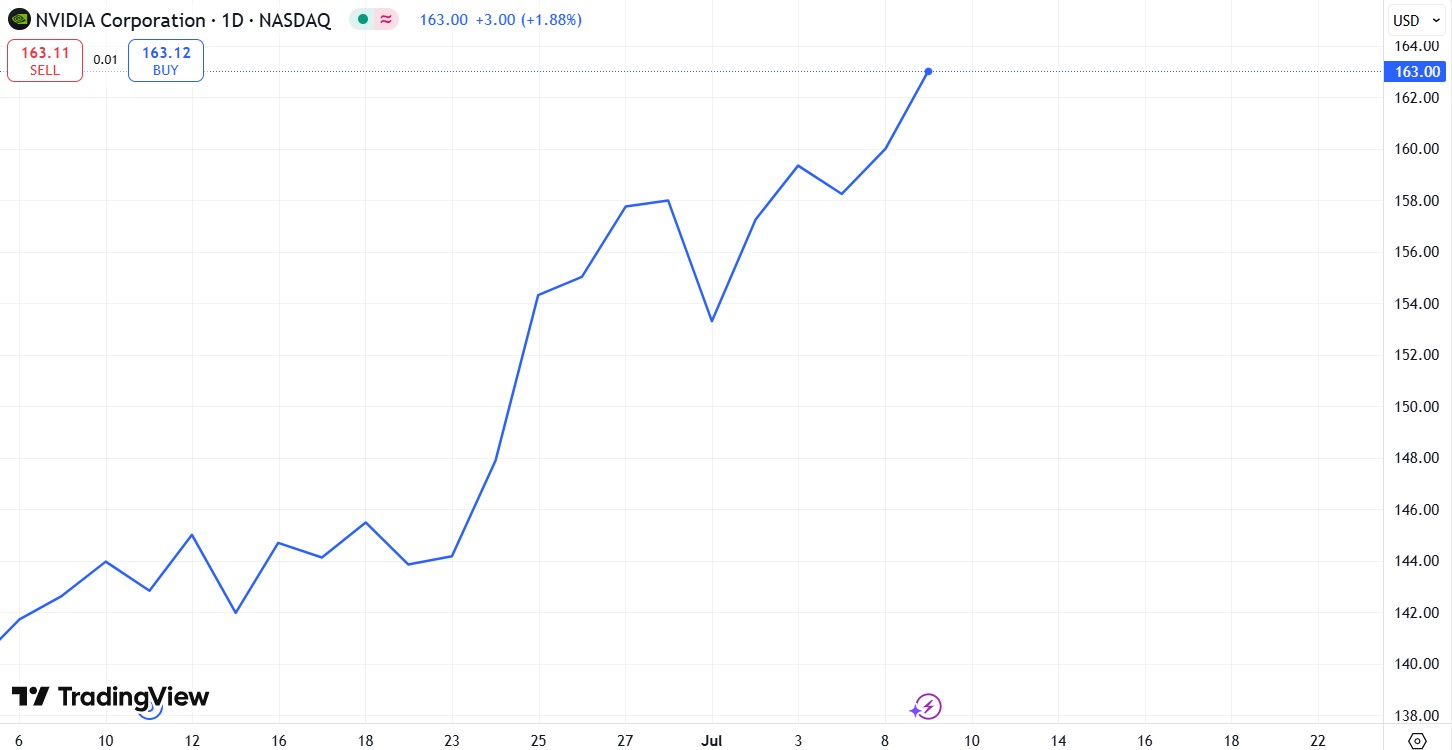
Nvidia price on the daily chart, source: TradingView
The company has also moved past earlier concerns that
Chinese AI models, such as DeepSeek, could reduce reliance on Nvidia’s high-end
chips. Huang previously told CNBC that restrictions on sales to China would
represent a “tremendous loss.”
Higher Valuation than Microsoft and Apple
With Wednesday’s move, Nvidia now has a higher valuation than Microsoft and Apple, which had each previously crossed the $3 trillion mark. This development reflects Nvidia’s dominant role in the
rapidly expanding AI chip market and its positioning as a key supplier to the
technology sector.
The company, founded in 1993, has shifted from its
origins in graphics hardware for gaming to become a core component of the
modern AI ecosystem. It $4 trillion valuation underscores the scale of
investor confidence in that transformation.
The regulatory environment has also been favorable for
Nvidia. Last month, the UK’s Financial Conduct Authority announced plans to partner
with the chip-maker to establish a testing environment where financial
institutions can safely trial artificial intelligence applications.
“This collaboration will help those who want to test AI ideas but lack the capabilities to do so,” said Jessica Rusu, the FCA's chief data, intelligence, and information officer. “We'll help firms harness AI to benefit our markets and consumers, while supporting economic growth.”
Interestingly, NVIDIA's other business segments have
shown significant growth. In Q1 FY26 performance, the company’s gaming division achieved
record revenue of $3.8 billion, up 42% year-over-year and 48% from the previous
quarter, boosted by strong sales of the company's new Blackwell architecture
chips.
Nvidia has become the first publicly listed company to
cross the $4 trillion market cap threshold, following a 2% rise in its share
price on Wednesday. The surge has elevated the California-based chipmaker to
the top of the global valuation leaderboard, surpassing Microsoft and Apple.
The company now has the highest market cap ever recorded for a listed business. Its growth has been propelled by sustained investor enthusiasm for generative artificial intelligence, for which Nvidia
provides the critical hardware, CNBC reported.
Rapid Rise Fueled by AI Demand
Nvidia first surpassed the $2 trillion mark in
February 2024 and crossed $3 trillion in June. The company’s stock has gained
more than 15% over the past month and is up 22% since the start of the year.
Over the last five years, shares have risen more than fifteenfold.
Demand for Nvidia’s graphics processing units (GPUs), widely
used to train and operate large language models, has continued to grow
following the launch of OpenAI’s ChatGPT in late 2022. The company counts
Microsoft among its key customers.
Nvidia’s recent stock rally has occurred despite
regulatory and geopolitical challenges. In May, the company said export
restrictions on its H20 chips, developed specifically for China, would result
in an estimated $8 billion in lost revenue.
Nvidia price on the daily chart, source: TradingView
The company has also moved past earlier concerns that
Chinese AI models, such as DeepSeek, could reduce reliance on Nvidia’s high-end
chips. Huang previously told CNBC that restrictions on sales to China would
represent a “tremendous loss.”
Higher Valuation than Microsoft and Apple
With Wednesday’s move, Nvidia now has a higher valuation than Microsoft and Apple, which had each previously crossed the $3 trillion mark. This development reflects Nvidia’s dominant role in the
rapidly expanding AI chip market and its positioning as a key supplier to the
technology sector.
The company, founded in 1993, has shifted from its
origins in graphics hardware for gaming to become a core component of the
modern AI ecosystem. It $4 trillion valuation underscores the scale of
investor confidence in that transformation.
The regulatory environment has also been favorable for
Nvidia. Last month, the UK’s Financial Conduct Authority announced plans to partner
with the chip-maker to establish a testing environment where financial
institutions can safely trial artificial intelligence applications.
“This collaboration will help those who want to test AI ideas but lack the capabilities to do so,” said Jessica Rusu, the FCA's chief data, intelligence, and information officer. “We'll help firms harness AI to benefit our markets and consumers, while supporting economic growth.”
Interestingly, NVIDIA's other business segments have
shown significant growth. In Q1 FY26 performance, the company’s gaming division achieved
record revenue of $3.8 billion, up 42% year-over-year and 48% from the previous
quarter, boosted by strong sales of the company's new Blackwell architecture
chips.
Jared Kirui is an Editor at Finance Magnates with more than five years of experience in financial journalism. He covers online trading, fintech, payments, and crypto industries with a focus on companies, regulation and compliance, executive moves, trading technology, and market analysis.
His work has been featured in other media outlets, including Benzinga, ZyCrypto, The Distributed, and The Daily Hodl.
Education:
Bachelor of Commerce degree (Finance option), University of Nairobi
In this video, we review @HolaPrimeMarketsOfficial, a multi-asset forex and CFDs broker offering different account types, trading platforms, and flexible trading conditions.
We cover the broker’s overall offering, including account options, trading environment, platforms like MT4 and MT5, and additional services such as managed accounts and fast withdrawals.
Watch the full video to see if Hola Prime Markets fits your trading needs.
📣 Stay up to date with the latest in finance and trading. Follow Finance Magnates for industry news, insights, and global event coverage.
Connect with us:
🔗 LinkedIn: /financemagnates
👍 Facebook: /financemagnates
📸 Instagram: https://www.instagram.com/financemagnates
🐦 X: https://x.com/financemagnates
🎥 TikTok: https://www.tiktok.com/tag/financemagnates
▶️ YouTube: /@financemagnates_official
#HolaPrime #ForexBroker #CFDTrading #FinanceMagnates #Trading #Forex #BrokerReview
In this video, we review @HolaPrimeMarketsOfficial, a multi-asset forex and CFDs broker offering different account types, trading platforms, and flexible trading conditions.
We cover the broker’s overall offering, including account options, trading environment, platforms like MT4 and MT5, and additional services such as managed accounts and fast withdrawals.
Watch the full video to see if Hola Prime Markets fits your trading needs.
📣 Stay up to date with the latest in finance and trading. Follow Finance Magnates for industry news, insights, and global event coverage.
Connect with us:
🔗 LinkedIn: /financemagnates
👍 Facebook: /financemagnates
📸 Instagram: https://www.instagram.com/financemagnates
🐦 X: https://x.com/financemagnates
🎥 TikTok: https://www.tiktok.com/tag/financemagnates
▶️ YouTube: /@financemagnates_official
#HolaPrime #ForexBroker #CFDTrading #FinanceMagnates #Trading #Forex #BrokerReview
Hola Prime Review: What You Need to Know | Full Breakdown by Finance Magnates
Hola Prime Review: What You Need to Know | Full Breakdown by Finance Magnates
In this video, we review @HolaPrime_Global, a proprietary trading firm offering evaluation programs and performance-based payouts in simulated market environments.
We cover how the challenge model works, including account types, profit splits (up to 95%), trading rules, and what it takes to reach a funded account. You’ll also learn about available platforms like MT4, MT5, cTrader, and more, along with insights into payouts, support, and trading conditions.
Watch the full video to see if Hola Prime fits your trading style.
📣 Stay up to date with the latest in finance and trading. Follow Finance Magnates for industry news, insights, and global event coverage.
Connect with us:
🔗 LinkedIn: /financemagnates
👍 Facebook: /financemagnates
📸 Instagram: https://www.instagram.com/financemagnates
🐦 X: https://x.com/financemagnates
🎥 TikTok: https://www.tiktok.com/tag/financemagnates
▶️ YouTube: /@financemagnates_official
#HolaPrime #PropFirm #Trading #FinanceMagnates #Forex #FuturesTrading #TradingReview #PropFirmReview
In this video, we review @HolaPrime_Global, a proprietary trading firm offering evaluation programs and performance-based payouts in simulated market environments.
We cover how the challenge model works, including account types, profit splits (up to 95%), trading rules, and what it takes to reach a funded account. You’ll also learn about available platforms like MT4, MT5, cTrader, and more, along with insights into payouts, support, and trading conditions.
Watch the full video to see if Hola Prime fits your trading style.
📣 Stay up to date with the latest in finance and trading. Follow Finance Magnates for industry news, insights, and global event coverage.
Connect with us:
🔗 LinkedIn: /financemagnates
👍 Facebook: /financemagnates
📸 Instagram: https://www.instagram.com/financemagnates
🐦 X: https://x.com/financemagnates
🎥 TikTok: https://www.tiktok.com/tag/financemagnates
▶️ YouTube: /@financemagnates_official
#HolaPrime #PropFirm #Trading #FinanceMagnates #Forex #FuturesTrading #TradingReview #PropFirmReview
Axi Winner Spotlight 🏆 | Global Most Innovative Broker 2025 #Innovation #Trading #Fintech #Broker
Axi Winner Spotlight 🏆 | Global Most Innovative Broker 2025 #Innovation #Trading #Fintech #Broker
Axi takes the spotlight at the Finance Magnates Awards, winning Global Most Innovative Broker 2025.
Olivia Xenofontos and Ivanna Openko share how the team will feel: proud, motivated, and ready to keep delivering.
They also describe the night as well-organized, focused, and enjoyable for all.
👉 Be part of FM Awards 2026.
Axi takes the spotlight at the Finance Magnates Awards, winning Global Most Innovative Broker 2025.
Olivia Xenofontos and Ivanna Openko share how the team will feel: proud, motivated, and ready to keep delivering.
They also describe the night as well-organized, focused, and enjoyable for all.
👉 Be part of FM Awards 2026.
Recognition that matters.
Built on transparency.
Driven by the industry.
The Finance Magnates Awards 2026.
Nominations are now open.
🔗 https://awards.financemagnates.com/?utm_source=SM&utm_medium=social&utm_campaign=recognition-matters
Recognition that matters.
Built on transparency.
Driven by the industry.
The Finance Magnates Awards 2026.
Nominations are now open.
🔗 https://awards.financemagnates.com/?utm_source=SM&utm_medium=social&utm_campaign=recognition-matters
Tickmill Winner Spotlight | Broker of the Year 2025 (LATAM) 🏆 | Finance Magnates Awards #Trading
Tickmill Winner Spotlight | Broker of the Year 2025 (LATAM) 🏆 | Finance Magnates Awards #Trading
What helped Tickmill stand out this year?
In this Winner Spotlight, Johnny Khalil, Executive Director at Tickmill Europe, shares how listening closely to clients and delivering strong trading conditions made the difference.
A big thank you to the community whose support continues to drive progress every day.
👉 Think your brand has what it takes? Nominate for the 2026 Finance Magnates Awards: https://awards.financemagnates.com/#nominate
What helped Tickmill stand out this year?
In this Winner Spotlight, Johnny Khalil, Executive Director at Tickmill Europe, shares how listening closely to clients and delivering strong trading conditions made the difference.
A big thank you to the community whose support continues to drive progress every day.
👉 Think your brand has what it takes? Nominate for the 2026 Finance Magnates Awards: https://awards.financemagnates.com/#nominate