The Bank of Japan refuses to budge on yield curve control policy.
After a two-day monetary policy meeting, and in defiance of market predictions, the Bank of Japan (BoJ) kept its ultra-low interest rates and bond yield limit in place on Wednesday 18th January.
The market had expected the BoJ to increase the target rate on 10-year bonds above 0%, increase the range within which rates might depart from the goal by more than 0.5 percentage points, or abandon yield curve control (YCC) completely.
In an effort to demonstrate its determination to continue implementing its YCC policy for the time being, the BoJ amended the rules for a funds-supply market operation on Wednesday to make it possible to use it as a tool to prevent long-term interest rates from rising excessively.
Some experts saw this action by the BoJ as an indication that Governor Haruhiko Kuroda would hold off on making significant policy changes during his tenure, which expires on April 8th, rather than revising its stimulus program.
BoJ confident of economic recovery despite global risks
Even though it is anticipated that Japan's economy will be subject to downward pressure due to high commodity prices and slowdowns in economies outside the country, the bank’s statement said that it is likely that the economy will “recover towards the middle of the projection period.”
Source: TradingView & ActivTrades
The BoJ further implied that this would be because new coronavirus effects are diminishing and supply-side limitations are relaxing. After that, a positive cycle of rising incomes and rising spending is expected to keep Japan's economy growing at a pace above its potential growth rate.
Core consumer prices in Japan's capital, a leading indicator of national trends, increased by 4.0% in December from a year earlier, exceeding the central bank's 2% inflation target for the seventh straight month, according to a report released on the 9th of January.
The ongoing situation in Ukraine and changes in commodity prices, notably grain prices, have been troublesome given Japan is a major importer. The bank surmised that the consequences of cost increases caused by the rise in import prices are anticipated to make the annual rate of growth in the CPI relatively high in the near term.
The pace of the rising prices is apparently then anticipated to slow down near the middle of the fiscal year 2023 as a result of a fading of these impacts as well as the effects of the government's economic policies driving down energy costs.
Then, it is anticipated to modestly increase once again as the production gap closes, wage growth accelerates and the impacts of the economic policies that have been used to lower energy costs start to fade by the middle of fiscal 2023.
Wage negotiations could be catalyst for change
The timetable of a withdrawal from Japan's loose monetary policy could depend in large part on impending wage talks.
In March, the shunto wage negotiations will begin. The discussions have significant ramifications for the third largest economy as they unite important unions and the biggest Japanese corporations. During the course of the negotiations, the "Rengo" trade union confederation, which is the biggest in the nation, establishes a particular aim for base-pay increases.
A wage increase of more than 3% might persuade the BoJ that inflation is becoming more entrenched. Given the history of the last 30 years or so, the BoJ is far more worried that inflation will go back down to unattractively low levels again than the majority of its peers. Most major central banks are obviously worried that inflation will get entrenched at levels that are unacceptably high.
Yen down almost 2% after the Bank of Japan’s decision
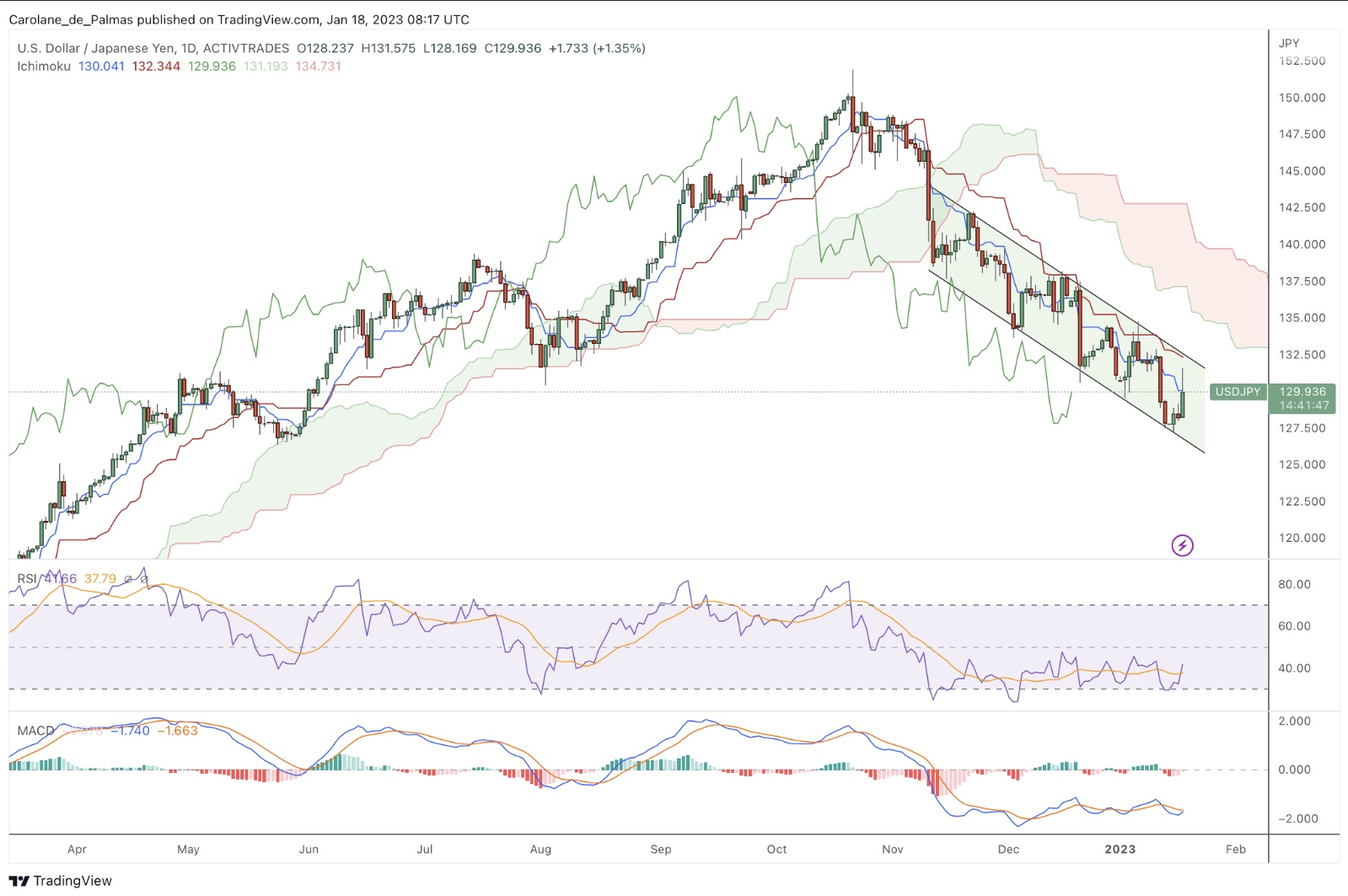
Since mid-November 2022, the USD/JPY pair has been trading downward, as the greenback has lost momentum after reaching record-high levels not seen in decades at the end of October 2022, when the pair was trading at 151.93 according to ActivTrades’ Forex data.
The currency has lost almost 16% from its highest level and a low level reached at 127.215 a few days ago.
With today’s monetary policy decisions, the Yen plunged by more than 2.5% against the USD during the Asian trading session, heading towards the upper part of the bearish channel.
As "speculators are likely to increase their hawkish bets on a policy shift from the BoJ" according to Anderson Alves - market analyst at ActivTrades, but if the BoJ keeps its monetary policy unchanged, then the Japanese currency is likely to lose ground and experience higher volatility.
After a two-day monetary policy meeting, and in defiance of market predictions, the Bank of Japan (BoJ) kept its ultra-low interest rates and bond yield limit in place on Wednesday 18th January.
The market had expected the BoJ to increase the target rate on 10-year bonds above 0%, increase the range within which rates might depart from the goal by more than 0.5 percentage points, or abandon yield curve control (YCC) completely.
In an effort to demonstrate its determination to continue implementing its YCC policy for the time being, the BoJ amended the rules for a funds-supply market operation on Wednesday to make it possible to use it as a tool to prevent long-term interest rates from rising excessively.
Some experts saw this action by the BoJ as an indication that Governor Haruhiko Kuroda would hold off on making significant policy changes during his tenure, which expires on April 8th, rather than revising its stimulus program.
BoJ confident of economic recovery despite global risks
Even though it is anticipated that Japan's economy will be subject to downward pressure due to high commodity prices and slowdowns in economies outside the country, the bank’s statement said that it is likely that the economy will “recover towards the middle of the projection period.”
Source: TradingView & ActivTrades
The BoJ further implied that this would be because new coronavirus effects are diminishing and supply-side limitations are relaxing. After that, a positive cycle of rising incomes and rising spending is expected to keep Japan's economy growing at a pace above its potential growth rate.
Core consumer prices in Japan's capital, a leading indicator of national trends, increased by 4.0% in December from a year earlier, exceeding the central bank's 2% inflation target for the seventh straight month, according to a report released on the 9th of January.
The ongoing situation in Ukraine and changes in commodity prices, notably grain prices, have been troublesome given Japan is a major importer. The bank surmised that the consequences of cost increases caused by the rise in import prices are anticipated to make the annual rate of growth in the CPI relatively high in the near term.
The pace of the rising prices is apparently then anticipated to slow down near the middle of the fiscal year 2023 as a result of a fading of these impacts as well as the effects of the government's economic policies driving down energy costs.
Then, it is anticipated to modestly increase once again as the production gap closes, wage growth accelerates and the impacts of the economic policies that have been used to lower energy costs start to fade by the middle of fiscal 2023.
Wage negotiations could be catalyst for change
The timetable of a withdrawal from Japan's loose monetary policy could depend in large part on impending wage talks.
In March, the shunto wage negotiations will begin. The discussions have significant ramifications for the third largest economy as they unite important unions and the biggest Japanese corporations. During the course of the negotiations, the "Rengo" trade union confederation, which is the biggest in the nation, establishes a particular aim for base-pay increases.
A wage increase of more than 3% might persuade the BoJ that inflation is becoming more entrenched. Given the history of the last 30 years or so, the BoJ is far more worried that inflation will go back down to unattractively low levels again than the majority of its peers. Most major central banks are obviously worried that inflation will get entrenched at levels that are unacceptably high.
Yen down almost 2% after the Bank of Japan’s decision
Since mid-November 2022, the USD/JPY pair has been trading downward, as the greenback has lost momentum after reaching record-high levels not seen in decades at the end of October 2022, when the pair was trading at 151.93 according to ActivTrades’ Forex data.
The currency has lost almost 16% from its highest level and a low level reached at 127.215 a few days ago.
With today’s monetary policy decisions, the Yen plunged by more than 2.5% against the USD during the Asian trading session, heading towards the upper part of the bearish channel.
As "speculators are likely to increase their hawkish bets on a policy shift from the BoJ" according to Anderson Alves - market analyst at ActivTrades, but if the BoJ keeps its monetary policy unchanged, then the Japanese currency is likely to lose ground and experience higher volatility.
FP Markets Winner Spotlight 🏆 | Global Broker of the Year 2025 #Trading #Broker #Innovation #Shorts
FP Markets Winner Spotlight 🏆 | Global Broker of the Year 2025 #Trading #Broker #Innovation #Shorts
FP Markets takes the spotlight as Global Broker of the Year 2025 at the Finance Magnates Awards.
Martin Stoilov, Head of Client Experience, shares that trust, innovation, and people played a key role in the company’s success, supported by a strong foundation of integrity and client-centricity.
Following this milestone, FP Markets continues to focus on growth, technology investment, and its core values of transparency and excellence.
👉 Be part of FM Awards 2026: https://awards.financemagnates.com/#nominate
FP Markets takes the spotlight as Global Broker of the Year 2025 at the Finance Magnates Awards.
Martin Stoilov, Head of Client Experience, shares that trust, innovation, and people played a key role in the company’s success, supported by a strong foundation of integrity and client-centricity.
Following this milestone, FP Markets continues to focus on growth, technology investment, and its core values of transparency and excellence.
👉 Be part of FM Awards 2026: https://awards.financemagnates.com/#nominate
In this video, we review @HolaPrimeMarketsOfficial, a multi-asset forex and CFDs broker offering different account types, trading platforms, and flexible trading conditions.
We cover the broker’s overall offering, including account options, trading environment, platforms like MT4 and MT5, and additional services such as managed accounts and fast withdrawals.
Watch the full video to see if Hola Prime Markets fits your trading needs.
📣 Stay up to date with the latest in finance and trading. Follow Finance Magnates for industry news, insights, and global event coverage.
Connect with us:
🔗 LinkedIn: /financemagnates
👍 Facebook: /financemagnates
📸 Instagram: https://www.instagram.com/financemagnates
🐦 X: https://x.com/financemagnates
🎥 TikTok: https://www.tiktok.com/tag/financemagnates
▶️ YouTube: /@financemagnates_official
#HolaPrime #ForexBroker #CFDTrading #FinanceMagnates #Trading #Forex #BrokerReview
In this video, we review @HolaPrimeMarketsOfficial, a multi-asset forex and CFDs broker offering different account types, trading platforms, and flexible trading conditions.
We cover the broker’s overall offering, including account options, trading environment, platforms like MT4 and MT5, and additional services such as managed accounts and fast withdrawals.
Watch the full video to see if Hola Prime Markets fits your trading needs.
📣 Stay up to date with the latest in finance and trading. Follow Finance Magnates for industry news, insights, and global event coverage.
Connect with us:
🔗 LinkedIn: /financemagnates
👍 Facebook: /financemagnates
📸 Instagram: https://www.instagram.com/financemagnates
🐦 X: https://x.com/financemagnates
🎥 TikTok: https://www.tiktok.com/tag/financemagnates
▶️ YouTube: /@financemagnates_official
#HolaPrime #ForexBroker #CFDTrading #FinanceMagnates #Trading #Forex #BrokerReview
Hola Prime Review: What You Need to Know | Full Breakdown by Finance Magnates
Hola Prime Review: What You Need to Know | Full Breakdown by Finance Magnates
In this video, we review @HolaPrime_Global, a proprietary trading firm offering evaluation programs and performance-based payouts in simulated market environments.
We cover how the challenge model works, including account types, profit splits (up to 95%), trading rules, and what it takes to reach a funded account. You’ll also learn about available platforms like MT4, MT5, cTrader, and more, along with insights into payouts, support, and trading conditions.
Watch the full video to see if Hola Prime fits your trading style.
📣 Stay up to date with the latest in finance and trading. Follow Finance Magnates for industry news, insights, and global event coverage.
Connect with us:
🔗 LinkedIn: /financemagnates
👍 Facebook: /financemagnates
📸 Instagram: https://www.instagram.com/financemagnates
🐦 X: https://x.com/financemagnates
🎥 TikTok: https://www.tiktok.com/tag/financemagnates
▶️ YouTube: /@financemagnates_official
#HolaPrime #PropFirm #Trading #FinanceMagnates #Forex #FuturesTrading #TradingReview #PropFirmReview
In this video, we review @HolaPrime_Global, a proprietary trading firm offering evaluation programs and performance-based payouts in simulated market environments.
We cover how the challenge model works, including account types, profit splits (up to 95%), trading rules, and what it takes to reach a funded account. You’ll also learn about available platforms like MT4, MT5, cTrader, and more, along with insights into payouts, support, and trading conditions.
Watch the full video to see if Hola Prime fits your trading style.
📣 Stay up to date with the latest in finance and trading. Follow Finance Magnates for industry news, insights, and global event coverage.
Connect with us:
🔗 LinkedIn: /financemagnates
👍 Facebook: /financemagnates
📸 Instagram: https://www.instagram.com/financemagnates
🐦 X: https://x.com/financemagnates
🎥 TikTok: https://www.tiktok.com/tag/financemagnates
▶️ YouTube: /@financemagnates_official
#HolaPrime #PropFirm #Trading #FinanceMagnates #Forex #FuturesTrading #TradingReview #PropFirmReview
Axi Winner Spotlight 🏆 | Global Most Innovative Broker 2025 #Innovation #Trading #Fintech #Broker
Axi Winner Spotlight 🏆 | Global Most Innovative Broker 2025 #Innovation #Trading #Fintech #Broker
Axi takes the spotlight at the Finance Magnates Awards, winning Global Most Innovative Broker 2025.
Olivia Xenofontos and Ivanna Openko share how the team will feel: proud, motivated, and ready to keep delivering.
They also describe the night as well-organized, focused, and enjoyable for all.
👉 Be part of FM Awards 2026.
Axi takes the spotlight at the Finance Magnates Awards, winning Global Most Innovative Broker 2025.
Olivia Xenofontos and Ivanna Openko share how the team will feel: proud, motivated, and ready to keep delivering.
They also describe the night as well-organized, focused, and enjoyable for all.
👉 Be part of FM Awards 2026.
Recognition that matters.
Built on transparency.
Driven by the industry.
The Finance Magnates Awards 2026.
Nominations are now open.
🔗 https://awards.financemagnates.com/?utm_source=SM&utm_medium=social&utm_campaign=recognition-matters
Recognition that matters.
Built on transparency.
Driven by the industry.
The Finance Magnates Awards 2026.
Nominations are now open.
🔗 https://awards.financemagnates.com/?utm_source=SM&utm_medium=social&utm_campaign=recognition-matters