
If you run a brokerage or its dealing desk, a few questions about last month's execution are worth asking.
How many client orders were filled at a worse price than shown on screen? When it happened, did the slippage run in both ways, or mostly in one? How many confirmations came back noticeably slower than usual, especially around news? How many orders were rejected or re-quoted? How many support tickets started with a client asking why?
Some of this has nothing to do with the liquidity provider. Markets gaps, liquidity thins, connections fail. Part of it, however, can be structural, and it is rarely discussed: whether your provider's hedging decision is allowed to reach your clients’ orders.
How Liquidity Provider Hedging Affects Execution
Every order a liquidity provider receives involves two decisions. The first concerns how the order is executed, the second, how much of the resulting risk to keep. In a hybrid model, the two are easily coupled. When the provider decides to pass an order's risk on, the order may be held while the hedge is placed, filled at whatever price the hedge achieved, or rejected when no hedge is available.
The broker sees none of this as a hedging decision. What reaches it instead is the result – a fill that came back slower, at a different price, or not at all. A matter of risk becomes an execution outcome, and it is the broker who has to explain it to clients.
Our Approach: B-Book Execution
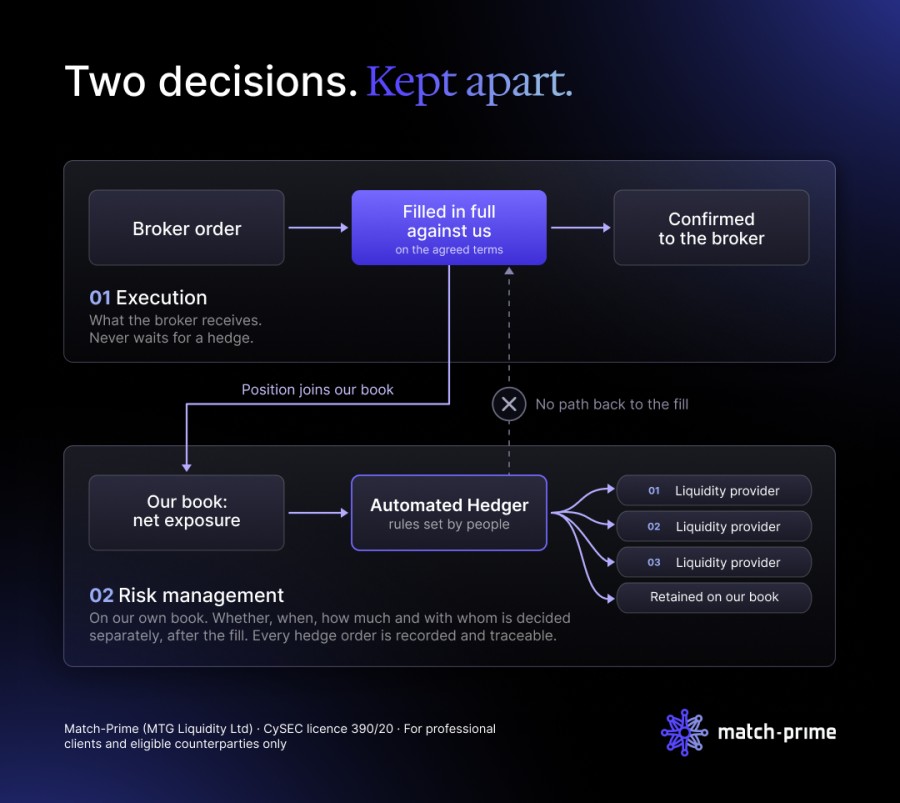
We keep the two decisions apart. Every order a broker sends is filled in full against us, on the terms agreed for its account. The fill is not held for a hedge, does not depend on a hedge's price, and is not conditional on whether a hedge can be placed.
We decide separately, and only after the fill, whether to hedge the resulting position, how much of it, when, and with whom. None of that affects the price, speed, or certainty of execution the broker receives. Hedging is a risk decision and plays no part in execution.
What Stands Behind It
"B-book execution" is easy to put on a sales sheet. The harder part is what stands behind it. A provider that fills every order against itself carries all of that risk. If that risk is not managed well, the pressure eventually returns to execution through wider spreads, tighter limits, or slower fills. A B-book promise is only as strong as the risk management behind it.
That is why we built our automated Hedger as part of the same infrastructure that runs HawkEye, our risk system. It follows the principle described in the first article of this series: people set the rules, and the machine applies them. Our dealing and risk teams define and approve the parameters within which we manage market risk. The Hedger acts on them around the clock, including the hours when no desk is fully staffed. We record and trace every hedge order it places.
The Hedger runs independently of execution and has no influence on the fill. That works in both directions. Because a fill never depends on our hedge, our hedge does not have to follow client flow order by order. We can hedge in whatever way the market demands at any given moment, and that changes quickly.
How Automated Hedging Works When Markets Move
The real test of a B-book commitment comes in volatile markets, not quiet ones. The following three scenarios illustrate how the Hedger upholds it as conditions change.
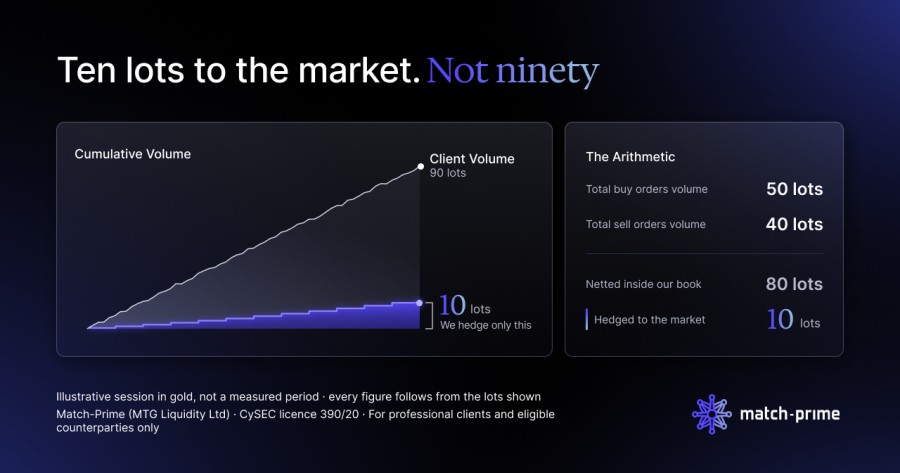
A normal session, with flow in both directions. On most days, buyers and sellers partly cancel each other out. If clients on one side buy 50 lots of gold while clients elsewhere sell 40, our net exposure is only 10 lots. The Hedger offsets the rest within our book and goes to the market for 10 lots, not 90. Much of the risk we take on never needs to leave our book.
A news spike, with everyone on the same side. A payrolls release or a breakout in gold, and exposure builds fast and in one direction; this year's gold market produced plenty of such sessions. Here the Hedger acts rapidly, just after the fills, reassesses the book more often as the market speeds up, and spreads the hedge across our liquidity providers, wherever each part is best placed. By then, every one of your clients' orders has already been filled, on the agreed terms.
A large ticket. For a size that would move the market if hedged in one go, the Hedger can hold back until exposure crosses a threshold, or build cover gradually, in steps of time or size. Our execution algorithms work each hedge to optimize price and keep latency minimal, without exposing us to excessive risk along the way. The client's order is filled in full on the agreed terms. Absorbing the risk is our responsibility.
In all three cases, your clients' orders are filled on the same terms. What changes is only how we manage the risk behind them.
None of this is fixed. Each instrument and market regime is assigned the combination of methods that suits it, and we revisit it as the flow and the conditions shift. Such changes require nothing from the broker. We can adjust limits, change liquidity providers, or switch methods, while the broker's setup, terms, and execution remain exactly as they were. The better we manage our own risk, the less reason it ever has to reach your execution.
Benefits for Brokers
B-book execution. Every order is filled in full against us, on the agreed terms, regardless of whether or how we hedge it.
Unaffected execution. Our hedging never changes the price, speed, or likelihood of execution you receive.
A competitive offer. Tighter spreads, lower commissions, and higher trading limits are offered on best terms tailored to every broker’s flow.
No burden from our changes. New liquidity providers, revised limits, or a different hedging strategy on our side require no action on yours.
A provider not constrained by your flow. Execution does not depend on the hedge, so we decide when, how much, and where to offset risk, and none of it falls on your clients.
Lower operational risk. Hedging runs continuously under pre-approved rules, with every hedge order traceable, removing the manual steps where operational errors typically arise.
The Question Worth Asking
Not every slipped fill has the same cause. Some of last month’s slippage, delayed confirmations, and rejections were simply the market, and no one can promise to remove those. The rest deserve a closer look. To find out whether any of them came from your provider’s risk management, ask one structural question. When you hedge, does it influence your execution? With us, it does not. Every order is filled in full on the agreed terms, backed by risk management built to keep it that way, so your desk can spend less time explaining fills and more time growing the business.
This is the third article in a series on the systems behind Match-Prime's flow management. The next article looks at the framework behind long-term flow classification.
Vladimiros Spanos is Chief Operating Officer at Match-Prime.
Jarosław Klamut, PhD, is Head of Risk at Match-Trade Technologies, a strategic technology supplier to CySEC-regulated liquidity provider Match-Prime.


